

The conclave to elect the 267th Pope will begin on May 7th, following the conclusion of the Novemdiales Masses to pray for the eternal repose of the late Pope Francis. The Cardinals present in Rome have agreed to begin the conclave on May 7th, 2025. The date was set on Monday morning by the approximately 180 cardinals present (just over a hundred of whom are electors) gathered for the fifth General Congregation in the Vatican. The conclave will take place in the Vatican’s Sistine Chapel, which will remain closed to visitors during those days.
The conclave will be preceded by a solemn Eucharistic celebration with the votive Mass Pro Eligendo Papa, attended by the Cardinal electors. In the afternoon, the Cardinal electors proceed in a solemn procession to the Sistine Chapel, where the Conclave begins to elect the new Pope. At the end of the procession inside the Sistine Chapel, each Cardinal elector takes the oath as prescribed in paragraph 53 of Universi Dominici Gregis. Through this oath, they commit, if elected, to faithfully fulfill the Munus Petrinum as Pastor of the Universal Church. They also pledge to maintain absolute secrecy regarding everything related to the election of the Roman Pontiff and to refrain from supporting any attempts of external interference in the election. At this point, the Master of Pontifical Liturgical Celebrations proclaims extra omnes, meaning that all individuals who are not part of the Conclave must leave the Sistine Chapel. Only the Master himself and the ecclesiastic designated to deliver the second meditation remain.
This meditation focuses on the grave responsibility that rests upon the electors and the necessity of acting with pure intentions for the good of the Universal Church, keeping only God before their eyes. Once the meditation is delivered, both the ecclesiastic and the Master of Pontifical Liturgical Celebrations leave.
The Cardinal electors then recite prayers according to the Ordo Sacrorum Rituum Conclavis and listen to the Cardinal Dean, who asks whether they are ready to proceed with voting or if any clarifications regarding the rules and procedures.
All election procedures take place exclusively in the Sistine Chapel within the Vatican Apostolic Palace, which remains completely sealed off until the election is concluded.
Throughout the election process, the Cardinal electors must refrain from sending letters or engaging in conversations, including phone calls, except in cases of extreme urgency.
They are not allowed to send or receive messages of any kind, receive newspapers or magazines of any nature, or follow radio or television broadcasts.
Category Archives: International
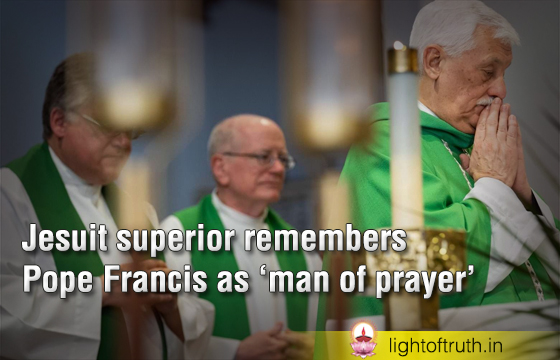
Jesuit superior remembers Pope Francis as ‘man of prayer’
The superior general of the Society of Jesus, said Pope Francis “did not seek to please everyone” or to measure him-self by a popularity index. “Once he chose to be a disciple of Jesus, his deep motivation in life was to put God’s will into practice,” Fr Arturo Sosa SJ told reporters, calling the late Pope “a man of prayer, who asked for prayers to make decisions according to the will of God.” The Jesuit superior defended Francis against claims he caused controversy – like with Fiducia Supplicans, the Vatican’s document on blessings for “irregular” couples – or fell short in some areas, saying he was not the source of problems in the Church but inherited problems that were already there. “Pope Francis helped put the difference of positions on the table” and provoked dialogue, Sosa said, emphasising that the late Pope wanted to listen to everyone.
“I don’t think of Pope Francis as a reformer,” Sosa said. “I think of him as someone who continued the reform that the Church has always carried out.”
Regarding his record on abuse, Sosa said Pope Francis “always acknowledged his limitations, his mistakes, and his slowness” to respond to cases.
“This is not about giving Pope Francis a medal or giving him a grade but about learning about potential criticism and mistakes,” he said. “With regard to abuse cases, I think the Church is not in the same place when Pope Francis was elected. That’s without a doubt. It hasn’t been a straight line … but the Church has advanced in that direction,” he added. Sosa said Pope Francis’ most urgent legacy for today will be his calls for peace: “I think Pope Francis has shouted in every moment, on every occasion, about peace.”
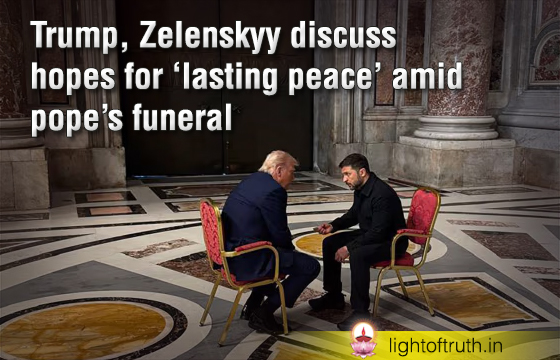
Trump, Zelenskyy discuss hopes for ‘lasting peace’ amid pope’s funeral
U.S. President Donald Trump and Ukrainian President Volodymyr Zelenskyy on Saturday held a brief discussion in the soaring halls of St. Peter’s Basilica amid the funeral of Pope Francis, speaking “one-on-one” about possible peace overtures in the Russia-Ukraine war.
“[It was a] good meeting. We discussed a lot one-on-one,” Zelenskyy said in a post on X. “Hoping for results on everything we covered.” The Ukrainian leader hailed the informal mini-summit as “very symbolic.” The talk took place while the leaders were at the Vatican for the funeral of Pope Francis, who for the last few years of his pontificate was a tireless advocate for peace in the Russia-Ukraine war.
The two heads of state discussed “protecting [the] lives of our people,” a “full and unconditional ceasefire,” and “reliable and lasting peace that will prevent another war from breaking out,” Zelenskyy said. The discussion “has potential to become historic, if we achieve joint results,” he said.
White House Deputy Chief of Staff Dan Scavino also shared footage of the meeting, including Vatican officials arranging the ornate chairs for the two leaders to sit in. Pope Francis regularly used his public addresses, especially his Angelus prayers, to call for peace between Ukraine and Russia. The Holy Father repeatedly urged the two countries to work toward a peaceful resolution of the conflict. In some cases he even sent material goods to Ukraine, dispatching multiple ambulances to help save lives in war zones there.
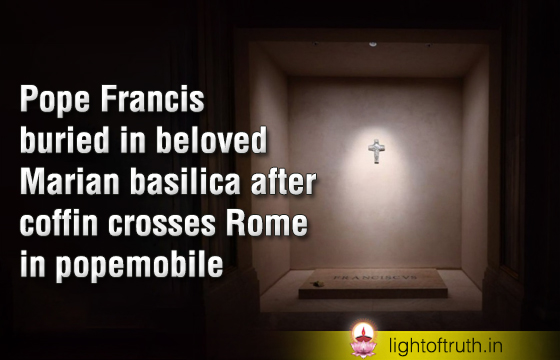
Pope Francis buried in beloved Marian basilica after coffin crosses Rome in popemobile
Pope Francis was buried on April 26 Saturday in the Basilica of St. Mary Major after his coffin crossed the centre of Rome, marking the pontiff’s final goodbye to the Eternal City. After the celebration of the funeral Mass in St. Peter’s Square, the pope’s coffin left the Vatican via the Perugino Gate at 12:30 p.m. local time. The simple wooden coffin was transported in a popemobile-style pickup truck and greeted to applause and cheers of “Goodbye, Pope Francis,” and “Good journey, Francis” from a small crowd gathered just outside the Vatican.
The white car carrying the papal coffin winded slowly through Rome, the city of which Pope Francis was bishop, past the white Monument to Victory Emmanuel II, the Roman Forum, and the Colosseum, to arrive at Via Merulana, a wide street leading to the main square of the Basilica of St. Mary Major.
The Vatican and local authorities estimate 150,000 people lined Rome’s streets to wave goodbye to Pope Francis’ coffin. Around 400,000 people attended the funeral Mass. As the bells of the basilica tolled, a group of poor from Rome were on the steps of the basilica to meet the papal funeral procession and to pay their final respects to the pope who loved them so much.
A small procession of cardinals, bishops, priests, and other Vatican officials led the way into the Marian basilica and to the side chapel housing Francis’ favorite icon of Mary, “Salus Populi Romani,” where four young children laid baskets of white roses before the historic image. The pope’s burial site, at his request, is the Basilica of St. Mary Major, one of the four papal basilicas in Rome. He joins seven other popes buried in the basilica, with roots dating back to the fifth century.
Francis’ tomb was prepared earlier this week, a white, Italian marble slab in the ground with his name in Latin, “Franciscus.” His distinctive silver pectoral cross, featuring the Good Shepherd carrying the lost sheep, hangs on the wall above.
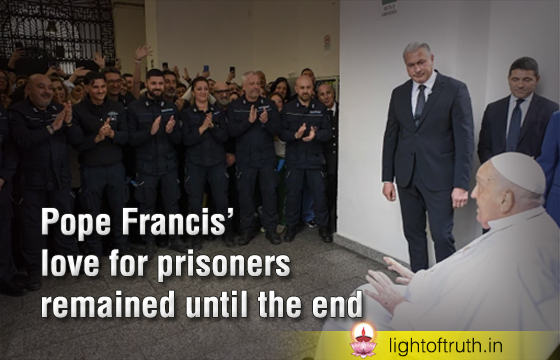
Pope Francis’ love for prisoners remained until the end
Prisoners always held a special place in Pope Fran-cis’ heart, and he demon-strated his love for them throughout his pontificate. He visited them in the vari-ous countries he traveled to and even, for the Jubilee of Hope, decided to open a Holy Door himself at the Rebibbia prison for the first time in history.
During his first Holy Week after being elected pontiff in 2013, he went to the prison to wash the prisoners’ feet, a gesture he repeated every year until his final Holy Thursday, four days before his death. On April 17, the ailing pontiff visited the prisoners at Regina Coeli (Queen of Heaven) prison near the Vatican, a testament to his tireless defense of human dignity and his predilection for castoffs. Father Raffaele Grimaldi, who oversees the work of Italian prison chaplains, emphasized in an interview with ACI Prensa, CNA’s Spanish-language news partner, that the initiative by the Holy Father is a sign that “his attention to the least and the poor was evident until his very last day.” “When he went to Regina Coeli, a few days before returning to the Father’s House, he wanted to leave us with a great message of ministering to the incarcerated,” he noted.
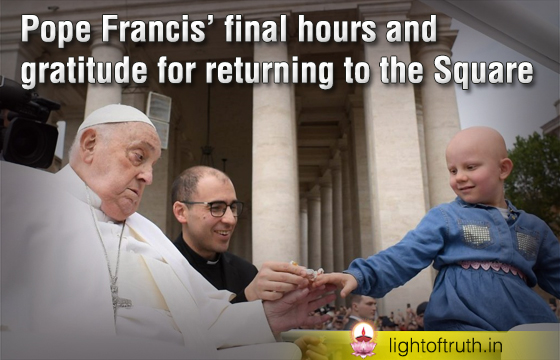
Pope Francis’ final hours and gratitude for returning to the Square
“Thank you for bringing me back to the Square.” This expre-ssion of gratitude was among Pope Francis’s last words to the person who watched over him tirelessly throughout his illness, as well as before. He spoke those words to Massimiliano Strappetti, the nurse who, according to the Pope himself, once saved his life by suggesting colon surgery, and whom the Holy Father later appointed in 2022 as his personal healthcare assistant. Mr. Strappe-tti stayed by the Pope’s side during all 38 days of his hospitalization at Rome’s Gemelli Hospital, and keeping watch round-the-clock during his recovery at the Casa Santa Marta. He was with the Pope on Easter Sunday, during the Urbi et Orbi blessing. The day before, they had gone together to St. Peter’s Basilica to review the “route” he would take the following day when he was to appear on the Central Loggia of St. Peter’s Basilica.
The late Pope wanted to offer one last, meaningful surprise to the 50,000 faithful with a ride in the popemobile on Sunday after the blessing on the balcony of St. Peter’s Basilica façade. However, Pope Francis did hesitate a bit and asked the opinion of Mr. Strappetti, asking him, “Do you think I can manage it?” Once in St. Peter’s Square, he embraced the crowd, especially the children, since this was his first ride after being discharged from Gemelli hospital, as well as the last outing among the faithful of his life. Tired but content, the Pope afterwards thanked his personal healthcare assistant, saying, “Thank you for bringing me back to the Square.” These heartfelt words reveal the deep desire of the Argentine Pope to be among the people of God, enjoying the human connection he made a hallmark of his papacy.
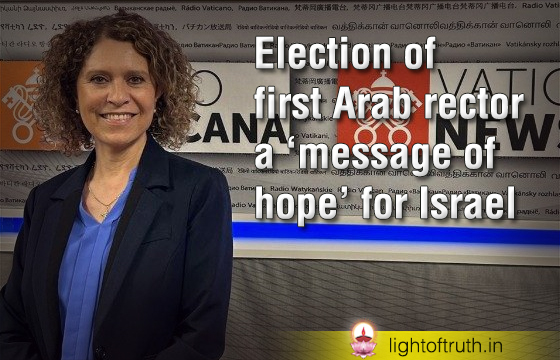
Election of first Arab rector a ‘message of hope’ for Israel
Mouna Maroun was appointed Rector of the University of Haifa, becoming the first member of Israel’s Arab minority – an underprivileged group that, according to rights organisations, continues to face structural discrimination – ever to hold the role at an Israeli university.
Maroun is also a Christian, hailing from a small Maronite Catholic village on the slopes of Mount Carmel. Christians make up only around 7% of the total Israeli Arab population, which in turn represents about one fifth of Israel’s total, and Maroun’s tale of success – as a woman, an Arab, and a Christian – is therefore a noteworthy one.
Her election was “a miracle”, Maroun tells Vatican News, coming as it did only a few months after Hamas’ 7th October attacks and rising tensions between Arabs and Jews within Israel. In April 2024, she had been appointed the University of Haifa’s Rector, or chief academic officer, a role second only to the President in the university hierarchy.
Speaking recently to the Vatican News Maroun describes her appointment as a “message of hope” and a sign that “things can be different in Israel”, that Jews and Arabs “can succeed together and can live together”.
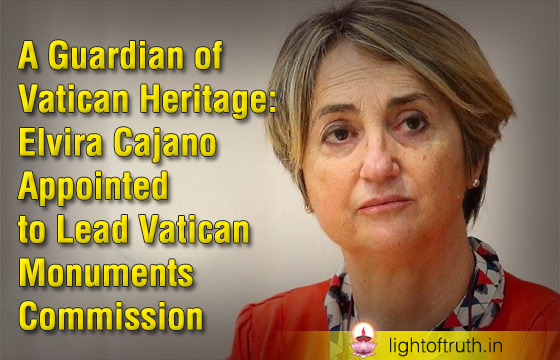
A Guardian of Vatican Heritage: Elvira Cajano Appointed to Lead Vatican Monuments Commission
Professor Elvira Cajano has been appointed President of the Permanent Commission for the Protection of Historical and Arti-stic Monuments of the Holy See. The announcement was made on April 10 by Cardinal Secretary of State Pietro Parolin, marking a new chapter for the century-old institution charged with safe-guarding some of the most trea-sured sites and artworks in Chri-stendom.
Cajano, an esteemed archi-tectural historian born in Parma in 1955, brings decades of expertise to her new role. With an academic background that bridges architecture, history, and conservation–earned at the Uni-versity of Rome “La Sapienza”–she has long stood at the inter-section of scholarship and public service. Her leadership roles within the Superintendency of Archaeology, Fine Arts, and Heritage of Umbria, coupled with her tenure as a visiting professor at the Pontifical Gregorian University, position her uniquely to take on the complex responsi-bilities of the Commission.
More than an administrative role, the presidency of the Co-mmission represents a stewardship of memory and meaning. Cajano succeeds Francesco Buranelli, a former director of the Vatican Museums and a leading figure in art conservation. Under Cajano’s direction, the Commission will continue to serve not only as a regulatory body but also as a cultural conscience for the Vatican–evaluating restoration projects, overseeing architectural developments, and shaping the ways sacred art is preserved and presented both within Vatican City and in extraterritorial sites under its jurisdiction.
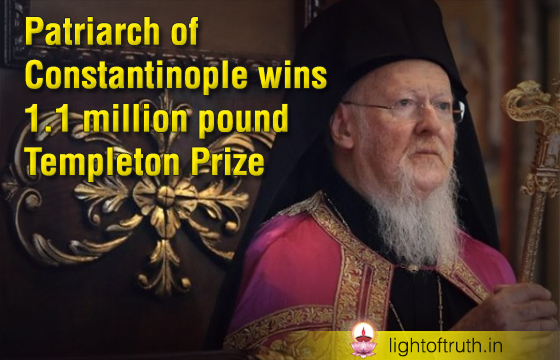
Patriarch of Constantinople wins 1.1 million pound Templeton Prize
The 2025 Templeton Prize has been awarded to Ecumenical Patriarch Bartholomew of Constantinople, the spiritual leader of Eastern Orthodoxy and a visionary voice in the global movement for ecological justice. The £1.1 million prize honours a lifetime of prophetic leadership that has redefined the moral dimensions of environmental stewardship and challenged both faith communities and secular institutions to see the Earth not merely as a resource, but as a sacred inheritance. Often referred to as the “Green Patriarch,” Bartholomew is not only the first among equals in the hierarchy of Orthodox Christian leaders, but also one of the first major religious figures to consistently frame environmental degradation as a spiritual crisis. Decades before climate change entered mainstream conversation, he had already begun weaving together theology and ecology in a call for moral responsibility toward creation.
The John Templeton Foundation, which announced the award on April 9, praised Bartholomew for “pioneering efforts to bridge scientific insight and spiritual wisdom in our relationship to the natural world.” The foundation highlighted how his tireless engagement with scientists, theologians, and policymakers has helped reframe environmental harm not simply as a technical or political issue, but as a profound ethical and spiritual failure.
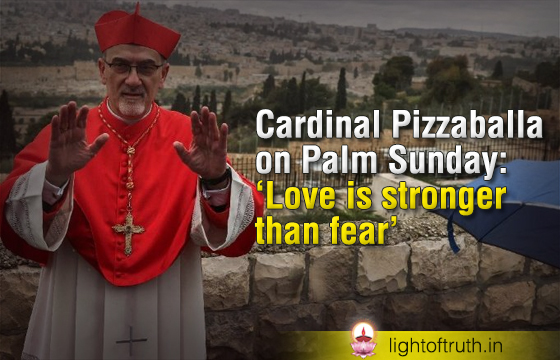
Cardinal Pizzaballa on Palm Sunday: ‘Love is stronger than fear’
As pilgrims and faithful gathered at the gates of the Holy City to commemorate the trium-phal entry of Jesus into Jerusalem, Cardinal Pierbattista Pizzaballa, Latin Patriarch of Jerusalem, delivered a Palm Sunday message calling for hope, unity, and perseverance in the face of ad-versity. Offering greetings to those present and to all united in prayer across the region – from Gaza to Nazareth, from Bethle-hem to Jenin, including the faithful in Jordan and Cyprus, Cardinal Pizzaballa’s words especially ho-noured the Christian community of Jerusalem, whom he described as the custodians of the flame of faith in the city of the Resu-rrection.
“We know we are living through difficult times,” the Cardinal acknowledged. “But we are not here today to speak only of hardship. We are here to proclaim with strength that we are not afraid. We are children of light, of resurrection, of life. We believe in a love that conquers all.” As the Church enters Holy Week, the Patriarch reflected on the Passion of Christ, reminding the faithful that suffering is not the final word. “The Passion is not God’s last word to the world. The Risen One is. And we are here to affirm it once more – with strength, with love, and with unshakable faith.”
Addressing all Christians, he appealed for a response of peace to hatred, unity to division, and welcome to rejection. “This is our vocation: to build, to unite, to tear down walls, and to hope against all hope.” Concluding his message, the Patriarch called on the faithful not to lose heart. “Let us not be discouraged. Let us not lose hope. Let us lift our eyes with trust and renew our concrete and sincere commitment to peace and unity, grounded in the power of Christ’s love.”