Category Archives: International

White Christians now minority in the United States of America

There have been “seismic shifts” in America’s religious landscape over the last few decades with white Christians now being a minority, reveals a survey of 101,000 Americans.

Racial and ethnic changes are transforming nearly all major Christian denominations, stated the Public Religion Research Institute (PRRI) in a survey that it declared was the largest of its type focusing on American religious and denominational identity.

“Today, only 43% of Ameri-cans identify as white Christian, and only 30% as white Protest-ant,” said PRRI about the survey results released Sept. 6. “In 1976, roughly eight in ten (81%) Americans identified as white and identified with a Christian denomination. A majority (55%) were white Protestants.”

The survey found a large shift in the makeup of the American Catholic Church with a large rise of Hispanics faithful in recent years.

In 1991, 87% of Catholics were white, non-Hispanic. Today they account for 55%. “Among Catholics under the age of 30, fewer than four in ten (36%) are white, non-Hispanic, compared to 52% who are His-panic,” said PRRI.

America’s 70 million Catho-lics make up 22% of the country’s 322 million people.

While Christians make up nearly 70% of Americans, the survey found a sharp increase in the numbers of the religiously unaffiliated who make up around a quarter of the population. The religiously unaffiliated includes atheists, agnostics, and those who don’t identify with any specific religion.

FUNERAL WORKERS NEED MORE COUNSELLING AND FACE GREATEST DISTRESS, SAYS SURVEY

Funeral directors should have access to professional counselling and they face more sadness than any other profession, according to a new survey commissioned by The Art of Dying Well website, run by the Catholic Church in England and Wales. The survey is designed to highlight a new Online guide to Catholic Funerals and Cremations which sets out a step-by-step guide to anyone who is organising a Catholic funeral. According to the poll of 2000 adults, almost half (44%) think that funeral directors should have access to professional counselling. More than a third (36%) feel that funeral directors must struggle with the constant theme of death and grief while almost 40% of people believe that they face more sadness than other professions.

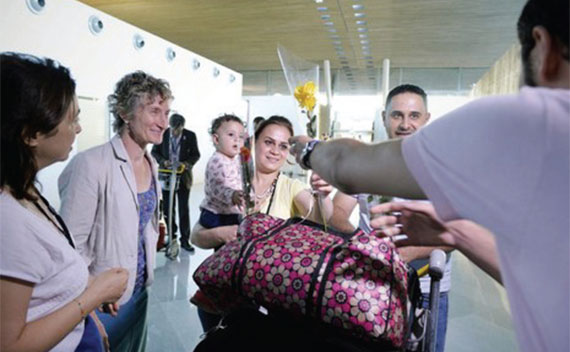
As German police attempt to deport refugees, hundreds of churches are trying to shelter them

Two guitar players strummed and sang in Farsi as a stream of Afghans and Iranians knelt at the front of Trinity Lutheran Church, sipping wine from a shared Communion cup. Most of the congregants had arrived in Germany within the last two years, part of the refugee influx that’s brought more than a million asylum seekers to the country since 2015.

At the peak of the crisis two years ago, this Lutheran Church was holding mass baptisms of more than 200 people at a time, said the pastor, Gottfried Martens. “This church went from just a few hundred members to more than 1,300 Iranians and Afghans,” Martens said. “All converts.”

When Germany opened its doors to refugees in 2015, churches and church-affiliated organizations played a critical role in the response. Most of them took care to separate religion from humanitarian aid, especially those implementing state-funded relief projects. More than two years later, however, some churches are more actively defending refugees, even housing rejected asylum seekers in churches so German police cannot deport them, while submitting legal appeals for their cases. Many of these “church asylum” beneficiaries have also converted, a controversial act that’s drawn criticism from Islamic groups and scepticism from German authorities. There are 351 church asylum locations in Germany, according to Asyl in der Kirche, a network of German parishes offering safe houses. They host 551 people, including 127 children and 301 Dublin cases. Legally, German police can deport both Dublin cases and rejected asylum seekers, a phenomenon that has increased for Afghans in particular. Germany started deporting hundreds of Afghans in 2016, sending them on charter flights back to Afghanistan, despite the country’s growing instability. If refugees are living on church grounds, however, police won’t enter.

Pontiff to visit Myanmar, Bangladesh in November

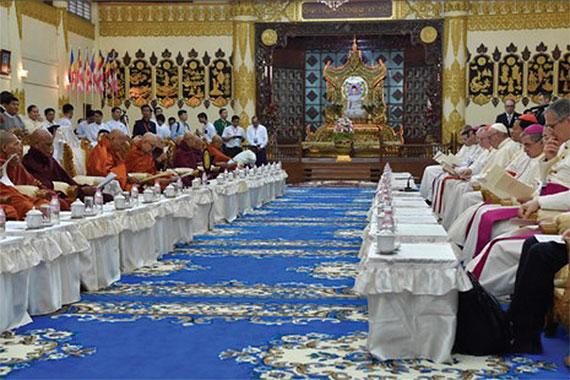
Pope Francis will visit Myanmar and Bangladesh in November, the Vatican has confirmed. Greg Burke, the director of the Vatican press office, announced on August 28 that the Holy Father will travel to Myanmar on November 27, remaining in that country until November 30. He will stop in Dhaka, Bangladesh, from November 30 to December 2 before returning to Rome.

The possibility of a papal trip to Myanmar had been a subject of heavy speculation for several weeks. The plan for a stop in Bangla-desh, a heavily Islamic country, was not generally anticipated.

Some Buddhist leaders in Myanmar had expressed opposition to a papal visit, because of the Vatican’s public protests against the persecution of the country’s (Muslim) Rohin-gya ethnic minority.

Pope Francis had repeated his pleas for the Rohingya in his regular public audience on Sunday, August 27: the day before his trip was announced.

In Myanmar the Pope will visit the cities of Yangon and Nay Pyi Taw, Burke said. The papal spokesman did not mention any cities in Bangladesh other than the capital, Dhaka, as stops on the papal itinerary. More details of the schedule for the papal trip are expected soon. The motto for his visit to Bangladesh is “Harmony and Peace.” According to the explanation given, it’s a call to harmony among “religions, cultures, peoples, society, history, heritage and traditions” in the country, while peace refers to that experience, “as well as a future aspiration with a vision of integrat-ed human and spiritual development in Bangladesh.”

“Love and Peace” this is the motto of Francis’s visit to Myanmar. “Christian peace is founded on Love,” says the statement released by the Vatican. “There cannot be peace without love. Love, which the people of Myanmar value most, will pave the way to peace. The visit of our Holy Father is to promote Love and Peace in Myanmar.”

After the trip was confirmed, Bishop Paul Ponen Kubi of Mymensingh, Bangladesh, told Crux that the “tiny minority” that is the Church in his country lives in communion with the universal Church, and also “in harmony and peace with different cultures, religions and society.”

‘Enemy’ Pope Francis is a symbolic target of ISIS

“Remember this, you mis-creants – we shall be in Rome, we shall be in Rome, Inch’ Allah!” The threat is clear. It comes from an ISIS Jihadi in the Philippines. In a video released on August 25, a group of “soldiers of the Caliphate” filmed themselves desecrating the church in Marawi, a southern town where Jihadists and government forces have been fighting since the month of May.
As he speaks these words, the man shreds photographs of Benedict XVI and Francis. “After all their efforts, it will finally be the religion of the cross that will be broken,” a voice adds off camera. “The hostility of the Crusaders towards Muslims has only served to strengthen the young generation.”

“I saw, that video that was shown on TV: evidently, one cannot avoid worrying. Especially because of this senseless hatred that there is,” said Italian Cardinal Pietro Parolin, speaking to reporters during a Catholic gathering in the Italian city of Rimini.

The prelate also said that, to his knowledge, no particular new security measures are in place in the Vatican as a direct result of that video, and the alarm level is the same as before. Threats by ISIS against the Vatican are nothing new. This video was just the latest example, but it shows that the specter of an attack against the Pope or of the “taking” of the Vatican City by its combatants is still quite real.

In fact, the use of the term “Crusaders” to designate Westerners is a regular reminder of the way the West and Christianity are used synonymously in the rhetoric of ISIS. The Pope thus becomes a prime symbolic target.

Evidence of this is to be found in Dabiq, the English-language propaganda magazine of ISIS, since October 2014. One of its first editions offers a front-page photo montage showing the flag of the Jihadi group flying over the obelisk on St Peter’s square with the title “The Failed Crusade.”

Chinese communist mouthpiece warns Party members: Religion is not a private matter

A major article in an influe-ntial Chinese Communist Party (CPP) journal has warned cadres that adopting religious beliefs is not a private matter. Qiushi is the top-level journal on communist theory run by the Party’s central committee.

The article by Wang Zuoan, director of the State Administra-tion of Religious Affairs, is entitled “Be politically minded while doing religious work.”

Chinese media in and outside of China picked up on his ad-monition to Communist Party members and officials that they should not believe in any religion. When the regime issues specific warnings, it is widely seen as reflecting high-level concerns. There is no doubt that some Party officials have become religious followers.

There are an estimated 90 million Communist Party members in China, with many joining to enhance their career prospects. There is no credible estimate of just how many of them have adopted a religion.

However, Wang Zuoan, in his lengthy article, noted that this had occurred with some senior Communist Party cadres, not only mi-ddle and low-level regime officials. He called for “edu-cation” to induce people to abandon their religious faith or, if necessary, face disci-plinary action.

Pope invokes ‘magisterial authority’ to declare liturgy changes ‘irreversible’

Addressing a group of liturgical experts on August 24, 2017, Pope Francis said that after the teaching of the Second Vatican Council (1962-65) and a long path of experience, “We can affirm with certainty and magisterial authority that the liturgical reform is irreversible.” The declaration came in a speech to Italy’s “Centre of Liturgical Action,” which sponsors an annual National Liturgical Week.

By “liturgical reform,” Pope Francis meant the changes in Catholic rituals and modes of worship which followed from Vatican II, the most immediately visible elements of which included Mass facing the congregation, the use of vernacular languages, and a stronger emphasis on the “full, conscious and active” participation of the people.

Although Pope Francis is often seen as having less interest in liturgical questions than some of his predecessors, this was a lengthy and carefully footnoted reflection, roughly 2,500 words in all. He began by highlighting some of the cornerstones of the liturgical movement of the 20th century, a reminder that the ongoing reform is rooted in tradition, and was actually kick-started by two Popes often seen as  ”conservative”: Pius X, who created a commission for renewal in 1913, and Pius XII, with his encyclical Mediator Dei and changes to the liturgy of Holy Week.

According to Francis, these changes came to fruition with 1963’sSacrosanctum Concilium, the Constitution on the Sacred Liturgy of the Second Vatican Council, the application of which is still ongoing, including overcoming “unfounded and superficial interpretations, partial revelations and practices that disfigure” [the liturgy].

Quoting Pope Paul VI, the Argentine pontiff added that this process is still ongoing in part because reforming the liturgical books is not enough to “renew the mentality.”

Also using the words of his predecessor, Francis called Catholics – priests and laity alike – to leave behind “disruptive ferments, which are equally pernicious in one sense and the other,” and to “apply integrally” the reform approved by the bishops who took part in the Council.

Battles over liturgical practice have been a chronic feature of Catholic life since Vatican II. A desire to maintain the older Latin Mass, for instance, was a primary force prompting French Archbishop Marcel Lefebvre to lead a group of traditionalist Catholics into a break with Rome. During the 1990s, the church in the United States engaged in a decade-long debate over how to translate liturgical texts into English and other matters dubbed the “liturgy wars.”

Nigeria: Archbishop calls for compensation for victims of Boko Haram

A Nigerian archbishop has called on the government to compensate churches and other victims of Islamist terror group Boko Haram.

“In the past six years, insurgents have attacked churches and other Christian places in the north, but the federal government is yet to compensate the victims,” said His Excellency Msgr Mathews Manoso Ndagoso, Archbishop of Kaduna, speaking on behalf of the Catholic Bishops of Kaduna Ecclesiastical Province.

The conference comprises the dioceses of Kaduna, Sokoto, Kotangora, Zaria, Minna, Kano and Kafanchan in the north of Nigeria, who held their plenary session, at the cathedral in Minna this week. Archbishop Ndagoso told journalists: “I want to inform you that the Catholic Church has not received any support from the federal government for the Churches affected.”

The first terrorist attack was on St Theresa Catholic Church, Madalla, on Christ-mas Day, 2011 in which 32 people were killed and many more injured. Last year, some youths attacked St Philips Catholic Church, Bakin Iku, near Suleja, destroying properties valued at several millions of Naira.

“No one has even sympathised with us,” the Archbishop said. Msgr Ndagoso said that the federal government was supposed to be responsible for giving assistance to the churches and the victims.
In May 2015, Aid to the Church in Need reported that more than 5,000 Catholics in northeast Nigeria had been killed and at least 100,000 had been displaced.

Report: Christianity spreading among Iran’s youth

Mohabat News, an Iranian Christian news agency, said in a recent report that Christianity is spreading rapidly among youth in some cities. “This high rate of conversion of Iranian youth to Christianity is in spite of rigorous Islamic indoctrination of the youth in their families and educational system,” according to the report.

“The Islamic government of Iran dedicates massive budgets to the support of Islamic organiza-tions that promote Islam among the youth within and without Iran’s borders,” the report continued. “Regardless of such efforts, Iranian youth seem to become increasingly distant from Islam, which is a cause of great concern for the Iranian Islamic govern-ment.”

One of the most senior Islamic Shi’ite clerics who has repeatedly expressed his concern over the spread of Christianity among the youth in the country is Ayatollah Makarem Shirazi. He, as well as most of his colleagues blame the foreign influence for the conver-sion of young Iranians to Christia-nity. The question that comes up however, is that what could be the real cause for Iranian youths’ rejection of Islam and its princi-ples, despite the serious risks involved with conversion to Christianity in an Islamic country such as Iran?

Last year, after Ayatollah Makarem Shirazi expressed his deepest concern over the popula-rity of Christianity in the suburbs of Mashhad, the city’s religious and political officials immediately sent a vast number of Islamic tea-chers and preachers to Mashhad’s suburbs in order to turn the youth away from Christianity. The next phase in dealing with this matter was to crack down on the youth who refused to turn back following the efforts of Islamic teachers and preachers.

Salesian missionary in Ethiopia has baptized over 7,500 

A Salesian missionary priest has baptized more than 7,500 people in the Ethiopian village where he works. Father Giorgio Pontiggia has been stationed for years in a village outside Gambella. “When I arrived eleven years ago, I found about 40 Catholics,” he recalls. He began offering instruction, bringing residents into the Church, a few at a time. This year, the total number of baptisms reached 7,569, he says. He has been joined by another Salesian missionary, and together with their parishioners they have built several chapels around the village.