Category Archives: International

Protestant churches embrace gluten-free bread for Communion as Vatican reaffirms ban

While the Roman Catholic world digests a Vatican letter confirming the church’s prohi-bition on gluten-free wafers, Protestant churches continue to place orders for a Eucharist that won’t bother the gluten-intolerant. Gluten or no gluten — the difference is theological. Protes-tant churches generally do not subscribe to the doctrine of transubstantiation, which holds that during the Communion service, the bread and wine turn into the actual body and blood of Jesus.

The Catholic Church, which affirms transubstantiation, wants to hew as closely as possible to the elements of the first-ever Communion — the bread and wine that Christians believe Jesus ate and drank during the Last Supper.

But Protestants consider Communion a symbolic act, and generally give themselves more leeway on the elements.

Wine can be grape juice. Bread does not necessarily have to be made out of wheat.

The Vatican letter released on July 8 reaffirmed that Communion wafers must contain at least some gluten. But the rule is not new, just a restating of an earlier teaching.

“ … bread made from another substance, even if it is grain, or if it is mixed with another substance different from wheat to such an extent that it would not commonly be considered wheat bread, does not constitute valid matter for confecting the Sacrifice and the Eucharistic Sacrament,” the letter reads.

And it makes clear: “Hosts that are completely gluten-free are invalid matter for the celebration of the Eucharist.”

Low-gluten wafers, however, are deemed acceptable by the church.

Those who suffer from celiac disease — about 1 in 100 people worldwide, according to the Celiac Disease Foundation — must stay away from gluten to avoid painful symptoms and serious health consequences.

‘For every person baptized, the U.S. Church loses six Catholics’

He may be at the helm of one of the most dynamic Roman Catholic parishes in Florida, with the 3,000 families present each weekend at one of the seven masses at Saint Peter’s Church in Deland, but Father Thomas Connery is still worried.

“We have many retirees in Florida, so the churches are full but take them away and it’s a catastrophe,” says Father Connery. “We’re not managing to reach the young generations.”

“For every person baptized, the American church loses six Catholics,” he laments. “We don’t dare talk about it among priests, doubtless because we do not know what to do, but it is past time to break this taboo.

“Imagine a company facing such a problem. It would immediately launch an emergency plan! What about us?”

U.S. bishops do not yet have an emergency plan, but they have organized a unique gathering. For the first time in a hundred years, priests, laymen, monks, nuns and other heads of services and movements from all over the United States have come together at a meeting in Orlando, Florida from 1 to 4 July.

Their purpose is to reflect on how to be the best “missionary disciples,” in the words of Pope Francis in his Evangelii Gaudium.

Catholics represent the largest denomin-ation in the United States, with 77.4 million believers (22% of the total population), but fewer people have actually been attending church. The number of people taking the sacraments, except baptism, is also dropping.

From 2013 to 2016, the number of children who had their first communion decreased by 50,000 or 7%. Catholic schools registered a loss of 250,000 students over the same period.

If the Roman Catholic Church is losing ground in the United States, this also has to do with the rampant secularization of U.S. society in general. Americans who define themselves as not belonging to any religion, the “nones,” make up close to 25% of the population, up from 6% in 1991.

Joaquín Navarro-Valls has died

The former Director of the Press Office of the Holy See, Joaquín Navarro-Valls,  on  5 July 2017, after a battle with pancreatic cancer. He was 80 years old. Navarro trained as a medical doctor with a specialization in psychiatry, as well as in journalism, moving to Rome in the early 1970’s, becoming a foreign correspondent and eventually being elected president of the foreign press association in the city.

How Facebook is like church, according to founder Mark Zuckerberg

Its members gather to comfort and encourage one another. They check in on the sick and struggling. They wish each other a happy birthday. Founder and CEO Mark Zuckerberg said in Chicago at the first Facebook Communities Summit that the two are similar in the way they create community and bring people together.

“As I’ve travelled around and learned about different places, one theme is clear: Every great community has great leaders,” he said. “Think about it. A church doesn’t just come together. It has a pastor who cares for the well-being of their congregation, makes sure they have food and shelter. A Little League team has a coach who motivates the kids and helps them hit better. Leaders set the culture, inspire us, give us a safety net and look out for us.”

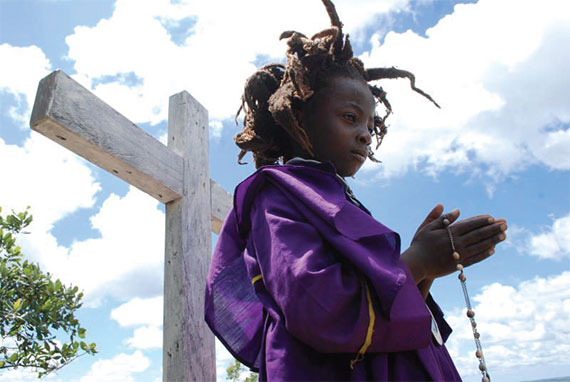
Cameroon’s bishops insist Bishop Balla was murder victim, not suicide

The Catholic bishops of Cameroon insist that Bishop Jean-Marie Benoit Balla of Bafia was “brutally assassinated,” rejected the conclusions of an autopsy that found “no trace of violence.”

At a July 7 press conference, Archbishop Samuel Kleda of Doula, the president of the nation’s episcopal conference, rejected the results of the autopsy that had been performed by German doctors. Government officials had stressed that the autopsy was performed independ-ently under international super-vision. The bishops’ rejection of the results points to the deep level of suspicion between the Catholic hierarchy and the government leadership. Some observers questioned whether the bishops feared that the government had provided another body for the autopsy. At his July 7 press conference, Archbishop Kleda decli-ned to give a direct answer to the question of whether the bishops had received Bishop Balla’s body for burial.

While investigation of Bishop Balla’s death continues, government officials now suggest that it was a suicide.

Embezzlement charges against two former officials of Vatican-run hospital

The Vatican has indicted two former officials of the Bambino Gesu Hospital on embezzlement charges. The indictment is the first brought by Vatican prosecutors under new rules designed to promote transparency and accountability in Vatican financial transactions. The Vatican has been under pressure from European banking authorities to prosecute violations of these rules.

Giuseppe Profiti and Massimo Spina—who were the president and treasurer, respectively, of the Bambino Gesu Foundation— were summoned to appear before a Vatican tribunal for a July 18 hearing on the charges. Although the summons was issued on June 16, the indictment was announced on July 13. The two former officials of the foundation connected with the Vatican-owned Bambino Gesu Hospital are charged with improperly spending more than €400,000 in foundation funds on the renovation of an apartment owned by Cardinal Tarcisio Bertone. In the past, Profiti has said that the expenses were justified because the cardinal’s apartment was used for the foundation’s fundraising events.

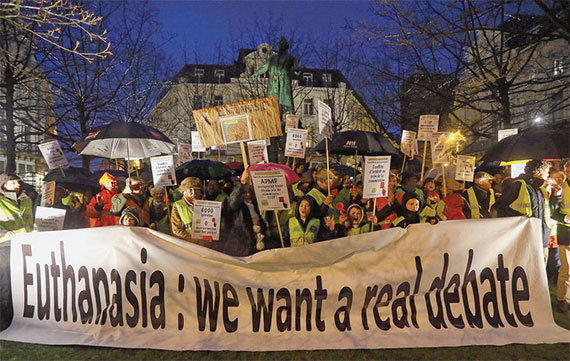
Netherlands: hundreds euthanized without patient’s request

New statistics on the use of physician-assisted suicide in the Netherlands show that hundreds of patients were given lethal drugs without a request from the patients. The figures for 2015—the most recent statistics available—show 431 cases in which the patient’s life was ended without an explicit request.

The figures also show that 1,693 cases of assisted suicide—more than 20% of the total for 2015—were not formally reported.

The figures provide strong support for arguments that the law governing assisted-suicide in the Netherlands is not rigorously enforced.

LAITY MAY START TO HAVE GREATER SAY IN THE APPOINTMENT OF BISHOPS, SAYS MEMBER OF THE COUNCIL OF CARDINALS

The laity may start to have a greater say in the appointment of bishops, a member of the Council of Cardinals has said. Cardinal Oswald Gracies, Archbishop of Bombay and one of the Pope’s close advisers, told the National Catholic Reporter in an interview that the Council of Cardinals — also known as the C9, a group of advisors Francis setup a few months after his election in 2013 — are considering whether to give more weight to the laity when choosing bishops.

The nomination of a bishop normally is usually at the behest of neighbouring bishops, the predecessor, apostolic nuncios — which are a form of Vatican ambassador — and the Pope. Though the laity are at times consulted, Cardinal Gracias said, “we have left it to the discretion of the nuncio whether he will” speak to them.

“We were reflecting whether we should not make it obligatory,” the Indian cardinal said.

By forcing the nuncios to consult with laypeople, the process would become more “objective.” If the appointment procedures were formally widened to include members outside the normal clerical gamma, Cardinal Gracias said, a person may be chosen that is better able to interact with his diocese.

Noose is tightening around Christian minority in Turkey

The ancient Syrian Orthodox Monastery of Mor Gabriel has been subjected to constant and unfair legal attacks since 2008. It has now fallen under the control of the all-powerful Diyanet, which governs Islamic Turkey (99.8% of the population).

The Mor Gabriel Monastery was founded in 397 by the ascetic Mor Shmu’el (Samuel) on the Tur Abdin plateau, “the mountain of the servants of God,” in south-eastern Turkey.

This sacred site of Eastern Christianity is one of the 50 churches and monasteries that have been seized by the Diyanet, according to Kuryakos Ergün, the Chairman of the Mor Gabriel Monastery Foundation.

This legal struggle goes back to 2008. In that year, an updating of the land registry requalified 250 hectares within the Mona-stery’s boundaries as “forests,” on the grounds that they were not “cultivated.”

Most Christians in Turkey (0.1% of the population) do not have any legal status. The Treaty of Lausanne (1923), which gave rights to non-Muslim minorities, recognized only minority groups of Armenian, Greek Orthodox, and Jewish origin.

Syrian Orthodox Christians (whose numbers have fallen from 70,000 in the 1970s to about 2,000 today) and Roman Catholics (between 10,000 and 15,000) are therefore excluded. They can only battle the courts to try to keep or to recover property confiscated from them by the State.

Pontiff grants Cardinal Pell leave of absence to face abuse charges in Australia

Card. George Pell, the prefect of the Vatican’s Secretariat for the Economy, has been ordered to appear in a Melbourne court on July 26 to face sexual abuse charges. The charges stem from allegations made by “multiple complainants,” according to a deputy police commissioner. In a separate hearing on July 6, a judge will decide whether to release details about the charges.

“I am looking forward finally to having my day in court,” Cardinal Pell said at a press conference. “I repeat that I am innocent of these charges. They are false.” Card.Pell is the highest-ranking Vatican official ever to be charged with sexual abuse. Pope Francis has said that he will not comment on the charges “until the justice system passes judgment.”