Category Archives: International

Middle East patriarchs discuss plight of Christian minorities with Pope Francis

Six Catholic patriarchs from Lebanon, Syria, Egypt, and Iraq met with Pope Francis at the Vatican on Feb 7, 2020 to discuss the difficulties faced by Christians in the region and their mass emigration. In the morning of Feb. 7, the Pope met Cardinal Louis Raphael Sako, Chaldean Patriarch of Babylon; Cardinal Bechara Boutros Rai, Maronite Patriarch of Antioch; Coptic Patriarch Ibrahim Isaac Sedrak of Alexandria; Melkite Patriarch Youssef Absi of Antioch; Armenian Patriarch Gregoire Pierre XX Ghabroyan of Cilicia; and Syriac Patriarch Ignatius Youssef III Younan of Antioch.

Patriarch Younan told CNA that the patriarchs requested the meeting with Pope Francis because of the “dramatic situation of the Middle East in general, whether in Syria, Iraq, Lebanon” and because of the “migratory flux” of the Christian minorities from their homelands.

It is a “a threat to our survival,” he said, explaining that they are struggling to provide proper spiritual assistance to their faithful in other parts of the world, especially Western Europe.

Russian Church plans to end blessing nukes

The Russian Orthodox Church has proposed a stop to the practice of having priests bless weapons of mass destruction, though sprinkling holy water on planes and ships is still deemed appropriate.

The Church on February 3 published a draft document out-lining its role in blessing Orthodox Christians who “protect the Fatherland” and “carry out their military duty,” inviting internet users to discuss the proposal online.

Russians often ask priests to bless anything from new cars and flats to Soyuz spaceships in the belief that the gesture bestows divine protection.

Since the fall of the Soviet Union, priests have also begun blessing troops, planes and ships, and all sorts of weapons, from Kalashnikov rifles to nuclear-capable Iskander ballistic missiles.

But the document proposed that “blessing any type of weapons the usage of which can inflict an indefinite number of deaths, including weapons with indiscriminate effects or weapons of mass destruction… be removed from pastoral practice.”

At the same time, it remains “appropriate” to “bless transport used by soldiers on land, water and in the air,” to ask God to protect the men using them, it said.

Pastor apologizes for words ‘hurtful to Muslims’ in homily on immigration

A Minnesota pastor has apologized after remarks he made about Muslim immigration and Islam being “the greatest threat in the world” sparked controversy. “My homily on immigration contained words that were hurtful to Muslims. I’m sorry for this,” said Father Nick Van Den Broeke, pastor of Immaculate Conception in Lonsdale, which is south of the Twin Cities, in the Archdiocese of St Paul and Minneapolis. “I realize now that my comments were not fully reflective of the Catholic Church’s teaching on Islam,” he said in a Jan. 29 statement. In a homily Van Den Broeke gave on Jan. 5, the feast of the Epiphany and, in Minnesota, Immigration on Sunday, he acknowledged the complexity of immigration as a political issue and that the Bible challenges Catholics to “welcome strangers.”

Pompeo announces new alliance for religious freedom

A new International Religious Freedom Alliance with 27 member states was announced by Secretary of State Mike Pompeo. Pompeo said that the alliance would include “like-minded partners who treasure, and fight for, international religious freedom for every human being.” According to the alliance’s official description, it “will advocate for freedom of religion or belief for all, which includes the right of individuals to hold any belief or none, to change religion or belief and to manifest religion or belief, either alone or in community with others, in worship, observance, practice and teaching.” Twenty-seven countries have signed on as members of the alliance—Albania, Austria, Bosnia and Herzegovina, Brazil, Bulgaria, Colombia, Croatia, Czech Republic, Estonia, The Gambia, Georgia, Greece, Hungary, Israel, Kosovo, Latvia, Lithuania, Malta, the Netherlands, Poland, Senegal, Slovakia, Slovenia, Togo, Ukraine, the United Kingdom, and the United States.

German lay leader condemns cardinal for opposing ‘synodal way’

A leading lay Catholic in the German city of Cologne has openly condemned his own archbishop for voicing concerns over the ongoing “binding synodal process” underway in the country. Tim Kurzbach, chairman of the Diocesan Council of Catholics in the Archdiocese of Cologne issued a public denunciation of Cardinal Rainer Woekli, accusing the cardinal of “destroying the authority of his episcopal office” by failing to support the so-called “synodal way.”

The statutes for a “synodal way” were formally adopted by the German bishops’ conference in September last year, despite repeated warnings and interventions from the Pope Francis and the curia. The two-year process proposes to debate and reform issues of universal Church teaching and discipline, including clerical celibacy, Church-approved blessings for same-sex couples, and the sacramental ordination of women.

Germany’s synodal assembly a step to rebuilding church’s credibility

Catholic leaders in Germany have compiled responses from lay Catholics in areas related to who holds power in the church, sexual morals, the role of priests and the place of women in church offices in preparation for an upcoming Synodal Assembly to debate church reforms. More than 940 suggestions and questions had been submitted by early January in advance of the Jan. 30-Feb. 1 assembly in Frankfurt, reported KNA, the German Catholic news agency.

The Synodal Assembly is one segment of the synodal path, which the German bishops agreed to stage at their annual meeting last March.

The Synodal Assembly will include 230 members. It is the highest decision-making body of the synodal path, an effort by the bishops’ conference and lay Central Committee of German Catholics to restore trust following a September 2018 church-commissioned report that detailed thousands of cases of sexual abuse by Catholic clergy over six decades.

Comments will continue to be accepted through Jan. 23 at the website of the German bishops’ conference. The bishops and the lay group are collaborating in planning the Synodal Assembly. During a September plenary meeting, the bishops approved statutes to guide discussions at the assembly.

The bishops’ conference and the committee each will send 69 members to the assembly. Decisions of the assembly must be passed by a double two-thirds majority: two-thirds of all participants as well as two-thirds of all members present from the bishops’ conference.

German church officials say the Synodal Assembly is not meant to be a Synod in the classic sense.

In describing the synodal path, KNA reported that the inclusion of the term synodal in the name of the reform process reflects that the dialogue, initially limited to two years, is more than a nonbinding conversation. As with a Synod, each respective local bishop will determine whether the decisions reached will be implemented.

Around the world, 260 million Christians face persecution 

Christian persecution around the world is a growing problem, says a new report from an agency that documents abuses against Christians across the globe.

Worldwide, the report states, 260 million Christians are facing persecution. This marks a 6% increase from the previous year.

The annual report from Open Doors, released on Jan. 15, rank-ed North Korea first on its list of 50 most dangerous countries in which to be Christian, the 18th straight year that the country has received that designation.

There are an estimated 300,000 Christians amidst the total population of 25.4 million in North Korea. Open Doors reports that if North Korean Christians are discovered, the government will deport them to labor camps as political criminals or even kill them on the spot. Meeting other Christians to worship is nearly impossible unless it is done in complete secrecy.

Following North Korea on the World Watch List Top 10 are Afghanistan, Somalia, Libya, Pakistan, Eritrea, Sudan, Yemen, Iran, and India.

Christians in China experienced, among other things, an increase in attacks on churches in the past year. Open Doors reports that 793 churches were attacked within the reporting period for the 2018 World Watch List, compared with 1,847 attacks reported on churches world-wide in 2019. In 2020, the numb-er is conservatively estimated to be at least 5,576 in China alone, the report states.

People of faith also suffer from continual surveillance by the government. Open Doors cites a CNBC report that says there are nearly half a billion surveillance cameras in China, a number only expected to grow.

Pope Francis condemns clerics who engage in simony

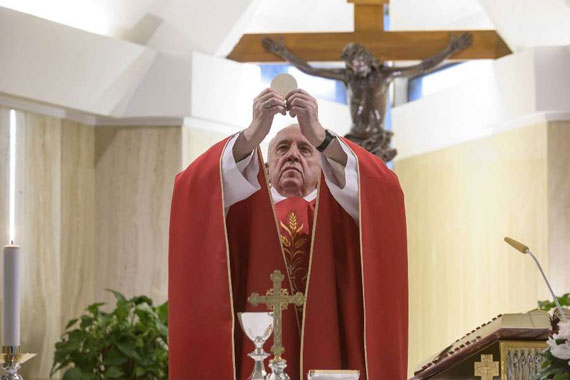
In a homily on January 21, Pope Francis condemned priests and bishops who use money to advance their careers.

To be a priest or bishop, like being a Christian, is a free and undeserved gift of God, not something to be bought, he said on Jan. 21 during Mass in the chapel of the Vatican’s Santa Marta guesthouse.

“We have paid nothing to become Christians. We priests, bishops have paid nothing to become priests and bishops,” he continued, “at least I think so.”

Francis went on to note there are those who try to move upward in their “so-called ecclesiastical career,” who “look for influences to get here, there…” as well as those “who behave in a simoniac manner.”

He said that anyone who does that “is not a Christian. Being Christian, being baptized, being ordained priests and bishops is pure gratuitousness. The gifts of the Lord cannot be bought.” The same thing can happen in “ordinary life,” he said, such as in business, when people try to get ahead at their work by asking for favours.

He recalled that it is by the Lord’s free anointing that someone is a Christian, rejecting the argument that one’s Christian identity comes from being from a Christian family or coming from a Christian culture.

“Many people from a Christian family and Christian culture reject the Lord,” he noted. “But how come we are here, elected by the Lord? For free, without any merit, for free.”

“What is the great gift of God?” he continued. “The Holy Spirit! When the Lord elected us, He gave us the Holy Spirit. And this is pure grace, it is pure grace. Without our merit.” We must have an attitude of humility in the face of this gift, Pope Francis urged. “This is holiness. The other things are not needed.”

Three churches reportedly burned down in Sudan

According to a local rights group in Sudan, three churches in a town were burnt down in December 2019 and quickly rebuilt, only to be burnt down again earlier this month.

Human Rights and Development Organization said that a Catholic Church, an Orthodox Church, and a Sudan Internal Church in Bout were burnt down on both Dec. 28 and Jan. 16; the church buildings had been rebuilt in the interim. Bout is the capital of Tadamoun district in Blue Nile state, more than 300 miles south-east of Khartoum.

According to HUDO, the alleged arsons were reported to Bout police each time, “but police did not investigate further or put preventive measures.”

The human rights organization has decried the attack and criticized the government for negligence of religious freedom.

But the Sundanese religious affairs minister, Nasr al-Din Mufreh, has claimed that only one church had been attacked twice.

The Sudan Tribune reported that Mufreh stated “Sudan’s full commitment to protecting religious freedoms.”

Church leader executed by Boko Haram

A senior church leader in Nigeria, who was abducted in early January, has reportedly now been killed.

Reverend Lawan Andimi, a state chairman of the Christian Association of Nigeria (CAN), was taken during a raid in Michika, a town in Nigeria’s Adamawa State.

A video was later released by a group linked to extremist Boko Haram showing him in captivity.

In it, he said: “I have never been discouraged because all conditions that one finds himself is in the hand of God.

“I still believe that God who made them to act in such a way is still alive and will make all arrangements.

“By the grace of God, I’ll be together with my wife, my children and all my colleagues. Don’t cry. Don’t worry, but thank God for everything. Thank you.”

Investigative journalist, Ahmed Salkida, now says he’s seen a video of his beheading.