Category Archives: International

Immigration is a ‘Gospel issue’ before a ‘political issue,’ U.S. bishop says

Bishop Mark Seitz of El Paso, Texas, said immigration is a “Gospel issue” before it is a “political issue” in the United States.  In an exclusive interview with EWTN News reporter Valentina Di Donato, Seitz said the Church has a responsibility to reaffirm Catholic social teaching regarding the preferential option for the poor. “It’s always the role of the bishop to speak the Gospel, to reflect on that Gospel and its implications for our daily lives,” the prelate told EWTN News. 

“We have a task to form people based on that teaching of love and mercy and compassion that applies not just in exceptional cases, not just to certain people, but in a special way to the poor and the vulnerable, and that includes immigrants,” he said. 

Speaking about the “inalienable rights” every person is endowed with by God, the bishop said the rights of immigrants should not only be a concern of the Church but should also be “respected in law.” “While we are not politicians — it’s not our task to develop rules and laws — we are responsible to help form consciences and bring people back to the basic underlying principles, which, by the way, are principles upon which our country was built,” he said.

According to the bishop, U.S. asylum law is not being respected “right now,” as several migrant families living in the El Paso Diocese, located near the U.S.-Mexico border, no longer feel protected and fear deportation. “We should practice that [respect for] human dignity when we are dealing with a person who simply fled here because they had no other option,” he told EWTN News.

Altar wine for Mass in Kenya now required to bear Catholic bishops’ ‘coat of arms’

Wine for Mass in Kenya must now bear the “coat of arms” of the country’s bishops, the chairman of the Kenya Conference of Catholic Bishops (KCCB) announced Oct. 4.  Speaking at the 2025 National Prayer Day at the Subukia National Marian Shrine in Kenya’s Nakuru Diocese on the feast of St. Francis, KCCB chairman Archbishop Maurice Muhatia Makumba announced that bottles containing the altar wine must bear the coat of arms of the bishops, as well as an official signature, to certify their authenticity. 

The Catholic faithful have welcomed the news as many believe the wine previously used “had lost its sanctity due to its widespread use outside the Church,” according to a BBC report. 

The wine formerly used is reportedly widely sold in liquor stores, bars, and supermarkets. After exploring options, the bishops in Kenya chose a South African vintage for the newly approved Mass wine. “Vigilance on the quality and standards of the wine and hosts used in the Mass is given to the Catholic bishops of the country. This is reviewed from time to time,” the archbishop added. The new wine was officially introduced to worshippers during the National Prayer Day. Muhatia has directed that local Catholic communities and Catholic institutions abide by the directives and sourcing for the new altar wine.“It is important that you acquaint yourself with your diocese and know what has been established as the outlets for this wine because different dioceses have different ways of distributing this wine,” he said at the National Prayer Day. “Some dioceses allow only specific persons to buy this wine for Mass; others allow everybody. Depending on your diocese, please be aware of the regulations.”

Man desecrates altar of St. Peter’s Basilica

A man urinated on the Altar of Confession of St. Peter’s Basilica on Oct. 10 before being taken away by security officers in the famous basilica, according to news reports. The man climbed the altar and “urinated under the stunned gaze of hundreds of tourists,” according to the newspaper Corriere della Sera’s Rome edition. Video of the desecration was widely shared on social media.

Il Tempo reported that the man “was promptly reached by plainclothes police officers present in the basilica” and was escorted out of the church.

The latter newspaper claimed Pope Leo XIV was “shocked to learn of the news,” though the Holy See Press Office had not released a statement about the incident as of Oct. 11.

This is not the first time this year that a vandal has attacked the altar from which the pope says Mass.In February, a man desecrated the altar by climbing on top of it and throwing six candelabras that were on the altar to the ground. In June 2023, meanwhile, a Polish man approached the high altar as the basilica was about to close, undressed, and climbed onto the altar. Photos posted online showed the words “Save children of Ukraine” written in marker on his back. The Vatican performed a penitential rite after that act of desecration.

NY Catholic sisters challenge Cardinal Dolan’s praise for Charlie Kirk

A group of Catholic sisters criticized Archbishop of New York Timothy Dolan for his recent
comments about the late conservative activist Charlie Kirk, suggesting the cardinal is
“confusing the true witness of the Gospel” by likening Kirk to a biblical saint. On Wednesday
(Sept. 24), Sisters of Charity of New York issued a statement in response to remarks Dolan
made earlier this month during an appearance on “Fox & Friends.” While discussing Kirk’s
killing, Dolan cast the work of the activist, an evangelical Christian, in religious terms.
“The more I learned about (Kirk), I thought, this guy is a modern-day Saint Paul,”
Dolan said. “He was a missionary. He’s an evangelist. He’s a hero. He’s one, I think, who
knew what Jesus meant when He said, ‘The truth will set you free.’”

Dolan joins many conservatives who have publicly compared Kirk to Christian saints and
martyrs after he was shot and killed while speaking at a college campus in Utah earlier this
month. The Sisters of Charity of New York condemned the comparison, noting Kirk’s history
of inflammatory rhetoric — which includes criticism of Catholicism itself — and arguing that
conflating him with biblical heroes could lead Catholics astray.

“What Cardinal Dolan may not have known is that many of Mr. Kirk’s words were marked
by racist, homophobic, transphobic, and anti-immigrant rhetoric, by violent pro-gun
advocacy, and by the promotion of Christian nationalism,” the sisters’ statement read. “These
prejudicial words do not reflect the qualities of a saint. To compare Mr. Kirk to St. Paul risks
confusing the true witness of the Gospel and giving undue sanction to words and actions that
hurt the very people Jesus calls us to love.”

In contrast to Kirk, who supported hardline immigration policies during his life, the Sisters of
Charity noted their own history of working with immigrants who arrive in the United States
“with nothing but hope,” adding, “they deserve true examples of discipleship, not false
prophets.”

“In this moment, we reaffirm our mission: to walk with all people who are poor and
marginalized, to welcome immigrants and refugees, to defend the dignity of LGBTQ+
persons, and to labour for peace in a world saturated with violence,” the statement read.
“These are the marks of authentic discipleship. These are the qualities of saints.”
The statement was signed by the group’s leadership, which includes Sisters Donna Dodge,
Margaret O’Brien, Mary McCormick, Mary Ann Daly, Sheila Brosnan and Margaret Egan.

Pope at Jubilee Audience: Faith of simple people guides the Church

Pope Leo XIV held a special Jubilee Audience in St. Peter’s Square on September 27, as thousands of catechists attend the Jubilee of Catechists on September 26-28. In his catechesis, the Pope reflected at length on the sensus fidei, which he said is like a “sixth sense of simple people for the things of God.” “God is simple and reveals Himself to the simple,” he said. “For this reason, there is an infallibility of the People of God in believing, of which the infallibility of the Pope is an expression and a service.”

Pope Leo turned to the 4th century St. Ambrose, who was serving as governor of the city of Milan during a time of great conflict in the Church. As a civil authority, he intervened at a crucial point in the election of a new Bishop of Milan, employing his great ability for listening and mediation to bring calm among the faithful. Tradition recounts that a child cried out “Ambrose bishop!” and the whole people joined him in acclamation. “Ambrose was not even baptized; he was only a catechumen, that is, preparing for Baptism,” he said. “Yet the people perceived something profound in this man and elected him. Thus the Church had one of its greatest bishops, and a Doctor of the Church.”

Ambrose, said Pope Leo, at first refused and even fled the city, before understanding that this was a call from God, thus allowing himself to be baptized and ordained bishop. The Pope marvelled at the great gift that “the little ones” gave to the Church. “Even today this is a grace to ask for: to become Christians while living out the vocation we have received!” he said. As parents, entrepreneurs, workers, teachers, priests, or religious, every person is called to be a Christian through their chosen path, noted the Pope, adding that people can “sense” whether we are truly becoming Christians or not.

After accepting his vocation, St. Ambrose lifted up the faith of his people, even creating new ways of singing psalms and hymns, of celebrating the liturgy and preaching.

St. Ambrose’s preaching even converted St. Augustine, who himself became a bishop and Doctor of the Church. “He himself knew how to perceive, and in this way hope multiplied,” he said. “To perceive, to intuit, is a way of hoping—let us not forget this!”

In conclusion, Pope Leo XIV said God moves His Church forward and shows her new paths through the sensus fidei, the faith of the people of God. “To perceive, to intuit, is the instinct of the little ones for the Kingdom that is coming,” he said. “May the Jubilee help us to become little ones according to the Gospel, so as to perceive and serve God’s dreams!”

Holy See says arms race ‘unacceptable’ and risks ‘nuclear catastrophe’

An urgent and necessary step to avoid nuclear catastrophe”. That’s how Archbishop Paul Richard Gallagher, Secretary for Relations with States and International Organisations, has described the Comprehensive Nuclear Test Ban Treaty. The Archbishop was speaking on 26 September, at the fourteenth UN conference on the entry into force of the treaty, which was signed by the Holy See 29 years ago.

The Archbishop stressed that the failure to ensure the treaty’s entry into force “undermines global efforts against nuclear testing”, and raises questions regarding “ethical responsibility”.

“Peace cannot be secured through mutual fear or the logic of deterrence,” said Archbishop Gallagher, pointing out that nuclear testing has had catastrophic humanitarian and environmental consequences. “Regrettably, the continuous expansion and modernization of nuclear arsenals, accompanied by increasingly belligerent rhetoric and threats concerning their deployment, perpetuate the dangerous illusion that security can be achieved through the threat of annihilation,” he added. Speaking at the high-level meeting organised to commemorate the International Day for the Total Elimination of Nuclear Weapons, Archbishop Gallagher recalled the profound suffering caused by the first nuclear test in New Mexico 80 years ago, and the tragic bombings of Hiroshima and Nagasaki that followed. The British Archbishop also emphasised “the ongoing threat that nuclear weapons continue to pose to global peace, to future generations, and to creation”. Gallagher went on to express the Holy See’s “profound concern over the growing trend towards extensive rearmament”. “The continued and massive diversion of resources to armaments, rather than to efforts that promote integral human development and lasting peace,” he said, “is unacceptable and calls for renewed international responsibility”.

UN: Cycles of violence in Holy Land risk reaching ‘point of no return’

The U.N. Secretary-General Antonio Guterres has warned that the cycles of deadly violence in the Holy Land risk reaching ‘point of no return.’ He also suggested that the two-state solution to the Israeli-Palestinian conflict is nearing collapse, citing expanding Israeli settlements, forced displacement and de facto annexation. Guterres said the cycles of violence, including attacks by extremist settlers, have entrenched an unlawful Israeli occupation and pushed the region “perilously close to a point of no return.” He condemned Israel’s approval of construction in the E1 area, warning it would sever the West Bank and destroy the territorial continuity of a future Palestinian state. “Israeli settlements are not just a political issue. They are a flagrant violation of international law,” he said.

Guterres praised France and Saudi Arabia for reviving a high-level conference on the two-state solution and welcomed recent recognitions of Palestinian statehood. He urged nations to build on the momentum. On Gaza’s future, he called for a framework rooted in international law, rejecting ethnic cleansing and ensuring a clear path to statehood. He demanded an end to settler violence and annexation threats, and urged Israel to comply with International Court of Justice rulings. “A just and lasting peace will never be built through more violence,” Guterres said. “It demands a collective commitment—to diplomacy, to international law, to the dignity of all people.”

Meanwhile, Gaza’s health authorities warned that hospital departments are on the verge of collapse due to a fuel shortage, placing patients and the wounded at “risk of certain death.” Efforts to ration generator power have failed, prompting an urgent appeal for fuel deliveries. The warning came a day after Israeli strikes forced Al-Rantisi Children’s Hospital and Nasser Eye Hospital to shut down. The Nasser facility was Gaza’s only public ophthalmology hospital. Health officials said both were rendered non-functional “following repeated shelling.”

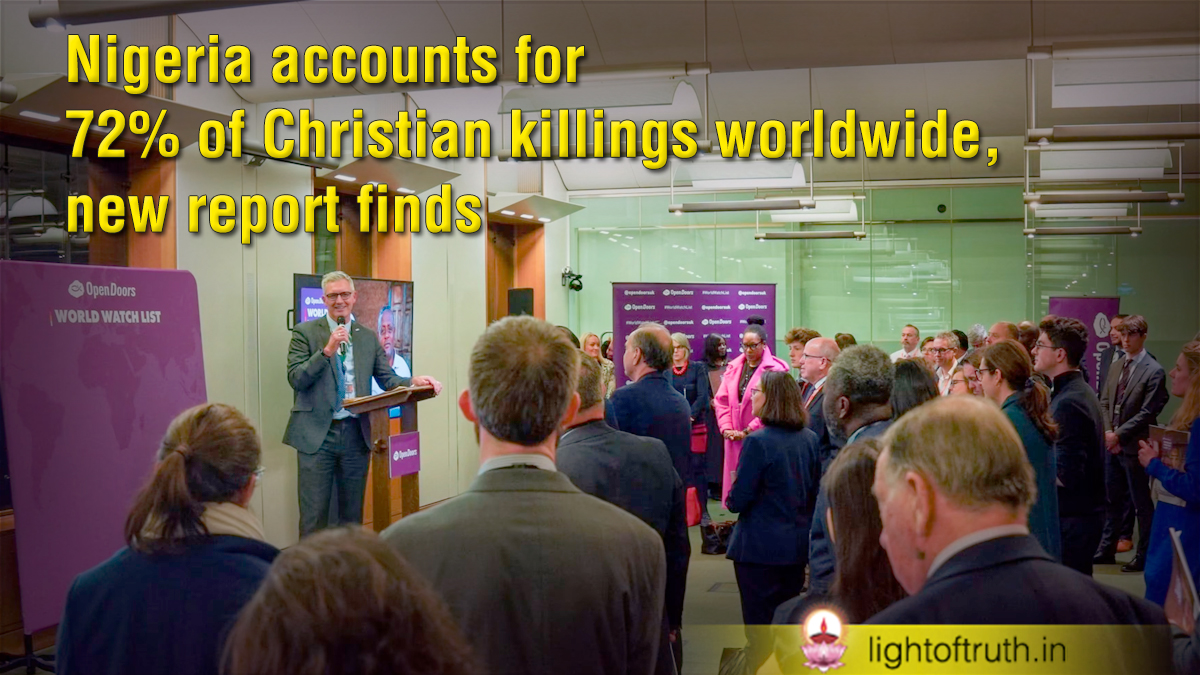
Christian persecution in Nigeria: 1,200 churches destroyed annually, hundreds killed

Violence against Catholic priests in Nigeria continues to increase, especially in the eastern part of the country. According to a report by the NGO International Society for Civil Liberties and Rule of Law (Intersociety), published in August and updated this week, at least 15 priests were kidnapped between January and September alone.

According to the Catholic Bishops’ Conference of Nigeria (CBCN), at least 145 priests have been kidnapped, 11 have been murdered, and four remain missing since 2015. However, Intersociety claims the reality is much worse. According to its counts, at least 250 Catholic clergy have been attacked in addition to another 350 clergy from other denominations.

The phenomenon, according to the report, is due to a combination of attacks by jihadist groups and organized criminal gangs operating for profit. Priests have been victims of both violent ambushes and financial extortion. 

“Many were kidnapped for ransoms reaching tens of millions of nairas [Nigreian currency] or thousands of dollars. In other cases, the attackers sought to seize luxury vehicles belonging to the clerics to sell them to criminal networks,” Intersociety details in the report.

One of the most recent cases is that of Father Wilfred Ezemba, parish priest at St. Paul’s in Agaliga-Efabo (Kogi state) who was kidnapped on Sept. 12 along with other travelers by suspected jihadists and released on Sept. 16. 

Pope Leo XIV to proclaim St. John Henry Newman a doctor of the Church on Nov. 1

Pope Leo XIV announced on 28 September that he will proclaim St. John Henry Newman a doctor of the Church on Nov. 1, the solemnity of All Saints.

“I will confer the title of doctor of the Church on St. John Henry Newman, who gave a decisive contribution to the renewal of theology and to understanding Christian doctrine in its development, in the context of the Jubilee of the World of Education,” the pope said after celebrating Mass for the Jubilee of Catechists in St. Peter’s Square.

With the proclamation, Newman will become the 38th doctor of the Church, joining a select group of saints recognized for their enduring contribution to Catholic theology and spirituality. He is especially noted for his insights on the development of doctrine and the role of conscience.

A 19th-century English theologian, Newman was first a renowned Anglican priest before entering the Catholic Church in 1845 under the guidance of Blessed Dominic Barberi. Ordained a Catholic priest two years later, he founded the Oratory of St. Philip Neri in England and was created a cardinal by Pope Leo XIII in 1879.

Pope Leo: Recognition of Palestine helps, but dialogue is broken

Responding to journalists’ questions on September 23 about the recognition of Palestine as a state, the Holy Father reaffirmed, “The Holy See recognized the two-state solution some time ago. That is clear: we must seek a path that respects all peoples.” Regarding that recognition, he added, “It could help, but right now there is no real willingness to listen on the part of the other side; dialogue is broken.”

Concerning the situation in Gaza, he explained: “Thank God, the parish is fine, although the incursions are getting closer and closer… This afternoon I got in touch with them.”

The journalists also asked him about the Russian incursions: “Someone is seeking an escalation. It’s getting more and more dangerous. I continue to insist on the need to lay down arms, halt military advances, and return to the negotiating table.”

In that context, he emphasized that “If Europe were truly united, I believe it could do a lot.”

When asked whether rearmament is necessary, he replied, “These are political matters, also influenced by external pressure on Europe. I prefer not to comment.” Moreover, the Pope responded to a question about the diplomatic initiatives the Holy See could undertake in the coming months, stating, “We are in constant dialogue with ambassadors. We also try to speak with heads of state when they come, always seeking a solution.”