

Jesus invites us to “liberate the sacred from the bonds of money”, following the example of the widow who is not afraid to give all that she has “because she trusts in God’s plenty,” Pope Francis reminded the faithful at this Sunday’s Angelus in St Peter’s Square.
Commenting on the passage proposed by the liturgy today, the Pope noted that “the Gospel places before us a stark contrast: the rich, who give their surplus to be seen, and a poor woman who, without appearing, offers all the little she has. Two symbols of human behavoir”.
In this way he warns against the sin of “living the faith in duplicity”: Jesus invites us to “beware of hypocrites, that is, to be careful not to base our lives on the cult of appearance, of outward show, on the exaggerated care of our own image and, above all, not to bend the faith to our own interests”.
Those scribes,” said Francis, “used religion to take care of their business, abusing their authority and exploiting the poor. This is the evil of “clericalism, this being above the humble, exploiting them, ‘beating down on them’ them, feeling perfect”.
But,” the Pope added, “it is a warning for all times and for everyone, Church and society: never take advantage of one’s role to crush others, never make money on the skin of the weakest. Let us ask ourselves: in what we say and do, do we wish to be appreciated and gratified, or do we wish to render a service to God and neighbour, especially the weakest?”.
But Jesus also points out the way to heal from this illness, inviting us to look at the poor widow. He denounces “the exploitation of this woman who, in order to make the offering, must return home deprived of even the little she has to live on”. He recalls the importance of “freeing the sacred from bonds with money” which is “a master we must not serve”.
Category Archives: International
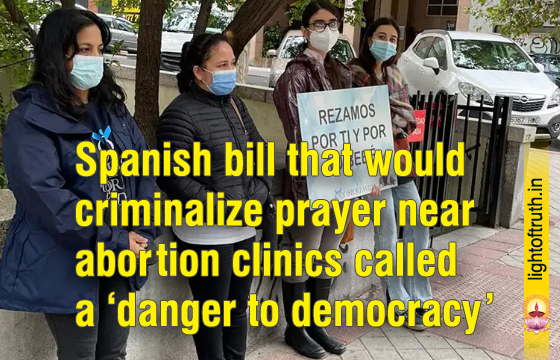
Spanish bill that would criminalize prayer near abortion clinics called a ‘danger to democracy’
An international 40 Days for Life director has said a bill proposed by the ruling Spanish Socialist Workers’ Party that would criminalize “harassment” of women entering abortion clinics is a “threat to democracy.”
Tomislav Cunovic, director of 40 Days for Life for International Affairs, told ACI Prensa, CNA’s Spanish language sister news agency, that “it’s a fundamental right that people can go out on the street, meet and express their opinion.”
“This new law criminalizes pro-life people who gather and pray peacefully in front of abortion clinics. This law interferes with these fundamental rights and freedoms that are guaranteed by the Constitution of Spain and by international conventions, such as the European Convention on Human Rights,” he pointed out.
“The people from 40 Days for Life pray peacefully, they don’t speak to pregnant women, nor to those who work in the clinics. We are outside praying, giving silent witness that each life has its dignity,” he explained, and pointed out that although with this bill “it seems they want to protect pregnant women, no one talks about unborn children, who must also be protected because they have the right to life, they have dignity.”
Many scientists are atheists, but that doesn’t mean they are anti-religious
Distrust of atheists is strong in the United States. The General Social Survey consistently demonstrates that as a group, Americans dislike atheists more than any other religious group. According to various studies, nearly half of the country would disapprove of their child marrying an atheist, some 40% of the public does not believe atheists share their view of American society, and only 60% of Americans would be willing to vote for an atheist in a presidential election.
There is one field, however, where atheism is often assumed: science.
These scientists espouse a frequently derisive rhetoric on religion and the religious public. Dawkins, for example, has argued that religion is a form of “mental illness” and one of the world’s “great evils” comparable to smallpox.
Drawing on quantitative surveys with 1,293 scientists who identified as atheists, 81 in-depth qualitative interviews conducted from 2013 through 2016 and context material collected since then, we found that scientists’ views of religion are much more diverse than the image conveyed by new atheists.
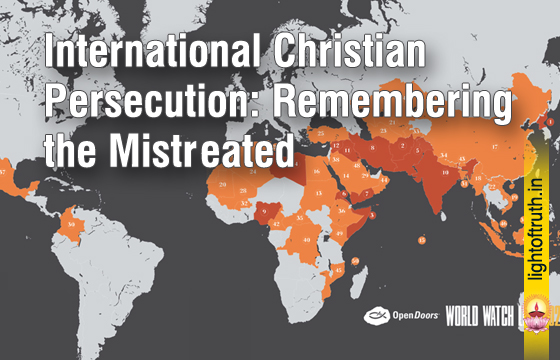
International Christian Persecution: Remembering the Mistreated
Today’s America is facing moral and political divisions that especially challenge our Christian communities. During these times of increasing uncertainty, we need to be aware of dangers that could affect our families and the future our faith.
However, a clear-eyed look beyond our American borders reveals another and even more urgent reality: internationally, Christians are facing immediate, dire, and dangerous circumstances.
“The Guardian,” a politically liberal British publication, published a worrisome statement in a January 2021 article:
“More than 340 million Christians—one in eight—face high levels of persecution and discrimination because of their faith, according to the 2021 World Watch List compiled by the Christian advocacy group Open Doors. It says there was a 60% increase over the previous year in the number of Christians killed for their faith. More than nine out of 10 of the global total of 4,761 deaths were in Africa.”
Of course, very few of those international Christians look like us, speak our language, or worship as we do. We may not immediately relate to them. Meanwhile, hidden in numerous Muslim countries, are millions of new converts to Christianity from Islam. Sadly, according to radical Islamism, their conversion is grounds for execution.
Random dictatorships and abusive regimes mistreat Christians for reasons of insatiable power and control. But today, surging dangers to Christians are due primarily to two specific causes: radical Islam and communism.
For example, consider the country that is listed by Open Doors as the worst persecutor of Christians in the world: North Korea.
North Koreans are required to “worship” the Marxist-Maoist Kim family in a peculiar, quasi-religious system. North Korean Christians—estimated at some 400,000 people—face particularly horrendous persecution. Torture. Starvation. Rape. Slave Labour. Public Execution. All this for simply possessing a Bible or otherwise practicing Christianity.
China is another serious persecutor, and it cooperates with North Korea’s oppression by sending fleeing Christians back across the common border, likely to torture and death. No higher authority–God–is permitted in either country.
Under Xi Jinping, China is increasingly abusive to Christians. Meanwhile, we see what’s happening to China’s millions of Uighur Muslims—either kept or killed in brutal concentration camps or barely surviving incapacitating surveillance, including facial recognition software, DNA identification, phone tracking, and a social credit system. These technologies are also used to track, capture, and abuse Christians and other religious minorities.
And speaking of global menaces to religious minorities, Iran is another danger-zone. Iranian Christians – particularly converts from Islam – are identified as enemies of Iran’s Shiite mullahcracy and as threats to national security. Arrests and behind-the-scenes violence against Christians are rampant.
Yet an underground movement comprised of converts from Islam is growing miraculously, even while severely repressed. These new Christians have zero rights, yet their courage is astonishing.
At the same time, as “The Guardian” reports, African believers are at high risk across that vast continent.
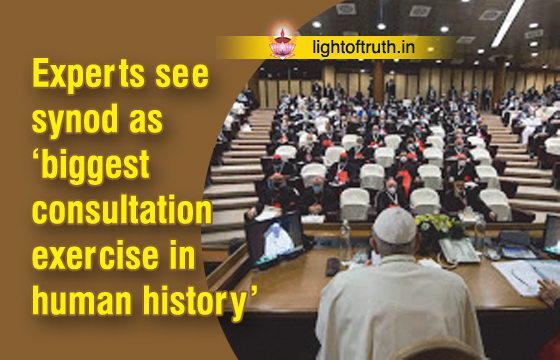
Experts see synod as ‘biggest consultation exercise in human history’
Though probably unbeknownst to most Catholics around the world, on October 9 Pope Francis officially opened a two-year global consultation process, all part of a Synod of Bishops on Synodality, which participants hope will help radically change the way the Catholic Church takes decisions.
“My expectation is that a new way of doing things, which will allow us to see synodality being lived at every level of the Church, is now underway,” Spaniard Carmen Peña Garcia, a synod participant, told Crux.
“The Synod should not be reduced to this moment, these two years, because synodality is a call for co-responsibility and co-participation of the entire people of God in the life and mission of the Church, with baptism being the entry card,” she said.
During the next year, a consultation will be launched at a parish level, with the faithful being invited to join in dialogue sessions. In March, there will be time for a diocesan and national gathering, followed by a continental one, with the process, in principle, concluding in Oct. 2023, with a general assembly of the Synod of Bishops, set to take place in Rome in October.
On Saturday, the people on hand were mostly laity, priests and religious, with some countries not even having Bishops in the Synod Hall. This was so because the Vatican’s Synod office had requested continents to send representatives, not each country individually, among other reasons due to COVID-19 restrictions on travel.
Some participants had to embark on a months-long process to get a greenlight from their governments to fly to Rome, as was the case of lay woman Susan Pascoe from Australia. All of the Bishops from Down Under are currently taking part in a national-level Plenary Council, the first session of which is being held this week, so none came. Upon her return home, Pascoe will have to isolate in a hotel for two weeks.
A member of the Synod’s Commission on Methodology who has worked both for the Australian Church and the Australian government, she told Crux she values “the authenticity of the process. I see hope in this process, and I trust in it. So, I hope other Catholics will answer the invitation issued by the Pope for them to participate.”
An invitation for all the baptized to take part, Peña Garcia said, has been issued, but it not only applies to them, because “the Church wants to be in dialogue with the world too. I think we have to encourage people to take part, so that you don’t only get the voices of the usual suspects, but well, there’s also the matter of free will!”
Putin asking Western civilization ‘to steer clear of our home’
The Western civilization has the right to choose its own values, but at the same time it should not force them on other countries, including Russia, President Vladimir Putin said.
“We are watching with asto-nishment the processes taking place in the countries that used to considering themselves flag-ships of progress. Of course, the sociocultural disturbances that are taking place in the States, in Western Europe are none of our business, we are not getting into that. Some people in Western countries believe that the aggre-ssive deletion of whole pages of their own history, reverse discri-mination against the majority in the interests of minorities or a demand to give up basic things such as mother, father, family or gender differe-nces constitute movement towards public renewal.”
“Adepts of so-called social progress believe they are bring-ing some new, better knowledge to humanity,” he said. “So, God willing. Let them go ahead with it. Only the recipes they are offer-ing are not new at all, we have done all that in Russia,” Putin said.
Vatican issues decree clarifying responsibilities for translation of Latin liturgical texts
The Vatican issued a decree on October 22 guiding bishops’ conferences on the proper protocol for the translation of liturgical texts from Latin into vernacular languages.
Published on Oct. 22, the feast of St. John Paul II, the decree, called Postquam Summus Pontifex, clarifies changes already made by Pope Francis to the process of translating liturgical texts. The decree from the Congregation for Divine Worship builds on a motu proprio Pope Francis issued in September 2017 shifting responsibility for the revision of liturgical texts toward bishops’ conferences.
The motu proprio, Magnum Principium, modified Canon 838 of the Code of Canon Law, which addresses the authority of the Vatican and national bishops’ conferences in preparing liturgical texts in vernacular languages.
“Fundamentally the aim is to make collaboration between the Holy See and the bishops’ conferences easier and more fruitful,” the 71-year-old English archbishop said in an interview with Vatican News. “The great task of translation, especially translating into their own languages what we find in the liturgical books of the Roman Rite, falls to the bishops.”
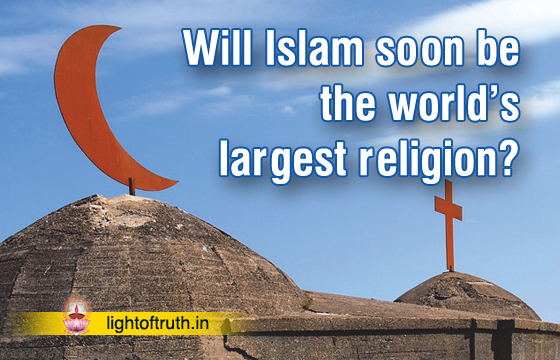
Will Islam soon be the world’s largest religion?
A Pew Research poll predicts that, based on current trends, the number of Muslims worldwide will be nearly equal to the number of Christians by 2050. In conversations, you might hear this statement as proof that Islam is growing and other religions (such as Christianity) are quickly declining. But such a conclusion is misleading and does not take into consideration a number of realities happening throughout the Muslim world.
Research reveals the cultural tendencies in Muslim families, not the attractiveness of Islam itself, explains the demographic surge. The growing number of Muslims is not primarily caused by conversion but is due instead to Muslim families producing more children. The higher rela-tive birth-rate occurs for various social and religious reasons, including the fact that, in most Muslim-dominant societies, women have few opportunities outside the home.
Of course, some converts are choosing Islam—but we should acknowledge recent research demonstrating that conversion works in two directions.
Consider the Muslim popu-lation in the United States. In January 2018, a Pew Research study declared that the number of converts to Islam almost equa-lled the number who abandoned the faith. Thus, there was virtua-lly no net growth at all. This study also found that about 25% of adult Muslims raised in the United States no longer identified as Muslims.

Catholics number 1,344,403,000, 17.74% of the world population
Catholics numbered 1,344,403,000 as of 31 December 2019, up by 15,410,000 over the previous year, while the world popu-lation stood at 7,577,777,000, up by 81,383,000 over the same period, Agenzia Fides reported to mark the 95th World Mission Day, which will be celebrated on 24 October.
The increase touches every continent, except Europe (-292,000). As in the past, the highest increases were reported in Africa (+8,302,000), Americas (+5,373,000), Asia (+1,909,000), and Oceania (+118,000).
The worldwide percentage of Catholics increased compared to the previous year, reaching 17.74 per cent. With respect to the continents, variations are minimal: increases in Africa (+0.14), Asia (+0.02), and the Americas (+0.09); decrease in Europe (-0.05); no change in Oceania.
The number of Bishops dropped by 13 to 5,364. Dio-cesan Bishops gained 12 new members, but religious bisho-ps declined by 25. Diocesan Bishops increased in Africa (+11), Asia (+5), Europe (+4) and Oceania (+2); decreased only in America (-10). Religious Bishops declined on all continents: Africa (-6), America (-7), Asia (-5), Europe (-4) and Oceania (-3). The total number of priests in the world went up, to 414,336 (+271). Europe again reported a major drop (-2,608) as did the Americas (-690) and Oceania (-69). Increases were reported in Africa (+1,649) and Asia (+1,989).
Permanent deacons also increased (+734) to 48,238. The largest gain was in the Americas (+562), followed by Europe (+177), Oceania (+5), Africa (+1), decreasing only in Asia (-11).
Adults from Afghanistan, Iran, prepare to be baptized as Catholics in Vienna
Eleven people from Afghanistan are among the 27 adults who will soon be baptized as Catholics in Austria’s Vienna archdiocese.
Cardinal Christoph Schönborn of Vienna formally welcomed the candidates for adult baptism at a ceremony on Oct. 20 at a Carmelite church in the city’s Döbling district. In addition to the 11 Afghans, there are six Iranians and four Austrians, with the remainder from five other countries.
More than two-thirds of the catechumens are male and between the ages of 20 and 40.
The 76-year-old cardinal told the candi-dates: “Being a Christian imparts a hope that is greater than the problems and crises of this world and also greater than the personal blows of fate that some of you have already experi-enced.”
Afghanistan is the world’s second-worst country in which to be a Christian after North Korea, according to the advocacy group Open Doors, which ranks Iran in eighth place.