
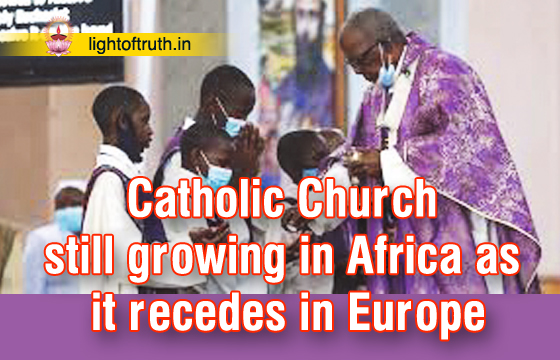
According to recent statistics, Africa added more than 8 million Catholics in 2019, the largest area of growth in the world.
In comparison, America added 5.3 million, Asia added 1.9 million and Oceania 118,000. Europe, on the other hand, saw a decrease of almost 300,000 Catholics.
Kinga von Poschinger, who works at the pontifical charity Aid to the Church in Need, said there are many reasons for the growth of the Church in Africa. “The fact that this growth in faith in Africa has only increased in recent decades can be explained on the one hand by the fact that the Christian faith is only now arriving in many regions – there are still many areas where traditional African religions are practiced – and on the other hand by the fact that evangelization today is no longer aimed at mass baptisms and thus mass conversions, but at a real and true encounter with God that comes from the innermost part of the human being. And it is precisely this true encounter with God that makes people shine and be a light for the world,” she told Crux. “On the African continent, this high level of technology does not exist. More than technology, people there rely on nature and on people in their daily lives. It is primarily nature, that provides them with food – not the supermarket, and it is the human being who takes care of them when they are old, sick or suffering – not a machine. Like everywhere else in the world, people in Africa naturally ask for a “sign of God”, in their lives, for answers to their questions – especially in the face of so much hunger and suffering. But at the same time, they are much more open to seeing such signs in their daily lives. In other words, they engage in spiritual experiences, and see in them a proof of God’s existence. The more people have such genuine spiritual experiences, and the more deeply they are convinced of the existence of God, the more their attitude to life changes. This then not only has an influence on their private lives, but also convinces other people of the existence of God – usually without a lot of words.”
Category Archives: International

Pope: the Beatitudes, proclamation of a new humanity that revolutionizes the world
The Beatitudes “are the prophecy of a new humanity, of a new way of living: to make oneself small and entrust oneself to God, instead of emerging over others; to be meek, instead of trying to impose oneself; to practice mercy, instead of thinking only of oneself; to commit oneself to justice and peace, instead of nourishing, even with connivance, injustice and inequality”.
This Pope Francis- reflection at the Angelus on the day in which the Church marks the liturgical memory of ”All Saints” and in which the liturgy recalls the Beatitudes that “show us the path that leads to the Kingdom of God and to happiness: the path of humility, compassion, meekness, justice and peace”.
The Bishop’s Beatitudes
Blessed is the Bishop who participates in poverty and the sharing of his lifestyle, because by his testimony he is constructing the kingdom of heaven.
Blessed is the Bishop who is not afraid to mark his face with tears until they reflect the sorrows of his people and the difficulties of his priests, finding in embrace with those who suffer the consolation of God.
Blessed is the Bishop who considers his ministry a service and not a power, making meekness his strength, and giving everyone the right of citizenship in his heart to inhabit the land promised to the meek.
Blessed is the Bishop who does not close himself in government buildings, who does not become a bureaucrat more attentive to statistics than to faces, to procedure than to stories, who tries to fight at the side of men for the dream of the justice of God, so that the Lord, met in the silence of daily prayer, will be his nourishment.
Blessed is the Bishop who has a heart for the misery of the world, who is not afraid to get his hands dirty in the mud of the human soul to find the gold of God, who is not scandalized by others’ sin and fragility, because he is aware of his own misery, so that the gaze of the Risen Lord will be for him the seal of infinite pardon.
Blessed is the Bishop who drives away duplicity of the heart, who avoids any ambiguous dynamic, who dreams of good even in the midst of evil, so that he will be able to rejoice in the face of God, finding its reflection in every puddle of the city of men.
Blessed is the Bishop who works for peace, who accompanies the paths of reconciliation, who sows the seed of communion in the heart of the presbytery, who accompanies a divided society on the path of reconciliation, who takes every man and every woman of goodwill by the hand to build fraternity: God will recognize him as his son.
Blessed is the Bishop who is not afraid to go against the tide for the Gospel, making his face “resolute” like that of Christ on his way to Jerusalem, without letting himself be held back by misunderstandings and obstacles because he knows that the Kingdom of God advances in the contradiction of the world.

Escalating Attacks on Poland
Poland’s prime minister is calling on the North Atlantic Treaty Organization (NATO) to help stay the influx of tens of thousands of migrants gathering at Poland’s eastern frontier. Mateusz Morawiecki is also calling on Poland, along with Latvia and Lithuania, to consider invoking Article 4 of the NATO treaty over the deepening crisis on the eastern flank.
Under Article 4 of the NATO treaty, any ally can request consultations “whenever, in the opinion of any of them, their territorial integrity, political independence or security of any of the parties is threatened.”
“It is not enough just for us to publicly express our concern. Now we need concrete steps and the commitment of the entire alliance,” the Polish leader said over the weekend.
Morawiecki pointed out that Poland is protecting the whole EU, not only itself. He added it was clear that the whole bloc should contribute to the funding of an eastern border wall. Morawiecki’s call is triggered by ever-increasing numbers of mostly Middle Eastern and African migrants attempting to gain illegal entry into Poland at various points of its border with Belarus — with the assistance of Belarusian authorities.
Aerial footage provided by the Polish Ministry of Defense shows outnumbered Polish troops at junctures defending the border and illegal immigrants heading from Belarus towards the border accompanied by Belarusian officers. TV crews, including Russian ones, are in tow.
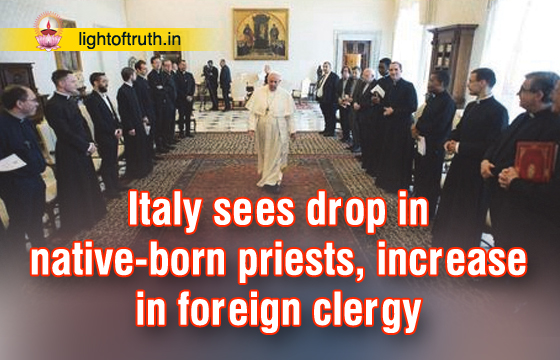
Italy sees drop in native-born priests, increase in foreign clergy
New data released by the Italian church highlights what has been a concerning trend among Catholic leaders in the country for decades: namely, a drop in the number of local priests and an increase in the average age of Italy’s clerics.
However, this data also found that while there are less men joining the priesthood in Italy, the decrease in local vocations has to an extent been offset by a significant increase in foreign priests serving in Italian dioceses.
According to data provided by the Italian bishops’ National Office for the Pastoral Care of Vocations, there has been a 16.5 percent drop in the number of priests in Italy since 1990, with 10%of this drop taking place in just the past decade.
As of 1990, there were a total of 38,209 priests in Italy, which decreased to 36,350 in 2000, and dropped again to 31,793 last year.
Of these 31,793 priests, around 8.3% are foreigners, which is a jump from 6.6% in 2000, and from just 3.4% in 1990.
Last year’s data indicates that the number of foreign priests serving in Italy has increased more than 10x in the past 30 years, jumping from just 204 in 1990, to 2,631 in 2020.
Priests aged under 30 are decreasing, with just 599 recorded in Italy in last year, marking a 60 percent drop since 2000, when there were some 1,708 priests under 30.
Why Bad Things Happen to People, According to 6,500 Americans
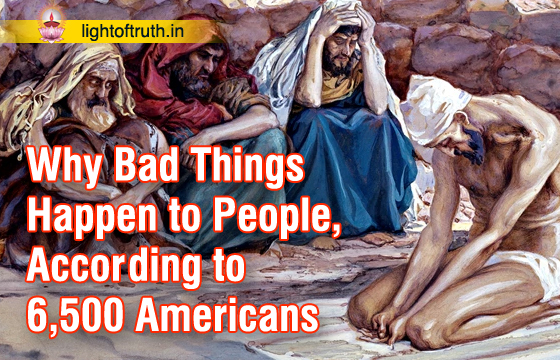
“Job and His Three Friends,” by 19th-century French painter Jacques Joseph (James) Tissot.
Long before Rabbi Harold Kushner’s When Bad Things Happen to Good People got Americans talking about theodicy in the 1980s, these famous thinkers wrestled with explaining why an all-loving, all-knowing, and all-powerful God would allow suffering.
Amid the pandemic and its 5.2 million reported deaths, the Pew Research Centre surveyed 6,485 American adults—including 1,421 evangelicals—in September 2021 about how they philosophically “make sense of suffering and bad things happening to people.” The most common explanation: It happens.
“Americans largely blame random chance—along with people’s own actions and the way society is structured—for human suffering, while relatively few believers blame God or voice doubts about the existence of God for this reason,” concluded Pew researchers in a new study released today.
Yet many Americans do see purpose in pain, as researchers noted: The vast majority of U.S. adults ascribe suffering at least partly to random chance, saying that the phrase “sometimes bad things just happen” describes their views either very well (44%) or somewhat well (42%). Yet it is also quite common for Americans to feel that suffering does not happen in vain. More than half of U.S. adults (61%) think that suffering exists “to provide an opportunity for people to come out stronger.” And, in a separate set of questions about various religious or spiritual beliefs, two-thirds of Americans (68%) say that “everything in life happens for a reason.”
Pope Francis to UNESCO: ‘The Gospel is the most humanizing message known to history’
Pope Francis said on November 12 that “the Gospel is the most humanizing message known to history.”
He made the remark in a video message marking the 75th anniversary of UNESCO, the United Nations’ educational, scientific and cultural organization.
“From my heart, I express my congra-tulations on the 75th anniversary of this United Nations agency. The Church has a privileged relationship with it,” the Pope said in the message released on Nov. 12.
“Indeed, the Church is at the service of the Gospel, and the Gospel is the most humanizing message known to history. A message of life, freedom, and hope, which has inspired countless educational initiatives in every age and in every place, and has inspired the scientific and cultural growth of the human family.”
“This is why [UNESCO] is a privileged partner of the Holy See in the common service to peace and solidarity among peoples, to the integral development of the human person and to the protection of the cultural heritage of humanity.”
The video message was played during a live-streamed 75th anniversary celebration attended by Ghana’s President Nana Akufo-Addo and artists including the actor and director Forest Whitaker and singer-songwriter Angélique Kidjo.
UNESCO, based in Paris, France, was founded on Nov. 16, 1945, in the immediate aftermath of the Second World War. Today, it has 193 member states and 11 associate members. The Holy See has permanent observer status. The first permanent observer of the Holy See to UNESCO was Angelo Roncalli, the then apostolic nuncio to France, who was elected Pope John XXIII in 1958 and canonized in 2013.
‘Our Church is a place of serious crimes,’ France’s leading prelate says, as bishops adopt reforms
In his closing address at the French bishops’ meeting in Lourdes, Archbishop Eric de Moulins-Beaufort, the president of the episcopal conference, said that “our Church is a place of serious crimes, of frightening attacks on the lives and integrity of children and adults.”
“We must recognize and confess it: we have allowed an ecclesial system to develop which—far from bearing life and opening up to spiritual liberty—damages, crushes, tramples on human beings and their most basic rights,” he added.
The bishops met a month after the publication of a report that found that more than 200,000 children were abused by Catholic clerics over the past 70 years, and another 100,000 by lay church workers. The bishops adopted a number of resolutions to address the abuse crisis, including
• the establishment of an independent authority for financial reparations to abuse victims, led by Marie Derain, former president of the National Council for Child Protection.
• a request to Pope Francis to send a team of visitors to evaluate their efforts
• a pledge to sell diocesan properties to compensate victims
• an external audit of current efforts to address abuse
• criminal background checks on all who work with minors
• the participation of at least one woman in the administration of every seminary.
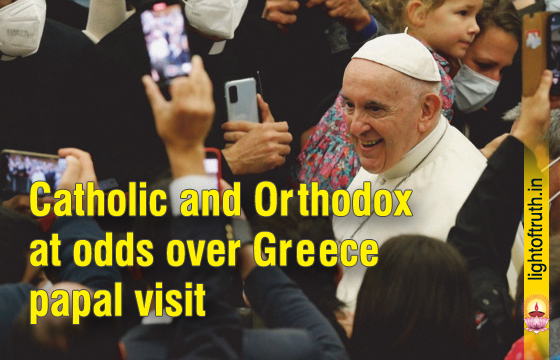
Catholic and Orthodox at odds over Greece papal visit
Catholic Church leaders in Cyprus and Greece have welcomed surprise plans for an early December visit by the Pope, as a chance to foster dialogue and improve links with the wider Catholic world. However, several Orthodox dignitaries have protested over the move, warning it would fuel scandal and division.
“The Pope’s visit to Greece will be above all a summons to faith, a call for openness to God and neighbour,” said Archbishop Theodoros Kontidis of Athens. “This country’s Catholics are made up of many different groups, Poles, Albanians, Filipinos and Africans, as well as native Greeks. They need the visit to strengthen their own unity and their links with the universal Church, and there will be a good atmosphere for it.”
The five-day pilgrimage, confirmed by Rome last weekend, will be the first by Francis since his April 2016 visit to Middle East refugees on Lesbos, and the first by a Pope to Cyprus since a stopover by Benedict XVI in June 2010. Pope John Paul II also paid a historic visit to Athens in May 2001, the first by a Roman pontiff since the thirteenth century.
However, several leaders of Greece’s predominant Orthodox church have protested plans for the visit, including the arch-con-servative Metropolitan Serafim of Pireus, who warned Greeks on Sunday the “immoral visit” risked “contamination by heretical evildoers, unrepentant in our sacred lands.”
Leaked letter reveals Old Rite to be gradually phased out
Archbishop Arthur Roche, the leader of the Holy See’s divine worship office, has spelt out the Vatican’s position on the Old Rite. The liturgical celebrations which took place before the Second Vatican Council, he says, were legally abolished – “abrogated” – by Pope Paul VI. Although pre-Vatican II liturgies can continue as an “exceptional concession”, the reformed version is the norm. In other words, a new currency was adopted even though it’s still permissible to use old money.
The British archbishop’s remarks, revealed in a leaked letter sent to Cardinal Vincent Nichols, the Archbishop of Westminster and President of the Bishops’ Conference of England and Wales, are significant. It is often claimed by traditionalists that St Paul VI did not legally abolish the Old Rite and when he lifted restrictions on the pre-Vatican II Mass in 2007 Benedict XVI said that it was “never abrogated, as an extraordinary form of the Church’s Liturgy.”
All of this reflects the dominant line of thinking from the Holy See: the Old Rite is to be gradually phased out, although pastoral care has to be offered to those attached to these liturgies.
During Benedict’s papacy, an attempt had been made to allow the old and new liturgies to exist side-by-side. That experiment has been ended by Francis, whose approach is closer to that of Paul VI who only envisaged the Old Rite for sick and aged priests.

The Covid Mass effect – dropped by 14%
The number of Catholics who say they go to Mass in US every week has dropped by 14% since the COVID-19 pandemic, according to The Pillar’s new Survey on Reli-gious Attitudes and Practices.
That decline could explain a proportional decline in parish collections: In March, The Pillar found parishes experi-enced a 12% average decrease in collections during 2020 as compared to 2019, as a result of the COVID-19 pandemic and the shutdown orders implemented in many localities. New information about Mass attendance is available from The Pillar’s Survey on Religious Attitudes and Practices, which aims to better understand the religious perspecti-ves, identities, and perspectives of American adults. We’re reporting the results of that survey this week in a series of special reports.
In part one of this series, The Pillar looked at America’s changing religious landscape. In part two, we look at what factors influence lifelong Catholic religious practice, and why people say they leave the Church. In part three, we took a look at what can be learned about religiously dis-affiliated Americans.
In this installment, we look at the COVID-19 pandemic has begun reshaping parish life. If you’re interested in the technical details of our survey work, here they are: The Pillar worked with research firm Centiment to conduct the survey, which was conducted online with 2653 members of Centiment’s nationally repre-sentative research panel. This included a nationally repre-sentative sample of 1564 Americans and an oversample of 1089 additional respondents who had been raised Catholic, which we used in order to better understand those raised Catholic who still identify as Catholic, and those who now call themselves members of other faiths or of no faith at all. We’ll publish our full-data set later this week.