

God is bigger than a church building. He reveals himself to us in myriad ways: through the Bible savoured in silence or thundered in a sermon, through prayerful solitude or bread broken with others. He reveals himself in the contours of nature and whispers of wind. We do not rely on church buildings for divine encounter.
And yet churches can reveal God to us. If we pay attention.
As an architect, I am learning how to read buildings. In the same way musicians must be musically literate, architects must be architecturally literate. A musician must be constantly exposed to a range of composi-tions to develop musical literacy; an architect must engage all kinds of buildings to be able to read them. This isn’t simply a matter of naming specific styles or not-ing unique details. It’s learning to understand what statements or narratives are embedded within the design of a building.
So, I study churches. Church, of course, is a weekly rhythm of small group, choir practice, Bible study, Sunday school, and an inevitable potluck. Church is community and fellowship and belonging. More broadly, there is “one holy, catholic and apo-stolic church” that spans time and culture. But there are also these buildings that often hide in plain sight.
Embedded in every church is a theology that reminds us of our relationship to God through Chri-st. If we can learn to read the buildings architecturally, through their elevation, plan, and section, we can grasp what the structures are communicating about God.
Category Archives: International

Bahrain inaugurates Cathedral of Mary Queen of Arabia
The small Catholic commu-nity of the Emirate of Bahrain is preparing to celebrate the solemn opening of the largest Catholic Church in the Arabic Peninsula dedicated to their Patron Saint. The Cathedral of Mary Queen of Arabia will be inaugurated on December 9 – significantly, one day after the Solemnity of the Immaculate Conception – by King Hamad bin Isa Al Khalifa. It will be subsequently consecrated on December 10 by Cardinal Louis Tagle, Prefect of the Vati-can Congregation for the Evangelizations of Peoples. The consecration will be attended only by a small group of faithful, due to the COVID-19 pandemic.
The cathedral, seating 2,300 people, is located in Awali, a small town in the centre of Bahrain. The project dates back to February 2013 when King Hamad donated a 9,000 square-meter piece of land to the local Catholic community so it could build a church. The project was enthusiastically supported the then Apostolic Vicar of Northern Arabia, late Bishop Camillo Ballin, MCCI.
The new church is the second cathedral built in the Apostolic Vicariate (which includes Bahrain, Kuwait and, formally, Saudi Arabia).

France’s interior minister condemns threats against Catholics during procession
France’s interior minister on Saturday condemned threats made against Catholics taking part in a Marian procession in the western suburbs of Paris.
Gérald Darmanin deplored what he said were “unacceptable acts” during a torchlight procession in Nanterre on Dec. 8, the solemnity of the Immaculate Conception.
“Freedom of worship must be able to be exercised in all serenity in our country,” he wrote on his Twitter account on Dec. 11, expressing “support for Catholics in France.”
The French daily Le Figaro reported that on Wednesday evening around 30 Catholics were due to depart from the chapel of Saint-Joseph-des-Fontenelles on an annual procession to the parish of Sainte-Marie-des-Fontenelles, around half a mile away, along a route approved by the local autho-rities.
Jean-Marc Sertillange, a permanent deacon at Sainte-Marie-des-Fontenelles, told Le Figaro: “But shortly after 7 p.m., and while we had advanced only a few hundred meters, a band of unknown people on the path verbally attacked us at the time of the first prayer station.”
The newspaper reported that the threats included cries of “Kafirs,” an Arabic term meaning “infidels,” and “Wallah [I swear] on the Quran I will cut your throat.”
“They then threw water on us, then grabbed one of the torches which they then threw in our direction,” Sertillange said.
When the police arrived, the group of around a dozen people, with three reported ringleaders, ran away. The procession resumed, heading directly to the parish without making further stops.
Nanterre, a commune of around 97,000 people, is located in the Hauts-de-Seine department in northern France.

Pope: New meeting with Russian Orthodox patriarch possible
Pope Francis said on December 6 there were plans for a possible second meeting with the head of the Russian Orthodox Church, after their historic 2016 encounter in Cuba became a landmark in mending relations severed by the 1,000-year-old schism that divided Christianity.
Francis said he planned to meet next week with the Russian church’s foreign envoy “to agree on a possible meeting” with Patriarch Kirill. The Pontiff noted that Kirill is due to travel in the coming weeks, but Francis said he was also “ready to go to Moscow” even if diplomatic protocols weren’t yet in place.
“Because talking with a brother, there are no protocols,” Francis told reporters as he travelled home from Greece. “We are brothers. We say things to each other’s face like brothers.”
The two churches split during the Great Schism of 1054 and have remained estranged over a host of issues, including the primacy of the pope and Russian Orthodox accusations that the Catholic Church is poaching converts in former Soviet lands.

Catholic Priests Survey Finds Lower Morale, ‘Conservative Shift’ Among U.S. Clergy
A new survey released this month suggests a more “pessimistic” view of the Catholic Church among U.S. priests today as compared to 2002, as well as an increasing perception of “more theologically conser-vative or orthodox” young priests as compared to their older counterparts.
A Nov. 1 report summarized findings from the 2021 Survey of American Catholic Priests (SACP), which comprised 54 questions posed to 1,036 Catholic priests in the United States.
“If the major story of the SACP had to be summarized briefly it would be noticeable conservative shifts among U.S. priests over the last two decades coupled with a turn toward pessimism about the current state and trajectory of the Catholic Church in America,” write the report’s three resear-chers.
When asked about politics, the priests surveyed were significantly more likely to describe themselves as “conservative” as compared to respondents in 2002, the researchers say. In addition, the percentage of priest respondents overall who view younger priests as “much more conservative” than older priests increased from 29% in 2002 to 44% in the new survey.
To track changes in answers over time, the survey reused questions from a 2002 poll of Catholic priests conducted by the Los Angeles Times, and also a few questions from a survey of priests from 1970.
The priests were contacted in late 2020 via two unconnected email lists, one provided by the Official Catholic Directory and one provided by an unidentified “Catholic NGO.” Despite the small sample size, the authors say the results they garnered from the two email lists are “reassuringly similar,” both to each other, and to the 2002 results.
The researchers analyzed the data they collected, classifying each priest by his self-described political persuasion. They also classified the priests into “cohorts” based on their ordination year.
Brad Vermurlen, the survey’s co-author and a sociologist with the University of Texas at Austin, wrote in an article announcing the study that researchers observed a “relatively conservative cohort of priests ordained prior to 1960” followed by “more permissive or liberal men ordained to the priesthood in the 1960s and 70s.”
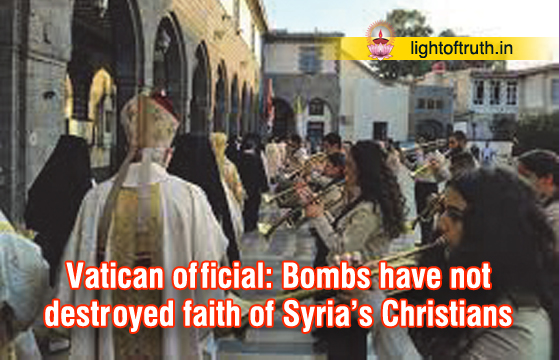
Vatican official: Bombs have not destroyed faith of Syria’s Christians
While much of the world has forgotten about the war in Syria and the extreme poverty plaguing most of its people, Pope Francis has not forgotten the Syrian people and the Christians there who continue to witness to the faith, said Cardinal Leonardo Sandri, prefect of the Congregation for Eastern Churches.
At the end of a meeting with the country’s bishops in Damascus Oct. 26, the cardinal announced that Pope Francis had sent $10,000 for each of the nation’s bishops to use to meet the greatest needs in his diocese or eparchy, according to information released at the Vatican. “The strings of the harps have for too long played the song of pain and mourning, especially for the dead, the kidnapped, the prisoners, for the children and young people who grew up under the bombs and were deprived of the affection of parents and of normal education,” the cardinal told the bishops.
“Now the lament can be heard that there is no bread, with a shocking percentage of the population forced to live below the poverty line,” he said. The U.N. World Food Program has estimated that 60 percent of the country’s population is “food insecure,” reflecting a record level of poverty after 10 years of civil war.
“The air, which was made unbreathable by the bombs and chemical agents, now may be polluted by the indifference that seems to have fallen over the drama of Syria, including in the media,” he said. “However, you know how Pope Francis, from the beginning of his papacy, has kept his gaze on all of you, inviting people to fast and to pray, calling for the end of the fighting, the reestablishment of justice and respect for law.”

How Archaeologists Are Finding the Signatures of Bible Kings, Ancient Villains, and Maybe a Prophet
The closest I’ve ever felt to the prophet Jeremiah was sitting at the bottom of an empty cistern. About 20 years ago, I was taken to an excavated water reservoir in Jerusalem and told this could be the actual hole in Jeremiah 38:6 where the prophet was left to starve when four government officials decided they didn’t like his messages from God.
I sat on a bench and looked up at the stone walls. Jeremiah sank into the mud, according to the biblical account.
But maybe it wasn’t at that spot. Who’s to say it was this cistern, which was dug up in 1998, and not another one that has yet to be found? Or perhaps it will never be found. I could imagine the prophet trapped in that exact place, wondering if God would rescue him, but short of finding “Jeremiah” scratched on the wall, no one could say for sure. In the time since I was there, questions have been raised about that cistern, casting doubt on its role in the Jeremiah drama. It’s not a place people visit these days. Archaeology can take you so close to the biblical world and still leave you wishing someone had left a signature.
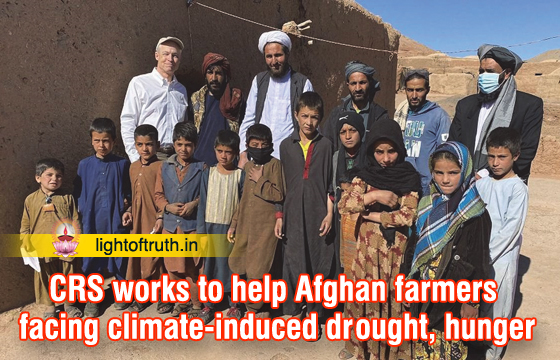
CRS works to help Afghan farmers facing climate-induced drought, hunger
Overshadowed by the politi-cal and military turmoil engulfing Afghanistan with the Taliban takeover in August, climate change – particularly drought – is relentlessly striking this Central Asian nation with dire consequences, warns a Catholic aid agency official. “CRS has been working on a response to this climate-induced drought over the past two years. But the rest of the world is only waking up to the fact that we have the worst climate – induced drought in the world right now – the worst in living memory in Afghanistan,” said Kevin Hartigan, the Middle East regional director of Catholic Relief Services.
“It was not apparent to people because there was so much focus on the political and military crisis. Now that has calmed, you are seeing the United Nations and the rest of world waking up to this enormous climate phenomenon, drought and hunger,” Hartigan told Catholic News Service by Zoom from Herat, Afghanistan. The lack of rain has compounded Afghanistan’s problems.
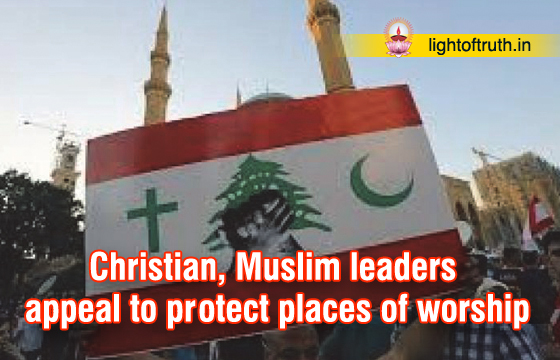
Christian, Muslim leaders appeal to protect places of worship
Spearheaded by Jordan’s Prince El Hassan Bin Talal, a group of Arab and international scholars, thinkers and religious figures – Muslim and Christian – have launched a global appeal to protect worshippers and places of worship. “In the face of what we see as the continuation of repeated attacks on places of worship and on the souls of safe worshipers in several places in this world, and based on a common human and moral responsibility, we call upon a group of religious leaders, scholars and thinkers … to urge all people to reject all forms of extremism, hatred and painful practices against the spirit of faith and human dignity,” the more than 40 signatories said in their Nov. 2 appeal.

Saying grace: How a moment of thanks, religious or not, adds meaning to our meals
Brett Levanto and his family had never said grace before meals, not regularly, anyway. But what began as a temporary challenge transformed them in small ways.
This year, his daughter decided to start saying grace before dinner during Lent, and he and his wife were encouraging, thinking it would be a nice thing to try out. He was surprised at the effects it had.
“It’s just been lovely. I really dig the way it creates a structure,” says Levanto, 38, who lives in Alexandria, Va., and works for a small lobbying and law firm. “Everyone has to get to the table and be together and not be distracted. We focus on where we are.”
The family sits, holds hands, and takes turns saying a free-form grace. They might say what they’re thankful for, or speak about a sick friend who is in their thoughts. The parents aren’t prescriptive about what a proper grace is supposed to sound like, he says. “If my son’s heart is telling him to thank God for mac and cheese, well, thank God for mac and cheese!”
They all say “amen,” and then dinner is off and running. Although the grace might take less than a minute, it sets a crucial tone. “It creates a grounding feeling — a moment of stillness,” he says. “I feel like our dinners at home are much better now — like, ‘Now we are together, and this is what we’re doing.’ I mean, I’m not going to say we have Rockwellian dinners or any-thing.”