
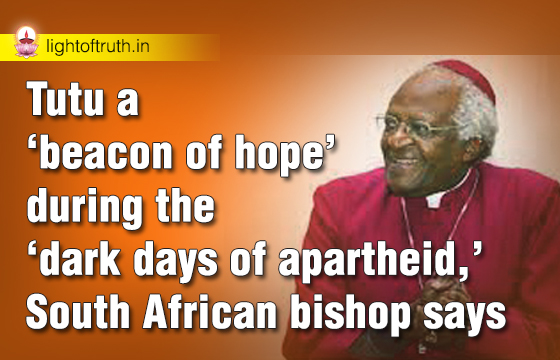
Archbishop Desmond Tutu was “a beacon of hope during the bleak days of apartheid,” according to Bishop Victor Phalana of Klerksdorp and the liaison Bishop for justice and peace at the Southern African Catholic Bishops’ Conference.
The Anglican prelate died on Sunday at the age of 90. A representative of the Archbishop Desmond Tutu IP Trust said he died “peacefully” at a Cape Town nursing home.
“He spoke truth to power and criticized both the apartheid government and the ANC-led government when they started to tolerate corruption and when they took time to deal with the problem of poverty in our country,” Phalana told Crux.
Category Archives: International
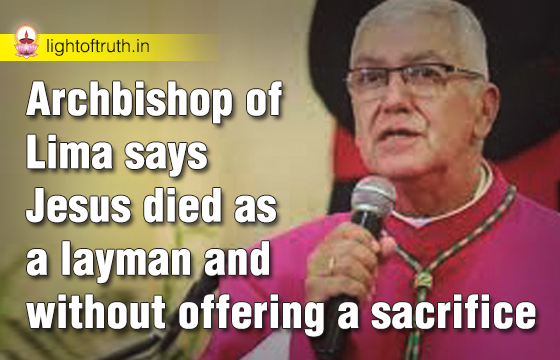
Archbishop of Lima says Jesus died as a layman and without offering a sacrifice
Archbishop Carlos Castillo Mattasoglio of Lima, Peru, has yet to clarify remarks he made in a pre-Christmas Mass that contradict the teaching of the Catholic Church about Jesus’ death. The Catechism of the Catholic Church affirms that Jesus is “the true priest” whose death is “a redemptive sacrifice.” Speaking on Dec. 19, however, Castillo stated that Jesus died as “a layman,” and did so without offering a “sacrifice.”
“And Jesus doesn’t die offering the sacrifice of a holocaust, Jesus dies as a murdered layman, to which He decides not to respond with vengeance and who accepts the cross to give us a sign of life,” the archbishop said during Mass in the Lima cathedral.
“And he dies as a layman who gives hope to humanity, he dies as a human being like all of you who are present here, we too, because we can’t be priests without first being baptized lay people,” he said.
Castillo said that “lay person comes from laos, which means people. And God wanted to sanctify his people, and if we are here, it is to serve them.”
The prelate recalled that God had promised Israel that from his people “a shoot would come forth that would be the Saviour.”
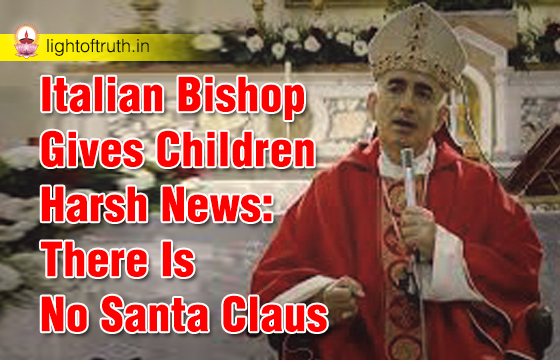
Italian Bishop Gives Children Harsh News: There Is No Santa Claus
All that separated the giddy Sicilian school children from meeting Old Saint Nick — arriving on horseback with his long white beard, crimson robe and bag full of gifts — was a Christmas message from the bishop of Noto.
“Santa Claus,” thundered Bishop Antonio Staglianò, “is an imaginary character.”
Children’s jaws dropped and the holiday wool fell from their eyes as, for many long minutes in the Santissimo Salvatore Basilica, the Bishop continued to stick it to Santa, who he said had no interest in families strapped for cash.
“The red colour of his coat was chosen by Coca-Cola for advertising purposes,” the bishop said. Big soda, he added, “uses the image to depict itself as an emblem of healthy values.”
The bishop’s broadside against Babbo Natale, as Father Christmas is called here, constituted only the latest instalment in what has become a new Italian holiday tradition. Just about every year, Roman Catholic clerics insist that for Italians to keep Christ in Christmas, Santa must be kept out of it.
“Is Father Christmas every-one’s father, or just some” he said, poking holes in the case for Santa Claus. “In the lockdown, Father Christmas didn’t visit the families that he used to. Why? It’s definitely not for fear of the coronavirus.”
The bishop recalled warmly the days when Italian children would address their wish lists to the Baby Jesus, “Not Santa Claus and the reindeer and let’s go to the movies and go bowling and all this American junk.”
This year, nationalists opened a new front in Italy’s fight over the shape of Christmas. Des-perate for an issue with popular appeal in a period of political stability, they have picked up on the American right’s claim to be opposing a war on Christmas.
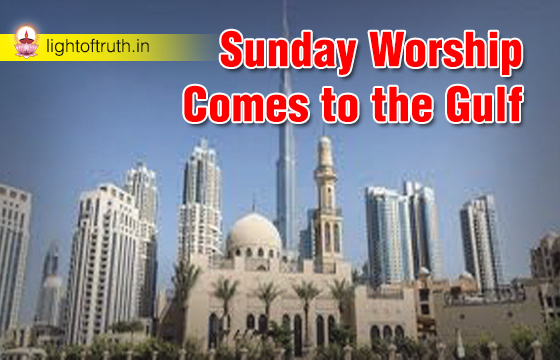
Sunday Worship Comes to the Gulf
The United Arab Emirates (UAE) wants to create a more friendly financial climate. Christians, say local evange-lical leaders, are among the unintended beneficiaries.
“The business of Dubai is business, even though they are committed Muslims,” said Jim Burgess, evangelical representative to the Gulf Churches Fellowship, referencing the UAE’s economic hub. “But worshiping on Sunday—our traditional day to celebrate the resurrection of Jesus—will be a great blessing.”
Seeking better alignment with international markets, the Emirates is adopting a Monday to Friday workweek. The weekend had previously begun with Friday, in deference to Muslim communal prayers. Christians aligned their cor-porate worship accordingly.
“It is a bit strange to worship on a Friday, but you get used to it,” said Hrayr Jebejian, general secretary of the Bible Society of the Gulf, who lives in Kuwait. “The [UAE’s] reasons are purely financial, but for Christians it will be like going back to normal.”
Of the UAE’s 10 million people, 88 percent are migrant workers. The Pew Research Center estimates 13 percent are Christians, coming largely from India, Indonesia, and the Philippines, in addition to Western expats.
It is necessary to keep and attract good talent.
Alongside officially secular Lebanon and Turkey, the UAE is now the third Middle Eastern nation to keep the Western calendar. But it comes with a tweak. All public sector employees will be dismissed at midday Friday, as the Emirates becomes the only nation in the world with a four-and-a-half-day workweek.
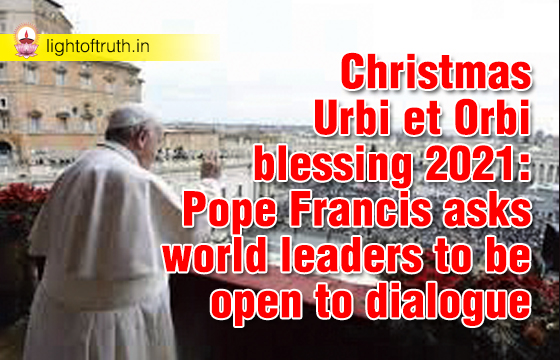
Christmas Urbi et Orbi blessing 2021: Pope Francis asks world leaders to be open to dialogue
Giving his traditional Christmas “Urbi et Orbi” blessing on Saturday 25th Decemebr, Pope Francis urged leaders to be open to dialogue to resolve the world’s many “con-flicts, crises, and disagreements.”
Speaking from the central balcony overlooking a rainy St. Peter’s Square on Dec. 25, the Pope said that people had become so accustomed to disputes that “by now we hardly even notice them.” Referring to the baby Jesus, he said: “In the cold of the night, he stretches out his tiny arms towards us: he is in need of everything, yet he comes to give us everything. Let us ask him for the strength to be open to dialogue.”
“On this festive day, let us implore him to stir up in the hearts of everyone a yearning for reconciliation and fraternity.”
Last Christmas, the coronavirus pandemic forced the Pope to break with custom and deliver his blessing “To the City and the World” inside the Vatican’s Hall of Bene-diction. But this year, he returned to the Loggia of the Blessings, with its view of the windswept square embraced by the arms of Bernini’s colonnade. The live-streamed ceremony began with musical accompani-ment by Italy’s Carabinieri Band.
The Pope, who celebrated his 85th birthday, offered Midnight Mass in St. Peter’s Basilica on Friday night.
The Pope began his “Urbi et Orbi” address with a reflection on the Christ Child. “The Word became flesh in order to dialogue with us. God does not desire to carry on a monologue, but a dialogue. For God himself, Father, Son, and Holy Spirit, is dialogue, an eternal and infinite communion of love and life,” he said. “By the coming of Jesus, the Person of the Word made flesh, into our world, God showed us the way of encounter and dialogue. Indeed, he made that way incarnate in himself, so that we might know it and follow it, in trust and hope.” Pope Francis noted that the pandemic had strained social relationships, isolating people from each other. “On the international level too, there is the risk of avoiding dialogue, the risk that this complex crisis will lead to taking shortcuts rather than setting out on the longer paths of dialogue,” he commented. “Yet only those paths can lead to the resolution of conflicts and to lasting benefits for all.”

EU draft pulled after Vatican complains Christmas ‘cancelled’
Vatican Secretary of State Cardinal Pietro Parolin smiles as he is welcomed by German President Frank-Walter Stein-meier for a meeting at the Belle-vue palace in Berlin, Germany on June 29, 2021. The European Commission on Tuesday Nov. 30, 2021, retracted internal communication guidelines that had proposed substituting the “Christmas period” with “holiday period” after an outcry by conservatives and the Vatican, which termed the document an attempt to “cancel” Europe’s Christian roots. Even the Vatican secretary of state, Cardinal Pietro Parolin, intervened with an unusually sharp critique.
The European Commission on Tuesday retracted internal communication guidelines that had proposed substituting the “Christmas period” with “holi-day period” after an outcry by conservatives and the Vatican, which termed the document an attempt to “cancel” Europe’s Christian roots.
The European Commissioner for Equality, Helena Dalli, said the draft document had been intended to highlight European diversity and showcase the “inclusive nature of the European Commission.” But in a statement, she said it didn’t meet Commi-ssion standards and failed to achieve its stated purpose.
“The guidelines clearly need more work,” she said, adding that a revised document would take into account concerns that had been raised.

Two German bishops question church’s teaching on LGBT relationships
Two Catholic bishops in Germany, Franz-Josef Over-beck of Essen and Heinrich Timmerevers of Dresden, have called for major changes in the church’s teachings on sexual morality as part of contributions to a new book called Catholic and Queer.
Homosexual partnerships, transgender issues and diversity must be re-evaluated on the basis of new understandings of sexuality, Timmerevers wrote in the book, published this week.
For centuries, the church “misjudged people and left them alone with their situation and sensitivities and de facto put them on the side-lines,” the bishop said. “Here we have committed injustice and have also become guilty.”
In his essay, Overbeck said he rejects “the adherence to a sexual morality which, for example, wants to practically deny people who love someone of the same sex the possibility of a successful and fulfilling rela-tionship.” Bishop Franz-Josef Overbeck of Essen, Germany, is pictured in a Sept. 2, 2019.
He continued: “The life experiences and deep feelings of those who are homosexual or transgender have touched me very deeply.” Church teaching must integrate these concrete testimonies of life, Overbeck wrote.
Overbeck wrote that Pope Francis has made clear that same-sex partnerships deserve legal protection. In doing so, Overbeck said, the pope had expressed “a new form of appreciation that can be the starting point for a (local church) re-evaluation of homosexuality.”

ABp Aupetit at Paris farewell Mass: ‘I lost my life for the love of Christ’
At a farewell Mass in Paris on December 10 , Archbishop Michel Aupetit directly addressed media reports claiming that he had “lost himself for love.”
Preaching at a Mass of thanksgiving at the Church of Saint-Sulpice in the French capital on Dec. 10, the archbishop referred to a headline published by the magazine Paris Match.
“A journalist wrote ‘the archbishop of Paris lost himself for love,’” he said. “It’s true, it’s true. But she forgot the end of the sentence. The complete sentence is ‘the archbishop of Paris lost himself for love of Christ.’”
Aupetit’s words were applauded by the congregation of around 2,000 people gathered in the city’s second-largest church after Notre-Dame Cathedral.
The 70-year-old archbishop, who had a late vocation to the priesthood after working as a doctor, said: “Yesterday, I lost my life for the love of Christ when I entered the seminary. Today, I lost my life for the love of Christ. Tomorrow, I will again lose my life for the love of Christ. For I remember those words of the Lord, ‘whoever loses his life for my sake will save it.’”
Aupetit served as archbishop of Paris from his installation on Jan. 6, 2018, to December 2, when Pope Francis accepted his resignation.
He asked the Pope to decide his future after the French weekly magazine Le Point published a report portraying the archbishop as a divisive and authoritarian figure.
The report raised concerns about Aupetit’s contacts with a woman dating back to 2012, when he was vicar general of the Archdiocese of Paris. Aupetit told Le Point that he was not in a relationship with the woman.
He said: “My behaviour towards her may have been ambiguous, thus suggesting the existence between us of an intimate relationship and sexual relations, which I strongly refute … I decided not to see her again and I informed her.” Lust is not the worst of the seven deadly sins, according to Pope Francis.
“I accepted the resignation of Aupetit not on the altar of truth, but on the altar of hypocrisy.” “It was a failing against the sixth commandment (You shall not commit adultery) but not a total one, one of small caresses, massage given to his secretary — that is what the accusation is,” Francis clarified about Aupetit’s actions. “There is a sin there but not the worst kind.”
(See Focus)
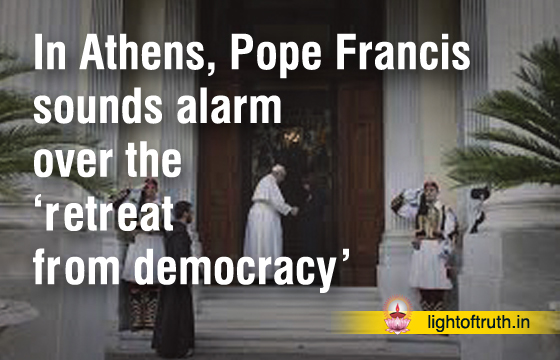
In Athens, Pope Francis sounds alarm over the ‘retreat from democracy’
As Pope Francis arrived in the birthplace of democracy on Dec. 4, he immediately sounded the alarm that democracy is under threat across the globe, as authoritarian leaders fuelled by populist and nationalistic interests are on the rise.
“Today, and not only in Europe, we are witnessing a retreat from democracy,” the pope said, warning that the common bonds of society are being severed by an increasing scepticism of institutions, hyper-individualism and partisanship — all heightened by social media that deepens divisions.
As he addressed Greece’s political leaders on Saturday, just over a mile from Athens’ iconic Parthenon, Francis kicked off his three-day visit to the nation by effectively offering a history lesson in the country’s democra-tic tradition and seeking to call Europe back to those roots.
“Democracy requires parti-cipation and involvement on the part of all. Consequently, it de-mands hard work and patience,” he said. “It is complex, whereas authoritarianism is peremptory and populism’s easy answers appear attractive.”
Over the last decade, Greece has been roiled by a severe financial crisis that plunged the country into political chaos, giving rise to both right-wing and left-wing populist move-ments that destabilized the country’s economy and nearly decimated its social programs.
In a spirited address that referenced the turmoil of recent years and one that was peppered with references to Greek philoso-phy and literature, the pope lamented how far the Western world has drifted from its heri-tage of a politics built around the common good.
A Requiem for the Disappearing Christians of Iraq, Syria, Egypt, and Gaza
“Islamic fundamentalist groups, in particular ISIS, have ravaged parts of Iraq and Syria and brought those countries’ already decimated Christian population to the verge of extin-ction. In Egypt, Christian Copts face legal and societal discrimi-nation. In Gaza, which in the fourth century was entirely Chri-stian, fewer than one thousand Christians remain.”
Sobering statistics like these set a grim backdrop for The Vanishing, war journalist Janine di Giovanni’s fearless account of what the book’s subtitle calls “Faith, Loss, and the Twilight of Christianity in the Land of the Prophets.” There can be few better suited or equipped to tell this story than di Giovanni, who has previously reported on the genocides in Bosnia, Rwanda, and Syria and is a senior fellow at Yale University’s Jackson Institute for Global Affairs.
The Vanishing is neither a chronological record of Christian withdrawal nor a geopolitical analysis of religious trends. Instead, di Giovanni offers a kind of requiem for a disappearing religious culture, a tale rendered all the more heart-wrenching for having been written during some of the worst months of the COVID-19 crisis.