
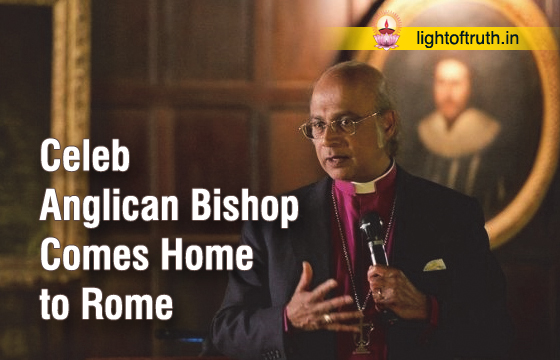
Dr Michael Nazir-Ali, former Bishop of Rochester, England – once the see of English martyr St John Fisher – and a champion of persecuted Christians in Islamic countries, has joined the Personal Ordinariate of Our Lady of Walsingham.
“I write to let you know of my reception into the ordinariate established for Anglicans who wish to be in full commun-ion with the See of Peter,” Lord Nazir-Ali announced.
“I am doing so because I believe that the traditional Anglican desire to adhere to the fullness of apostolic, patristic and conciliar teaching can now best be maintained in this way,” he explained.
An Ordinariate priest told Church Militant that “Lord Nazir-Ali is the most high-profile convert from the Church of England to Rome for the last 100 years, probably since the con-version of the intellectual giant Msgr Ronald Knox.”
Such a high-profile conver-sion is a setback to ecumenism.
“Michael is one of the most prodigious intellects of our time, a heroic apologist for the faith, a bulwark against radical Islam, a laser-sharp cultural commenta-tor, a persuasive preacher, a pa-ssionate evangelist of the highest calibre, and a brilliant linguist and poet,” the priest said.
Cardinal Vincent Nichols, Archbishop of Westminster, will ordain the former Anglican pre-late to the Catholic priesthood October 30 at the Ordinariate pro-cathedral of Our Lady of the Assumption & St Gregory at Golden Square in London.
Category Archives: International
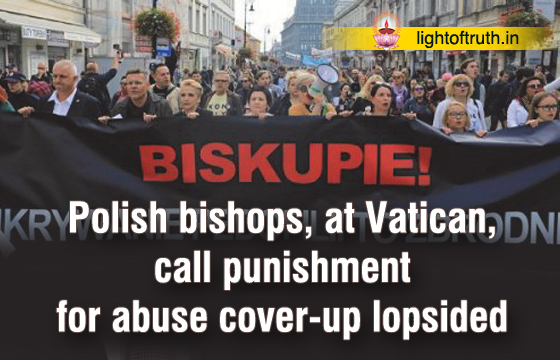
Polish bishops, at Vatican, call punishment for abuse cover-up lopsided
The president of the Polish Bishops’ conference said that in meetings with a Vatican official, several church leaders criticized the Vatican’s handling of sex abuse cases, particularly “dispro-portionate punishments” inflicted on bishops accused of cover-ups in comparison with convicted abusers.
Archbishop Stanislaw Gade-cki, conference president, told Poland’s Catholic Information Agency, KAI, that Polish bishops met with Cardinal Marc Ouellet, prefect of the Congregation for Bishops, at the Vatican October 12. He said the bishops were trying to be faithful to Pope Francis’ May 2019 motu proprio, “Vos Estis Lux Mundi,” revising and clarifying norms and pro-cedures for holding bishops and religious superiors accountable for protecting abusers.
“Our task is to work with the Holy Father in clearing up our church’s current situation, which has undermined trust among certain people,” Gadecki told KAI after the meeting with Ouellet. The meeting was part of the bishops’ “ad limina” visit to meet with Vatican officials every five years.
“But critical remarks have been made about the Holy See’s treatment of bishops who’ve had punishments imposed for short-comings, transgressions or acts of forgetfulness in dealing with clergy accused of paedophilia. Some (Polish bishops) highlight-ed the disproportionate, lasting penalties imposed on bishops after initial investigations, when paedophile criminals can leave prison after five years and begin a new life with a clean sheet.”
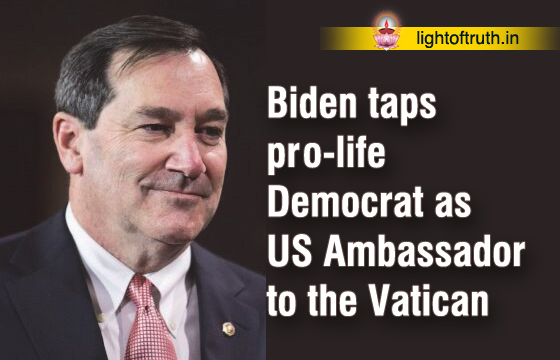
Biden taps pro-life Democrat as US Ambassador to the Vatican
After months of anticipa-tion, the White House announ-ced on October 8 afternoon that President Joe Biden will nominate former U.S. Senator Joseph Donnelly as the U.S. ambassador to the Holy See.
Like President Joe Biden, Donnelly is a devout Irish Catholic.
Donnelly, a Democrat, was senator from Indiana from 2013-2019 and was a member of the U.S. House of Repre-sentatives from 2007 to 2013, representing Indiana’s 2nd Congressional District.
“I am truly honoured to be nominated to this role by President Biden, a man of faith and a friend,” Donnelly said in a statement to Insider. “If confirmed, I look forward to working with the Holy See on a wide variety of issues, in-cluding human rights, religious freedom, immigration, climate change, peace, and poverty.”
Donnelly, a pro-life Democrat, didn’t mention issues of life, mainly abortion. Biden, the second Catholic president in U.S. history has been under fire from many Catholics since the election for his pro-abortion stance. This includes from a portion of the U.S. Conference of Catholic Bishops that have advocated he, and other pro-abortion politicians including Speaker of the House Nancy Pelosi be barred from receiving communion.
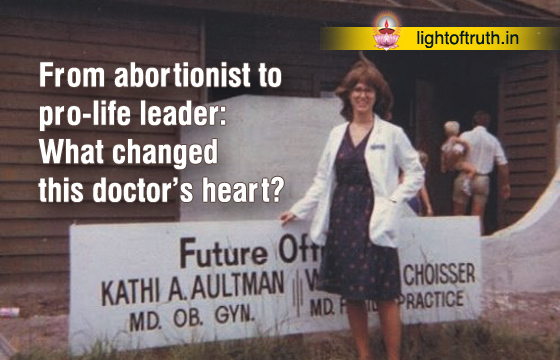
From abortionist to pro-life leader: What changed this doctor’s heart?
Kathi Aultman was six weeks postpartum when she returned to work at an abortion clinic in Gainesville, Florida. She performed abortions on the weekends to earn money while in medical school.
“I felt really strongly that abortion was a woman’s right,” Aultman told in an interview on September 17 interview. “I mean, I bought the whole thing: hook, line, and sinker.” “I even did abortions when I was pregnant — very pregnant. But I didn’t see any contradiction. My baby was wanted, theirs wasn’t. If they wanted to abort their baby, that was their right.”
But Aultman remembers something was different about that first abortion she performed after delivering and caring for her own baby. For the first time in her life, Aultman made the connection that the unborn child she was aborting was, in fact, a child. Not dissimilar to her own child.
Aultman completed the abortion, and she continued to perform abortions in the weeks that followed. But she said her experience that first day back from maternity leave marked the beginning of her journey toward be-coming a pro-life advocate.
Today, Aultman has testified on pro-life issues before state and congre-ssional bodies and state courts, and has assisted various state attorneys and the Justice Department in considering cases related to abortion. She was a speaker at the 2019 March for Life in Washington.
Most recently, Aultman was one of 240 of pro-life women to sign an amicus brief in support of Dobbs v. Jackson Women’s Health Organization, a case out of Mississippi that has the potential of overturning federal protection for abortion in the United States.
“I was fascinated,” she said. “I thought they were so interesting. I love[d] sending foetal parts down to pathology so I could look at the slides and see what the embryonic tissue looked like. I did not see them as people.”
Suddenly, Aultman saw herself as a mass murderer. It happened to be within a few years of the arrest and execution of infamous serial killer Ted Bundy, and Aultman remembers thinking that she had probably killed a lot more people than Bundy had.
“That was the point when I understood that abortion was wrong, and I became pro-life.”

Good News for Iraq’s Christians: More Autonomy
This week, the Christian enclave of Ankawa in Erbil, the capital city of Iraqi Kurdistan, was designated by the autonomous region’s prime minister as an official district with administrative autonomy. Starting next week, Christians will directly elect their own mayor and be in charge of security, among other matters.
Prime Minister Masrour Barzani called Ankawa a home for “religious and social coexistence, and a place for peace.”
Archbishop Bashar Warda, the Chaldean Catholic archbishop of Erbil, called it an “important” and “strategic” decision.
“Our confidence in the future of Kurdistan makes us encourage Christians not only to stay,” he told Kurdistan 24, “but also to invest in this region.”
Ordained a priest in 1993, Warda was consecrated in his current position in 2010. With Iraq’s haemorrhaging of Christians since the 2003 US invasion, Warda’s bishopric in the autonomous Kurdish region soon became a providential band-aid.
Beginning in 2014, ISIS drove Christians from Mosul and their traditional homeland in the Nineveh Plains, and thousands took refuge in Erbil and other cities in the secure northeast. From 1.5 million Christians in 2003, the Chaldean Catholic church now estimates a population of fewer than 275,000 Christians.
Warda has long been investing to turn the tide. In 2015, he established the Catholic University of Erbil, and has coordinated relief aid from governments and charities alike. The situation stabilized following ISIS’s defeat in 2017.
But freedom does not come from politics alone. Two years ago, Christians endorsed widespread popular uprisings against the political class. Violently suppressed, the movement’s main celebrated achievement was early elections under a new law designed to promote better local and small-party representation.
Polls open on October 10, and a quota gives Christians five of 329 seats in parliament. However, Warda’s Baghdad-based patriarch has called for a Christian boycott, fearing fraud.
Warda wants a Christian revival. Buoyed by the March visit of Pope Francis, he believes that ISIS broke the fundamental religious and cultural underpinnings of Islamic superiority. Christians no longer are seen as second-class citizens.
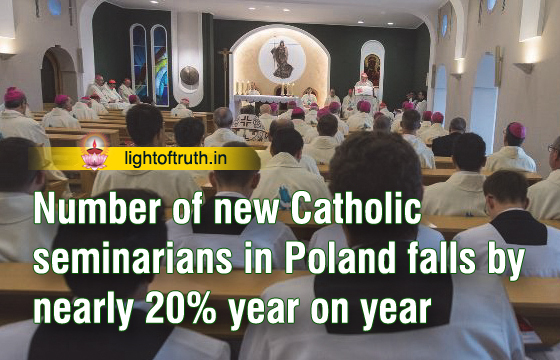
Number of new Catholic seminarians in Poland falls by nearly 20% year on year
Nearly 20% fewer candidates for the Catholic priesthood have enrolled in Poland’s seminaries this year, compared to 2020.
Fr. Piotr Kot, chairman of the Conference of Rectors of Major Seminaries, told the Polish Catholic news agency KAI on October 12 that 356 seminarians began their studies in 2021.
Last year, he said, there were 441 candidates, meaning that “the number is lower by approxi-mately 20%.”
He explained that of the 356 candidates, 242 were training for the diocesan priesthood and 114 for religious orders.
There were 47 fewer semi-narians in diocesan seminaries and 38 fewer candidates for religious orders compared with the previous year, he said.
The Polish Catholic weekly GoϾ Niedzielny noted that priestly vocations had declined sharply in Poland in recent years.
In 2012, it said, 828 candidates enrolled in the first year of seminary. There were 498 in 2019 and 441 in 2020.
In March this year, Poland’s bishops made their final adjust-ments to a decree, called “The Way of Formation of Priests in Poland” (Ratio institutionis sa-cerdotalis pro Polonia), setting out new rules for priestly for-mation.
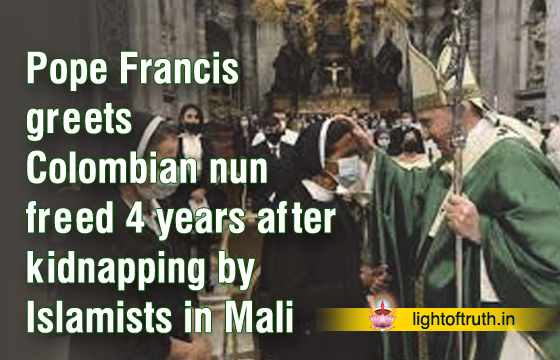
Pope Francis greets Colombian nun freed 4 years after kidnapping by Islamists in Mali
Pope Francis greeted a Colombian nun on October 10, shortly after she was freed four years after being kidnapped by Islamists in Mali.
The Pope blessed Sr. Gloria Cecilia Narváez Argoti before a Mass in Saint Peter’s Basilica launching a worldwide synodal process. Sr. Gloria, a member of the Congregation of the Franciscan Sisters of Mary Imma-culate, was kidnapped in southern Mali in 2017.
The Malian presidency announced that she was released on Oct. 9 after “four years and eight months of combined efforts of several intelligence services.”
It posted photographs on social media of her meeting with interim president Col. Assimi Goïta, accompanied by Cardinal Jean Zerbo of Bamako.
“We prayed a lot for her release. I thank the Malian authorities and other good people who made this release possible,” the cardinal told.
Armed men kidnapped Sr. Gloria in Karangasso, about 90 miles south of the town of San, near the border with Burkina Faso, on Feb. 7, 2017.
The men forced her to hand over the keys to the community’s ambulance. The vehicle was later found abandoned. Three other sisters were present at their house but escaped.
The kidnappers were going to take the youngest nun, but Sr. Gloria reportedly volunteered to take her place.

Science Closes In on Covid’s Origins
Where did Covid-19 come from? The answer can be found in the SARS-CoV-2 virus itself. To get to the truth, we need only unleash the power of science. Based on experience with SARS-1 in 2003 and MERS in 2012, we know that many people are infected by a host animal long before a co-ronavirus mutates to the point where it can jump from human to human. An extensive data set from late 2019—more than 9,000 hospital samples—is available of people exhibiting flulike (thus Covid-like) symptoms in China’s Hubei and Shaanxi provinces before the epidemic started. Based on SARS-1 and MERS, the natural zoonotic theory predicts 100 to 400 Covid infections would be found in those samples. The lab-leak hypothesis, of course, predicts zero. If the novel coronavirus were engineered by scientists pursuing gain-of-function research, there would be no instances of community infection until it escaped from the laboratory. The World Health Organization investigation analysed those stored samples and found zero pre-pandemic infections. This is powerful evidence favouring the lab-leak theory.
Within months of the SARS-1 and MERS outbreaks, scientists found animals that had hosted the viruses before they made the jump to humans. More than 80% of the animals in affected markets were infected with a coro-navirus. In an influential March 2020 paper in Nature Medicine, Kristian Ander-sen and co-authors implied that a host animal for SARS-CoV-2 would soon be found. If the virus had been cooked up in a lab, of course, there would be no host animal to find.
The WHO team searched for a host in early 2020, testing more than 80,000 animals from 209 species, including wild, domesticated and market animals. Not a single animal infected with SARS-CoV-2 was found. This finding strongly favours the lab-leak theory. We can only wonder if the results would have been different if the animals tested had included the humanized mice kept at the Wuhan Institute of Virology.
In their Nature Medicine paper, Mr. Andersen and colleagues pointed to what they considered the poor design of SARS-CoV-2 as evidence of zoonotic origin. But a team of American scientists mutated the stem of the coronavirus genome in nearly 4,000 different ways and tested each variation. In the process they actually stumbled on the Delta variant.
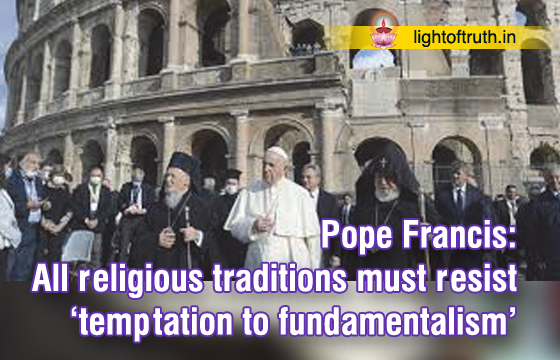
Pope Francis: All religious traditions must resist ‘temptation to fundamentalism’
Pope Francis asked leaders of world religions to resist “the temptation to fundamentalism” for the sake of peace at an interreligious gathering Thursday in front of the Colosseum. Peace “summons us to serve the truth and declare what is evil when it is evil, without fear or pretence, even and especially when it is committed by those who profess to follow the same creed as us,” the pope said Oct. 7. “For the sake of peace, please, in every religious tradition let us defuse the temptation to fundamentalism and every tendency to view a brother or sister as an enemy.” Speaking on a stage together with Muslim, Jewish, Buddhist, and Hindu representatives, Pope Francis appealed for peace amid the world’s current conflicts. “Dear brothers and sisters, as believers it is our responsibility to help eradicate hatred from human hearts and to condemn every form of violence. Let us unambiguously urge that arms be set aside and military spending reduced, in order to provide for humanitarian needs, and that instruments of death be turned into instruments of life,” the Pope commented.
“Fewer arms and more food, less hypo-crisy and more transparency, more vaccines distributed fairly and fewer weapons marketed indiscriminately,” he said.
The Islamic scholar, who signed the landmark Document on Human Fraternity with Pope Francis in 2019, criticized the uneven distribution of COVID-19 vaccines throughout the world.
He said that “the world has suffered a setback despite the efforts made by religious institutions, their representatives and leadership, to foster a collaborative approach and exchange of goods, giving precedence to the public interest over private interests.” The Pope was speaking at the live-streamed closing ceremony of “Peoples as Brothers, Future Earth. Religions and Cultures in Dialogue,” the 35th event promoted by the Sant’ Egidio Community in the “spirit of Assisi,” the interreligious gathering convened in St Francis’ birthplace by Pope John Paul II in 1986.
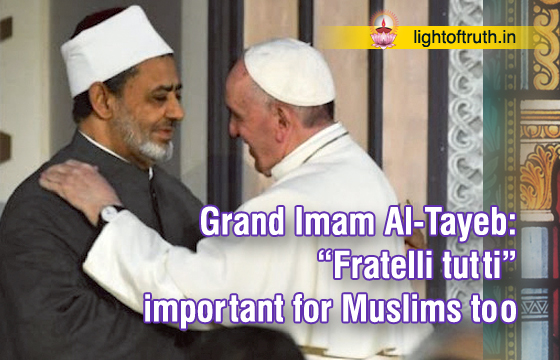
Grand Imam Al-Tayeb: “Fratelli tutti” important for Muslims too
The Grand Imam of Al-Azhar speaks to Vatican Media about his relationship with Pope Francis: “From the first minute of our meeting I had confirmation that he is a man of peace and humanity. The encyclical is an appeal to create a true fraternity where there is no room for dis-crimination on the basis of diffe-rences of religion, race, gender, or other forms of intolerance.”
“Each one of us has disco-vered a great spiritual and thoughtful attunement to the crises that afflict contemporary man…” The Grand Imam of Al-Azhar, Prof. Ahmad Muhammad Al-Tayeb, during his days in Rome to participate at some important events alongside Pope Francis and other religious lead-ers, visited the studios of Vatican Radio – Vatican News and spoke about his relationship with Pope Francis, one year after the publi-cation of the Encyclical Fratelli tutti.
The Grand Imam recounted that “after the election of dear brother Pope Francis, Al-Azhar took the initiative to congratulate him, and we received a beautiful response from Pope Francis.” He noted that it was a response that encouraged us to renew the relationship, and so, he decided to visit the Pope in the Vatican in May 2016.