
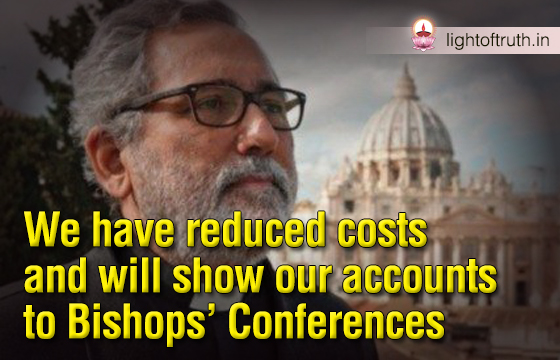
“To help the economy of the Holy See to meet its needs, taking care that economic activity does not distract or detract from the credibility of the Holy See’s mission of fostering unity in charity and the evangelising mission of the Church, which is what matters.”
In this interview with Vatican Media, Guerrero offers some data on the new budget of the Holy See, which has increased significantly this year due to the inclusion of new entities. Cost containment continues (further reduced by €4 million). The budgeted deficit is lower than that of last year, and the Prefect hopes to soon be able to provide data on the income and expenditure of Peter’s Pence as well, anticipating that this year too contribution of the faithful has decreased.
We are well aware that we have made major mistakes in financial management, which have undermined the credibility of the Holy See. We seek to learn from them and we believe we have remedied them so that they do not happen again. In recent years, encouraged by the Holy Father, we have taken important steps in the right direction in economic management: greater professionalisation, more teamwork, more transparency and less secrecy, establishment of oversight procedures, greater recognition of our weaknesses and attempting to remedy them… Important changes have been made with the publication of certain laws. But slowly, the culture is changing. We are working in the right direction.
Category Archives: International
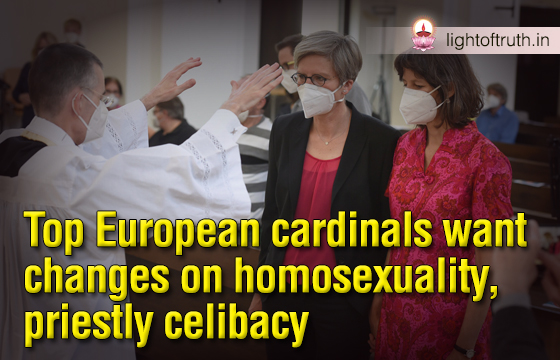
Top European cardinals want changes on homosexuality, priestly celibacy
Over the past week, two leading European Cardinals, both of whom enjoy broad favour with Pope Francis, have made public statements calling for a change in the Catholic Church’s current position on the issues of homo-sexuality and priestly celibacy.
In an interview published in Germany’s Catholic News Agency (KNA) earlier this week, Jesuit Cardinal Jean Claude Hollerich, Archbishop of Luxembourg, voiced his belief that the Church’s position viewing homosexual relationships is wrong.
“I believe that the sociological-scientific foundation of this teaching is no longer correct,” he said, saying the time has come to revise this position, and suggesting that Pope Francis’s own rhetoric on homosexuality could open the door for this change to take place.
Since the beginning of his pontificate, Pope Francis, who has also voiced concern over homosexuality in the priesthood, has taken a softer approach to the issue and has urged the Church to be more welcoming to homosexual individuals and to families with homosexual members.
In 2013, he signalled a new approach to the issue with his famous declaration that if a person “is gay and is searching for the Lord and has good will … Who am I to judge?”
In 2018, he said that the Church has to find a way to help the parents of gays and lesbians so that they “stand by” their children, telling parents with LGBT children, “Do not condemn. Dialogue. Understand.”
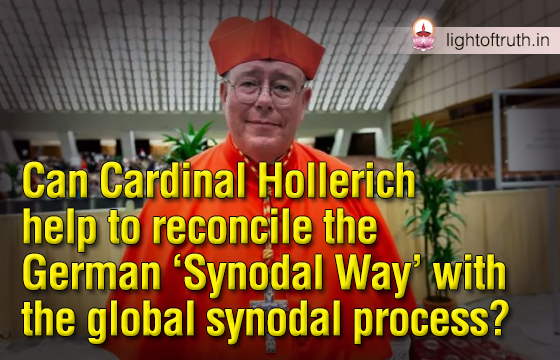
Can Cardinal Hollerich help to reconcile the German ‘Synodal Way’ with the global synodal process?
The German “Synodal Way” is moving forward boldly following a decisive meeting in Frankfurt at the start of February. But one important question remains unanswered: how does the initiative fit in with the two-year global synodal process launched by Pope Francis leading up to the 2023 Synod on Synodality?
Bishop Georg Bätzing, chairman of the German bishops’ conference, went some way to answering that question at the end of the three-day meeting of the Synodal Assembly, the supreme decision-making body of the Synodal Way.
“It was received with great approval and joy in the Synodal Assembly that we will establish a mixed discussion group between those responsible in the Roman Synod Secretariat and the presidium of the Synodal Way in our country,” he said on Feb. 5.
Bätzing made it known that he had a meeting in Luxembourg with Cardinal Jean-Claude Hollerich and Cardinal Mario Grech. Both men have critical roles in the worldwide synodal process. Pope Francis chose Hollerich, the archbishop of Luxembourg, to serve as relator general of the Synod on Synodality. The pope selected Grech, from Malta, as secretary general of the Synod of Bishops.
According to a source familiar with the work of the General Secretariat of the Synod of the Bishops, Grech’s presence at the gathering was “part of a series of meetings that the General Secretariat of the Synod intends to hold with the particular Churches,” with the will to “accompany them in the synodal process.”
In this regard, Grech also gave a speech at the last general assembly of the Italian bishops in November 2021. So, the Maltese cardinal is talking to multiple national bishops’ conferences about the global synodal process.
The idea of establishing a working group is part of a mediation effort that also aims to avert a possible schism of the Church in Germany. In June 2019, Pope Francis sent a 19-page letter to German Catholics high-lighting a “growing erosion and deterioration of faith” in the country. He urged Church members to resist the temptation to reorganize structures in the face of difficulties and engage instead in evangelization.
At the Synodal Assembly meeting on Feb. 3-5, participants voted in favour of draft texts calling for the abolition of priestly celibacy in the Latin Church, the ordination of women deacons and priests, same-sex blessings, and changes to Catholic teaching on homosexuality.
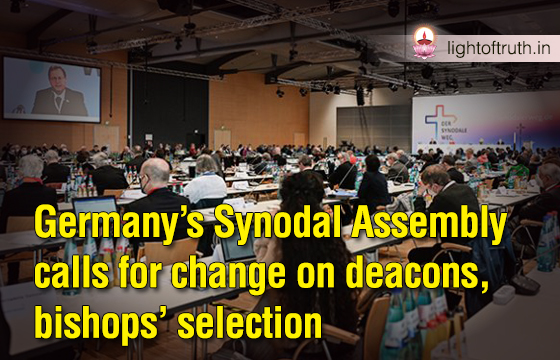
Germany’s Synodal Assembly calls for change on deacons, bishops’ selection
The Synodal Path of the Catholic Church in Germany wants laypeople to be able to participate in choosing bishops and wants the church to have women deacons. The third Synodal Assembly to bring about reforms to the Catholic Church ended Feb. 5 with the first concrete decisions of the process. Most German bishops signalled they are prepared to support far-reaching change in the Catholic Church.
For three days, nearly 230 delegates — lay and clerical — discussed reforms based on texts that had been drawn up in four working forums and reflecting theological arguments they hope to present to Rome in 2023, at the end of the Synodal Path process.
This third of five planned synodal assemblies marked the first time that the highest body of the Synodal Path adopted some fundamental texts in a second reading. The texts received approval of more than two-thirds of all delegates, in addition to the approval of more than two-thirds of the bishops. But two years after the Synodal Path process started, the Vatican has yet to give a clear signal of support. Limburg Bishop Georg Bätzing, president of the German bishops’ conference, announced that he met with Pope Francis in January and that he is in dialogue with Cardinal Mario Grech, secretary-general of the Synod of Bishops. Bätzing said a discussion group between the synod secretariat and the executive committee of the Synodal Path in Germany will be established.
The pope’s representative to Germany, Archbishop Nikola Eterovic, greeted the assembly and reminded delegates Pope Francis “is the point of reference and the centre of unity for more than 1.3 billion Catholics worldwide, 22.6 million of whom live in Germany.” He said the pope often speaks of synodality, but warns against “parliamentarism, formalism, intellectualism and clericalism.”
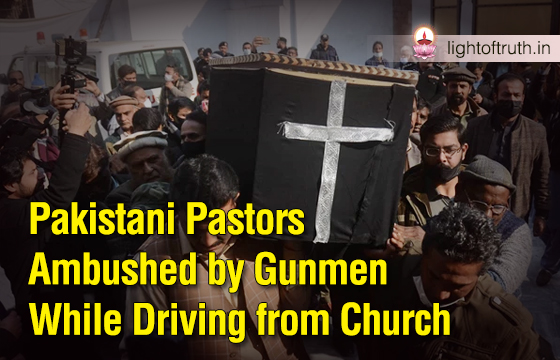
Pakistani Pastors Ambushed by Gunmen While Driving from Church
A Church of Pakistan lay pastor was gunned down and a priest wounded by unknown assailants as the leaders drove home from a worship service on Sunday in the northwestern Pakistan city of Peshawar, where Christians had suffered their deadliest attack in the country’s history nearly a decade earlier.
Church of Pakistan Bishop of Peshawar Humphrey Peters said that William Siraj, 75, was shot and died instantly in the ambush in the Gulbahar neighbourhood, while Patrick Naeem, 55, sustained a bullet wound but was in stable condition. A third church leader in the car was unharmed, he said.
The Protestant church leaders were returning from All Saints Church parish when two gunmen riding a motorcycle intercepted their car and opened fire on them, Peters said.
“Siraj received one bullet in the forehead and one on the arm and died instantly, while Rev. Naeem received a bullet wound in the hand,” he said. “It’s a miracle that Rev. Naeem and another priest escaped the volley of bullets.”
The assailants fled the scene unchallenged, according to wit-nesses, Peters said.
Siraj was a senior lay leader and led worship at three different parishes while Naeem was the priest of the All Saints Church parish, Peters said.
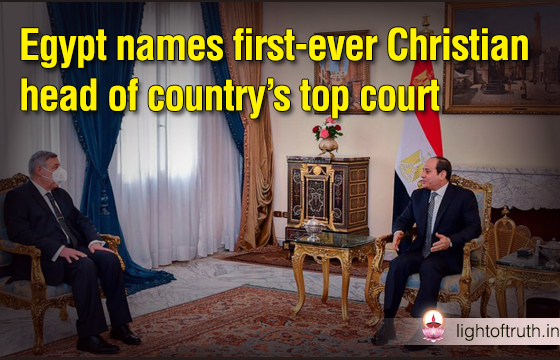
Egypt names first-ever Christian head of country’s top court
Egypt’s president on Wednesday swore in the first-ever Coptic Christian to head the country’s highest court.
Judge Boulos Fahmy is the 19th person to preside over the Supreme Constitutional Court since it was established in 1969. President Abdel Fattah el-Sissi picked the 65-year-old Fahmy from among the court’s five oldest of 15 sitting judges, as is prescribed by law.
Fahmy succeeded Judge Saeed Marei, who retired over health reasons, according to Mohammed Bassal, a respected expert in Egypt’s judicial affairs and editorial manager of the Shorouk daily.
Fahmy has headed the court’s General Secretariat since 2014. His appointment as chief judge has been welcomed by many in the Muslim majority country.
Moushira Khattab, head of the government-appointed National Council for Human Rights, hailed the decision as “historic” and “a giant move” in the field of political and civil rights.
However, Ishak Ibrahim, a prominent expert on Christian affairs in Egypt, said in a Face-book post that the move will have little impact on ending discrimination against Christians as they are vastly under represented in Egypt’s state institutions.
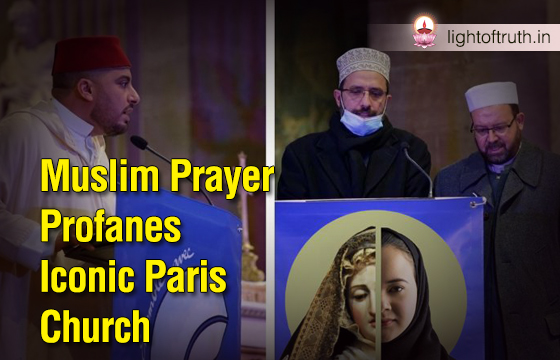
Muslim Prayer Profanes Iconic Paris Church
A respected Islamic scholar and Parisian Catholic priest is condemning the recitation of the Koran and Muslim prayer in Paris’ largest church as the “abandonment of evangelization” and the “introduction of the Antichrist.” Fr Guy Pagès’ censure is being echoed by Parisian Muslim converts, who face the death penalty for apostasy from Islam — including a former high-ranking Islamic jurist who confessed to engaging in interfaith events “only to sanitize the true face of Islam in preparation for jihad.”
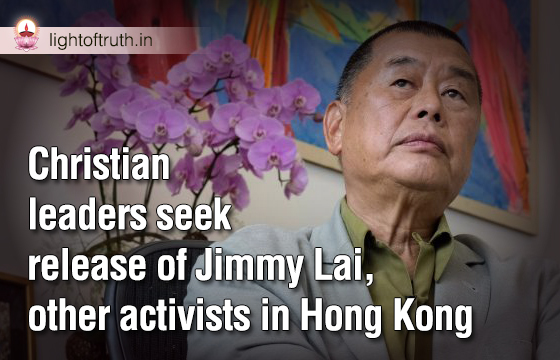
Christian leaders seek release of Jimmy Lai, other activists in Hong Kong
An international coalition of Christian leaders, including the president of the Federation of Asian Bishops’ Conferences, appealed for the release of Hong Kong’s Catholic pro-democracy supporter Jimmy Lai and other imprisoned activists as part of a Chinese New Year amnesty.
Cardinal Charles Bo of Myanmar, FABC president, joined other Catholic and Protestant leaders from across Europe, North America and Asia to send a letter to Hong Kong Chief Executive Carrie Lam, a practicing Catholic, reported ucanews.com.
“There is the very real prospect that Jimmy Lai may spend the rest of his years in prison. This would be a sad injustice and would raise unfortunate doubts as to China’s continued commitment to the ‘one country, two systems’ model and the tolerance it engenders,” the letter said.
Ucanews.com reported Fr Franco Mella of the Pontifical Institute for Foreign Missions and the Rev. Fung Chi Wood, former Hong Kong legislator and a priest of the Hong Kong Anglican Church, handed the letter to Lam Jan. 31.
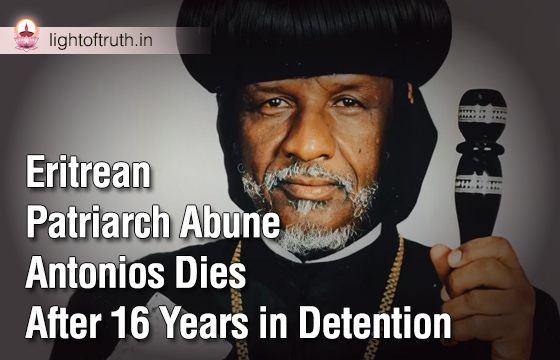
Eritrean Patriarch Abune Antonios Dies After 16 Years in Detention
Abune Antonios, a confined Eritrean Orthodox Church patriarch and the longest-serving prisoner of conscience in the Horn of Africa, died on February 9 at the age of 94.
He was still serving detention in the Eritrean capital, Asmara, after his arrest in 2006 just two years after his installation as the third patriarch of the Eritrean Orthodox Church. For 16 years, he was kept in solitary confinement under the orders of the country’s authoritarian leader, President Isaias Afwerki, for his resistance to government interference in the ancient church.
Eritrea has long been on the US State Department’s list of worst religious freedom violators, and ranks No. 6 on Open Doors’ 2022 list of where Christian persecution is worst.
Rashad Hussain, the newly confirmed US religious freedom ambassador, said in a tweet that he was “saddened by the news” and that “Patriarch Abune Antonios was a true leader.”
“It is very unfortunate that the patriarch died while in detention. There was no reason for the government of Eritrea to put him in detention,” Francis Kuria, the secretary general of the African Council of Religious Leaders, told RNS. “The Orthodox Church in Eritrea and elsewhere is always very supportive of the people’s development.”
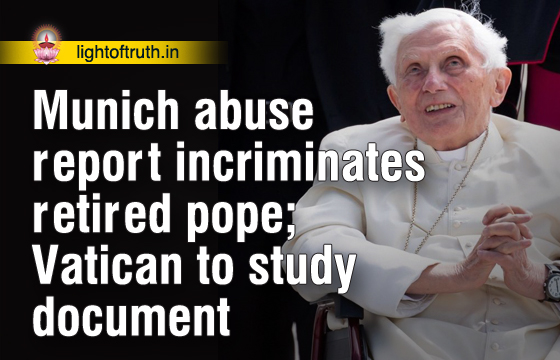
Munich abuse report incriminates retired pope; Vatican to study document
A law firm’s report on how abuse cases were handled in the Archdiocese of Munich and Freising incriminated retired Pope Benedict XVI, with lawyers accusing him of misconduct in four cases during his tenure as Munich archbishop.
Lawyer Martin Pusch of the law firm Westpfahl Spilker Wastl said the retired Pope had denied wrongdoing in all cases, reported the German Catholic news agency KNA.
Pusch expressed doubt about Pope Benedict’s claim of ignorance in some cases, saying this was, at times, “hardly reconcila-ble” with the files.
At the Vatican, Matteo Bruni, director of the Vatican press office, said, “The Holy See believes it has an obligation to give serious attention to the document” on cases of abuse in the Archdiocese of Munich and Freising, but it has not yet had a chance to study it.
“In the coming days, following its publication, the Holy See will review it and will be able to properly examine its details. Reiterating its sense of shame and remorse for the abuse of minors committed by clerics, the Holy See assures its closeness to all victims and confirms the path taken to protect the youngest, ensuring safe environments for them,” Bruni said.
From 2001, when St. John Paul II charged the Congregation for the Doctrine of the Faith — headed by then-Cardinal Joseph Ratzinger — with the authority to take over cases from local bishops for investigation, Pope Benedict was aware of many examples of abuse. It was his office in 2003 that expedited the process for laicizing priests guilty of sexually abusing minors.
Although he mostly stayed out of public view in retirement, in April 2019 the former Pope published what he described as “notes” on the abuse crisis, tracing the roots of the scandal to a loss of a firm faith and moral certainty that began in the 1960s. The church’s response, he insisted, must focus on a recovery of a sense of faith and of right and wrong.
The Munich investigation followed two years of research and covers the period from 1945 to 2019, centering on who knew what about sexual abuse and when, and what action they took, if any, KNA reported. The report identified 497 victims and 235 abusers, but the lawyers who conducted the study say they’re convinced the real numbers are much higher.
Four volumes with almost 1,900 pages comprise the “litany of horror” that lawyers presented. They spoke of the “total failure” of a system, at least until 2010.