
Threatened by an uprising of his treacherous generals, the Christian Emperor Basil II, based in the glorious city of Byzantium, reached out to his enemies, the pagans over in the land of the Rus. Basil II was a clever deal maker. If Vladimir of the Rus would help him put down the revolt, he would give him the hand of his sister in marriage. This was a status changer for Vladimir: the marriage of a pagan to an imperial princess was unprecedented. But first Vladimir would have to convert to Christianity.
Returning to Kyev in triumph, Vladimir proceeded to summon the whole city to the banks of the river Dnieper for a mass baptism. The year is 988. This is the founding, iconic act of Russian Orthodox Christianity. It was from here that Christianity would spread out and merge with the Russian love of the mother-land, to create a powerful brew of nationalism and spirituality. In the mythology of 988, it was as if the whole of the Russian people had been baptised. Vladimir was declared a saint. When the Byzantine empire fell, the Russians saw themselves as its natural successor. They were a “third Rome”.
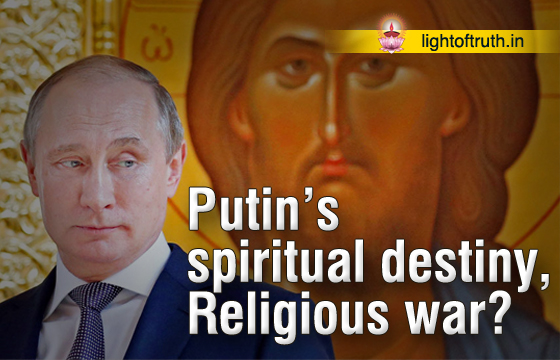
At the heart of this post-Soviet revival of Christianity is another Vladimir. Vladimir Putin. Many people don’t appreciate the extent to which the invasion of Ukraine is a spiritual quest for him. The Baptism of Rus is the founding event of the formation of the Russian religious psyche, the Russian Orthodox church traces its origins back here. That’s why Putin is not so much interested in a few Russian-leaning districts to the east of Ukraine. His goal, terrifyingly, is Kyev itself.
Category Archives: International
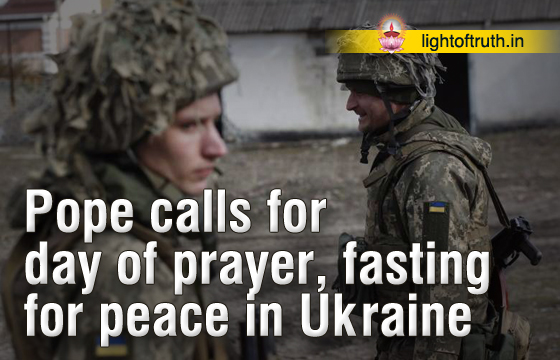
Pope calls for day of prayer, fasting for peace in Ukraine
As the threat of war loomed over the world, Pope Francis called on people to pray and fast for peace in Ukraine on Ash Wednesday.
Before concluding his general audience on Feb. 23, the pope called on believers and non-believers to combat the “diabolical insistence, the diabolical senselessness of violence” with prayer and fasting.
“I invite everyone to make March 2, Ash Wednesday, a day of fasting for peace,” he said. “I encourage believers in a special way to devote themselves intensely to prayer and fasting on that day. May the Queen of Peace protect the world from the folly of war.”
In his appeal, the pope said he, like many around the world, felt “anguish and concern” after Russian President Vladimir Putin recognized the independence of the eastern Ukrainian regions of Donetsk and Luhansk.
The pope said that due to the “alarming” developments in the region, “once again, the peace of all is threatened by partisan interests.”
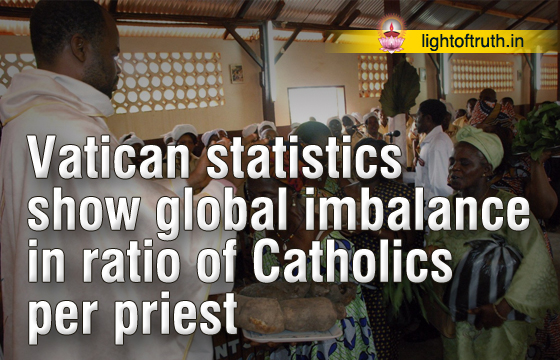
Vatican statistics show global imbalance in ratio of Catholics per priest
The number of Catholics and of Catholic men and women who devote their lives to serving them continues to grow in Africa and Asia, Vatican statistics show, but pastoral ministry is still much more readily available to Catholics in Europe.
At the end of 2020, the number of Catholics in the world reached 1.36 billion, an increase of 16 million over the previous year, according to the Vatican’s Central Office of Church Statistics, which published a brief overview of the global numbers in early February. While Catholics remained about 17.7% of the global population, their numbers grew in Africa by about 2.1% and in Asia by 1.8% while in Europe the increase was just 0.3%, said the summary, which was based on numbers reported Dec. 31, 2020. And while just over 20% of the world’s Catholics live in Europe, 40% of the world’s priests minister there. The Americas have 48% of the world’s Catholics, but only 29.3% of the world’s priests.

Make no Mistake, if There’s a War Between Russia and Ukraine, it Will be a Religious War
Putin has now ordered Russian troops into Donetsk and Luhansk. The first major conflict between two Orthodox Christian nations since the War of the Stray Dogs in 1925 has likely just begun. That conflict (the resolution of which was incidentally perhaps the only significant accomplishment of the League of Nations) was clearly and plainly a territorial dispute. On its surface so is the current conflict in Ukraine. But appearances can be deceiving. Make no mistake about it, if there is a war between Russia and Ukraine, it’ll be a religious war. The sooner those in the West recognize this reality and catch up on the details the better.
There is a very recent precedent for this. In the early part of this century, in the aftermath of 9/11, the rise of Islamic fundamentalism was—quite justifiably to be clear—given a significant amount of attention. At the same time, many rushed to assure the world that those young men who flew planes into buildings and stoned unveiled women in the street, did not represent “the real Islam.”
Far fewer made the much more accurate observation that both Osama bin Laden and Abdolkarim Soroush represent real and legitimate positions within Islam, be-cause traditions are complicated and people with vastly differing worldviews can believably lay claim to the same historical community. If you need further proof of this, remember that both Greg Locke (who believes witches have infiltrated his church) and leshia Evans (who peacefully stared down police at a protest of the killings of Alton Sterling and Philando Castile) are both devout Christians.
This reality sometimes leads to conflict, particularly in historical epochs characterized by significant change and instability. Western Christianity saw its tensions boil over during the Protestant Reformation and the subsequent Counter-Reformation, which not only resulted in permanent fissures within Western Christendom, but the Thirty Years’ War, which killed between 25% and 40% of the entire German population. Modern Russia also has designs on Africa, where it seeks to compete with China and the Western powers for influence on a continent of natural resources and growing markets. And there’s little doubt that Russia has, in recent years, sought increasingly to use the Russian Orthodox Church as an instrument of foreign influence: in Ukraine, Serbia, Western Europe, and the United States. A tactic only made possible by the Patriarchate of Moscow’s desire to establish itself as the leader of the conservative Orthodox cause.

Catholics in Poland, Western Ukraine welcome people fleeing threat of war
With the “further escalation of tension in Ukraine,” the president of the Polish bishops’ conference asked Polish Catholics to continue praying for peace, but also to be prepared to welcome Ukrainian refugees.
An archbishop in Lviv, Ukraine, made a similar statement, saying people displaced from their homes already were arriving in the western part of the country, and a representative of Catholic Relief Services said the U.S. Catholic international aid organization was prepared to help.
Archbishop Stanislaw Gadecki of Poznan, president of the Polish bishops’ conference, appealed “to my countrymen for open and hospitable hearts for refugees from Ukraine who will seek refuge from war in Poland.”
He made his appeal in a statement posted Feb. 21 on the bishops’ website after news that Russian-allied separatists in Eastern Ukraine had increased artillery and mortar attacks and, Feb. 17, had hit a kindergarten in Stanytsia Luhanska, when children were in the building; according to reports, none of the children were injured, but three staff members were.
Archbishop Gadecki’s statement was posted before Russian President Vladimir Putin formally recognized the independence of separatists’ self-proclaimed Donetsk People’s Republic and the Luhansk People’s Republic, a move the U.S. government said was against international law.
Encouraging Poles to continue praying for peace, the archbishop told them: “Everyone has the right to live in peace and security. Everyone has the right to seek for themselves and their loved ones conditions that will ensure a safe life.”
Even before the threat of war became so real, the archbishop said, Poland “opened its doors to newcomers from Ukraine, who live among us, work with us, pray in Polish churches and study in Polish schools.”
Archbishop Gadecki asked Polish Catholics to give generously to Caritas Poland and their local parish Caritas agencies to help refugees; the agencies, he said, are making plans to increase refugee support programs “in case of further escalation of tension and military action.”
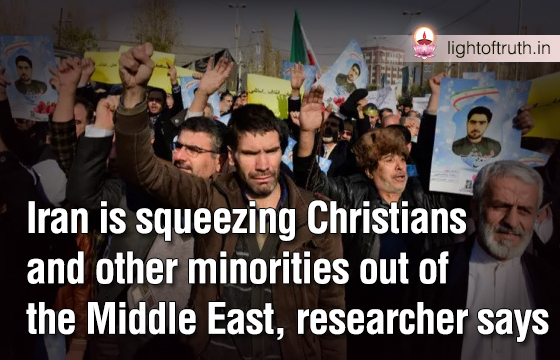
Iran is squeezing Christians and other minorities out of the Middle East, researcher says
A researcher with the Philos Project told journalists Feb 22 that Iran is using incremental strategies to squeeze non-Muslims out of the country and in nearby states such as Iraq and Syria, and that the plight of Christians in the Middle East is “truly misunderstood” by most in the West.
Senior Research Fellow Dr. Farhad Rezaei, an Iranian Kurd, is a Christian convert who fled Iran and now teaches at York University in Canada. The Philos Project is a nonprofit group that educates about and advocates for Christians in the Near East.
Rezaei said during a Feb. 22 briefing that the narrative that only jihadists have contributed to the persecution of Christians in the Middle East is “too simplistic,” and ignores the influence of Iran-backed militias in countries like Iraq.
A native Iranian, Rezaei noted that since the country’s 1979 revolution, Islamic leaders in Iran have described adherents to minority religions such as Christianity and Judaism as “pollution,” and have taken steps to shrink the size of the Christian and Jewish communities by pushing them out of the country.

Pope Francis’ cardinal advisers discuss role of women in the Church
The Holy See press office said on Feb. 23 that during the three-day meeting the seven cardinals heard and commented on report by the theologian Sister Linda Pocher, F.M.A., on “the role of women and the ‘Marian principle’ in the Church.”
Pocher, a member of the Salesian Sisters of Don Bosco, is an adjunct professor at the Pontifical Faculty of Educational Sciences “Auxilium” in Rome.
Pope Francis spoke of the “Marian principle,” which theologians often contrast with the “Petrine principle,” in a homily at St. Peter’s Basilica in 2019.
He said: “Mary is our Mother. She is the Mother of our people. She is the Mother of us all. She is the Mother of the Church, but she is also the image of the Church. And she is the Mother of our hearts, of our souls.”
“There is a Holy Father who says that what can be said of Mary, can also be said in its own way of the Church and in its own way of our souls. Because the Church is feminine and our soul has this ability to receive grace from God, and in a certain sense, the Fathers saw the Church as a woman. We cannot think of the Church without this Marian principle.”
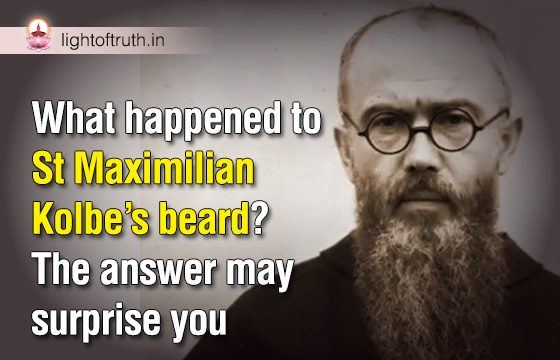
What happened to St Maximilian Kolbe’s beard? The answer may surprise you
On Feb 18, the Catholic Church in Poland shared a photo commemorating the 81th anniversary of St Maximilian Kolbe’s arrest by the Nazis. The image, the last one taken of the saint before his final arrest, was notable for what it didn’t show… Kolbe’s signature long beard.
By the time the photo was taken, Kolbe had already been arrested by the Nazis once, but was clearly resolved to continue his nationwide evangelization efforts. The monastery he had established at Niepokalanów, 25 miles west of Warsaw, had become a major Catholic publishing centre. The beard with which Kolbe is often pictured is notable for several reasons, one of which was the fact that not many of his Franciscan counterparts in Poland sported them. He shaved his signature beard in order to blend in with his fellow Franciscans, and with society at large.
The second reason is that Kolbe’s beard is the only first-class relic that exists of him. The rest of his body was incinerated in the ovens of Auschwitz after he was murdered by the Nazis in 1941.
Father James McCurry, a Conventual Francis-can and minister provincial of the Our Lady of the Angels Province, gave a homily in 2016 co-mmemorating the 75th anniversary of Kolbe’s martyrdom in which he mentioned the saint’s beard.
McCurry, author of the book “Maximilian Kolbe: Martyr of Charity,” said that Kolbe chose to keep the beard upon his return from six years of missionary work in Japan. In those days, it was customary for missionaries to grow long beards, and Kolbe wanted to keep it as a reminder of his missionary days, and as a reminder to always be a “missionary” of the Gospel. McCurry said Kolbe’s beard made him unusual among his Conventual Franciscan counterparts, who generally did not wear them. Kolbe’s fame was spreading among Poland thanks to his publishing work, and his unique beard helped him to stand out all the more.
It was for this reason that Kolbe eventually, after the 1939 Nazi invasion of Poland, made the decision to shave it, McCurry said, so as not to stand out. Kolbe’s founding of the Militia Immaculata (MI), an evangelization movement identifying with Mary, put him high on Nazi watchlists.
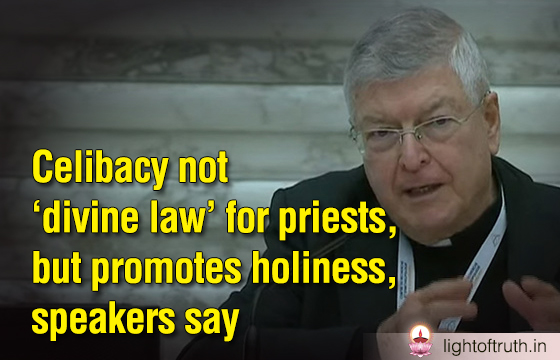
Celibacy not ‘divine law’ for priests, but promotes holiness, speakers say
The requirement that most priests in the Latin rite of the Catholic Church be celibate has theological and spiritual foundations and not only practical motivations, said speakers at an international conference on priesthood.
Jesus’ chastity, poverty and obedience were not “incidental or simply functional,” but expressed his total union with God and dedication to the salvation of humanity, Jesuit Father Gianfranco Ghirlanda, a well-known canon lawyer, said Feb. 19 at the Vatican conference.
The church has never claimed that celibacy is “intrinsic” to the priesthood, he said, and, in fact, the Eastern Catholic churches have maintained the discipline of having both celibate and married clergy, and the Latin church has welcomed married priests coming from other denominations.
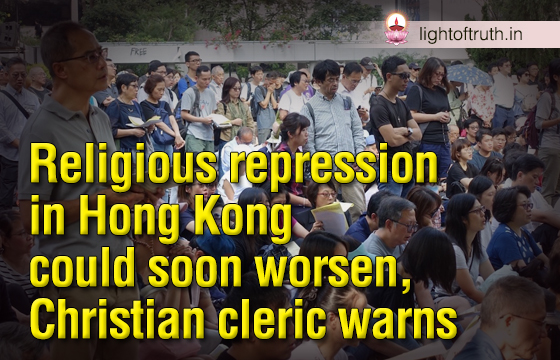
Religious repression in Hong Kong could soon worsen, Christian cleric warns
Speaking anonymously during an online discussion, a Christian cleric in Hong Kong said he thinks it is likely that greater repression by the Chinese government of religious freedom in Hong Kong, particularly the freedom of religious schools, is about to occur.
The cleric, identified only as Reverend L, told the Hudson Institute’s Nina Shea on Feb. 10 that the Chinese Communist Party appears to be using ideological tactics, such as education, to chip away at the freedom of religion in Hong Kong, which came under Chinese control in 1997.
“In terms of restricting the rights of religious freedom, the CCP is doing it step-by-step,” Reverend L said, noting that China has in recent years imposed serious restrictions on the rights of assembly, press, and speech in Hong Kong. “Freedom of religion is the only remaining freedom in Hong Kong at this moment,” he said.
Hong Kong is a special administrative region of China, whose citizens have historically enjoyed freedom of religion, “comparable to any country in the free world,” Reverend L said. In contrast, on the Chinese mainland, religious believers of all stripes are routinely restricted, surveilled, and oppressed by the communist government.
However, Reverend L says that religious freedom has been particularly eroded in Hong Kong since 2019, thanks to the CCP’s efforts to control the populace through an “ideological war.”
Reverend L pointed to a Reuters report from late December documenting an October meeting at which Chinese bishops and religious leaders briefed senior Hong Kong Catholic clergymen on President Xi Jinping’s vision of religion with “Chinese characteristics.”
Reverend L opined that the meeting sounded like a “brainwashing session” to attempt to make the faith more Chinese, and thus more expedient for the CCP.
At the end of January 2022, the Chinese-language newspaper Ta Kung Pao, which Reverend L described as a CCP propaganda publication, published four articles about Catholicism in Hong Kong, one of them about Hong Kong archbishop emeritus Cardinal Joseph Zen.
Zen, 90, has been a strong advocate of the Hong Kong pro-democracy movement for years, and is a sharp critic of the 2018 Vatican-China deal on the appointment of bishops.