
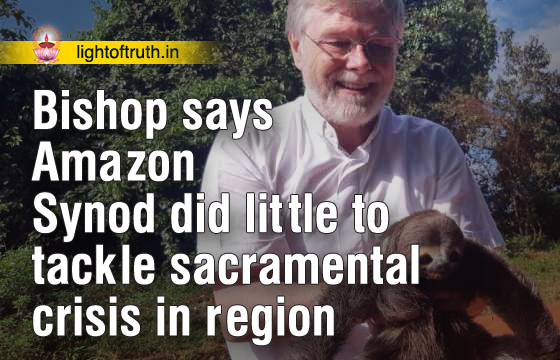
Bishop Eugenio Coter, an Italian who has been a missionary in Bolivia’s Amazon region since 1991, has a great sense of hu-mour: You ask him for a picture of himself, and he sends one in which he is holding a sloth.
Coter has been leading the Apostolic Vicariate of Pando since 2011. It’s a 64,000 square mile region with 260,000 inhabitants, 60,000 of whom live in 450 communities deep within the Amazon rainforest. To go from one community to the other, clergy and religious use small planes, boats, jeeps and motor-cycles.
The bishop spends a month a year living on a boat, but he says that is “fortunate,” since during most pastoral visits, he ends up staying in a tent or someone’s shed.
The primary source of inco-me for the inhabitants of this region come from the jungle, with almonds, plantains, acai and other fruits being the main products.
However, Coter says there are other “industries” of a more criminal nature, including “the seasonal trafficking in human beings,” a criminal endeavour that spiked in 2020 when thousands of Haitians and Cubans entered the region — they trek from Guyana, walking through Brazil and Bolivia as they head to Chile. The “coyotes” the bishop said, take advantage of the migrant’s desperation. Some of these criminals double as drug traffickers, another illegal industry in the Pando region.
Category Archives: International
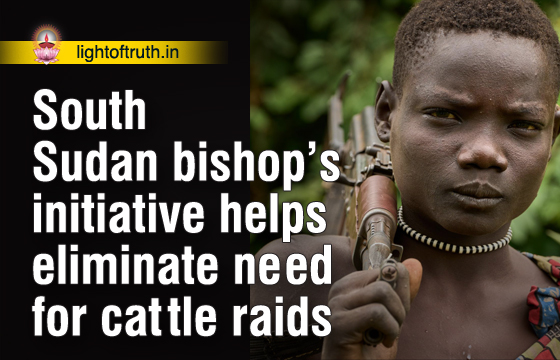
South Sudan bishop’s initiative helps eliminate need for cattle raids
In a country at war, it’s a region at peace, thanks to a retired South Sudanese Catholic bishop who has championed friendship among those who once saw each other as enemies.
During the civil war between southern Sudanese and the government in Khartoum, Sudan, Bishop Paride Taban was bishop of Torit, working to keep people alive in the middle of a decades long struggle. Though imprison-ed and beaten by Sudan People’s Liberation Army rebels, he bore no grudges and worked to foster reconciliation when the rebels took power following a landmark 2005 peace agreement.
But Bishop Taban knew political agreements signed by politicians weren’t going to make much difference on the ground, especially among the nomadic pastoralists in his diocese who viewed other tribes as enemies, competitors for the only real thing of value in the parched landscape: cattle. The age-old tradition of cattle raiding, essentially a violent sport that allowed young men to obtain the cows they needed to buy a bride, had been transfor-med by the addition of high-powered weapons left over from war. What had once produced only occasional injuries from spears now frequently turned into a massacre.
In 2004, Bishop Taban resigned as head of the Torit Diocese. The following year he founded Holy Trinity Peace Village in Kuron, where, as bishop, he had built a bridge over a river that was impassable during the rainy season. While the bridge opened up transport to a neglected area of the country, it posed a dilemma.
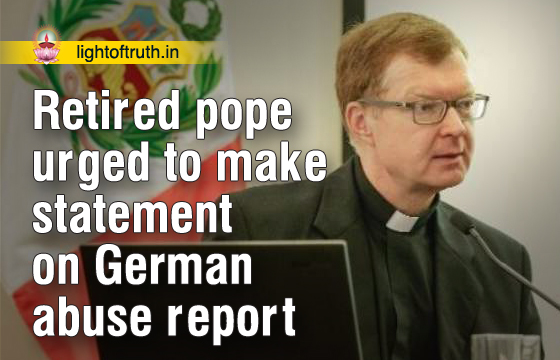
Retired pope urged to make statement on German abuse report
Following the publication of an experts’ report on how sexual abuse was handled in the Archdiocese of Munich and Freising, the German Catholic news agency KNA spoke to Jesuit Father Hans Zollner, a member of the Pontifical Commission for the Protection of Minors since its creation and president of the Institute of Anthropology: Interdisciplinary Studies on Human Dignity and Care at Rome’s Pontifical Gregorian University. Father Zollner said, “Each one individually should take a concrete, perceptible and understandable position and signal that they understand. The lawyer (Marion) Westpfahl said some-thing that I also noticed in my discussions with theologians: Church representatives give the impression that they do not believe in the power of the sacra-ment of reconciliation – the confession – when they deal with the sins and failures of those in position of responsibility. Examination of conscience – in this case: the experts’ report – confession, repentance and an act of compensation: All these are, according to classic Catholic teaching, a condition for forgiveness. This is true for individuals, but also for dioceses and bishops’ conferences.”

The 50 Countries Where It’s Hardest to Follow Jesus in 2022
Afghanistan is the new No. 1, according to the 2022 World Watch List (WWL), the latest annual accounting from Open Doors of the top 50 countries where it is most dangerous and difficult to be a Christian.
“This year’s findings indicate seismic changes in the persecution landscape,” said David Curry, president of Open Doors USA.
Since Open Doors began its tally in 1992, North Korea has led the ranking. But since Afghanistan’s takeover by the Taliban last August, Afghan believers have had to leave their country or relocate internally. Many lost everything they had, notes the report, while house churches were closed in their wake. “Before the Taliban, it was not great, but it was good,” said one evacuated Afghan, requesting anonymity in hopes that he may one day return. “[Now] Christians are living in fear, in secret, totally underground.”
Overall, 360 million Christians live in nations with high levels of persecution or discrimination. That’s 1 in 7 Christians worldwide, including 1 in 5 believers in Africa, 2 in 5 in Asia, and 1 in 15 in Latin America.
Last year, for the first time in 29 years of tracking, all 50 nations scored high enough to register “very high” persecution levels on Open Doors’ 84-question matrix. This year, all 50 again qualified—as did 5 more nations that fell just outside the cut-off. overall, the top 10 nations only shuffled positions from last year. Somalia held steady at No. 3, as did Libya at No. 4, Eritrea at No. 6, and India at No. 10. Yemen rose two spots to No. 5, replacing Pakistan which fell three spots to No. 8. Iran fell one spot to No. 9, and Nigeria rose two spots to No. 7, completing the group.
Violations of religious freedom in Nigeria are tied to a rapidly growing Islamist presence in the African Sahel. Mali rose to No. 24 from No. 28, and Open Doors fears it may increase further next year. Burkina Faso held steady at No. 32, and Niger jumped to No. 33 from No. 54. Nearby, the Central African Republic (CAR) rose to No. 31 from No. 35.
“The epicenter of international jihadism is now [in] the Sahel area,” said Illia Djadi, Open Doors senior analyst for freedom of religion and belief for sub-Saharan Africa. “This terrorism is moving south … and predominantly Christian countries like Benin, Togo, Ghana, Ivory Coast are now affected.” (None rank on the watch list.) Countries with Christian majorities rank relatively low in the top 50, and include Colombia (No. 30), Cuba (No. 37), Ethiopia (No. 38), the Democratic Republic of the Congo or DRC (No. 40), Mozambique (No. 41), Mexico (No. 43), and Cameroon (No. 44).
Of the top 50 nations:
11 have “extreme” levels of persecution and 39 have “very high” levels. Another five nations outside the top 50 also qualify as “very high”: Kenya, Sri Lanka, Comoros, United Arab Emirates, and Tanzania.
· 18 are in Africa (6 in North Africa), 29 are in Asia, 10 are in the Middle East, 4 are in Central Asia, and 3 are in Latin America.
· 34 have Islam as a main religion, 4 have Buddhism, 2 have Hinduism, 1 has atheism, 1 has agnosticism—and 10 have Christianity.
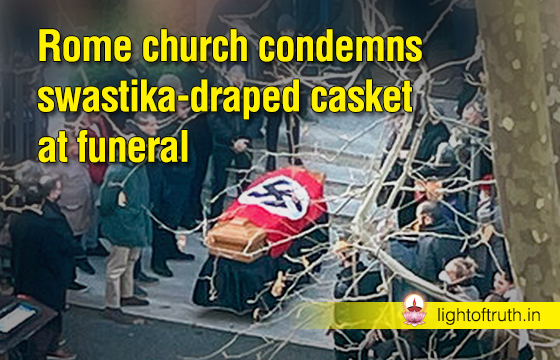
Rome church condemns swastika-draped casket at funeral
The Catholic Church in Rome on January 11 strongly condemned as “offensive and unacceptable” a funeral procession outside a local church in which the casket was draped in a Nazi flag and mourners gave the fascist salute. Photos and video of the scene outside St. Lucia church following the Monday funeral service were published by the Italian online news portal Open. They showed around two dozen people gathered outside the church as the swastika-draped casket emerged, shouting “Presente!” with their right arm extended in the fascist salute.
In a statement Tuesday, the Vicariate of Rome strongly condemned the scene and stressed that neither the parish priest, nor the priest who celebrated the funeral, knew what was going to transpire outside after the funeral Mass ended.
It called the swastika-emblazoned Nazi flag “a horrendous symbol irreconcilable with Christianity.”
“This ideological and violent exploitation, especially following an act of worship near a sacred place, remains serious, offensive and unacceptable for the church community of Rome and for all people of good will in our city,” it said.
The statement quoted the parish priest, Father Alessandro Zenobbi, as distancing himself and the church from “every word, gesture and symbol used outside the church, which are attributed to extremist ideologies far from the message of the Gospel of Christ.”
Italian news reports identified the deceased as a 44-year-old former militant of the extreme right-wing group Forza Nuova, who died over the weekend of a blood clot.
Pope Francis is technically the bishop of Rome, but he delegates the day-to-day management of the diocese to his vicar, Cardinal Angelo De Donatis.
‘Polite persecution’ of Christians gathers pace in Europe
European communities, with their sprawling churches, ancient cities, culinary skills, dance, music, et al, were once proud of their Christian roots. They slowly became secular in the 20th century and the evolution continues to move in a trajectory of despising the Christian faith and its followers.
When former German chancellor Helmut Kohl suggested that Turkey would never join the European Union (EU), it was hard to dismiss the criticism that he was speaking on behalf of Europe’s Christian fraternity and his concern for preserving a common cultural heritage.
When Princess Diana died in a car crash in Paris in 1997, Libya’s Colonel Muammar Gaddafi described it as a Franco-British plot to prevent the princess from marrying a Muslim
In the past, despite a policy-based separation of church and state, they worked together in crises as hands of the same body. In a secularized society, the state distanced itself from the church in the guise of nationalism and secular policies.
This has led to populist leaders in Europe interpreting religion according to their political views. Their current mantra of “inclusion” excludes the continent’s Christian roots and traditions. According to liberals, Europe’s strength lies in its diversity, and embracing differences of approach is necessary to pre-vent another war from taking place among European nations.
Italian bishop bans no-vaccinated priests from distributing communion
A bishop in the southern Italian region of Campania is making waves for his recent decision to ban priests, religious, and lay people who have not been vaccinated from distributing communion at Mass in a bid to curb Italy’s rising infection rate.
Bishop Giacomo Cirulli, who leads the Dioceses of Teano-Calvi and Alife-Caiazzo, in the Italian region of Campania, which has had 11,815 new COVID cases and five new COVID-related deaths in past 24 hours, issued a decree announcing the ban earlier this week.
In the Jan. 8 decree, Cirulli said the status of the pandemic “is constantly and seriously worsening,” and invited the faithful under his pastoral direction to “respect and strictly enforce prophylaxis and the sanitation norms for the containment of the pandemic within our churches and in the relevant premises.”
Specifically, he urged faithful to obey the rules of a May 7, 2020, Memorandum of Under-standing between the Italian government and CEI on the resumption of liturgical celebrations, which bans the use of holy water and the reception of communion on the tongue, requires Mass attendees to maintain at least three feet of distance, use hand sanitizer, and to wear face masks.
Cirulli asked Mass-goers to “to strictly respect the distance and therefore the number of admissions into the liturgical hall” in the days and weeks to come.
Vatican delays external audit of contracts in Germany’s Cologne archdiocese
The Vatican has said that an external review of contracts in Germany’s Cologne archdiocese must wait until Cardinal Rainer Maria Woelki returns from a sabbatical.
The archdiocese disclosed Rome’s decision on Jan. 4, less than a month after it announced the review of contracts surrounding a landmark study of clerical abuse, reported CNA Deutsch, CNA’s German-language news partner.
The archdiocese said on Dec. 7 that Bishop Rolf Steinhäuser, who was named administrator of the archdiocese in October 2020, had “immediately” commission-ed two independent canon lawyers to study the contracts awarded by Woelki and vicar general Msgr. Markus Hofmann.
The contracts related to the 800-page Gercke Report, released in March. The study, known as the “Independent Investigation into the Handling of Sexualized Violence in the Archdiocese of Cologne,” covered the period from 1975 to 2018.
Pope’s Latin Mass decision hasn’t affected his popularity, survey finds
Pope Francis’ decision in July to re-impose restrictions on the celebration of the older form of the Latin Mass appears not to have affected his standing among U.S. Catholics, according to a report released Oct. 7 by the Pew Research Center. About 83% of Catholics in the country have a favourable view of Francis, based on responses from 1,374 Catholics to a Pew online survey in September. Some 65% of the respondents said they had heard “nothing at all” about Francis’ decision, which reversed a 2007 move by retired Pope Benedict XVI to allow priests to celebrate the form of the Mass used before the 1962-65 Second Vatican Council.
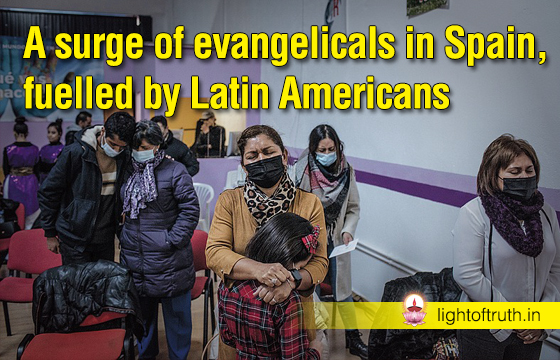
A surge of evangelicals in Spain, fuelled by Latin Americans
When Kent Albright, a Baptist pastor from the United States, arrived as a missionary to Spain in 1996, he was unprepared for the insults and threats, or the fines from the police for handing out Protestant leaflets on the streets of Salamanca. “Social animosity was big — they had never seen a Protestant in their life,” said Albright, recalling one woman who whispered, “Be thankful we don’t throw stones at you.”
He couldn’t have imagined that 25 years later, he would be pastoring an evangelical congregation of 120 and count about two dozen other thriving Protestant churches in the north-western city. And there’s a distinctive feature to the worshippers: Most of them are not Spanish-born — they’re immigrants from Latin America, including about 80 percent of Albright’s congregation.
The numbers reflect huge surges in Spain’s migrant population and evangelical population in recent decades, producing profound changes in how faith is practiced in a country long dominated by the Catholic Church. “The Bible says there are no ethnicities, there are no races. I don’t go down the street asking, nor do I ask for passports at the church door.” Albright said. He marvels that in a course he teaches for deacons, his six students include one each from Peru, Venezuela, Colombia and Ecuador.
One of the newest members of his congregation is Luis Perozo, 31, a former police officer from Maracaibo, Venezuela who arrived in Spain in February 2020 and applied for asylum with his wife, Narbic Escalante, 35.
While the couple wait for their status to be resolved, Perozo works in the laundry of a hotel. His wife does nursing in a retirement home.
“I was a lifelong Catholic,” says Escalante. “When I arrived in Salamanca, I entered the church, looked everywhere, said hello, and they ignored me. I went to several churches — I felt absolutely nothing.”
Perozo and Escalante soon visited Albright´s church — one of Perozo’s uncles had emigrated earlier and was already a member.
“The next day, Pastor Albright was helping us find a house, appliances and kitchenware. He moved us with his van,” Escalante said.
She commended Albright’s approach to pastoring, including services with lively music and less emphasis on repetitive prayer.
“I definitely feel better here than in the Catholic Church,” she says. “It allows me to live more freely, with less inhibitions.”