

Over the course of nine days, a religious procession known as the Folia of the Di-vine Holy Spirit brings messages of faith and song to farms and villages across the countryside of Brazil’s Goias state. Like a medieval caravan, the group framed by small red and white flags is comprised of more than 300 people, many of them on horseback.
The image of a dove decorates the pole of a banner during the culmination of the religious tradition, “Folia do Divino Espirito Santo” or Feast of the Divine, in the rural area of Pirenopolis, state of Goias, Brazil, Saturday, May 28, 2022 A mounted rider plays a Berrante, an ox horn musical instrument, during a parade culminating the religious tradition, “Folia do Divino Espirito Santo” or Feast of the Divine, in the rural area of Pirenopolis, state of Goias, Brazil, Saturday, May 28, 2022 Revelers take part in the grand dance of the night of the religious tradition, “Folia do Divino Espirito Santo” or Feast of the Divine, in the rural area of Pirenopolis, state of Goias, Brazil, Saturday, May 28, 2022.
Category Archives: International
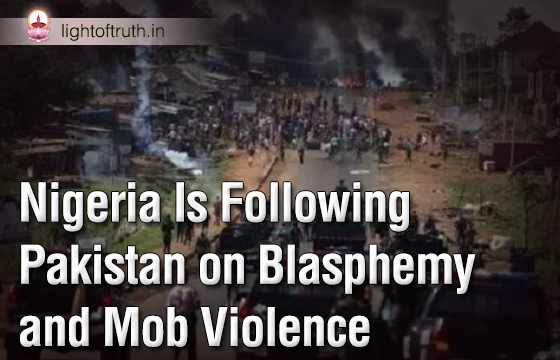
Nigeria Is Following Pakistan on Blasphemy and Mob Violence
On May 12, a Nigerian Christian student named Deborah Emmanuel Yakubu was stoned, beaten to death, and her body burnt in Sokoto, Nigeria, by her fellow classmates because of allegations of blasphemy. On May 16, protestors in Borno State, Nigeria, went to police headquarters in Maiduguri demanding the release of Christian woman Naomi Goni so that they could kill her for alleged blasphemy on social media. On May 20, rioters in Bauchi State, Nigeria, set Christian-owned homes and stores on fire based on allegedly blasphemous statements made online by Christian woman Rhoda Jatau.
While violent murders and riots over allegations of blasphemy have occurred sporadically in Northern Nigeria for decades, the recent string of attacks and the high-profile coverage of the murder of Deborah Emmanuel is a troubling indicator of what may become a new normal in Nigeria. The increase in mob violence related to blasphemy accusations resembles the reality in Pakistan, a country infamous for its harsh treatment of alleged blasphemers.
In February of this year, a mentally disabled man, Muhammad Mushtaq, was tortured and lynched after being accused of burning pages from the Quran inside a mosque in Pakistan. Ninety individuals have been killed in mob violence for blasphemy allegations in Pakistan since 1947.
Pakistan sees more mob killings related to blasphemy allegations than any country in the world. Joining them as one of the worst countries for such attacks is Nigeria, according to the U.S. Commission on International Religious Freedom. But while the U.S. sanctions Pakistan as one of the worst violators of religious freedom, Nigeria inexplicably had similar sanctions lifted in Dec. 2021.
Open Doors’ World Watch List tracks the worst places in the world to be a Christian and, often, any other religious minority. Pakistan was ranked the 8th worst country, in large part because of its blasphemy laws and the mob violence they inspire against Christians, Hindus, and others. But edging out Pakistan for the first time this year? Nigeria at 7th place.
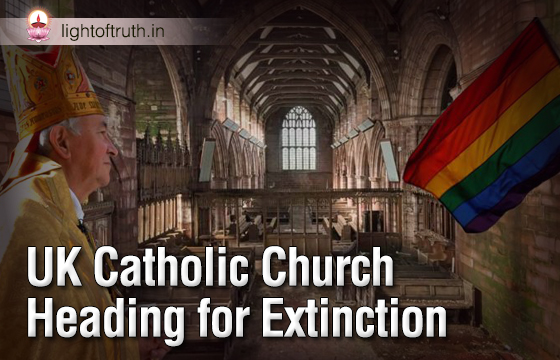
UK Catholic Church Heading for Extinction
A leading British mathematician is predicting the “exponential decline” of the Catholic Church in England and Wales by 2050, as it becomes increasingly woke in its embrace of progressive ideology.
Using epidemiological modeling, which is designed to calculate the number of persons infected with a contagious illness in a closed population over time, Dr. John Hayward computes that with a current “reproduction potential of 0.91,” the Catholic Church in England and Wales “will eventually become extinct.”
Noting that the decline in attendance at Holy Mass is “accelerating,” Hayward predicts that “in the worst-case scenario, the … church will be extinct by 2048.” Indeed, according to the visiting mathematics fellow at the University of South Wales, “The church’s future will likely lie somewhere between linear and exponential decline.”
Hayward argues that the critical factors hastening church extinction are a lack of enthusiasm in making converts and an openness to cultural Marxism, critical race theory, the sexual revolution and the LGBTQ+ agenda.
“To date, no growing church has adopted same-sex ‘marriage,’” Hayward writes, noting that all growing denominations hold firmly to historic Christianity and have statements affirming that marriage is between a man and a woman only.
Moreover, growing churches demonstrate a confidence in the authority of Scripture, which “enables them to stand against progressive ideology and drives their efforts in making disciples,” observes the statistician and founder of the Church Growth Modeling site.
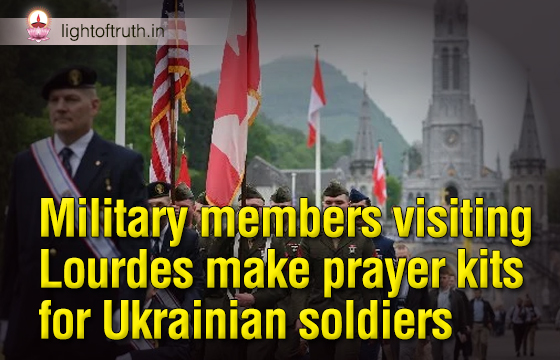
Military members visiting Lourdes make prayer kits for Ukrainian soldiers
Participants in an annual pilgrimage to Lourdes, France, for U.S. active-duty military personnel and veterans assembled 3,000 prayer kits for Ukrainian soldiers.
The “Warriors to Lourdes” pilgrimage May 10-16 drew more than 175 participants and was co-sponsored by the U.S. Arch-diocese for the Military Services and the Knights of Columbus.
U.S. military personnel visit-ed the Shrine of Our Lady of Lourdes, which is where Mary appeared to St. Bernadette Soubirous in 1858. They attended daily Mass and had various opportunities for prayer, formation and fellowship. The prayer kits blessed by Archbishop Timothy P. Broglio, who heads the U.S. military archdiocese, and were then shipped to Ukraine for distribution to active-duty and injured Ukrainian soldiers.
Each kit included a rosary, an Our Lady of Lourdes prayer card, a vial of Lourdes holy water and a Blessed Michael McGivney prayer card.
McGivney, who was beatified Oct. 31, 2020, was a parish priest in New Haven when he founded the Knights of Columbus in 1882 to serve the needs of a largely immigrant Catholic community.
“What began as a small fraternal benefit society has since grown into one of the world’s leading international charitable organizations, with 2 million members in more than 16,000 local councils,” said a news re-lease about the pilgrimage.
The Knights also sponsored a Ukrainian delegation to be part of the Lourdes pilgrimage through the organization’s United in Charity initiative, offering them an opportunity for prayer and healing during this time of war in their nation.
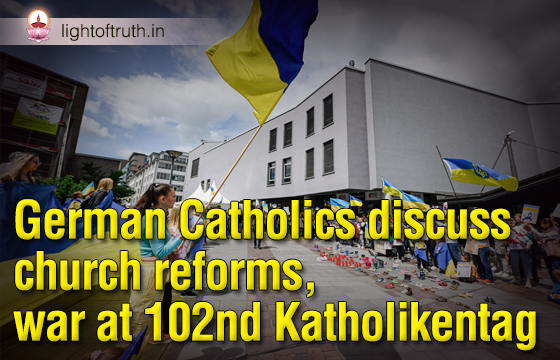
German Catholics discuss church reforms, war at 102nd Katholikentag
Peace, justice, climate justice, the war in the Ukraine and its global impact and the ongoing crisis in the German Catholic Church were some of the themes Catholic laity, bishops and politicians and activists discussed during the five-day 102nd Ger-man Katholikentag.
The biannual festival and meeting for German-speaking Catholic laity took place for the first time in four years May 25-29 in Stuttgart. Participants heard from political and church leaders.
Speaking May 27, German Chancellor Olaf Scholz said Russian President Vladimir Putin’s war in Ukraine is directed against “the values and convictions that unite us as a society.” Putin, he said, “must not be allowed to get away with his cynical, inhuman war.”
Scholz, who had just returned from a three-day trip to Senegal, Niger and South Africa, blamed the Russian president for an impending food crisis that is expected to hit the global south the hardest.
Scholz thanked the churches for their aid to Ukraine and for receiving refugees in Germany. He admitted that the war raises questions that are both political and ethical and that need to be discussed.
“At the heart of the matter is the question of whether violence can be fought with violence,” said the chancellor, who as a young man was a conscientious objector to compulsory military service.
About 200 demonstrators were chanting “Arm Ukraine now” in front of the hall where Scholz was speaking. On placards, they criticized that the arms deliveries were not arriving fast enough.
Bishop Gebhard Fürst of Rottenburg-Stuttgart, the diocese hosting the event, said he was in favor of arms deliveries to Ukraine.
“I observe that some things are delayed there, and it is, however, urgently necessary that much that is necessary for self-defense continues to be delivered. That’s a commitment to peace when you resist the aggressor,” he told the audience.
The president of the Catholic peace movement Pax Christi Germany, Bishop Peter Kohlgraf of Mainz, said in an interview with KNA, the German Catholic news agency, that he believed a reorientation and new reflection of Christian peace ethics is necessary. Situations like Russia’s current war of aggression against Ukraine are not usually foreseen in most of the peace ethics theories, books and debates, he said.
Also May 27, a rally for peace among participants found many Ukrainians joining in. A local radio station spoke to one of the participants, Father Roman Wruszczak, a parish priest of the Ukrainian Greek Catholic Church. “We suffer with Ukraine, we cry every day. Personally, I do too. There are days when I find it difficult to celebrate the liturgy,” he said during the interview.
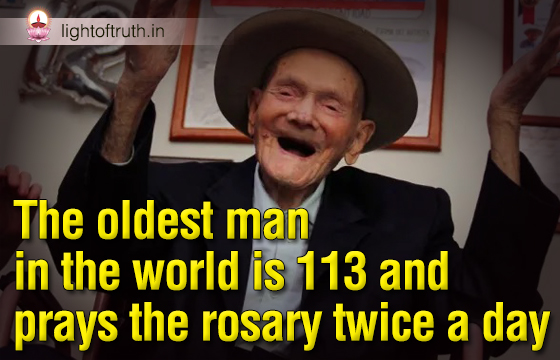
The oldest man in the world is 113 and prays the rosary twice a day
His name is Juan Vicente Pérez Mora, he’s Venezuelan, passionate about his faith, prays the rosary twice a day, and is in the Guinness World Records as the oldest man in the world.
Mora was born on May 27, 1909 and this year he turned 113 years old.
In an article published on May 17 on the Guinness World Records website, Mora said his secret to living a long life is to “work hard, rest on holidays, go to bed early, drink a glass of aguardiente (a strong liquor made from sugarcane) every day, love God, and always carry him in your heart.”
He says his family and friends are his greatest life companions and that the greatest thing he has learned in life is “the love of God, the love of family, and that we must get up early to work.”
According to the Guinness World Records, Mora was officially confirmed the oldest living man in the world on Feb. 4, 2022.
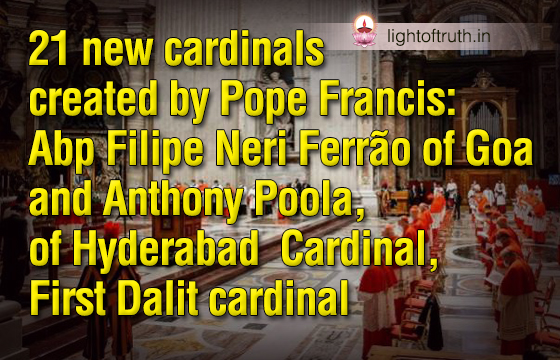
21 new cardinals created by Pope Francis: Abp Filipe Neri Ferrão of Goa and Anthony Poola, of Hyderabad Cardinals, First Dalit cardinal
There will be 16 cardinals under the age of 80 elevated at the next consistory, to be held Aug. 27. This will be the eighth consistory of Pope Francis’ pontificate, and the first of his to be held in August.
The last time a cardinal was made in August, a torrid month in Rome when all things slow down in the Vatican Curia, was on Aug. 24, 1807 when Pius VII created Francesco Guidobono Cavalchini a cardinal “in pectore”, announcing his name only in April 1808.
With these new cardinals, Pope Francis will have created 122. There are three members of the Curia: The cardinals are:
— Cardinal Jean-Marc Noël Aveline, 63, Archbishop of Marseille, who will become the first French diocesan bishop to get the honor during Pope Francis’ pontificate;
— Peter Ebere Okpaleke, 59, Bishop of Ekwulobia in the central region of Nigeria, who was created bishop in 2012 by Benedict XVI;
— Leonardo Ullrich, 77, Archbishop of Manaus, in Brazil’s Amazon region, a Franciscan who played a leading role during the Amazon Synod and the current Vice President of the recently created Amazonian Bishops’ Conference;
— Filipe Neri António Sebastião do Rosário Ferrão, 69, Archbishop of Goa, appointed bishop by St. John Paul II in 1993 and currently the President of Latin-rite bishops of India;
— Robert McElroy, 68, Bishop of San Diego (United States), whose diocese is suffragan to the Archdiocese of Los Angeles, led by the President of the USCCB, Archbishop José Gomez;
— Virgilio do Carmo Da Silva, 68, a Salesian, Archbishop of Dili (East Timor);
— Oscar Cantoni, 71, Bishop of Como (Italy), appointed in January 2005 by St. John Paul II, who is suffragan to Milan;
— Anthony Poola, 60, Archbishop of Hyderabad (India), a bishop since 2008 and the first dalit to become a cardinal;
— Paulo Cezar Costa, 54, Archbishop of Brasilia (Brazil), the fourth archbishop of the Brazilian capital to become a cardinal;
— Richard Kuuia Baawobr, 62, Bishop of Wa (Ghana), former Superior General of the White Fathers, and bishop since 2016;
— William Goh Seng Chye, 62, Arch-bishop of Singapore since 2013; — Adalberto Martinez Flores, 70, Archbishop of Asunción (Paraguay) and the first Paraguayan cardinal;
— Giorgio Marengo, 47, Italian Missionary of the Consolata and Apostolic Prefect of Ulan Bator in Mongolia, who will be the youngest cardinal in recent history, along with Karol Wojtyla, who also was created a cardinal at 47, during the consistory of June 26, 1967.
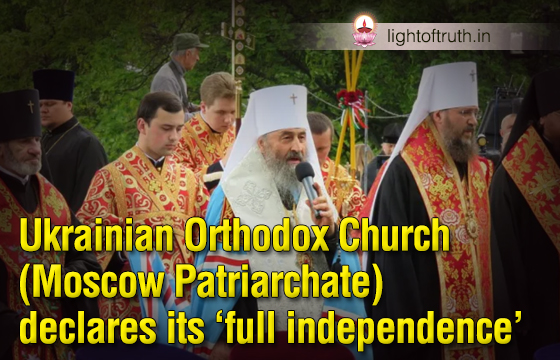
Ukrainian Orthodox Church (Moscow Patriarchate) declares its ‘full independence’
A council of the Ukrainian Orthodox Church (Moscow Patriarchate) on May 27 resolved on its “full self-sufficiency and independence,” distancing the Church from Russian Orthodoxy. The decision comes amid the third month of the Russian invasion of Ukraine, which has been prominently supported by Patriarch Kirill of Moscow.
“The Council adopted relevant amendments and additions to the Statutes on the administration of the Ukrainian Orthodox Church, indicating the full self-sufficiency and independence of the Ukrainian Orthodox Church,” the Church resolved May 27 in Kyiv.
The council also condemned the Russo-Ukrainian War, gave terms for dialogue with the Orthodox Church of Ukraine, and broached the possibility of making chrism, which as been considered a sign of autocephaly in the Russian tradition.
“The council condemns the war as a violation of God’s commandment Thou shalt not kill,” it said, and it expressed its “disagreement with the position of Patriarch Kirill of Moscow and All Russia regarding the war in Ukraine.”
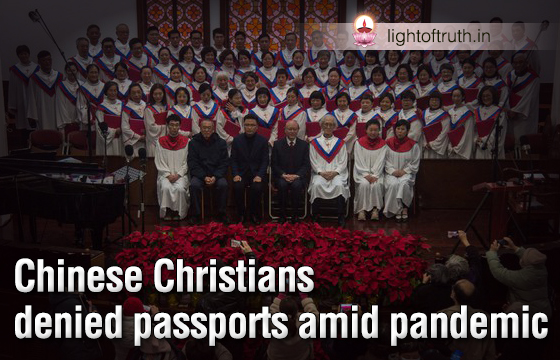
Chinese Christians denied passports amid pandemic
Christians in eastern China who wish to travel abroad for various reasons including emigration and studies are facing hard times as authorities have denied them passports, citing travel restrictions due to the Covid-19 pandemic.
Christians from several families in Zhejiang and Jiangsu provinces said immigration officials questioned the purpose of their passport applications and later rejected the applications after they discovered their religious adherence, Radio Free Asia (RFA) reported on May 26.
In Zhejiang’s Wenzhou city, which has a significant concentration of Protestant Christians, authorities have reportedly rejected the passport applications of many students seeking over-seas education, an education consultant said.
The scenario is similar in Jiangsu province as well.
“A bunch of students from Wenzhou with a church back-ground had been planning to go and study at overseas universities, but the government has refused to give them passports,” said Zhu, a Christian from Xu-zhou city in Jiangsu who would be identified only by his surname.
Pope Francis highlights danger of staid liturgies that ‘deny Vatican Council II’
Pope Francis is pushed in a wheelchair by his aide, Sandro Mariotti, as he leaves an audience with students and professors of Rome’s Pontifical Institute of Liturgy at St. Anselm, May 7 at the Vatican. The Pope said that the celebration of the liturgy and the study of it should lead to greater unity in the church, not division and squabbles.
There is an old saying: “During Holy Week, there is nothing more useless than a Jesuit.” The magnificent liturgies of that holiest of times requires a profound liturgical sense. Members of the Society of Jesus have never been known for their liturgical flair and Pope Francis is no exception. When he presides, it is in a very unembellished, straightforward manner.
Consequently, his remarks to the members of the Pontifical Liturgical Institute last weekend (May 7) were a bit surprising. No one should be surprised that a man of such spiritual solidity entertains deep spiritual sentiments about the liturgy, but to hear him share them was a rare insight into what makes the Holy Father tick.
Much of the attention has focused on his remarks about liturgical formalism. “I would like to underline the danger, the temptation of liturgical formalism: going after forms, formalities rather than reality, as we see today in those movements that try to go backwards and deny Vatican Council II itself,” the Pope said. “In this way, the celebration is recitation, it is some-thing without life, without joy.” (Emphasis in original.)
The key phrase there is “deny Vatican Council II.” We have all attended post-conciliar liturgies that lack joy. But it is when the liturgy becomes a weapon in the culture wars, when doubts are raised about Vatican II and its legitimacy, when liturgy becomes an ideological expression rather than an ecclesial one, that is where the Holy Spirit is shut out and the in-breaking of the divine mystery is nullified.
Francis did not mince words here: “When liturgical life becomes something of a banner of division, there is the odor of the devil, the deceiver, in there.”