
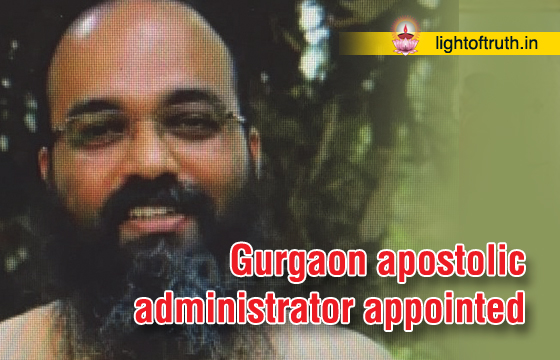
Pope Francis has appointed Father Varghese Vinayanand Vekkal as the apostolic administrator of the Gurgaon Syro-Malankara diocese.
The appointment came August 28, two days after Bishop Jacob Barnabas Chacko Aerath of Gurgaon died of post Covid complications in a private hospital in New Delhi. The gathering at St Mary’s Cathedral, Neb Sarai, New DelhiAn official communication from Cardinal Baselios Cleemis, head of the Syro-Malankara Church, said the appointment took effect from August 28.
Category Archives: From The States
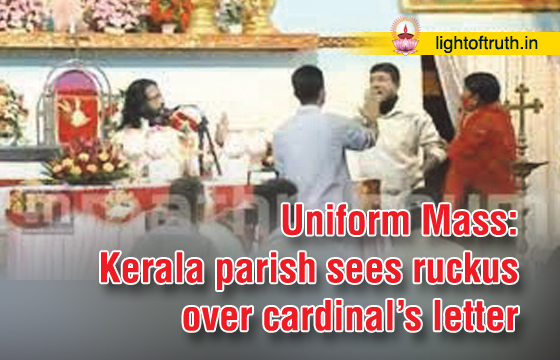
Uniform Mass: Kerala parish sees ruckus over cardinal’s letter
A parish in Kerala on September 5 witnessed unruly scenes when its priest tried to read a pastoral letter from the head of the Syro-Malabar Church during the Sunday Mass.
A section of parishioners of the Holy Family Church at Prasannapuram near Aluva rushed to the altar to prevent the priest from reading the letter from Cardinal George Alencherry.
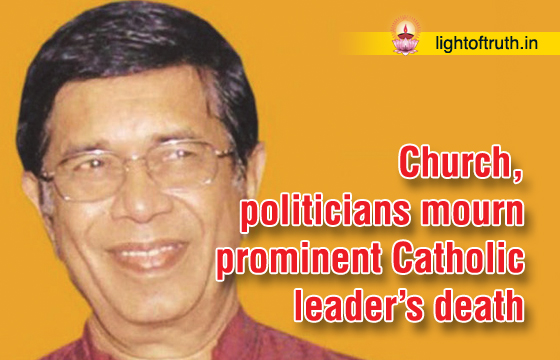
Church, politicians mourn prominent Catholic leader’s death
Cardinal Oswald Gracias, head of the Catholic Church in India, on September 13 joined political and social leaders to mourn the death of Oscar Fernandes, a former federal minister. Fernandes, a member of the Congress party, died earlier in the day at Mangaluru, a port town in Karnataka state. He was hospitalized after he suffered an injury in July. He was 80. Fernandes was being treated the ICU at Yenepoya Hospital in Mangaluru after the fall during his regular morning yoga sessions.
He is survived by his wife Blossom Fernandes, son, and a daughter.
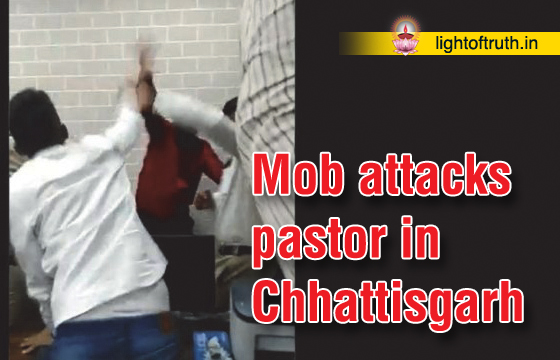
Mob attacks pastor in Chhattisgarh
A pastor and two others were beaten up by a right-wing mob inside a police station in Raipur, capital of the central Indian state of Chhattisgarh.
The mob accused the pastor of indulging in forced religious conversions. The September 5 attack occurred after heated arguments between the mob and those who accompanied the pastor to the police station where they were called for questioning.
The incident took place at the Purani Basti police station in Raipur. The police had received complaints of forced religious conversions being carried out in the Bhatagaon area. A few local right-wing Hindutva leaders, too, reached the police station shortly after.
The complainants were furious and gheraoed the building demanding action against those carrying out such conversion. The arrival of the pastor, along with some Christians of the Bhatagaon area, sparked the exchange of words between the mob and those called in for questioning.
The pastor was then taken into the station in-charge’s room where the tense situation only worsened. Soon the pastor was subjected to physical assault, officials said. A video of the incident shows some members hitting the priest with slippers and shoes.

Minorities’ commission awaits
Pakistan’s National Commission for Minorities (NCM) has called on President Arif Alvi to approve a draft bill for empowerment of the commission formed by the federal cabinet last year.
The recommendations, shared in a Sept. 7 meeting at the presidential house, include appointing only a non-Muslim as commission chairman and cover the process of appointing members and budget allocation.
“This bill should have been passed 70 years ago. We hope it is passed in our tenure. This commission was formed 20 years ago but none of our communities knew about its existence. It only existed on paper. We have already shared our concerns with the prime minister and the chief justice of Pakistan,” Jaipal Chhabria, a Hindu NCM member, told.
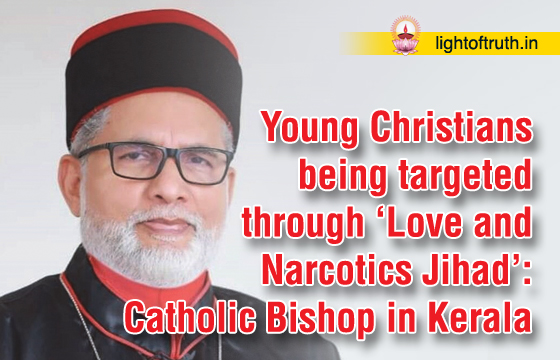
Young Christians being targeted through ‘love and narcotics jihad’: Catholic Bishop in Kerala
A prominent Catholic Bishop in Kerala claimed that young men and women, belonging to the Christian community and other non-Muslim faiths, were being lured and targeted through means such as ‘love jihad’ and ‘narcotic jihad’ in the state.
Addressing the laity on the occasion of the Eight day of Lent of Mary earlier this week, Joseph Kallarangatt, Bishop of the Palai diocese of the Syro-Malabar Church, alleged that those who claim that ‘love jihad’ doesn’t exist in Kerala are “blind to reality.” “Such people, be they politicians or those from social and cultural spaces, media may have their own vested interests. But one thing is clear. We are losing our young women. It’s not just love marriages. It’s a war strategy to destroy their lives,” he claimed.
The Bishop, presiding over a diocese that has the largest concentration of Syro-Malabar Catholics in the state, alluded to former DGP Loknath Behera’s statement that Kerala was becoming a recruitment centre for terrorists and that it was home to ‘sleeper cells’ for such persons.
“In a democratic country like ours, since it’s not easy to use weapons to destroy people of other faiths, jihadis are using means which are not easily identifiable. In the view of jihadis, non-Muslims are to be destroyed. When the objective is expansion of their religion and destruction of non-Muslims, the means they use are of different forms. Two of such widely-discussed means today are love jihad and narcotics jihad,” he alleged.
India’s Eastern Church moves for uniform liturgy ignoring opposition
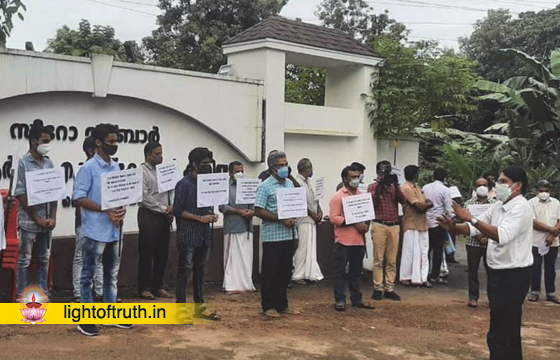
Synod of the Eastern rite Syro-Malabar Church has decided to implement a uniform mode of celebrating mass in all its 35 dioceses from Nov. 28, ignoring the opposition from a section of priests and laity. All dioceses will celebrate the liturgy in a uniform way by next April 17, Easter Sunday of 2022, said the synod in an Aug. 27 statement, issued at the end of its week-long online gathering.
The synod decision follows Pope Francis’ letter on July 6, which asked the Church to implement a standardized form of liturgy, as agreed by the synod of Bishops in 1999. The Church has been divided over the liturgical celebration for more than four decades with some priests celebrating the Mass facing the congregation, while some faced the altar against the congregation.
The synod two decades ago agreed that all its priests will face the congregation during the Mass until the Eucharistic prayer, and then again from Communion to the end of the Mass. During the Eucharistic prayer, they will face the altar against the congregation.
However, a section of priests and laity opposed it and sought papal intervention. They did not want priests to stand facing the altar, against the congregation during the Mass.
The latest papal letter asked to implement the 1999 synod decision as “an important step towards increasing stability and ecclesial communion” in the Church, based in southern Indian Kerala state.
The synod “unanimously welcomed” the papal letter and thanked “his intervention for the unity and growth” of the Church, the synod statement said.
As a first step of implementing the decision, all cathedral churches, pilgrim centres, religious houses and minor seminaries will implement the decision on Novem. 18, the beginning of the Church’s liturgical year.
Some bishops, who expressed difficulties in implementing the decision in their whole diocese, can introduce the uniform mode of celebration starting with all possible parishes on Nov. 18.
“By effective catechesis, the uniform mode shall be gradually introduced in the whole eparchy as early as possible, not later than Easter 2022,” the statement said.
However, soon after the decision was announced, a group of people under the banner of the Archdiocesan Movement for Transparency (AMT) protested in front of Mount St Thomas, the headquarters of the Church in Kerala’s Ernakulum district.
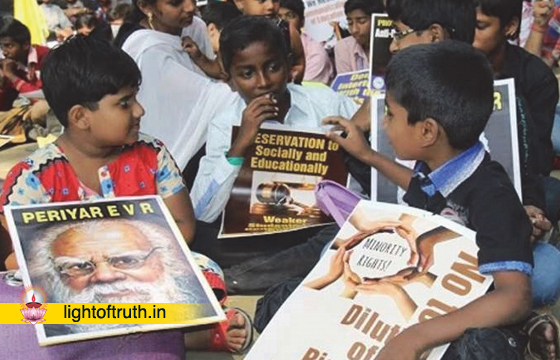
India seeks to curtail privileges of minority schools
A Catholic official in India has criticized as “politically motivated” a federal commission’s recommendations to curtail the rights of schools run by religious minorities such as Christians.
The National Commission for Protection of Child Rights (NCPCR), in a study released last week, sought to bring minority schools, most of them run by Christian institutions, under its right to education and universal elementary education policies.
The federal government makes it mandatory to include underprivileged children in schools under its Right to Education (RTE) Act and provides elementary education to all children aged 6-14 under a universal education scheme.
However, the Supreme Court of India declared the RTE Act inapplicable to schools with minority status while upholding their right to establish and administer institutions of their choice.
“This study, which targets Christians and Muslims, may be politically motivated,” Fr Maria Charles, secretary of the Indian Catholic bishops’ commission for education and culture, told.
He said minority-run institutions share the responsibility of offering good education to the poor and marginalized while reminding the government of its responsibility to provide good education to children who are deprived of it.
Skewed sex ratio leads to dubious marriages in India
They say marriages are made in heaven but in the western Indian state of Gujarat, a dubious syndicate of paid agents is playing matchmaker for the mostly jobless boys from the prosperous Patel community and young girls from the indigenous Adivasi communities. The consequences are evidently disturbing and causing much pain and loss to the poor tribal people, who are highly protective of their girls like any class or caste community in India.
Bharatiya Tribal Party leader Raj Vasava says this has been a common practice among the Hindu Patel men to buy tribal women for marriage. But now it is being resented by the tribal communities. “It is a cultural assault and cannot be allowed,” he said.
The Patels, who are socially, economically and politically the most influential community in Gujarat, have no other way to deal with their skewed sex ratio of 700 girls for every 1,000 boys.
The state has some 10 million tribal people among its 62 million population. The state also has some 350,000 Christians, an estimated half of them are tribal people. While selecting brides, the Patels do not distinguish between Christian and Hindu tribal people, a Petel leader said.
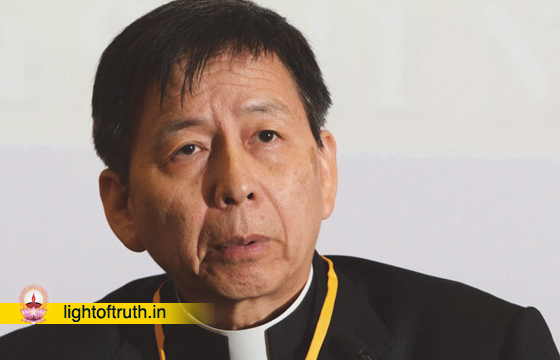
Chinese abp: Three stages to ‘drama’ involving church, communists
The ongoing “drama” between Chinese Catholics and the nation’s communist leaders has three stages, said Chinese Archbishop Savio Hon Tai-Fai, the Vatican’s nuncio to Greece.
The current stage in the drama, in effect since 2013, is one of “shrinking and getting confused,” Hon said.
“As a result of the drama, people feel so disoriented, disconnected,” Hon said in his recent keynote address to the 28th international conference of the U.S.-China Catholic Association, held at Jesuit-run Santa Clara University.
Hon cited three major players in each stage of the drama: the communist regime, the church in China and the Vatican. At this time, the Vatican was “trying to normalize the diplomatic relationship” with China, he noted. “The Holy See encouraged the Catholics to remain faithful, stating that an ‘independent church’ cannot be the ‘Catholic Church,’” Hon added.