
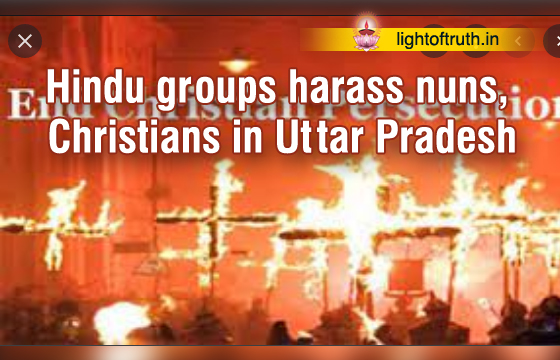
Some 50 Christ devotees attending Sunday service were attacked by Hindu radicals in the Mau district of the northern Indian state of Uttar Pradesh. The activists of Bajrang Dal (party of the stout and strong) and Hindu Yuva Vahini, a youth group, paraded the Christians to the nearby police station where they were detained until late night on October 10.
Seven of them, including three women and a pastor, were sent to jail for attempting forced religious conversion and other allegations.
Meanwhile two Ursuline Franciscan nuns, who had come to the city bus stand, were forcibly taken to the police station and kept there from 12:30 pm to 6 p.m. They were released under pressure from high ranking police officials from Lucknow, the state capital.
Sister Gracy Monteiro, working in Mirpur Catholic mission, told Matters India that she had gone to the bus stand to help her companion Sister Roshni Minj to board a bus to Varanasi.
Sister Minj was going home to visit her ailing father in the eastern Indian state of Jharkhand. As Minj went to ask about the bus, some Hindu radicals attacked the driver and forced the nuns to walk to the police station, where the Sunday worshipers were already detained..
Sister Monteiro said she was under terrible shock for almost an hour as she and Sister Minj were accused of being part of the Sunday worshippers who were allegedly attempting to forcibly converting the people.
Vijendra Rajbhar, the leader of the Christ devotees, told the police and the journalists that the Catholic nuns were not part of the prayer meeting. The Hindu radicals insisted that the nuns are part of the conversion gang.
Category Archives: From The States
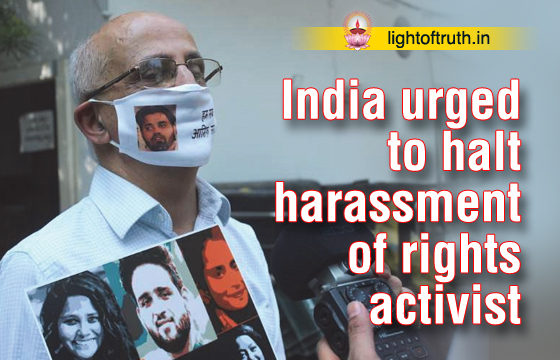
India urged to halt harassment of rights activist
CIVICUS, the global civil society alliance, has condemned a recent raid carried out on facilities associated with human rights defender Harsh Mander, director of the Centre for Equity Studies, and called on the Indian government to stop intimidating rights activists.
On Sept. 16, the Enforcement Dire-ctorate under the Ministry of Finance conducted the raid on Mander’s residence, the Centre for Equity Studies’ office and a children’s home run by the organization under the pretext of investigating money-laundering allegations against him. The raid was carried out several hours after he departed for Germany to attend a fellowship program.
Mander has been critical of the Narendra Modi government. He has rais-ed concerns about how the government handled the pandemic, the increasing attacks on press freedom and the discri-minatory citizenship law passed in 2019 which human rights groups have called “unconstitutional and divisive.” Following the raid, more than 500 activists in India issued a joint statement in solidarity with Mander and condemned the intimi-dation tactics.
“The authorities must halt their harassment of human rights activist Harsh Mander. These actions conducted by the Enforcement Directorate are a clear tactic to intimidate and criminalize the defender. It also creates a chilling effect on govern-ment critics and is a strategy to force many to self-censorship,” said Josef Benedict, CIVICUS civic space researcher for Asia Pacific.
Similar raids were conducted by the National Commission for Protection of Child Rights in October 2020 on two children’s homes associated with Mander based on accusations of financial irregu-larities and illicit activities.
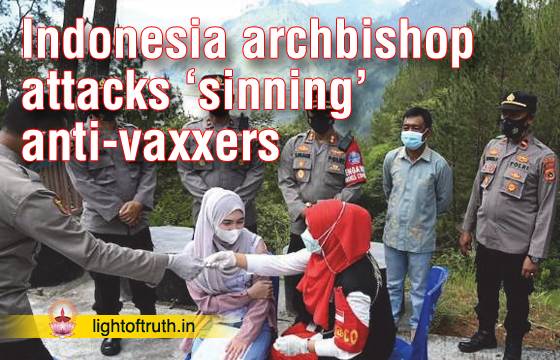
Indonesian archbishop attacks ‘sinning’ anti-vaxxers
People who refuse to be vaccinated against Covid-19 are sinners for endangering other people, according to an Indonesian archbishop who has been infected with the virus.
“Let’s not say that I don’t need to be vaccinated. If you don’t want to be vaccinated, you are actually a sinner be-cause you will become a source of the disease for other peo-ple,” said Archbishop Petrus Canisius Mandagi of Merauke.
He was speaking at a Mass at the Sacred Heart of Jesus Church in West Olilit, Maluku, on Sept. 22.
He invited his flock to think about the impact of Covid-19, which has killed millions of people worldwide.
“If we are not careful, everyone will die from Covid-19,” said Archbishop Mandagi, who is also the apostolic administrator of Amboina Diocese. The archbishop also urged his flock to think about their health and the health of others, including telling smokers to stop so that they do not fall victim to the virus.
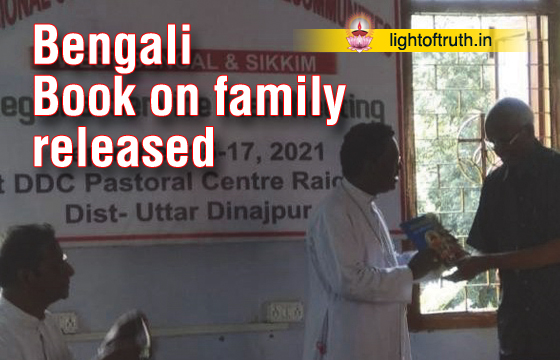
Bengali Book on family released
A book on “United families source of Small Christian Communities” in Bengali was released on September 16 by Bishop Clement Tirkey of Jalpaiguri. It was released during the Regional Small Christian Communities (SCCs) meeting of West Bengal and Sikkim Region at Raiganj Pastoral Centre about 400 km north of Kolkata. This is the first Bengali book published on SCCs and family, said Bishop Salvadore Lobo, chairman of Bengal Regional Bishops’ Council.
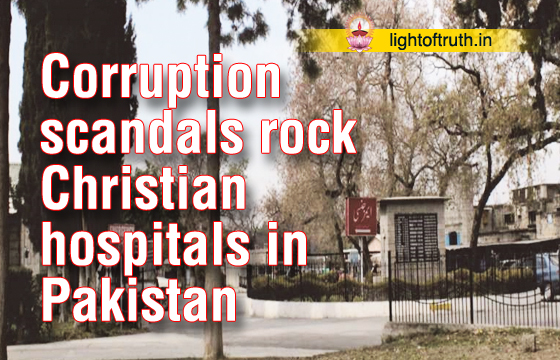
Corruption scandals rock Christian hospitals in Pakistan
Christian Hospital Taxila made headlines in 2002 when a grenade attack on a chapel inside killed four Christian nurses. Pope John Paul II was deeply grieved by the “reprehensible assaults on innocent life.”
Established in 1922, the facility specializes in eye dis-eases and occupies 38 acres in Taxila, 40 kilometers west of Pakistan’s capital, Islamabad.
Swedish nun Wenny Lekardal, who served here as a nurse for 27 years, was award-ed the President’s Award for Pride of Performance this March. The Swedish embassy in Pakistan shared video footage of the event on its Facebook page.
However, scandals of nepotism, corruption and maladministration lurk behind the scenes.
“Another Christian institute is getting closed. The community should raise its voice aga-inst these incompetent people. Government or other forces might nationalize it. We strongly demand that hospital board members take urgent action against this administration,” Roheel Zafar Shahi, an activist, stated in a Facebook post.
The accompanying videos showed nurses and hospital staff protesting over unpaid wages and arguing with administrators. The protesters included Dr. Felix Gill who has been waiting for his monthly salary since May.
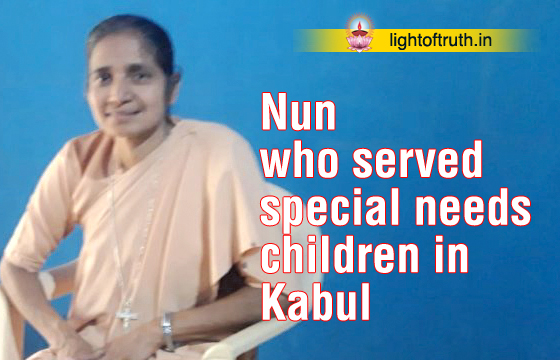
Nun who served special needs children in Kabul
Sister Theresa Crasta is the only woman religious from India who was rescued by the Indian government from Afghanistan in August after
the Taliban captured Kabul. Crasta belongs to the Congregation of the Sisters of Charity of Saints Bartolomea Capitanio and Vincenza Gerosa, or Sisters of Maria Bambina, an Italian congregation that was involved in educating special needs children in Afghanistan.
Crasta comes from Bela village under the Mangalore Diocese in Kerala on the border of Karnataka state in south western India. The 49-year-old nun went to Kabul, capital of Afghanistan, in 2018 after her silver jubilee in the congregation. She served in the only special needs school of its kind in Afghanistan set up by men and women major superior groups in Italy.
After her rescue and two-week quarantine, she visited her family home in Bela and very recently has returned to her Holy Angels Convent, also known as Belvedere, in the Mangalore Diocese to await reassignment.
Crasta shared with Global Sisters Report her experiences of working with special needs children in Afghanistan as well as her rescue from the war-stricken country.
“To be honest, I really did not want to come back. Even when my father died in May this year, I opted not to come. But after the sudden fall of Kabul to the Taliban, there was no option but to leave. I thank everyone who had helped me get out of that country”.
“I landed in Kabul November 1, 2018. No one had forced me to go there. I knew the situation in Afghanistan and the dangers involved before I chose to go there.
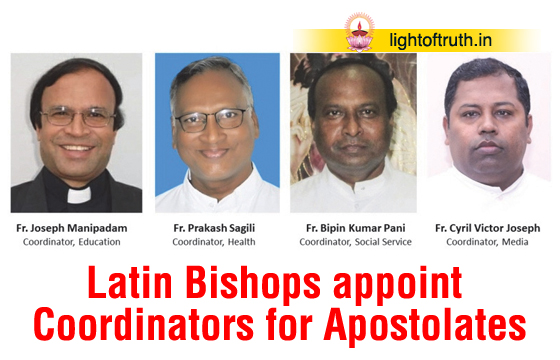
Latin bishops appoint coordinators for apostolates
The Conference of Catholic Bishops of India (CCBI) has appointed coordinators for education, health, social service and media apostolates.
The appointment was made during the conference’s 87 executive committee meeting held September 21-22.
Salesian Father Joseph Manipadam, currently the coordinator for Education and Culture of Don Bosco Youth Animation for South Asia, is appointed the education coordinator.
Father Prakash Sagili from Cuddapah diocese in Andhra Pradesh is appointed the coordinator for the health apostolate.
Father Bipin Kumar Pani, currently the regional director of social service of Jharkhand Bishops’ Council, is appointed the social apostolate coordinator.
Father Cyril Victor Joseph from the Archdiocese of Bangalore has
been appointed the media coordinator. He is currently the secretary for the Commission for Social Communication and Director of Paalanaa Bhavan of the Archdiocese of Bangalore.
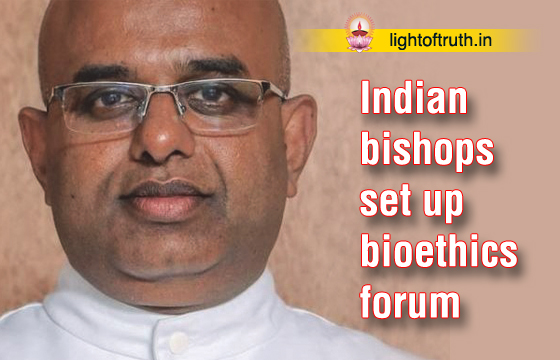
Indian bishops set up bioethics forum
The Conference of Catholic Bishops’ of India (CCBI) has established a Bioethics Forum and appointed Father Christopher Vimalraj from the Archdiocese of Bangalore as its first director. Bioethics is generally understood to refer to the ethical implications and applications of the health-related life sciences.
The decision to establish the Bioethics Forum was taken during the 87th Executive Committee meeting of the CCBI, held September 20-21.

Pope ‘accepts’ Afghan’s wedding ring as sign of friendship, hope
Pope Francis accepts artwork from children as he meets with families from Afghanistan prior to his general audience in the Paul VI hall at the Vatican Sept. 22, 2021. The Pope met
three Christian families from Afghanistan – a total of 14 people, including seven children, who fled from Afghanistan.
When Pary Gul, a Christian woman from Afghanistan, met Pope Francis Sept. 22, she gave him her wedding ring as a reminder of her husband, who has disappeared and may be dead. According to the Vatican newspaper, L’Osservatore Romano, Pope Francis accepted the ring, but only on the condition that Gul keep it for him “as a commitment of friendship and a sign of hope.”
Gul, 57, was among 14 Afghan Christians who met the pope just before his weekly general audience. The Italian military helped the three Christian families to flee Kabul after the Taliban takeover in mid-August. They have been resettled in northern Italy by the Meet Human Foundation.
Gul was accompanied by her four children, who are between the ages of 14 and 25. She told L’Osservatore Romano that the children saved the family by sending out an SOS on their phones. They had been hiding in a cellar for four days.
“My husband first was fired and then arrested, and we have heard nothing more from him,” she said. She believes “someone probably denounced us for being Christians.”
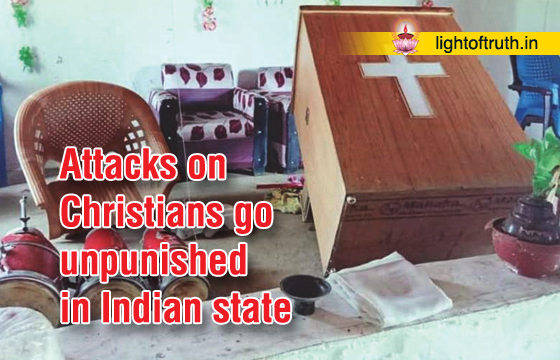
Attacks on Christians go unpunished in Indian state
A Christian leader in the central Indian state of Chhattisgarh has accused the state government of inaction after six incidents of Christian attacks were reported within a week. The latest attack was reported from a remote village in Kabirdham district on Aug. 29. More than 100 Hindu activists beat up a pastor after barging into his house during a prayer service, said Mohit Garg, superintendent of police for the district. The mob also manhandled Pastor Kawalsingh Paraste’s family members and vandalized the house, damaging scriptures, articles of worship and household items, before fleeing. The incident occurred in Polmi village around 11am when the Sunday prayer service was underway, Garg said.
“It is very unfortunate that we have witnessed repeated attacks on our Christian brothers and sisters last week. But it is nothing new. We have documented more than 200 such incidents in the state during the past two years,” Chhattisgarh Christian Forum president Arun Pannalal told.
He said what was more unfortunate was that every time the government would try to play down the incidents and push for a compromise between the attackers and their victims. “Few of them will be called to the police station but no first information report [documenting the initial details of the incident] will be registered,” he said.
Police inaction and the government’s failures had made the Christian faithful in the state insecure and disturbed social harmony, the Christian lay leader alleged.
Meanwhile, police said the pastor was accused of being involved in religious conversion activities by his attackers who also raised slogans against him.
Pannalal told media that members of all Christian denominations in the state had met recently in Bilaspur town where they discussed ways to defend their community leaders and places of worship against similar attacks. “We will approach the Supreme Court for justice with all the required evidence,” he said.
Chhattisgarh has in place an anti-conversion law enacted during the rule of the pro-Hindu Bharatiya Janata Party (BJP). The Chhattisgarh Freedom of Religion (Amendment) Act, 2006, requires anybody wanting to change religion to seek permission from district authorities at least 30 days in advance.