
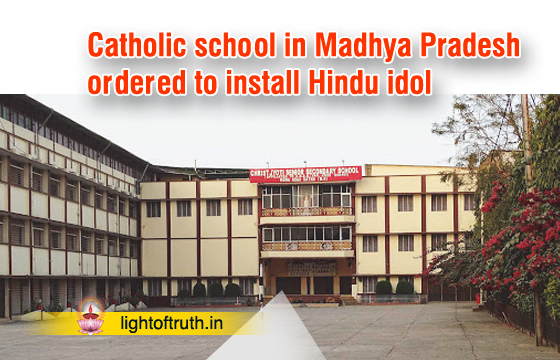
Right-wing Hindu activists on October 25 served a 15-day ultimatum to Catholic school in the central Indian state Madhya Pradesh state to install in the campus an idol of Saraswati, the goddess of know-ledge. A 30-member delega-tion of the Vishwa Hindu Parishad and Bajrang Dal met Father Augustine Chittupara-mbil, manager of Christ Jyoti Senior Secondary School in Satna district headquarters, to make the demand through a memo-randum. The memora-ndum they gave the priest 15 days to comply with their demand or face protests in front of the school.
“The Hindu activists came to our school and wanted us to install an idol of goddess Saraswati in the campus,” Father Chittuparambil told. The radicals forced the priest to give in writing that he had received their memorandum that he accepted at the school’s main gate.
The Hindu activists left the place with a warning to come back in case the school failed to comply with their demand.
“They claim that the school was built at a place where the idol of goddess Saraswati had existed,” the priest explained.
He pointed out that the school was built 49 years ago and no one had made such a claim until now. The Syro-Malabar diocese of Satna manages the school. Satna town is some 455 km northeast of Bhopal, the state capital.
Category Archives: From The States
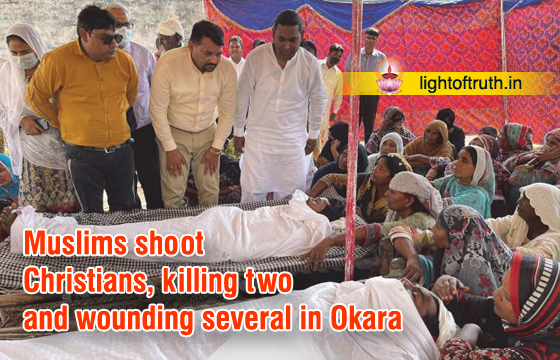
Muslims shoot Christians, killing two and wounding several in Okara
More than 20 Muslims have attacked a Christian commu-nity in Punjab. The violence followed a row between two families over the irrigation of some fields in the Okara area.
When a group of young Christians went back to water their fields, Muslims opened fire with guns and rifles.
Two young Christians, Yaqub Mukhtar and Haroon Mukhtar, died on the spot, whi-le half a dozen other Christians had to be hospitalised in critical conditions. A First Information Report (FIR) was drawn up against a group of Muslims, said Indrias Mukhtar, a witness to the incident.
Those named in the FIR include Muhammad Abbas, Babar, Mustafa, Shafqat, Gulzar, Qadir Gulzar, Nasar-Ullah, Noor, Abbas Ahmad, Hassan Ahmad, Azhar Taj.
In all, police registered a case against 18 people, but only two have been arrested so far.
Asif Munawar, a human rights activist and member of the Jhang District Committee, visited the site of the shooting and attended the funerals. He offered his condolences to the families of the dead.
In this case the violence was unleashed by a disagree-ment between three young Christians who were cleaning the entrance of their church and a Muslim passing by.

Indian Dalit Christians demand separate Catholic rite
Dalit Christian organiza-tions in the southern Indian state of Tamil Nadu have demanded a separate rite for Dalit Catholics as a solution to caste-based discrimination in the Indian Church. Dalit Chri-stians have long wanted an end to caste-based discrimination in the Church and have in the past urged Pope Francis to create a Catholic rite like the Kerala-based Syro-Malabar and Syro-Malankara churches.
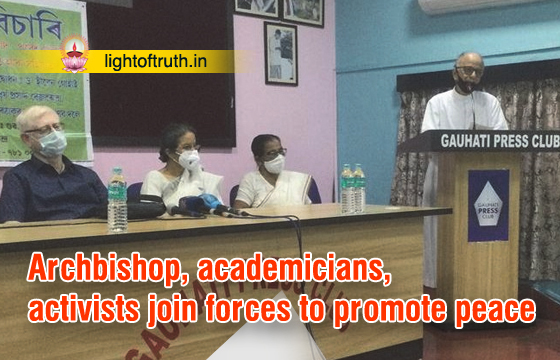
Archbishop, academicians, activists join forces to promote peace
A group of academicians and social activists came together under the leadership of Archbishop emeritus of Guwahati to promote peace at a time when the whole of Brahmaputra Valley is “in search of peace.”
The occasion was the re-lease of an Assamese langua-ge book entitled Hanti Bisari (In Search of Peace) written by Archbishop Thomas Mena-mparampil. The original work in English language was tran-slated into Assamese by a civil society leader, Paresh Mala-kar.
The book-release on Octo-ber 22 turned out to be a social-discussion session in which the need for mutual understanding between communities was emphasized. A reputed intelle-ctual of Assam, Hiren Gohain released the book at Guwahati Press Club.
Archbishop Thomas says, “Professor Satyakam Bortha-kur of the University of Dibrugarh had helped in the compi-lation of texts from original Assamese authors. So, the book turns out the product many hands, coming out precisely at a time when the whole of Brahmaputra Valley is ‘in search of peace’.”

From Mumbai to Jerusalem, the synodal path begins in Asia
The Churches of Asia, in communion with Catholic communities around the world, yesterday marked the start of the two-year synodal path announced by Pope Francis centred on the theme “For a Synodal Church: Communion, Participation and Mission”.
The first phase, which entails listening to the whole people of God, will see individual dioceses take the lead.
To this end, Card Oswald Gracias, president of the Catholic Bishops’ Conference of India (CBCI), led a solemn Mass in the Cathedral of the Holy Name of Jesus in Mumbai.
Due to COVID-19 restrictions, only 122 people representing various groups attended the service, while thousands more people followed the service via online streaming.
In a show of the willingness to listen to everyone, women were given a prominent place in the liturgical readings. A migrant woman from Jharkhand proclaimed the first reading in Hindi (the national language), while a second woman performed the second reading in Marathi (the local language). Prayers were also recited in Tamil and Konkani.
In his homily, Card Gracias said, “the Synodal process [is] meant to reform the church, by discerning what ails the Church, which means even listening to those who have left the Church and those who are thinking of leaving the Church, [for] they have a story to tell, which might make us reflect.”

Rally launched to promote communal harmony in Kerala
Leaders of various religious communities and social organizations have started a journey in the southern Indian state of Kerala to promote communal harmony and national integration.
The journey named ‘Sarva Dharma Sadbhavana Yatra’ (Journey to foster goodwill among all religions, is an initiative of the Dharmabharathi mo-vement and promoted by a 16-member team. The journey was flagged off October 8 from Ananda Ashram, a Hindu centre, in Kasargod, Kerala’s northernmost town. It will end October 14 at Thiruvananthapuram, the state capital in the south.

Displaying cross no sign of religious conversion, says Indian court
A top court in the southern Indian state of Tamil Nadu has ruled that a Dalit Hindu woman marrying a Christian or displaying religious symbols such as the cross cannot be cited as reasons to revoke her scheduled caste (SC) community certification. The Madurai bench of Madras High Court held that hanging the cross on a wall or going to church does not necessarily mean one has altogether abandoned the original faith to which one was born and cannot be the basis for cancelling an SC certificate.
The bench was hearing the case of Dr. P. Muneeswari, who belongs to the Hindu Pallan community. Her SC certificate was cancelled by district officials in Ramana-thapuram in 2013 on grounds that she was married to a Christian man and their child-ren were also being brought up in the Christian faith. The officials had reached the decision after finding a cross hanging on the wall of her clinic and concluded that she had converted to Christianity and hence was not liable to continue as a member of her Hindu SC community.
Members of the Hindu Dalit or former untouchable communities in India are often discriminated against under the centuries-old caste system. In legal and constitutional terms, they are now listed as scheduled castes enabling them to access the government’s affirmative action policies and programs.
Dalits who converted to Christianity and Islam are excluded from India’s affirmative action plan that includes reservations in educational institutions and government jobs among other social welfare schemes.

R.S.S. Magazine wants probe into Indian Catholic clergy
Panchjanya, a weekly ma-gazine linked to the Rashtriya Swayamsevak Sangh (RSS), has sought an inquiry into the Indian Catholic Church and its clergy while citing the recent expose of child sexual abuse within the French Church.
In its latest issue, which will hit the stands on Oct. 17, the magazine has reportedly published a cover story on the sexual exploitation of children and nuns by priests across the world.
Panchjanya, published in Hindi to uphold Hindu patri-otism in keeping with the objectives of the nationalist RSS, has claimed that incidents of sexual exploitation of children and nuns are on the rise in India too.
Referring to the reported incidents of rape of a woman in a missionary college in Che-nnai and a nun from Kerala, the magazine has said the people of the country wanted a probe against the Church and its priests.
Detailing the inquiry that unearthed the scale of abuse within the French Church, the magazine termed the earlier apology by Pope Francis in 2019 for such incidents a “formality under pressure.”
It went on to question and blame the style of functioning of the Church for the declining number of religious nuns acro-ss the globe. A similar trend was witnessed in the southern Indian state of Kerala and so the Church was targeting girls from poor families in under-developed states such as Chha-ttisgarh, Jharkhand, Himachal Pradesh and Odisha, the maga-zine alleged.

Desperate Indians sell family gold to survive Covid cash crunch
In Mumbai’s jewellery bazaar, Kavita Jogani gingerly places her wedding bangles on the shopkeeper’s scales, one of the thousands of Indians parting with their most cherished asset – gold.
It was not an easy decision – Jogani was desperate after her garment business took a severe hit in the past year and a half with multiple corona-virus lockdowns, making it difficult to pay shop bills and the salaries of her 15 emplo-yees.
The headline growth numbers suggest Asia’s third-largest economy is rebounding from the economic crisis un-leashed by Covid-19, but there is no end yet to the financial pain for many Indians.
“I don’t have any other option than selling the gold,” said Jogani as she waited nervously for the shop owner to make her an offer.
“I bought these bangles before my wedding 23 years ago,” the 45-year-old told.
Business closures and job losses pushed more than 230 million Indians into poverty in the past year, according to a study by Azim Premji University, leaving many struggling to pay rent, school fees and hospital bills.
Their difficulties have been compounded in recent weeks by soaring prices for electricity, fuel and other items.
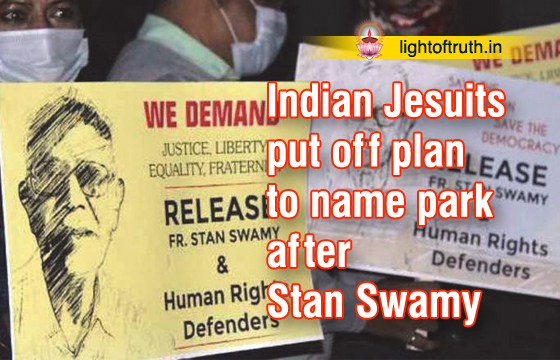
Indian Jesuits put off plan to name park after Stan Swamy
The opposition from Hindu nationalists’ organiza-tions has compelled a Jesuit-run institution in the southern Indian state of Karnataka to postpone the naming of a park inside its campus after late Jesuit priest and tribal rights activist Father Stan Swamy.
The 140-year-old St. Aloy-sius College in Mangaluru had decided to hold the naming ceremony on Oct. 7 but post-poned it citing President Ra-manath Kovind’s two-day offi-cial visit to the city.
Vishwa Hindu Parishad, its youth wing Bajrang Dal and Akhil Bharatiya Vidyarthi Pa-rishad, the students’ wing of the ruling BJP, had threatened to stage a protest if the college went ahead with the plan. The park is located on the college’s Beeri campus on the outskirts of the coastal city but VHP said it would be an insult to name it after someone accused of terror activities.
“It is unfair to oppose the naming of the park in the name of Father Stan and to brand him as a Maoist because it is not yet proven in court,” Father Denzil Fernandes told.