

India’s top court has told the warring factions in the Oriental Syrian Orthodox Church of Antioch to share all public amenities at disputed Church properties in a southern state until a solution to the row can be found. The government in Kerala is finding it difficult to implement a 2017 apex court order that awarded disputed churches to the Orthodox faction due to stiff opposition from the Jacobite camp, a breakaway faction of the Da-mascus-based Church. While hearing a contempt petition against the communist-led state government and the Jacobite faction, a division bench of Justices Surya Kant and Ujjal Bhuyan of the Supreme Court on Dec. 3 told the warring fa-ctions to share among them-selves all public amenities in the disputed church compounds without discrimination. The current stalemate concerns six disputed churches located in the state’s Ernakulam and Pa-lakkad districts. These chur-ches are under the control of the Jacobite faction of the Oriental Church, which has nearly 2 million followers in Kerala. “All public facilities like burial grounds, schools, hospitals, etc. on church premises shall continue to be availed by everyone, including Catholics,” the judges said in the order. Though it is an interim order, “it is significant as the court wanted to see both sides come together,” as shar-ing the amenities was not there in the 2017 order,” observed Biju Oommen, secretary of the Orthodox Church Association. He said they would consult their lawyers before sharing the amenities.
Category Archives: From The States
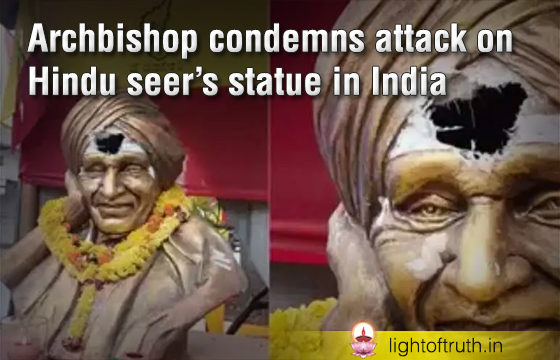
Archbishop condemns attack on Hindu seer’s statue in India
An archbishop has conde-mned an attack on a revered Hindu seer’s statue in a south-ern Indian state. “We have learned through media reports of the unfortunate and deeply disturbing incident of the defacement and vandalization of the statue of the late Shivakumara Swamiji in Girinagar in Banga-lore,” Archbishop Peter Ma-chado of Bangalore said in a statement on Dec. 5. The act, which has rightfully outraged people, “has no place in our society,” the prelate said, urg-ing the public not to be pro-voked by such incidents. Police arrested a 37-year-old delivery executive for damaging the statue on Dec. 4. The bronze-colored statue of the Lingayat seer was vandalized in the early hours of Nov. 30. “We arrested him under Section 324 of the Bharatiya Nyaya Sanhita (the new Indian penal code),” police told the media. Shiv Krishna hails from neighboring Andhra Pradesh state. During questioning, he claimed he was “inspir-ed” to deface the statue by a vision of Jesus Christ in a dream. “The claim of the alleged culprit is baseless,” the prelate observed. He said such statements can “sow discord and create communal tension.” The statue was installed five years ago and local residents staged a protest, demanding stiff punishment for the accus-ed. “The Swamiji has been an inspiration to countless indi-viduals,” Archbishop Machado said. His legacy promotes har-mony, and this act of disrespect toward him is a “violation of the very principles he upheld,” he noted. The prelate has urged the police to conduct an impartial investigation.
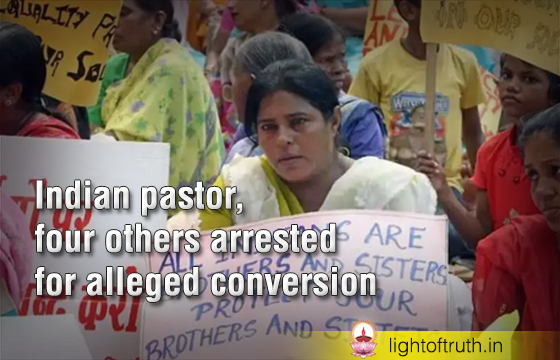
Indian pastor, four others arrested for alleged conversion
Five Christians, including a pastor, have been arrested in a northern Indian state under a sweeping anti-conversion law after hardline Hindu activists objected to their holding a Sunday prayer meeting. Police in Uttar Pradesh on Dec. 8 arrested Pastor Vineet, his wife Payal, who were both identified by a single name, and three others, who were not named, in Kherki Mujkkipur village in Meerut district. The pastor was holding a prayer meeting and a medical camp at his house. The police recovered religious books, registers, bank details, and other materials from the house, the local Hindi newspaper Jagaran reported on Dec. 9. Vineet embraced Christianity a decade ago and converted around 250 people, according to the police. He purchased the house six months ago and organized Sunday prayer meetings there under the banner of the Kingdom of God Ministries Trust. The Dec. 8 meeting was attended by 50 people when a mob from the Hindu Raksha Dal (Hindu Protection Army) reached the spot and objected to it. The Dal’s state president Gaurav Parashar alleged people were being converted at the prayer meeting and informed the police.
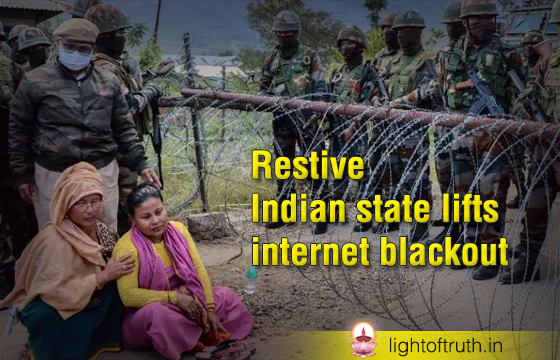
Restive Indian state lifts internet blackout
Internet was restored in India’s conflict-torn northeastern state of Manipur on Dec. 9, weeks after a blackout was ordered to contain deadly ethnic violence and clashes between protesters and police. Ethnic clashes broke out in Manipur last year between the predominantly Hindu Meitei majority and the mainly Christian Kuki community, killing more than 250 people. Since then, communities have splintered into rival groups across swaths of the northeastern state, which borders war-torn Myanmar. Fresh clashes that killed at least 17 people last month in a part of Manipur previously spared from the violence prompted the latest of several internet shutdowns imposed in the state. That order came after protesters, outraged by the killings, tried to storm the homes of politicians in state capital Imphal, vandalising some of the properties. The local government on Dec. 9 ordered the lifting of “all forms of temporary suspension of internet and data services” imposed on November 19. Internet services were shut down for months in Manipur last year during the initial outbreak of violence, which displaced around 60,000 people from their homes according to government figures. Thousands of the state’s residents are still unable to return home owing to ongoing tensions. Long-standing tensions between the Meitei and Kuki communities revolve around competition for land and public jobs. Rights activists have accused local leaders of exacerbating ethnic divisions for political gain. Manipur is ruled by Bharatiya Janata Party and Human Rights Watch has accused the government of facilitating the conflict with “divisive policies that promote Hindu majorita-rianism.”
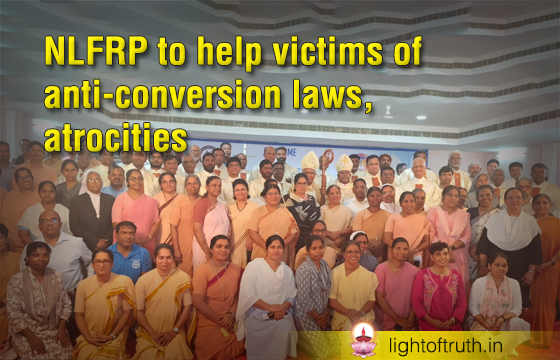
NLFRP to help victims of anti-conversion laws, atrocities
More than 100 priests, brothers and nuns who practice law have resolved to reach out to those affected by anti-conversion laws and anti-minority atrocities. The National Lawyers Forum of Religious and Priests (NLFRP) that held its Dece-mber 6-8 convention at Eluru in Andhra Pradesh has also formed three high-power committees to deal with such cases. The convention at Eluru’s St. Joseph’s Dental College addressed the theme, “Changing the Landscape – The Context and the Call.” The convention began with a Mass led by Bishop Jaya Rao Polimeru of Eluru, who has a background in criminal law. “I am pleased to note there is a good amount of awakening within the Church. There are so many of you–religious priests who are also law-yers,” Bp Polimeru said welcoming the participants from 16 Indian states.

Indian Catholics strive to protect Portuguese heritage church
Catholics have sought the resto-ration and protection of a 16th-century Portuguese-era church in a western Indian state after it was reportedly struck down in the new development plan by the local urban body. The Our Lady of Mercy Church was built by Portuguese Jesuits in 1562 at Thane in Maharashtra. “When we went through the draft [of the development plan] we found that the name of the church was missing from the official list” of monuments, said Melwyn Fernandes, general secretary of the Mumbai-based Association of the Concerned Christians. The organi-zation along with the Bombay Catholic Sabha sought immediate intervention of senior officials from Thane district to restore the church in its official records.

Thousands flock to Christmas music festival in India
Thousands of people cutting across religious affiliations have taken part in an annual Christmas music festival in India’s commercial capital Mumbai. Catholic parishes and members of the Methodist Church and the Church of North India participated in the Prabhu Yeshu Janmotsav (Lord Jesus’s Birthday) festival on the evening of Dec. 8. “In its 59th year, the Prabhu Yeshu Janmotsav has grown into a beacon of unity and joy, bringing together people from all walks of life,” Cardinal Oswald Gracias of Bombay told the gathering at Girgaum Chowpatty in Mumbai. This special occasion inspires us to be “messengers of peace and goodwill in a world yearning for healing and reconciliation,” the cardinal said.
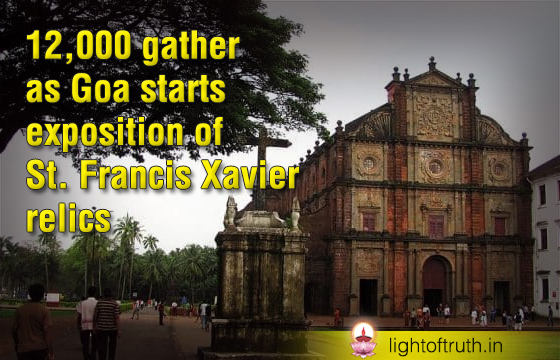
12,000 gather as Goa starts exposition of St. Francis Xavier relics
At least 12,000 people thronged India’s western state of Goa on November 21 to participate in the ceremonies marking the start of the once-in-ten-year exposition of St. Francis Xavier’s relics. The 18th expo-sition started with a Mass at the Basilica of Bom Jesus, a 16th-century UNESCO-approved world heritage monument that houses the saint’s body. “We come here as pilgrims to his feet, begging for Goa’s mercy through his intercession,” Archbishop Anil Couto of Delhi, who led the Mass, said in his sermon. Four centuries have passed since “his incorrupt body” arrived in Goa from the island of Sancian [now Shangchuan] via Malucca,” the prelate said. Cardinal Filipe Neri Ferrão of Goa and Daman said the theme of this year’s exposition is “We are messengers of the Good News of Jesus Christ.” “We are called to spread it as St. Francis did in his life,” the prelate said. Goa archdiocese has commissioned a book, Stories in Silver, with photos and text by Pantaleao Fernandes, which will be sold during the exposition. Fernandes said whenever he visited the basilica, he was curious to know the details of the 32-panel plates that adorn the casket. Fernandes told that the book narrates the stories and miracles contained in the panels and also tells the story of St.Francis Xavier’s journey from Europe. After the Mass, the relics were taken out in an electric carriage, deviating from the practice of Catholics carrying them on their shoulders. Over 2,000 men and women formed a human chain to view the relics from the basilica’s entrance to the nearby cathedral, and many joined the procession. According to authorities, all 10,000 chairs set for the visitors were occupied, and many stood to witness the opening ceremony on Nov. 21. The relics were brought down and kept inside the nearby 16th-century cathedral, open from 7 a.m. to 6 p.m. “We expect 8 million people to visit this year,” Father Henry Falcao, diocesan convener of the exposi-tion committee, told.
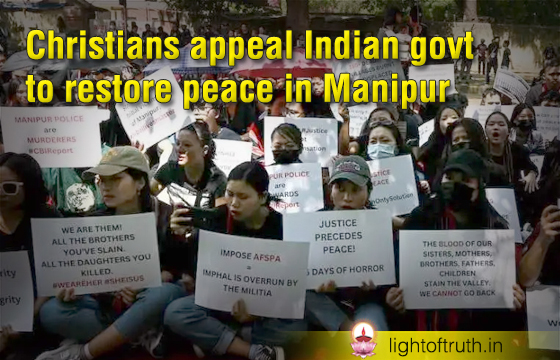
Christians appeal Indian govt to restore peace in Manipur
A Christian ecumenical body has urged India’s federal government to restore peace in Manipur state, where life was disrupted by the latest bout of violence between indigenous Christians and Meitei Hindus. “The gravity of the situation cannot be overstated. The peo-ple of Manipur are caught in a state of utter hopelessness and insecurity,” said Reverend Asir Ebenezer, general secretary of the National Council of Chur-ches in India (NCCI), repre-senting Protestant and Ortho-dox Churches in the country. In a public appeal on Nov. 19, the NCCI referred to the brutal killing of 20 people, including women and children, since Nov. 7 in the state bordering civil war-hit Myanmar. “Fami-lies have been torn apart, and entire communities have been displaced from their homes. Children cannot continue their studies,” it said. The NCCI also referred to the miseries caused to the people by the acute shortage of basic nece-ssities such as food, health-care, and transport facilities. “The continued instability is eroding the very social fabric of Manipur, and the toll on the mental and physical well-being of the people is staggering,” it said. The spate of violence began on May 3 last year and has claimed around 250 lives besides displacing some 60,000 people, mostly Christians. Over 360 Churches have been destroyed. “We condemn the violence in the strongest terms and express our grave concern over the lack of sufficient and timely intervention by the authorities,” the NCCI said.

Tribal Christians hail secular alliance’s win in India’s Jharkhand
Tribal Christian leaders have welcomed a secular regio-nal party returning to power in India’s eastern Jharkhand state in the recently concluded polls. The Jharkhand Mukti Morcha (JMM), which advocates tribal people’s rights and interests, secured 34 seats in the 81-seat state assembly. Its secular allies, including the Indian National Congress and socialist and communist parties, won 22 seats, bringing the alliance tally to 56 when the results were announced on November 23. “More than happiness, tribal Christians are relieved they won’t have to live in fear and uncertainty under a BJP government,” said Ratan Tirkey, a former member of the Jharkhand government’s tribal advisory panel. Bharatiya Janata Party (BJP) could secure only 21 seats. Smaller parties, including those allied with the BJP, won the rest of the seats. The JMM-led alliance impro-ved its performance with 56 seats, up from 47 in the 2019 election, and its leader, Hemant Soren, will again be the chief minister. Tirkey told that the BJP tried its “best to polarize the voters” based on religion and caste “but did not succe-ed.” Tirkey, a tribal Catholic leader, said the JMM is favo-urable to Christians. “Hence, we are planning to put forth some of our long pending demands like the revival of subsidies for pilgrimages in and outside India for Christians, and establishment of a minority commission office to ensure the welfare of minority commu-nities in the state,” he said.