
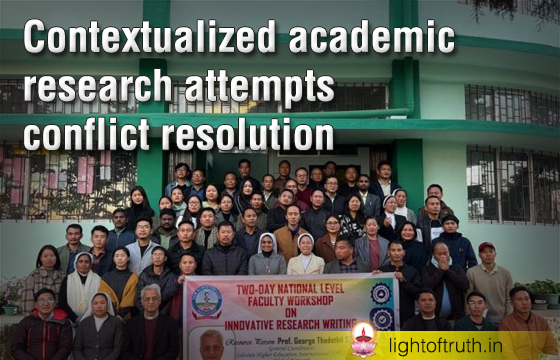
A premier college in violence hit Manipur state conducted a three-day innovative Faculty Deve-lopment Program Workshop on Innovative Research Writing, November 21-23. The faculty members of Don Bosco College Autonomous Maram who belonged to the different communities of the state having experienced or known persons who were affected by the ongoing conflict participated in the workshop. The college is headed by Dr Sebastian Karot the principal and noted historian of the region. Former Salesian College Siliguri and Sonada Principal and General Coordinator of Salesian Higher Education International (SHEI) Global Network, Rome, Italy Prof. George Thadathil was the resource person. During the workshop, participants identified the conflict causes from their perspective and prepared conflict resolution document on Manipur 2023-24 with possible solutions. They intend to make their findings known to the government of India and the United Nations through the Salesian Representative member at United Nations Economic and Social Council (ECOSOC) in New York.
Category Archives: From The States
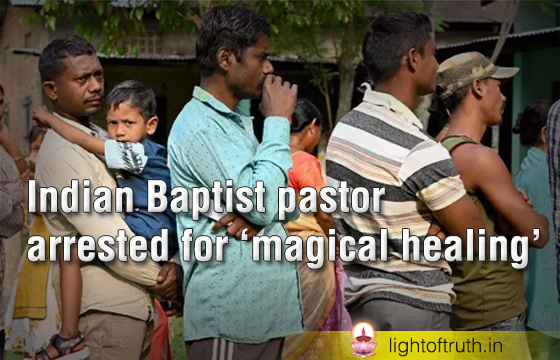
Indian Baptist pastor arrested for ‘magical healing’
Police in India’s Assam state have arrested a Baptist pastor on charges of violating a newly enacted law that curbs magical healing after he prayed over some tribal people in a village. Pastor Pranjal Bhuyan was arrested on Nov. 22 in the northeastern state for violating the Assam Magical Healing (Prevention of Evil Practices) Act and attempting to convert people to Christianity. He has been remanded to judicial custody for 14 days, police said. Bhuyan was arrested in Upper Golaghat district after a resident of Padampur village complained that the pastor was trying to convert tribal people, claiming to heal their illness through prayers. The state law came into force in March purportedly to create science-based knowledge and a safe environment to protect human health. It also aims to end evil and sinister practices that thrive on ignorance and people’s ill health. The law criminalizes practices resorting to magical healing and stipulates a three-year jail term and a fine for violations. “We had objected to the bill when it was introduced in the state assembly. The bill targets minorities like Christians and Musli-ms,” Archbishop John Moolachira of Guwahati in Assam told on Nov. 26. Under the law, people can be arrested when they pray for their relatives, said Moolachira, who is the president of the Assam Christian Forum. Prayer is a universal practice used to invoke divine intervention. The prelate observed that labeling it as a “magical healing” is misleading. “Healing is not synonymous with proselytization,” he said, adding that lawyers have been engaged in helping the pastor get bail. “We are planning to meet next month to discuss the controversial law,” Moolachira said. The Hindu right-wing Bharatiya Janata Party (BJP) runs the state government. The BJP and its supporters oppose Christian missionary work, considering it a challenge to their aim of establishing Hindu hegemony in India.

Teen rep at COP29 made climate ambassador
A student delegate from Don Bosco School Park Circus, Kolkata at COP29 held in Baku Azerbaijan last week, was declared Climate Ambassador by United Nations Agency for Develop-ment and Peace (UNADAP).
The citation presented to 14 year old student Swanik Choudhury of Class 9 reads: We commend your invaluable contribution as part of the official delegation to COP29. Your efforts have been recognised by the Secretariat, and we commend your commitment to mitigating climate change through responsible steward-ship, dedicated advocacy, and align-ment with the UNFCCC and UNSDG goals. Your participation exemplifies the spirit of global cooperation needed to drive impactful and sustainable change. The citation is signed by Executive Director of UNADAP Dr Dominic F Dixon.
Swanik, a minor, who traveled with his mother Swati Chowdhury, a teacher in the same school says, “Meeting campaigners and activists from around the world reinforced my belief in the power of unity.”
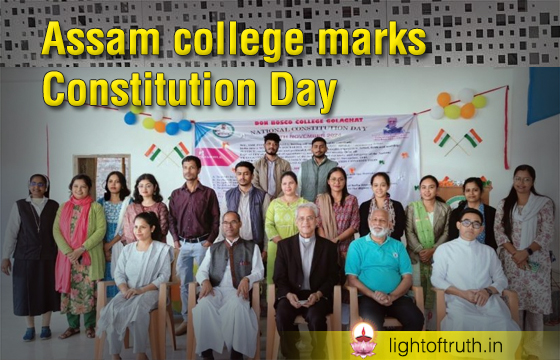
Assam college marks Constitution Day
Faculty members and students of a college in Upper Assam marked 75th anniversary of the adoption of Indian Constitution with seminar, pledge taking and medley of patriotic songs on Nov. 26.
Faculty members and students of Don Bosco College Golaghat, the second oldest Salesian Educational Centre in Assam started in 1941 cele-brated the constitution in the presence of Coordinator of Salesian Higher Education and Vice Chancellor of Don Bosco University Guwahati.
“The event was a significant occasion aimed at fostering awareness and appreciation of constitutional values among students and faculty members,” says Principal of the college, Dr. Fr. A. Amaladoss. The principal called on both students and faculty members, “to embrace their fundamental duties as citizens and to unite as brothers and sisters in upholding the values enshrined in the Constitution.”
To add a patriotic flair to the celebration, students from B.A. 3rd Semester performed a stirring patriotic songs led by Wangli Lowang and his team. Additionally, a vibrant dance performance by Ansila Dung Dung and her team captivated the audience, showcasing their artistic talents while celebrating national pride.
The program ended on a high note with everyone singing the National Anthem.
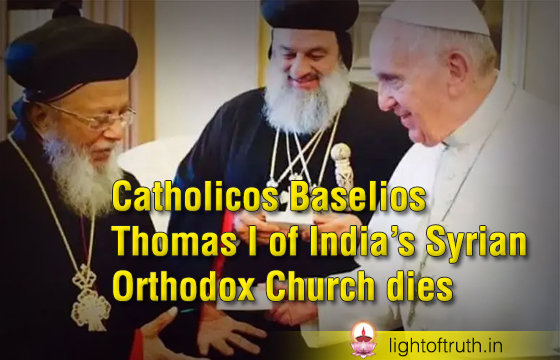
Catholicos Baselios Thomas I of India’s Syrian Orthodox Church dies
Catholicos Aboon Mor Baselios Thomas I, the spiritual head of the Syrian Orthodox Church’s Jacobite faction in India, died on Oct. 31. He was 95. The prelate passed away while undergoing treatment for age-related ailments in southern Kerala state, where the Damascus-based Church has more than 2 million followers. Thomas, affectionately called Bava, “was an ardent supporter of ecumenical unity,” said Major Archbishop Raphael Thattil, head of the Kerala-based Eastern rite Syro-Malabar Church. “He led the Church in the most challenging period” and served the Church “even at the cost of his life,” added Thattil. The Catholic Bishops’ Conference of India (CBCI) said his death “has left a void in the Christian community.” “He was an iconic figure in the Indian Christian community, having completed 50 years of dedicated Episcopal service,” the bishops said. Kerala Chief Minister Pinarayi Vijayan said the late prelate dedicated his life to the service of humanity. He made “unparalleled contributions to the growth of the Church,” Vijayan, the only serving communist chief minister in the country, said in his condolence message. Kerala Governor Arif Mohammed Khan said the prelate was known for his compassion and commitment to the community. The Syrian Orthodox Church of Antioch was based in Turkey. However, after World War I, the patriarchate was transferred to Homs in Syria in 1933. In 1959, it was shifted to Damascus. In 1911, the Church in India witnessed a spilt over its leadership, which led to a protracted dispute over Church properties. Thomas headed the Jacobite faction, which owed its allegiance to the Church’s head in Damascus. The rival Orthodox group’s supreme head is based at its headquarters in Kerala. In 2017, the Jacobite faction suffered a setback when, in a protracted legal battle, it lost almost all its temporal properties to the Orthodox faction.
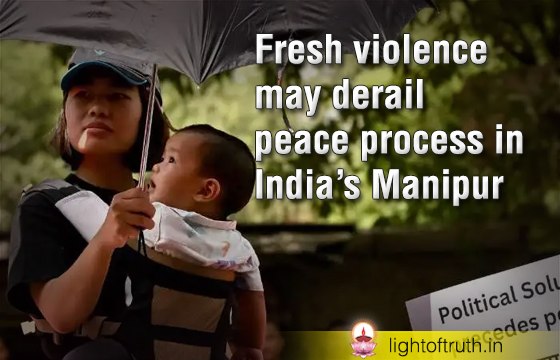
Fresh violence may derail peace process in India’s Manipur
A Church leader in India’s Manipur has expressed concern that the latest killings in a fierce gunfight between tribal Kuki militants and security forces may lead to “further escalation of violence” in the troubled northeastern state. At least 11 militants, who were described as “village volunteers” by their tribal body, were killed when security forces claimed to have “repulsed an attack on a police station” by them on Nov. 11. The fresh bout of violence will “increase animosities between rival groups” and “may jeopar-dize the federal government’s initiative to restore peace” in the state, the Church leader who did not want to be named due to security concerns told on Nov. 12.
Government sources said two personnel from the Central Reserve Police Force (CRPF) were injured as the militants in camouflage uniforms and arm-ed with sophisticated weapons fired indiscriminately at the Borobekra police station in Jiri-bam district. The Indigenous Tribal Leaders’ Forum (ITLF) condemned the killings of tribal men and denied the govern-ment’s claim that they were militants. The tribal body in a statement on Nov. 12 expressed deep sorrow over the “tragic loss of our 11 brave voluntee-rs.” The gunfight comes close after the burned corpse of a Kuki woman was found in the district last week. The woman was reportedly killed by Meitei gunmen in Zairawan village on Nov. 7. The ITLF claimed that “the CRPF personnel posted nearby refused to fire even one shot to help the villagers.”
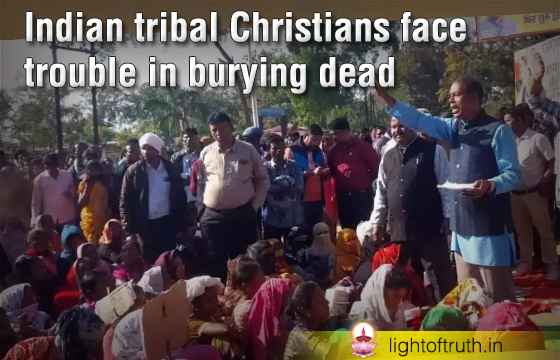
Indian tribal Christians face trouble in burying dead
Indigenous Christians face difficulties in burying their dead because of their faith in a central Indian state, according to Church leaders. “It is really painful to see villagers create obstacles in burying the dead,” said Protestant minister Jaldev Andhkury after he was released from jail for officiating the funeral service of one of his relatives in Bastar district in central Chhattisgarh state. The 42-year-old Andhkury was among the seven people, inclu-ding six pastors and a deacon, arrested after they joined the funeral service of Pastor Iswar Nag, his cousin, in his ancestral village in Chhindawada villa-ge. It is a custom among villa-gers in Chhattisgarh to bury their dead in ancestral villages even after their conversion to Christianity. Andhkury said their forefathers were buried in the village, but now villagers object to the burial of those who converted to Christianity. “The villagers opposed the burial on the plea that it would bring misfortune to the village and summoned the police. But, we still buried the body in the century-old graveyard,” Andh-kury told on Oct. 30, a week after being released from prison. The police summoned seven of us who prayed over the body and arrested us after accusing us of creating law and order problems, he said. They were released from prison on Oct. 22 after a local court accepted their bail pleas. The villagers, along with police, wanted us to exhume the body from the graveyard, but “we refused,” he added.
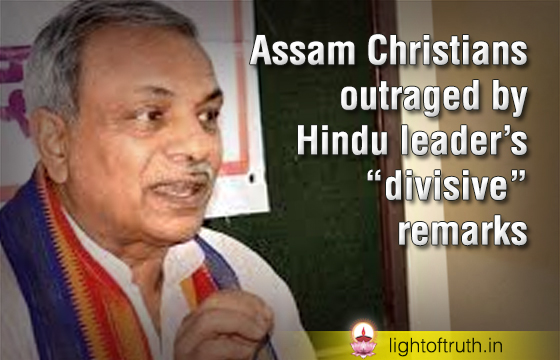
Assam Christians outraged by Hindu leader’s “divisive” remarks
Various Church groups in Assam have demanded action against a rightwing Hindu leader who allegedly maligned Christians and tried to undermine religious harmony in the northeastern Indian state. On Oct. 27, Surendra Kumar Jain, the international joint general secretary of the Vishwa Hindu Parishad (world Hindu council), stirred a controversy by accusing Churches of drug trafficking. He reportedly asserted that Churches were linked to drug trafficking that contributed to the degradation of youth in the region. He made the remarks at a function to honour Joya Thaosen (1925-1944), a revered freedom fighter who died fighting the British, at KK Hojai Chatrinivas Building, Haflong, Dima Hasao District. The United Christian Forum of Dimahasou, the United Christian Forum of Karbi Anglong, and the Assam Christian Forum (ACF) on November 5 expressed “deep shock and dismay” over Jain’s “divisive remarks.” “We believe that [Jain’s] baseless accusations against the Church and the Christian community are not only harmful but seem to be a deliberate attempt to malign an entire faith community. His statements undermine the invaluable contributions of the Christian community to this region,” stated the Assam Christian Forum, an ecumenical group. The Christian groups regretted that the Hindu leader used a significant event as a platform to condemn and divide communities on religious grounds. “Jain’s comments are perceived as a dishonour to the rich legacy of Thaosen, who stood for unity and secular values,” they added. They said all communities of Dima Hasao and the country at large cherished Thao-sen’s legacy. They noted that Christians have played “a transformative role” in northeastern India from the pre-Indepen-dence era. The community has worked in areas such as education, healthcare, social welfare, literature, media, relief, rehabi-litation, and sustainable development, they claimed.
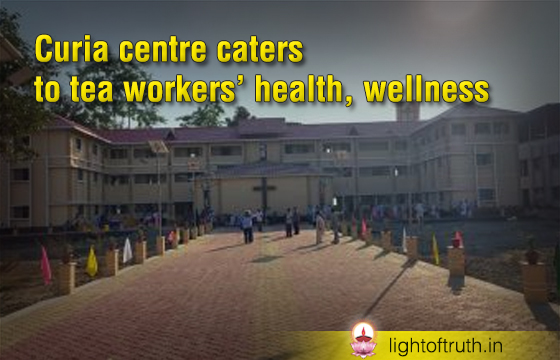
Curia centre caters to tea workers’ health, wellness
A newly inaugurated curia centre of Bagdogra diocese in Siliguri, serves health and wellness of local tea workers. The facility was blessed on November 9 by Archbishop Vincent Aind of Ranchi. “The building christened ‘Dishangan’ connotes direction, guidance, leading and nurturing; the kind of things which Jesus who is the ‘way and the truth’ came to do,” says Vicar General of Bagdogra diocese Fr Felix Pinto. Situated in Gulma area of Siliguri, the majority of the beneficiaries of the new facility are tea labourers surviving on meagre income from neighbouring tea gardens. “The focus of this centre is to improve the mental health of the community and to promote naturopathy, treatment with less of allopathy medicine and using more of traditional and non-intrusive health remedies,” adds Pinto. Through the Health & Counselling Centre housed in Dishangan, Fr. Anthres Toppo and Fr. Michael Kerketta are already giving counselling and reflexology treatment.
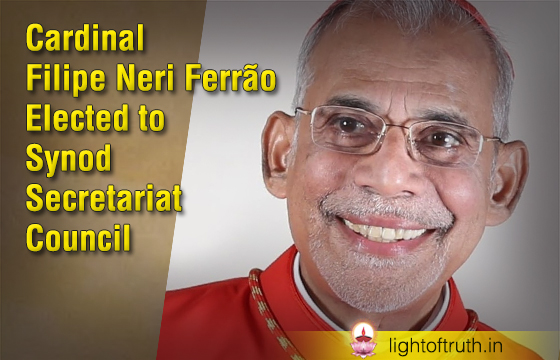
Cardinal Filipe Neri Ferrão Elected to Synod Secretariat Council
Cardinal Filipe Neri Ferrão, Pre-sident of the Conference of Catholic Bishops of India (CCBI) and the Fe-deration of Asian Bish-ops’ Conferences (FABC), has been elected as a member of the Ordinary Council of the General Secretariat of the Synod. The election took place on October 23, 2024, during the 15th General Congregation of the Synod of Bishops. The Ordinary Council of the General Secretariat is responsible for the preparation and implementation of the Ordinary General Assembly. The Members of the Ordinary Council take office at the end of the Ordinary General Assembly that elected them; they are Members of the next Ordinary General Assembly and cease from their mandate at the dissolution of the latter. The Council, chaired by the Holy Father Pope Francis, is an integral part of the General Secretariat.