

His Beatitude Mar Raphael Thattil, the Major Archbishop of the Syro-Malabar Church and the Metro-politan Archbishop of Emakulam-Angamaly, appointed Archbishop Mar Joseph Pamplany as the Vicar of the Major Archbishop for the Archeparchy of Emakulam-Angamaly on January 11, 2025. This appoint-ment was made following the First Session of the XXXIII Synod of Bishops of the Syro Malabar Church, held at Mount St. Thomas, Kakkanad from 6 to 11 January 2025, where Archbishop Pamplany was elected to the Office of the Vicar of the Major Archbishop. The election was subse-quently confirmed by the Holy Father. Archbishop Pamplany will continue to serve as the Metropolitan Archbishop of Tellicherry. Holy Father Pope Francis has accepted the resignation of Bishop Mar Bosco Puthur from the Office of Apostolic Administrator of the Archeparchy of Emakulam Angamaly. Mar Puthur, who was appointed to the Office on December 7, 2023, had submitted his resignation in September 2024. With the resignation of the Apostolic Administrator accepted, the gover-nance of the Archeparchy of Erna-kulam-Angamaly has been entrusted to the Major Archbishop by the Apo-stolic See. At the same time, Arch-bishop Cyril Vasil SJ will continue to be the Pontifical Delegate for the Archeparchy of Emakulam Anga-maly.
Category Archives: From The States

Mumbai musicians release youth anthem for 2025 Jubilee
A group of musicians from Mum-bai has launched an album featuring 15 songs to mark the 2025th year of the birth of Jesus of Nazareth. The collection, titled “Jubilate Jesus 2025,” released on December 31, 2024, is an initiative by Tej-Prasarini, the media production house of the Mumbai Salesian province.
The project was coordinated by Salesian Father Peter Gonsalves, the founder of Tej-Prasarini, former dean of the Faculty of Social Communi-cations at the Salesian Pontifical University in Rome, and a member of the Vatican Department for Communications.
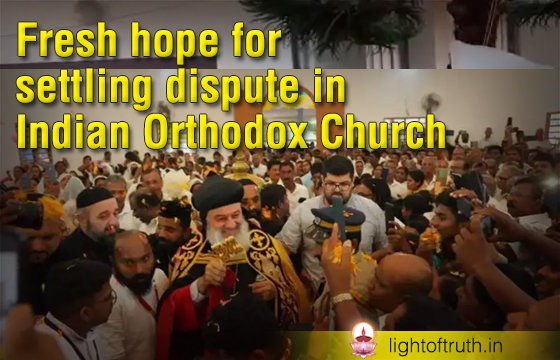
Fresh hope for settling dispute in Indian Orthodox Church
An order from India’s top court has rekindled hope for settling a property dispute between two warring factions of the Oriental Syrian Orthodox Church of Antioch, which is based in southern Kerala state. The Supreme Court, in its Dec. 21 order, told the Kerala state government to assess the facts while maintaining the “status quo with regard to management and administration of the churches, as it exists today.” The government in Kerala is finding it challenging to implement a 2017 Supreme Court order. The court awarded disputed churches to the Orthodox faction, but the state failed to implement it because of stiff opposition from the Jacobite camp, a breakaway faction of the Damascus-based Church. In early December, the top court told the warring Orthodox and Jacobite factions to share all public amenities at disputed church properties until a solution to their row could be found. The latest hearing was held on Dec. 17, but the top court released the order on Dec. 21.
The division bench of Justice Surya Kant and Justice Ujjal Bhuyan told the state government to furnish vital statistics “such as total number of faithful belonging to Orthodox and Jacobite denominations, churches under the control of each side, list of churches under dispute, composition of parishioners of these churches from village panchayat level.” The order also gave liberty to both parties to submit their parish registers before the court. “The state government of Kerala, however, is given the liberty to intervene as and when required in accordance with law in case of any dispute arising between them,” it further said. The top court was hearing a bunch of petitions challenging a Kerala High Court order that directed the state government to take possession of six churches in Ernakulam and Palakkad districts under the control of the Jacobite faction in compliance with its 2017 order.
In its Dec. 3 order, the top court held the Jacobite side guilty of contempt and directed it to hand over “only” the admini-stration of the six churches.
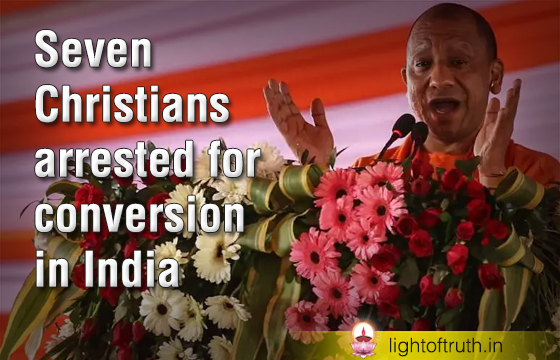
Seven Christians arrested for conversion in India
Seven Christians, including two pastors, have applied for bail in a court in a northern Indian state after they were arrested, accused of violating a sweeping anti-conversion law. “We applied for their bail at a local court in Sitapur in nor-thern Uttar Pradesh on Dec. 16,” said an activist extending legal help to the arrested Chri-stians. “Hopefully, they will get bail soon,” added the activist, who did not want to be named due to security reasons. Police in Uttar Pradesh arrested the Christians on Dec. 13 for allegedly violating the state’s anti-conversion law, which criminalizes conversion using force, coercion, undue influ-ence, or allurement.
The state government, run by the Bhartiya Janta Party, amended the law in 2024, allowing anyone to complain about a violation. Earlier, only a victim of conversion or close relatives could complain. Cha-kresh Mishra, superintendent of police in Sitapur, told the local media the police acted on the complaint and seized two mobile phones and religious books from the arrested people. Local media reports also accused Christians of luring local people with job offers and monetary benefits while they assembled in a house in Katsa-riya village for a prayer meet-ing. The reports said members of the Vishwa Hindu Parishad (VHP or World Hindu Council) alerted the police, and its member Abhishek Kumar complained to the police that Christians were making dero-gatory remarks against Hindu deities.

Cardinal Poola celebrates Christmas with transgender community
Cardinal Anthony Poola has joined the transgender community of Hyderabad, a southern Indian city, to cele-brate Christmas that many say has sent a message of inclusivity and Christian love for the margi-nalized. “True Christmas lies in embracing the poor and ne-glected, offering them accep-tance and dignity,” said Cardi-nal Poola, the Archbishop of Hyderabad and a member of the Vatican Dicastery for Pro-moting Integral Human Deve-lopment. The December 18 celebration was organized by the Hyderabad Archdiocese Social Service Society (HASS). Cardinal Poola distributed certificates to transgenders who completed jute bag-making training programs facilitated by the society. He also presented sewing machines to women from Self-Help Groups and distri-buted Christmas gifts to all 93 transgender participants, along with members of the women SHG groups. “This semi-Chri-stmas celebration serves as a powerful testament to the Church’s commitment to inclu-sivity, spreading the message of love, hope, and dignity for all, especially those on the peri-pheries of society,” the cardinal added. The society director Father Madanu Anthony said the program was “a witness to the Church’s commitment to serving marginalized commu-nities.” Transgender community is among the most marginalized groups, often facing discrimi-nation and rejection and the cardinal’s gesture has sent out a “powerful message of inclu-sion and compassion,” Father Anthony added.
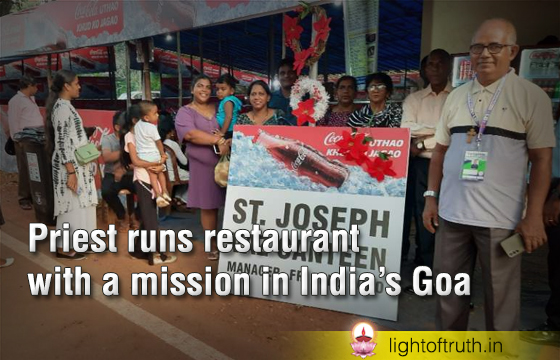
Priest runs restaurant with a mission in India’s Goa
British national Carl Cox was surprised to know St. Joseph Vaz Canteen, where he had just had some snacks and tea in old Goa, was run by a Catholic diocesan priest. “The snacks are delicious, and I was taken aback to find that a Catholic priest was running it,” the 32-year-old scientist working at a private firm in the UK, told. “This is my third time visiting Old Goa and the crowds are getting bigger and bigger here, revealing their deep faith in St Francis Xavier,” Cox said. As he spoke, his wife, Danica Pereira, 30, nodded approvingly with a smile. “The food served here in the canteen is typically Goan, tasty and spicy,” she says, as she collected some packed food from the counter. Cox, his wife, and father, Jeff Cox, 68, were visiting the western Indian state as part of their pilgrimage to witness the once-in-a-ten-year Exposition of the relics of St. Francis Xavier in the former capital of Portuguese-ruled India. Jeff Cox was sipping a fresh lime soda, just served to him by the waiter. “It is very fresh and cool,” he said with a smile. The canteen is named after St. Joseph Vaz, a Goa-born Indian missionary priest hailed for pioneering evangelization in Sri Lanka in the late 17th and early 18th centuries.
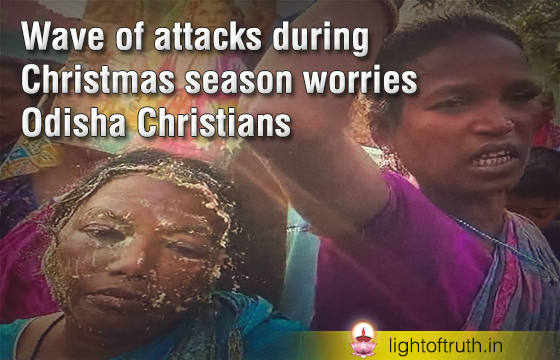
Wave of attacks during Christmas season worries Odisha Christians
A wave of violence against Christians in Odisha, eastern India, has raised alarm over citizens’ religious freedom guaranteed by the country’s Constitution. The latest incident occurred on December 26 in the Gabardhanpur village of Balasore district, where the members of the New Life Church were attacked while celebrating Christmas with a local family. According to Pastor Sadhu Sundar Singh of the Church, Gobinda Singh, a resident of Gabardhanpur, had invited him and his colleagues, Subhasini Singh and Sukanti Singh, to his home for prayers and Christmas celebrations. The gathering involved cake cutting and a shared meal. However, a drunken man from the village approached Gobinda Singh under the pretext of asking for food. Ignoring requests to wait, he rallied villagers waiting nearby and falsely claimed that religious conversion was taking place in the house. The mob attacked the gathering, severely beating Subhasini and Sukanti Singh. Their clothes were pulled, as the mob shouted accusations of forced conversion. Pastor Singh shared a video of the incident. In the video, a man named Badal Kumar Panda, wearing a white shirt and a tilak, introduced himself as the Block President of Devsena. He is seen pointing towards the women and saying, “I came here because these people are converting our people to their religion. We have been working tirelessly, turning our blood into water to preserve our religion, and these people are converting them. They are destroying our society. If anyone knows of such conversions happening in our area, please report them to us immediately, and we will respond without delay.” Though Gobinda Singh and his family denied the allegations, the group dragged them out and attacked them.
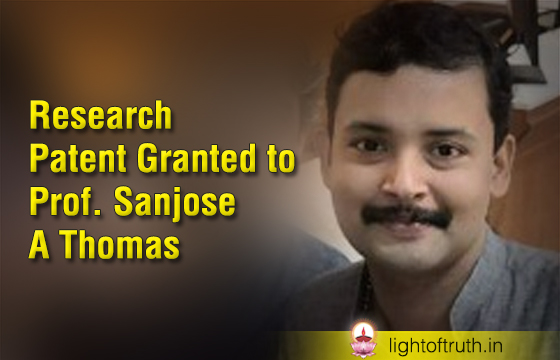
Research Patent Granted to Prof. Sanjose A Thomas
Prof. Sanjose A. Thomas, Head of the Department of Sociology at Theva-ra S.H. College, has been awarded a pa-tent for his research titled “How to Transform Emotiona-lity in Social Media for the Benefit of Society.” The Department of So-cial Sciences at Sacred Heart College is spearheading this innovative study. By utilizing new technologies, the research aims to redirect the use of social media towards areas that require urgent intervention, thus enabling it to be used constructively for the benefit of mankind. This is the first time a social scientist from Kerala has received a patent for re-search in the field of communication & media. The IQAC patent depart-ment at SH College, Thevara ex-pressed confidence that this timely research will help regulate the in-ternet usage of the new generation and thereby enhance their partici-pation in social lives. The proposed patent has the scope to transform social media activism in the 21st century and may redefine online culture both in terms of entertain-ment as well as information dissemi-nation.

Radio Salesian marks 9th birthday with listeners
The first college based community radio of Darjeeling Hills marked its 9th birthday with its listeners from a remote tea garden village. Operating from Salesian College Autonomous Sonada, Radio Salesian is a venture of Kolkata Salesians with its claim to be the only Community Radio of South Asia Salesians. “Radio Salesian 90.8 FM celebrated its 9th birth day with great enthusiasm, with a cake-cutting ceremony led by Marma Tea Estate listeners under the Mirik Sub-division last week,” says Program Coordinator Radio Journalist Samir Chhetri.
The event featured a joyous gathering of senior listeners and village elders who have been dedi-cated supporters of the station. Re-presenting Radio Salesian were Radio Journalists (RJ) including Program Director Sameer Chettri, along with RJs Moses Tamang, Pratap Rai, Wang Lama, and Bandana Lohagun, who were given royal felicitation by the villagers. The celebration also includ-ed the participation of listeners from neighbouring tea garden villages.
The station’s only female RJ, Miss Bandana Lohagun, said, “This anni-versary celebration strengthened the connection between Radio Salesian and its community of listeners, high-lighting the station’s ongoing co-mmitment to engage with its audience and be their voice.” Listeners from neighbouring tea garden villages also participated in the celebration.

Christians slam move to enact anti-conversion law in Indian state
Church leaders and activists have criticized a state government’s decision to enact an anti-conversion law in the northern Indian state of Rajasthan, calling it “politically motivated.” The Bharatiya Janta Party (BJP)-run government in the state approved the draft for a tough new law to prevent so-called “forced religious conversions” in the state. The draft bill, containing stringent provisions, will be tabled for a vote at the upcoming session of the state assembly, Parliamentary Affairs Minister Jogaram Patel told media people on Nov. 30. The bill, which was approved in a Cabinet meeting chaired by Chief Minister Bajanlal Sharma, proposes a jail term of up to 10 years for proven cases of forced conversion, according to media reports. The bill stipulates that individuals wishing to convert to another religion must apply to the district magistrate at least 60 days in advance. “The district magistrate will examine whether or not it is a forceful conversion,” Patel said. The minister said that special focus is being given to addressing the issue of conversions in tribal areas, where such activities are reportedly prevalent. If the bill is passed by the state legislature, Rajasthan will become the 12th state in India to promulgate an anti-conversion law. Currently, 11 Indian states, most of them ruled by the BJP, have the repressive law in place. “It is too early to comment on the subject as it is a sensitive issue,” Bishop Joseph Kallarackal of Jaipur, the state capital of Rajasthan told UCA News on Dec. 3. He said prelates in the state will have to discuss the bill with legal experts and leaders from the community. “We will examine in detail the likely impact of the proposed law,” Kallarackal added. Christian activist Minakshi Singh condemned the decision to enact the repressive law. “Under article 25 of the Indian constitution, people are free to profess, practice and propagate any religion of their choice,” she said.