
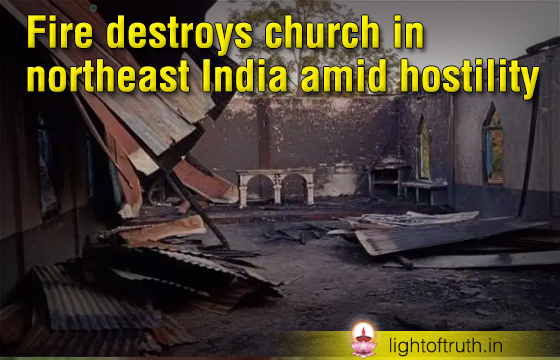
A fire has burnt down a village Church in India’s north-eastern Assam state amid right-wing Hindu group’s campaigns against Christian missionaries, but police are yet to confirm if it was an arson attack or an accident.
Tezpur diocesan Father Ambrose Musahary told that the church of his St. Teresa parish in Jhakar Gao village had been “burnt down to ashes.” The five-decade-old church in the Udalguri district has about 160 Catholic families, “most of them coming from Indigenous backgrounds,” the priest said.
The priest added that Hindus and Christians in the village lived in peace, and “we never had any disturbance or hatred among different communities.”
Bishop Michael Akasius Toppo of Tezpur, who visited the spot on Jan. 17, told that police and Church officials “are not sure whether someone deliberately set the church on fire or it was an accident.” “We have no evidence” for either case and “we can say anything about it” only after the police investigation is completed, the bishop said.
The fire happened three days after the parish celebrated the first Mass of two newly ordain-ed diocesan priests who belong to the parish’s indigenous families.
Category Archives: From The States
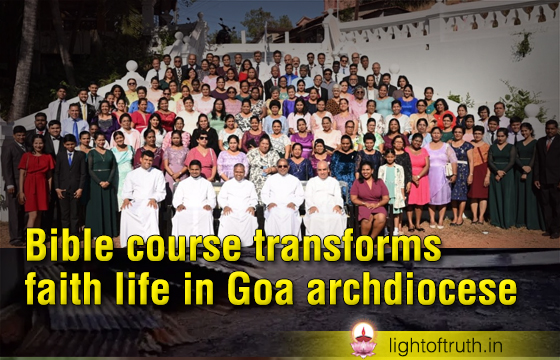
Bible course transforms faith life in Goa archdiocese
Bible study classes are transforming people’s lives besides deepening their understanding of the Scri-ptures, say the graduates of this year’s Bible course conducted by the Archdiocese of Goa and Daman. “Little did I know that it would change my daily walk with Christ. It was one of the best decisions we ever made and it turned out to be a life changing experience,” said Rupa Colaco, a dentist who was among the 133 graduates who received the certificate on January 26 at a program in the Aldona parish. As many as 925 graduates received the certificates at various centres and parishes in the archdiocese on the day marking the Sunday of the Word of God. The participants came different walks of life – teachers, parents, children, youth, catechists, nurses and doctors, said Father Mariano D’Costa, the director of Diocesan Centre for Biblical Apostolate that conducts the annual nine-month course. Doctor Colaco, who received baptism at the age of 16 after an encounter with Christ, said she had “a profoundly enriching experience that impacted my spiritual growth.” The course has “deepened my understanding of the Scriptures and its relevance in my life,” added the 44-year-old woman, who attended the classes with her three children aged 11, 13, and 16. Selma, another graduate of this year, described the course as the “best” that changed her life as a nurse as well as her family life.
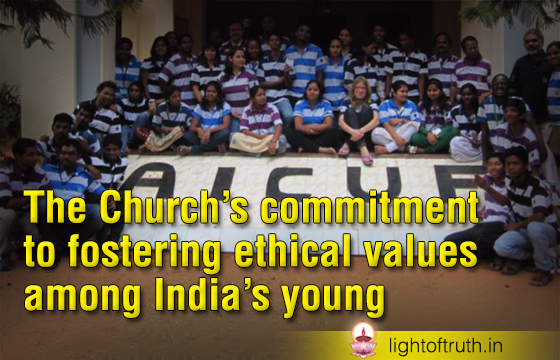
The Church’s commitment to fostering ethical values among India’s young
In our rapidly evolving world, the Church’s role in nurturing ethical values among young people is more crucial than ever. In India, various Catholic religious orders, notably the Jesuits, Salesians of Don Bosco, and the Holy Cross Fathers have establi-shed numerous youth programs and educational initiatives aimed at shaping the moral character of the next generation. Through organizations like the All India Catholic University Federation (AICUF) and a network of schools and colleges, the Church strives to develop leaders grounded in ethical principles, compassion, and a commitment to social justice. India’s former president Dr. A.P.J. Abdul Kalam once remarked, “The ignited mind of the youth is the most powerful resource on Earth.” His emphasis on the potential of young people aligns with the Church’s vision of investing in youth to create a more just and ethical society. By focusing on education, mentorship, and character formation, the Church seeks to empower young individuals to become ethical leaders and respon-sible citizens.

BEC animators undergo media training at Bandel pilgrim center
Basic Ecclesial Community (BEC) animators from eastern India are atte-nding a media training to strengthen their groups in parishes.
As many as 24 representatives from 13 eastern India dioceses are attending the January 27-31 program at Bandel Basilica Retreat Centre, about 40 km from north of Kolkata.
Media has central place in the lives of all Christians presently, said Sister Christin Joseph from Kolkata. So, we want to train our BEC anima-tors how best they can use the social media to proclaim the Gospel, added the Holy Cross nun who is involved in BEC promotion for the past three decades in eastern India.
Jesuit Father Sebastian Kanekattil, one of the facilitators and a media expert from Patna, said the training will enable the participants to under-stand the great influence of social media among youth.
Besides the training, the partici-pants will have a chance to make pilgrimage to the Bandel Basilica during this Jubilee year, said Father Sameer Kerketta from Hazaribag diocese in Jharkhand.
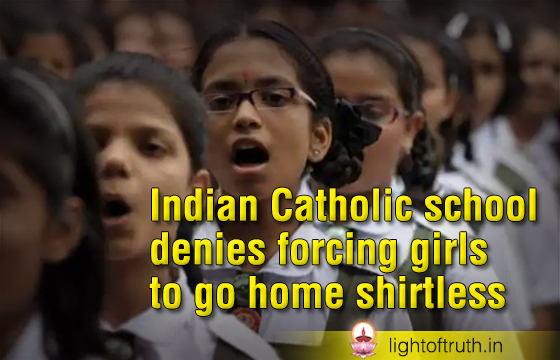
Indian Catholic school denies forcing girls to go home shirtless
Catholic officials in the eastern Indian state of Jharkhand have accused the media of trying to tarnish Church-run institutions after a school was accused of forcing about 80 teenage girls to return home in their blazers without shirts. Media reports accused Carmel School in Digwadih city, Dhanbad district, of confiscating the shirts of the tenth-grade girls on Jan. 9 as they celebrated Pen Day, the final school day before board exams. They were supposedly taken from the girls because they were writing messages on each other’s shirts to mark the end of their academic year. The Sisters of the Apostolic Carmel congre-gation, which runs the school, denied the media reports.
Sister Maria Kirti, Councillor for Edu-cation of the congregation’s Northern Province, said an initial inquiry showed that the students were “wearing an extra shirt over their school uniform on which they were writing the messages.” “At the time of dismissal, the students were only requested to return [home] in their original uniform,” Kirti said in a statement on Jan. 13. The media reports said the school principal disapproved of the celebration and told them to remove their shirts autographed by friends to create lasting memories. Social media videos reportedly showed the girls in tears as the school authorities ignored their repeated pleas to keep the shirts, sparking a public outcry. The nun blamed a section of the media for publishing unverified and inaccurate reports that “do not fully reflect the facts” that triggered a public uproar and maligned the image of the reputed school. She said her religious order had asked the school to conduct an internal inquiry to ascertain the facts and recommend corrective measures. She said the school principal has been ordered to “stay away from all administrative responsibilities” until the inquiry is completed. Meanwhile, on Jan. 12, the parents of the students filed a complaint with the National Commission for Protection of Child Rights, prompting an official investigation.

Temporary truce in Indian Church’s troubled archdiocese
Catholic priests in a troubled Indian Church archdiocese have called off a four-day protest after an assurance of dialogue to resolve their demands amid a raging decades-old liturgy dispute on the rubrics of Mass. The temporary truce within the Eastern rite Syro-Malabar Church, based in southern Kerala state, was reached on Jan. 13. The protesting priests were hoping for a settlement of the liturgy dispute at the Synod of Bishops, which was held from Jan. 6 to 11. On Jan. 9, some 21 priests entered the archbishop’s house to press their demands. However, the police evicted them on Jan. 11 and moved them to the adjacent compound of St. Mary’s Cathedral Basi-lica. “The protest was called off after the new vicar, Archbishop Joseph Pamplany, agreed to consider our demands and hold a dialogue to resolve them,” said Fr Kuria-kose Mundadan, the presbytery council secretary of the troubled Archdiocese of Ernakulam-Angamaly. Nearly 12 priests sustained injuries, including fractures, in the police action, leading to public protests by priests, nuns, and laypeople in the arch-diocese on Jan. 12. “They demanded action against police officials for their barbaric actions,” Mundadan told on Jan. 13.
When the situation escalated, the district collector convened a meeting with Church officials and the protesters late on Jan. 12. The Church authorities assigned Vicar General Father Jacob G Palakkappilly for the meeting, but the protesters refused to speak to him, saying he did not have the mandate to make a decision. Instead, they insisted on holding talks in the presence of Pamplany, the newly-appointed vicar of the archdiocese and the Archbishop of Tellicherry in Kerala state. The collector, the district’s top govern-ment official, contacted Pamplany, who was traveling but was asked to abort his journey. He joined the talks around 10.30 pm. The discussions continued until 1:30 am on Jan. 13, when Pamplany agreed in writing to consider the protesting priests’ demands, which included setting up cano-nical bodies in the archdiocese, considering the appointment of new curia, and halting all disciplinary actions initiated against them. The prelate also agreed to begin a dialogue with the priests and lay leaders regarding all the pending issues, including the liturgy dispute, from Jan. 20. Earna-kulam-Angamaly Archdiocese is the seat of power of the Church’s head and the biggest diocese, with close to 10% of the over five million followers worldwide.
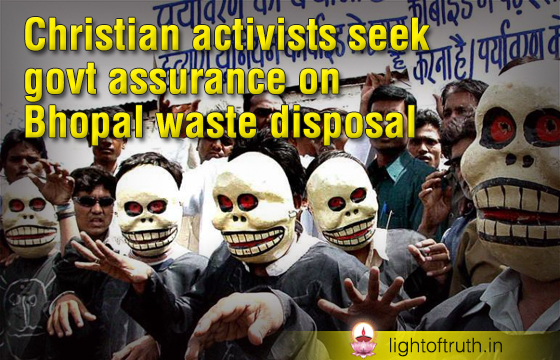
Christian activists seek govt assurance on Bhopal waste disposal
Christian leaders in central Indian Madhya Pradesh state have urged the government to dispel fears among people before disposing of hazardous waste from the four-decades-old Bhopal industrial disaster. The appeal was made after two people set themselves on fire on Jan. 3 in protests. Protests erupted after authorities moved hundreds of tonnes of toxic waste from the site of the world’s deadliest industrial disaster in the state capital, Bhopal. The 337 tonnes of waste–sealed inside containers–were ferried in a long convoy of trucks over-night on Jan. 1, with a police escort, to Pithampur town, about 220 kilometres away. “We want safe disposal of toxic waste from the site of Union Carbide Corporation. It should not risk the life of people,” said Jerry Paul, national president of the Sarva Isai Mahasabha (All Christian Federation) based in Bhopal. Paul and his family are survivors of the chemical leak that killed some 3,500 people in its immediate aftermath in December 1984. For decades, local people have blamed the toxic gas leak for a high level of sickness due to groundwater contamination caused by the poisonous gas leak. Overall, 25,000 people are estimated to have died so far, according to activists helping the survivors cope with the tragedy.
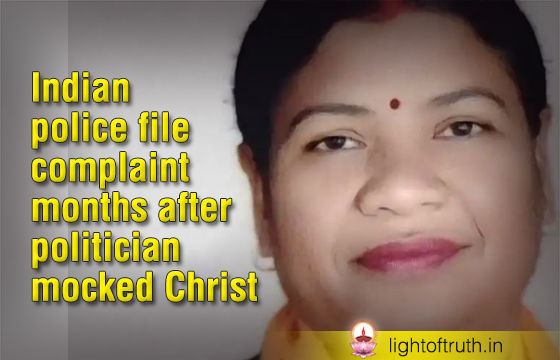
Indian police file complaint months after politician mocked Christ
Christian leaders in the central Indian Chhattisgarh state say police have regi-stered their complaint against a state legislative member following four months of persuasion after the politician allegedly in-sulted Jesus Christ. State police registered the complaint by Chhattisgarh’s Christian Forum against legislative member Raymuni Bhagat on Jan. 7. Forum president Arun Pannalal said the police acted after refusing to accept the complaint since Septem-ber. “We are satisfied with the development as we ran from pillar to post to register our complaint,” Pannalal said. He added the administration was favouring the culprit by not registering the complaint. Pannalal told on Jan. 8 that police were forced to accept the complaint following the intervention of the local court. Bhagat, a member of the Hindu-leaning Bharatiya Janata Party (BJP), is accused of making remarks denigrating Christianity in a programme organized in Dhengni village on Sept 1. Bhagat, who represents the Jashpur constituency, made fun of Jesus Christ, saying: “Christ was nailed to the cross…he couldn’t remove the nails, how do you expect Christ will remove your problems.”
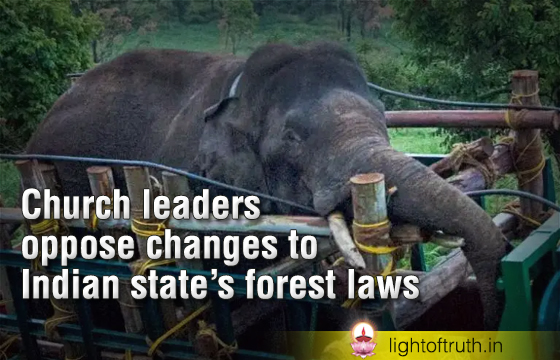
Church leaders oppose changes to Indian state’s forest laws
Catholic bishops of the Eastern rite Syro-Malabar Church have opposed changes to the forest law in southern Kerala state, saying the move could harm farmers amid a rising man-animal conflict. The Communist-led government has proposed amending the Kerala Forest Act of 1961 purportedly to suit current social needs and help better forest conservation. The amendments “will adversely affect the farmers living in the periphery of the forests,” the bishops said in a statement on Jan. 8 during their synod. The five-day synod, the supreme decision-making body of this Eastern Rite Church, began Jan. 6. It is attended by 54 serving and retired bishops at Mount St Thomas, the Church’s headquarters in the Ernakulam district. “Prima facie, the changes look more harmful to humanity instead of being human friendly,” the bishops said, urging the state government to “clear the anxiety of the people over its move.” The statement said the prelates held extensive discussions over the proposed changes. It expressed concern over granting forest officials more powers to arrest or detain individuals without a warrant and search the premises or vehicles of anyone based on mere suspicion.
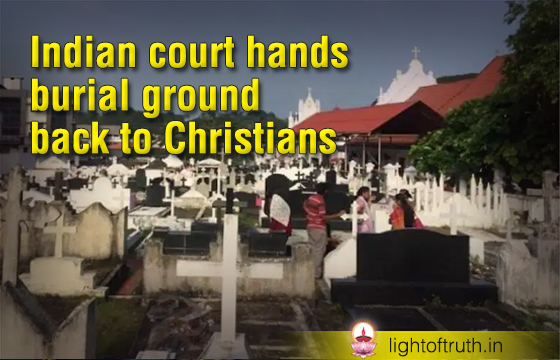
Indian court hands burial ground back to Christians
A district authority in Maharashtra state in western India has been ordered to take back land encroached upon by a state minister and designate it as a multi-faith burial ground as per a directive the authority made eight years ago. Last week, the Bombay High Court ordered the Thane Municipal Corporation “to secure the land from illegal encroachment.” The court also asked for a status report by Feb.12 on the land’s readiness to be used as a burial ground for faith groups, including Chri-stians. The Thane district administration, through a government notification in November 2016, allotted 37,000 square meters of government land as a burial ground, the court noted in its Jan. 8 order. The land “shall not be put to any use other than the use for which it has been reserv-ed,” the order said. The court took up the issue following a petition by Melwyn Fer-nandes, a Catholic activist, who complained that the Christian community in the area suffered from a lack of burial grounds as it could not use the land the government had allotted for burials. Fernandes, general secretary of the Association of Concerned Catholics, filed the public interest litigation in 2021 seeking the court’s intervention to ensure adequate burial land for Christians in Thane district. The petition alleged that the municipality, in 2019, engaged a private land-developing firm to prepare the land for use as a cemetery. But, the firm, alle-gedly owned by the state transport mini-ster, Pratap Sarnaik, did not develop the plot. However, Sarnik’s firm began constru-cting a commercial housing project adjacent to the designated burial ground and en-croached upon it. Fernandes told that the court order made the Christian community happy as the original burial ground plan designated an area for the community in the district. Christians in the state, who form barely 1 percent of its 132 million people, do not have enough burial grounds, Fernandes said, adding: “The case for Christians in Thane is worse.”