

Christian leaders in strife-torn Manipur state in northeastern India have welcomed the resignation of its chief minister, close to two years after the state witnessed unprecedented violence that claimed over 250 lives, mostly Christians.
Chief Minister Biren Singh submitted his resignation letter to Governor Ajay Kumar Bhalla who is the constitutional head of state, on Feb. 9 in the state capital amid continuing unrest between Kuki tribal Christians and Hindu-majority Meitei people. The resignation is “definitely a welcome move for the betterment of the violence-ravaged state,” said a Christian leader who did not want to be named, fearing retribution. “Now there is a scope for restoration of peace and reviving the shattered lives of the people of Manipur,” the Church leader told.
The tiny, hilly state with 3.2 million people has been in turmoil since May 3, 2023, after unprecedented violence broke out between the Meitei and indigenous Kuki people, who are a minority in the state but mostly Christians. The violence erupted after the Meitei people attacked Indigenous Christians, who were rallying to protest the Singh government’s decision to extend tribal status to the Meiteis. Kuki people say the extension of the status will help Hindu Meitei people eat up tribal benefits meant for weaker sections. Meitiei people are considered comparatively wealthy and politically influential, they say.
The violence persisted, and at least 11,000 houses and 360 Churches were burned down, and scores of Church institutions, including schools, presbyteries, and other offices, were destroyed. Kuki leaders accused Singh, a Meitei, of orchestrating and supporting the violence and demanded his resignation. But Singh refused, asserting that his government, led by the Bharatiya Janata Party (BJP), made all possible efforts to restore peace.
“The presence of Singh as the leader of the government was a major stumbling block for peace in the state as the indigenous Kuki-Zo people never trusted him,” another Church leader said. Singh, a state leader of BJP, “was outright a partisan leader who only represented the interests of his [Meitei] community.
Therefore, the state could not move forward with any peace talk until now,” the Church leader said. He expressed hope that the federal government under Modi “will now take appropriate steps to restore peace in the state.”
Category Archives: From The States

Nun who won global award for anti-trafficking mission
Canossian Sister Grasy Luisa Rodrigues received the Common Good Award at the Sisters’ Anti-Trafficking Awards May 23, 2024, in Rome for saving trafficking victims for the past 13 years.
She also educates youth about the Indian Juvenile Justice Act, cyber safety and online exploitation, child labour, health and hygiene, and children’s rights and protection.
The 45-year-old nun organizes human trafficking awareness campaigns in hotels, colleges, villages, schools and slums with the support of law enforcement agencies. She helps rehabilitate the rescued and works with networks such as the International Justice Mission and Justice and Care.
In 2022, Rodrigues became a founding member of Mukti Kiran (Ray of Liberation), an organization that works with Goa police to prevent human trafficking.
Rodrigues, who lives in Goa’s Arambol village, shared with Global Sisters Report how she entered social work and contributed to society.
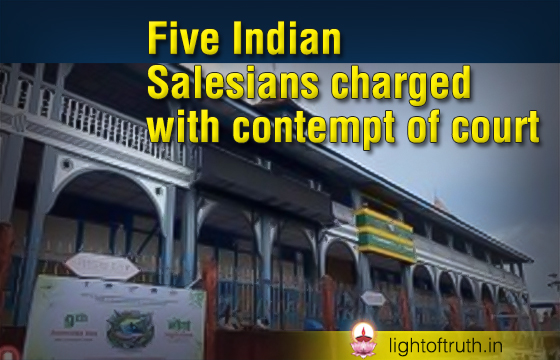
Five Indian Salesians charged with contempt of court
The top court in India’s northeastern Meghalaya state has issued contempt of court notices against five Salesian priests for demolishing a build-ing, ignoring a petition that sought the court’s intervention to protect it. Meghalaya High Court on Jan. 28 issued notices to the priests – Saji Stephen, Arcadius Puwein, Edmund Gomes, Dianetius Fernandez and Cyril Tirkey – asking them to explain “why they should not be punished for criminal contempt” of the court.
The bench Chief Justice I P Mukerji and Justice W Dieng-doh issued the notice and scheduled Feb. 24 for the next hearing. The priests are ma-nagement officials of the Salesian-run Don Bosco Tech-nical School in Shillong, the state capital. The fiasco centres on demolishing the building of St. Anthony’s Lower Primary School, which is on the Don Bosco Technical School cam-pus. Last December, a public interest litigation (PIL) challe-nged the plans to demolish the school building and sought court intervention to help protect it as a heritage building. The school’s director, Saji Stephen, told that they demolished the building after obtaining permission from the state government. He said the school, with some 1,200 students, continues functioning in other buildings on the same campus. During the previous hearing on Dec. 9, the court “neither imposed any order to maintain the status quo, nor any stay on dismantling the dilapidated building.
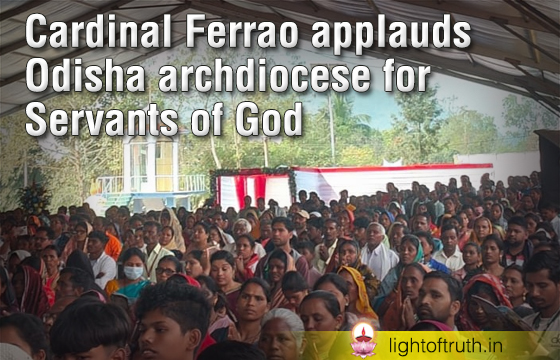
Cardinal Ferrao applauds Odisha archdiocese for Servants of God
Cardinal Felipe Neri Ferrao, president of the Conference of Catholic Bishops of India (CCBI), has congratulated the Archdiocese of Cuttack-Bhubaneswar for producing 35 martyrs of faith. The cardinal’s message was read by Archbishop Peter Machado of Bangalore, newly elected CCBI vice president, at a function to mark the golden jubilee of the only archdiocese in the eastern Indian state of Odisha. The February 6 function at Our Lady of Holy Rosary Parish, Daringbadi, in Kandhamal district was attended by 23 bishops, 145 priests, 150 nuns and 20,000 Catholics. “We the bishops of India are delighted to congratulate you on the beatification and canonization of 35 Servants of God. You have unwavering faith in Christ,” said the cardinal’s message. “We cannot forget the sacrifice of the people of your diocese for faith in the anti-Christian violence of 2007-2008. We appreciate you [Divine Word Archbishop] John Barwa [of Cuttack-Bhubaneswar] and your people. Kandhamal has become the land of martyrs now, added the message offering solidarity, affection and closeness to the faithful of the archdiocese.
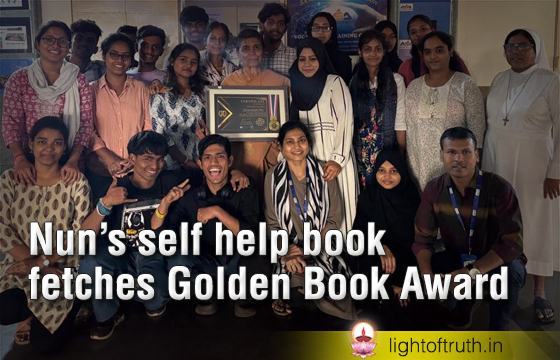
Nun’s self help book fetches Golden Book Award
Salesian Sister Teresa Joseph, a Mumbai-based nun, has been conferred the Golden Book Award 2025 for her self-help and motivational book. The award is given by Wings Publication International, an international publishing company to recognize books and authors for their literary contributions.
Sister Joseph received the award at a function on January 31 in Mumbai. Sister Teresa’s book – “Dream Big Dream True – 35 Tips to make the best of your life” – first published in 2004, has made a significant impact on readers, spreading positivity and motivation, the award committee noted.
The book covers themes such as self-love, self-confidence, optimism, trust, forgiveness, and friendship among others. Receiving the award, Sister Teresa expressed her gratitude and said, “The Golden Book Award has given me another chance to experience the depth of my conviction. I’m delighted that my book passed the rigorous selection process.” Manika Singh, CEO of the Wings Publication International, congratulated Sister Teresa. “We’re honoured to feature you on our platform, recognizing your exceptional contribution to impacting readers across genres.”
The book, now in its 10th edition, has been translated into several languages, including Marathi, Hindi, Braille, and Khasi. It has received a Best-Seller award and five-star reviews on Amazon.
Professor Cosmas Rynshon, who wrote the foreword to the Khasi edition, said, “Such contents on self-help and motivation do not exist in Khasi.” Sister Teresa, who holds a doctorate in Education, credits her writing inspiration to her professors at Auxilium, Rome, who stressed the importance of writing for teachers.

Catholic religious in Mangaluru celebrate World Day of Consecrated Life
Around 675 Catholic religious from various congregations in the Mangalore diocese of southern India have celebrated the World Day of Consecrated Life. The gathering held under the regional unit of the Con-ference of Religious in India (CRI) on February 2, the feast of Presenta-tion of the Lord, underlined the need for unity and brotherhood among religious community. “The Manga-lore diocese continues to be a cradle of religious vocations and we stand united to face the challenges of the modern world,” Providence Sister Severine Menezes, the president of the CRI Mangaluru unit, told the gathering at the Jesuit managed St Aloysius University in Mangaluru.
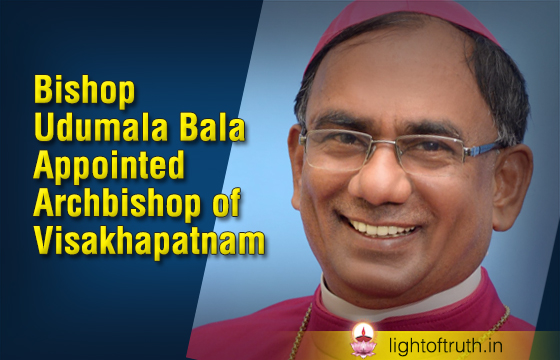
Bishop Udumala Bala Appointed Archbishop of Visakhapatnam
The Holy Father Pope Francis has appointed Bishop Udumala Bala Sho-wreddy (70) as the Abp of Vishakapat-nam in Adhra Prade-sh transferring him from the diocese of Warangal on February 8, 2025. He was appointed Bishop of Wara-ngal on April 13, 2013 and ordained Bishop on May 23, 2013. He was the Apostolic Administrator of the diocese of Khammam from 2022 to 2024. He was the Deputy Secretary General of the CCBI from 2006 to 2013 and the Chairman of the CCBI Commission for Vocations, Semina-ries, Clergy and Religious from 2015 to 2023.
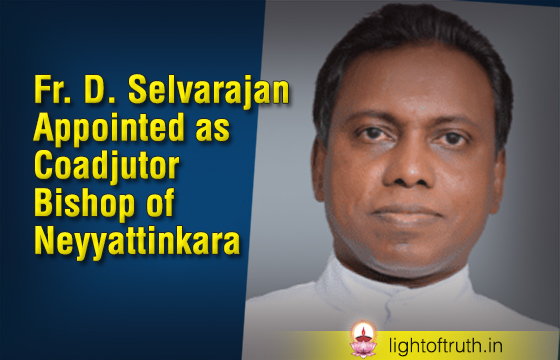
Fr. D. Selvarajan Appointed as Coadjutor Bishop of Neyyattinkara
The Holy Father Pope Francis has appointed Fr. D. Selvarajan (62) as Coadjutor Bishop of Neyyattinkara, Kerala on February 8, 2025. Since 2011, he has been the Judicial Vicar of Neyyattinkara, and since 2019, he has been the Parish Priest of St. Francis Xavier in Thiru-puram. He was born on January 27, 1962, in Valiyavila. He studied Philosophy and Theology at St. Joseph’s Pontifical Seminary in Alwaye and earned a License and Doctorate in Canon Law at the Université catholique de Louvain. He was ordained a priest on December 23, 1987, for the Archdiocese of Tri-vandrum of the Latins. The diocese of Neyyattinkara was erected on June 14, 1996, bifurcated from the Archdiocese of Trivandrum. Bishop Vincent Samuel is the first bishop of the diocese. The diocese consists of two taluks, Neyyattinkara and Nedumangad.

Indian Catholic bishop urges cordial relations with Sikhs
An Indian Catholic bishop has stressed the need to maintain harmonious relations with the majority Sikh community in northern Punjab state amid reports of rising conversions to Christianity. A Sikh youth group in the state has launched an awareness campaign to stop conversions and the establishment of new churches. “We are aware of the campaign, it is the result of activities of some house churches and their ministries that have damaged the reputation of mainstream churches,” said Bishop Agnelo Rufino Gracias, the apostolic administrator of Jullundur diocese. He told on Jan. 16 that the campaign to counter conversions “is a wakeup call for all of us to keep intact the rapport we have made with the Sikh community.”
The Sikh Youth Federation-Bhindran-wala said it aimed to expose the truth regarding various allurements, promises of miraculous healing, and other fraudulent practices adopted by Christian groups to convert people, reported the Times of India newspaper on Jan 15. Its president Bhai Ranjit Singh said, “The rise in conversions and establishment of new churches, particularly in the districts of Amritsar, Gurdaspur, and Pathankot, prompted us to act.” He said there was an urgent need to engage with Sikh and Hindu people in the state and “understand why they are changing their faith, and encourage them to remain committed to their own religion.”
Gracias, the Auxiliary Bishop Emeritus of Bombay who was appointed apostolic administrator of Jullundur diocese in 2023, said that “there is nothing wrong with the campaign” by the Sikh youth group. “It may have been disturbed by the house church ministries that are very aggressive, but as far as the Catholic Church is concerned it does not believe in forced conversion,” the prelate said. Gracias further said that because of a few house church pastors “we cannot and should not make our relations complicated with the Sikh people.”
Sanwar Bhatti, president of the Protestant United Church of Northern India Trust Association, said the campaign by the Sikh youth group has been going on for the past six months or so. “It will have no impact on our relations with the Sikh community. We have shared a good rapport with them in the past and present, and will continue to do so in future,” he told. Bhatti said the activities of certain church ministries are creating a misunderstanding among Christians and Sikhs in the state. “But we have to sit together and find a solution,” he added.

Indian court jails first Christians under anti-conversion law
In a first in India, a court has jailed a Christian couple for five years for attempting to convert people in a northern state, considered a hotbed of anti-Christian activities.
A special court in Uttar Pradesh’s Ambedkar Nagar district, which deals with cri-mes against socially poor castes, convicted Pastor Jose Pappa-chan and his wife, Sheeja Pappachan on Jan. 22.
They were sentenced to five years imprisonment and each fined 25,000 rupees. “This is the first time we have en-countered such a sentence for a suspected conversion attempt,” said A.C. Michael, a Christian leader who monitors anti-Chri-stian activities in the country.
He said the verdict and punishment “for a suspected attempt to convert will not stand the scrutiny of a higher court.” An attempt to convert is “not a recognized crime under the law,” Michael said.
Pastor Joy Mathew, who has been assisting the couple, said the judgment was “biased.” “We will challenge it in the High Court, the top court in the state,” Mathew told.
“There was no evidence on record to substantiate the con-version charges, but still, they were convicted,” he said.