
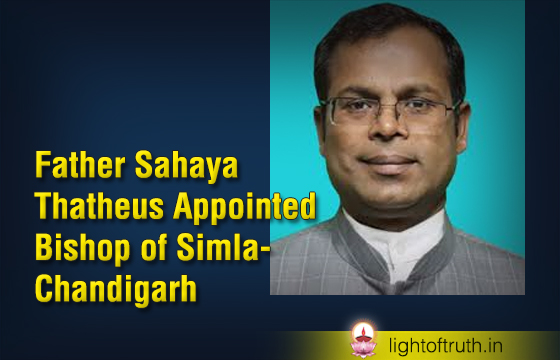
Pope Francis has appointed Father Sahaya Thatheus Thomas (54), Rector of Holy Trinity Major Seminary, Jalandhar, as the new Bishop of the Diocese of Simla-Chandigarh. The announcement was made on Saturday, 12 April 2025. At the same time, the Holy Father accepted the resignation of Bishop Ignatius Loyola Ivan Mascarenhas (75), who has led the diocese since 2009.
Father Thadeus was born on 6 November 1971 in Chinnavilai, Tamil Nadu, in the Diocese of Kottar. He was ordained a priest for the Diocese of Simla-Chandigarh on 13 May 2001. Father Thadeus holds two Master’s degrees: one in Journalism and Mass Communication from Punjabi University, Patiala (2006–2008), and another in Human Rights from the Indian Institute of Human Rights, New Delhi (2007–2009). He also studied German at the Uni-versity of Vienna before completing a Licentiate in Theology (2010–2013) and a Doctorate in Sacred Scripture (2013–2016) from the University of Vienna, Austria. His pastoral ministry began as Parish Assistant at Little Flower Parish, Panchkula (2001–2004), where he also served as Priest-in-Charge. He then took on responsibilities as Vice-Rector of the Diocesan Minor Seminary, Kauli (2004–2009), while also serving as Director of the Diocesan Commission for Media and the Bible Enquiry Center. The Diocese of Simla-Chandigarh, which covers parts of Himachal Pradesh, Punjab, and Haryana, now welcomes its new shepherd, a man deeply rooted in pastoral care, academic excellence, and missionary zeal.
Category Archives: From The States
Bishop Ignatius Mascarenhas Retires After 16 Years of Episcopal Ministry
Bangalore: Bi-shop Ignatius Loyo-la Ivan Mascarenhas (75), Bishop of Si-mla-Chandigarh, retired on 12 April 2025, marking the end of a 16-year episcopal ministry that began on April 3, 2009. Pope Benedict XVI appointed him Bishop of Simla-Chandigarh on February 10, 2009. He was ordained on April 3, 2009. Over the next 16 years, he led the diocese with dedication, fostering evangelization, education, and community life. Bishop Ignatius also served as President of the Simla-Chandigarh Educational Society and remained actively involved in dioce-san development through various pastoral and educational initiatives. Nationally he led the CCBI Commi-ssion for Basic Ecclesial Communities from 2019 to 2023. He was also Se-cretary of the Regional Bishops of the North until 2017.

Fr. Sonatan Kisku Appointed as Auxiliary Bishop of Dumka
Pope Francis has appointed Fr. Sonatan Kisku, aged 56, as the Auxiliary Bishop of the Diocese of Du-mka in Jharkhand. The announcement was made on Satur-day, 12 April 2025. Fr. Kisku is currently serving as the Vicar General of Dumka and the Parish Priest of St. Mary’s Church, Dumka.
Fr. Sonatan Kisku was born on 15 May 1969 in the village of Kaudia, under Kalhajor Parish in the Dumka Diocese. He was ordained a priest on 15 April 2002. In 2004, Fr. Kisku was sent to Rome to pursue higher studies in Canon Law. He earned his Licen-tiate in Canon Law in 2007 and return-ed to serve his dio-cese in various capacities. That same year, he was appointed Director of Candidates at the diocesan vocation centre. From 2008 to 2013, he served as Diocesan Treasurer, Chance-llor, and Minister at the Bi-shop’s House. He was also appointed Father-in-charge of Gopikandor from 2012 to 2014.
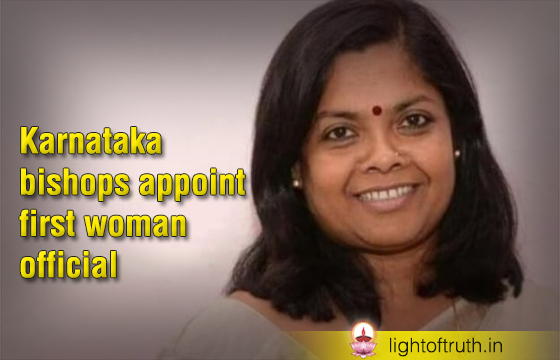
Karnataka bishops appoint first woman official
The Karnataka Region Catholic Bishops’ Council has created history by appointing two laypeople to head its co-mmission for Scheduled Castes, Scheduled Tribes and Backward Classes. Arch-bishop Peter Machado of Ban-galore, the council president, on April 7 announced the appointment of Isabella Selvaraj Xavier as the commi-ssion’s joint secretary, the first woman to hold the post. The council has also promoted the current joint secretary Alphonse G Kennedy as the commission secre-tary. Kennedy is the first layperson to serve as secretary of the commission. Fr. Yagappa, the outgoing secretary, hailed Kennedy’s promotion as a “a significant and well-de-served recognition” of his dedication and commit-ment. “We extend our warmest congratulations to him on this important role. We are confi-dent that his expertise and passion will greatly benefit the interests and welfare” of those under the commission.
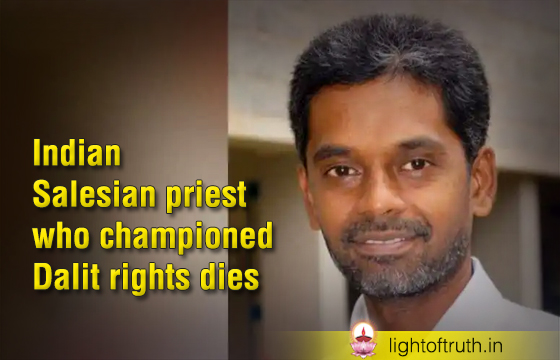
Indian Salesian priest who championed Dalit rights dies
Father Arul Valan, a Salesian priest who led a movement for the rights of a Dalit or former untouchable community in the southern Indian state of Tamil Nadu, has died at 54. Valan, who co-founded the Thurumbar Liberation Movement along with Sister Alphonsa, died of a heart attack on April 8, Radio Veritas Asia (RVA) reported on April 9. Father Devasagayaraj M. Zackarias, former executive secretary of the Catholic Bishops’ Conference of India’s office for scheduled castes and backward classes, called Valan “a powerful fighter” for the Thurumbar community. The Thurumbars, also known as Puthirai Vannars, are considered “unseeable” because of their lower caste status. The community traditionally washed the clothes of other Dalits and was placed in the lowest rungs of Tamil Nadu’s caste-based society. Valan created “a new dawn for the politically, economically, and socially marginalized community. We cannot summarize his contributions in just a few lines,” Zackarias said. He fondly remembered the “deep ideological discussions” with Valan and noted how the deceased priest would not hesitate to invite leftist groups to the protest alongside the washermen.
Church hails Indian court ruling on education institutions
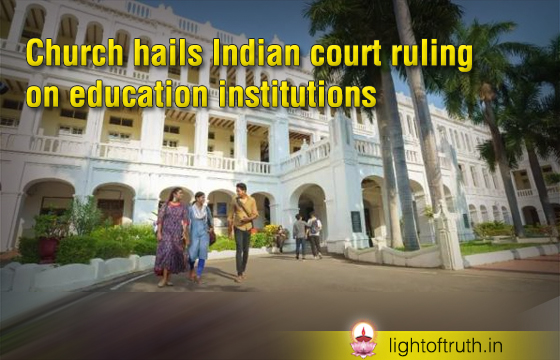
Catholic officials have welcomed a ruling by the top court in Tamil Nadu state, in southern India, reaffirming the autonomy of higher education institutions run by religious minority groups.”We are very happy that the high court has rightly upheld the constitutional provisions for minority higher education institutions to select their staff, which is essential for their existence as minority institutions with core values,” said Maria Charles, a Catholic priest and secretary of the Indian bishops’ Office of Edu-cation and Culture. The respon-se came after the Madras High Court in the Tamil Nadu state capital, Chennai, ordered two state-run universities on March 27 to approve the appointment of 66 assistant professors and a principal at five Christian-run colleges, which had been pending since 2020. The court ruling followed a petition from the Women’s Christian College, the Madras Christian College, Loyola College, and the Stella Maris College, all four in Chennai. Meanwhile, Sacred Heart Arts & Science College in Tindivanam challenged Annamalai University’s refusal to allow it to appoint a princi-pal. The state pays staff sala-ries in such state-aided colle-ges, but only after the university under which they function approves the staff appointments.
The Madras University blocked the appointment of the 66 assistant professors selected by the four Chennai-based colleges. Christian colleges challenged Madras University’s decision, resulting in the current order.
Catholics mourn central India’s popular Indigenous archbishop
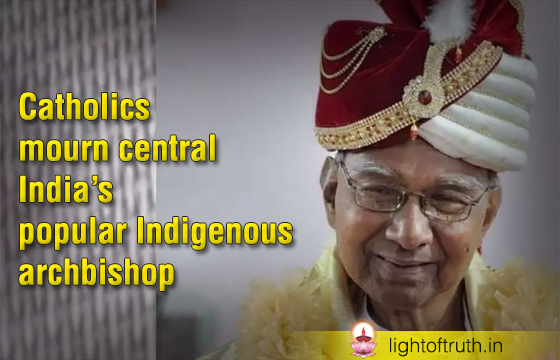
Thousands of people joined the funeral service of retired Jesuit Archbishop Pascal Topno of Bhopal in central India on April 9, hailing the indigenous Church leader’s simplicity and love for his people. Archbishop Topno died of age-related ail-ments at a Church-run hospital on April 6. He was 94. Topno led the Bhopal archdiocese, based in the Madhya Pradesh state capital, for 13 years until his retirement in 2007. A state-ment from the Conference of Catholic Bishops of India (CCBI), a body of Latin rite bishops in India, said the pre-late was known for his “sim-plicity, wisdom, and deep spiri-tual insight.” “He was regarded as a living saint by both the people and the priests in the archdiocese,” said Fr. Maria Stephan, former public relations officer of the archdiocese. “He was extremely supportive, encouraging, and collaborative with his priests,” Stephan told on April 10. “He was so humble and traveled by train in the general compartments like ordinary people, avoiding the air-conditioned coaches,” the priest said. “He never carried money. Sometimes, while traveling long distances for pastoral visits, his driver had to pay for their tea or drinking water,” the priest said.
Catholic religious in Odisha urged to promote unity, cooperation
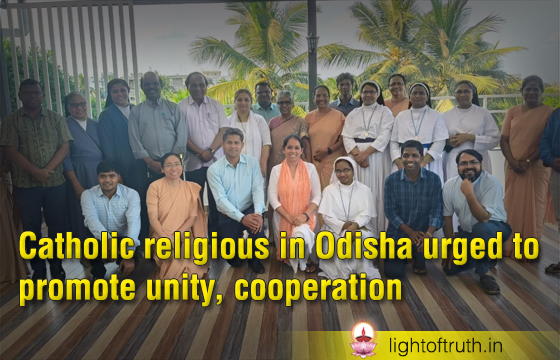
The Odisha unit of the Conference of Religious India (CRI) that met April 8 heard their national secretary stressing the importance of dialogue with lay collaborators, integrated prayer life, and formation programs that are relevant to today’s challenges. “If our preferential option for the poor remains only in our preaching and not in our practice, we risk creating a painful dichotomy between our words and our witness,” warned Presentation Sister Elsa Muttathu while addressing some 25 members of the unit at the Archbishop’s House in Bhubaneswar, the state capital. She told the gathering that the Conference of Religious India exists to promote unity and cooperation among religious congregations. “Our mission is to address shared challenges, strengthen our collective voice, and support the individual charisms of each institute.” Sister Muttathu reminded the gathering that religious life is not about institutional survival or personal security, but about responding to the needs of the present moment. “Let us not limit ourselves to routine physical tasks. Make time for reading, writing, and deep reflection,” she urged. “Our communities were not founded to build institutions or secure our comfort,” she stated. “We are called to live among the people, listen to them, and be part of their lives–just as the early religious did.” She challenged the participants to critically evaluate their ministries. “Do we visit families to truly know them and share in their lives, or simply to seek vocations for our congregations?” she asked. Under-scoring the need for authenticity, the national secretary stressed the importance of aligning action with values. Speaking on the role of women religious, Sister Muttathu encouraged them to prioritize intellectual and spiritual growth alongside daily responsibilities. She also advocated for greater involvement of women in decision-making spaces within the Church. The meeting helped the participants voice their expectations, struggles, and hopes in living out their vocation as the CRI members.

Eviction-facing Indian Catholics to fight Muslim charity’s claims
Threatened with eviction from their homes, some 600 families, mo-stly Catholics, have vowed to conti-nue a 16-month-old hunger strike in Kerala state, in southern India. The protesters resolved to continue their fight after a court last week stopped a government-appointed commission tasked with finding ways to protect their land rights, their leaders said. The court stated that the government lacks the authority to appoint such a commission. Last December, the government established a commi-ssion to propose solutions for the dispute, which began after a Muslim organization claimed that the villa-gers lived on some 400 acres of land donated to it for charitable purposes many years ago. The court ruling “is a setback for us. But the people will continue their struggle,” said Fr. Antony Xavier, the parish priest of Velankanny Matha Church in Munamban, in Ernakulam district. The priest told on March 21 that the state government, the respondent in the case, “has agreed to appeal the single bench ruling. We want the government to appeal.” The 610 affected families, all from his parish in the Kottapuram diocese, purchas-ed the land at market rates, paid for it, and registered the deeds following all state legal systems. “We will conti-nue the fight until our legal rights to the land are recognized.”

Goans oppose tourism project near 16th century basilica
About 700 people, mostly Catho-lics, marched through Old Goa, the colonial-era Portuguese capital, to protest a government plan for a tourism project near the Bom Jesus Basilica, the 16th-century church that houses the relics of Saint Francis Xavier. Environmentalists and resi-dents of Old Goa joined the protest at the popular pilgrimage site on Mar. 23 to oppose the project. The Goa Tourism Department reportedly planned to build a ‘tourism mall’ on the ruins of a 16th-century church near the basilica. Residents of Old Goa have formed a forum–Save Old Goa Action Committee–to oppose the project, which they say is planned with scant regard for their history, Catholic sentiments and environment. “It is outrageous that a commercial structure is being planned on the ruins of the Five Wounds of Christ Church. The project is also within the 100 meters of the world heritage site of Bom Jesus Basilica,” Catholic priest Savio Barretto, former rector of the Basilica of Bom Jesus told on March 24.