
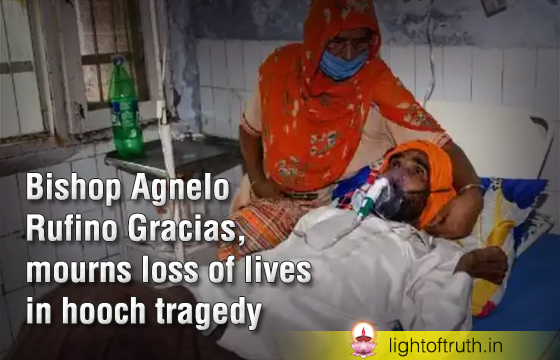
Church leaders in northern India’s Punjab state have blamed a lack of urgency by authorities in dealing with bootleg liquor for the deaths of at least 17 people this week. Government officials told the media on May 13 that three people were still in critical condition after drinking spurious liquor in the Majitha area of Amritsar district. The tragedy “could have been avoided easily had authorities been alert. It is a man-made tragedy,” Bishop Agnelo Rufino Gracias, the Apostolic Administrator of Jalandhar diocese, told on May 13. Gracias, whose diocese covers the entire Punjab, expressed his “heartfelt condolences” to the bereaved families who lost their loved ones. “What is disheartening is that we have not learned from the past experience” of 2020, when 121 people died after consuming spurious liquor in the state, the prelate said. “It’s very unfortunate that some money-minded people are risking the lives of ordinary citizens by supplying substandard things.” Gracias stressed that the government must combat the life-threatening and illegal liquor business by arresting the people involved in it. A Church leader who wished to remain anonymous, said that the church was unaware of any Christian families affected by the tragedy.
Category Archives: From The States

Indian Christians hopeful as govt promises to restore land rights
Leaders representing around 600 families, mostly Catholics, are hopeful about concluding their six-month protest to reclaim their lands after a federal minister visited their southern Indian village and promised to seek an early solution. Kiren Rijiju, federal minister for minorities, visited Munambam coastal village of Kerala’s Ernakulam district on Jan. 15 and addressed the people, who have been on a protest since October 2004. “We are very hopeful of ending the protest after the minister promised to find a solution in three weeks,” said Father Antony Xavier, the parish priest of Valankanny Matha Church, which is part of the disputed land. The 610 families, including some Hindus, began the protest almost two years after officials informed them in January 2022 that approximately 400 acres of land in the village, including the land they had purchased decades ago, did not belong to them. The officials informed them that nearly a century ago, the land was designated as waqf, a Muslim dedication for charity. The State Waqf Board has asserted its ownership of the land, and as a result, the families’ land rights have been suspended. Archbishop Joseph Kalathi-parambil of Verapoly archdiocese, based in Ernakulam district, submitted a memo-randum to the federal minister, who called on him at his residence, on April 15.
“I request you to re-establish the revenue rights of the people of Munambam, which is entangled in the waqf issue in a time-bound manner and give specific directives to the various authorities in the lower appropriate departments for resolving the issue,” the prelate appealed in his memorandum. The land issue became complicated because of a federal law governing waqf properties – the Waqf Act of 2013 – that granted excessive power to Waqf Boards, allowing them to designate any property as waqf land based on their own investigations.

Indian tribal village forces Christian families to abandon faith
Tribal villagers in central India’s Chhattisgarh state forced seven Christian families to abandon their faith, but six other families remain steadfast in their faith despite intense pressure, a local Christian leader said. Pastor Chinnam Wycliff Sagar said that the 13 Christian families in Karigundam, a village in the Maoist-infested Sukma district, were ordered by the local village council to return to their animist tribal religion or get expelled from the village. The village council issued the order on April 12, Palm Sunday, Sagar told UCA News. Six families “stood firmly against the illegal order,” and it “has irked villagers,” Sagar told UCA News on April 17, three days after visiting the families in the village. The village has 136 tribal families, totaling 660 people. Villagers “threw household items belonging to the Christians out of the village” and told them to stay away. However, local officials and police helped them return on April 13, Sagar said. “Now they are back in their homes, but their struggle to maintain their faith will be another challenge as the entire village is hostile to them”, he explained. Sager said the villagers did not allow him to see the families that left the Christian faith. The pastor said no police complaint has been filed as they “were allowed to regain access to their homes.”
Forest trespassing charges dropped against retired Indian bishop
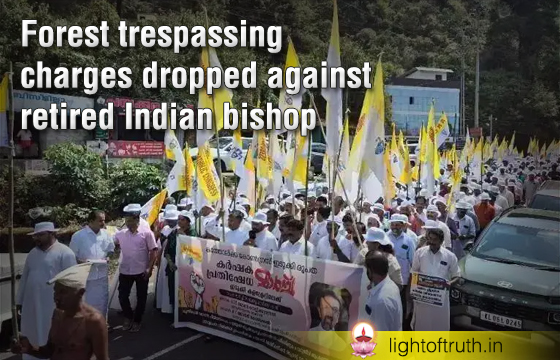
The Church has welcomed a decision by the communist-led government in India’s southern Kerala state to drop charges against an 88-year-old Catholic bishop and 23 others for entering a restricted forest during a march demanding the reopening of a blocked public road. “We are happy the go-vernment announced dropping of charges against our elderly bishop for joining a public protest,” said Vincent Nedun-gatt, Vicar General of Kotha-mangalam diocese of Eastern Rite Syro-Malabar Church based in Kerala. Retired Bishop George Punnakottil of Kotha-mangalam and others, including elected representatives, were charged with violating forest laws and trespassing on forest land on March 23, along with over 3000 aggrieved local people, mostly farmers. Father Nedungatt told on April 21 that the prelate should not have been charged with violation of the law. “He knew the difficulties and pain of his people, especially farmers, and joined the protest to protect their interests,” he added. People from different walks of life, including Catholics, condemned the Left Democratic Front government and demanded that it withdraw the charges against the bishop and others. The government decided to drop the charges at a high-level meeting attended by Law Minister P. Rajeev, Forest Minister A. K. Saseen-dran and other senior officials on April 16, official sources said.
Indian state releases convict in Australian missionary murder
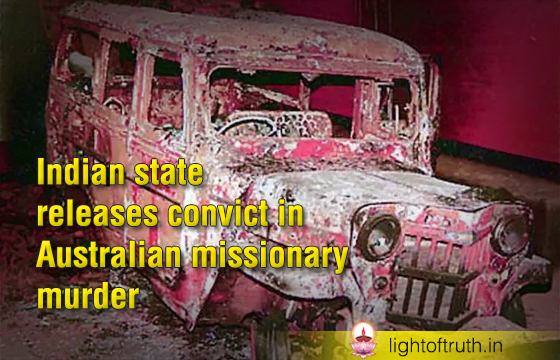
The government in eastern India’s Odisha state has released a man serving a life term for the murder of Australian missionary Graham Staines and his two minor sons, reportedly considering his “good conduct” in jail. The government, led by the Hindu-leaning Bharatiya Janata Party (BJP), released Mahendra Hembram, 51, on April 16 after he had spent 25 years in prison. Keonjhar district prison authorities gave Hembram a cordial farewell and, garlanded him in recognition of his good conduct in jail, reports said. “The Christian community in Odisha is shocked over the news of his pre-mature release,” said Father Ajay Singh, a lawyer and activist belonging the archdiocese of Cuttack–Bhubaneswar in the state. Singh told on April 17 that the release of Hembram, who murdered a missionary and his two sons, “will set a horrible precedent.” Hembram was given life in prison for assisting Dara Singh, the main culprit, who burnt alive Staines and his two minor sons – Philip (aged 10) and Timothy (aged 6) – on Jan. 22, 1999, in the Koenjhar district of eastern Odisha state. The missionary and the children were sleeping inside their vehicle in the remote village.
Indian state uproots cross, parishioners fight for land rights
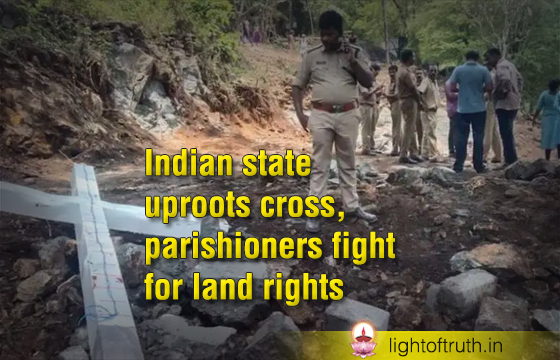
Catholics in a parish in Kerala in southern India have accused the state’s forest department of “terrorizing” them after officials uprooted a cross and registered charges against their priest and leaders for encroaching on forest land. James Aikkaramattam, parish priest of St. Thomas Church in Idukki district, told on April 21 that the cross was on “parish land that a parishioner donated decades ago.” On April 12, Palm Sunday, forest officials used an earthmover to remove the 3-meter concrete cross, claiming it was illegally occupying forest land. The forest department also registered a case against 18 people, including the parish priest, for violating forest laws by trespassing onto forest land and encroaching upon government property. ”The charges against me and others are false, as we did not trespass onto any protected forest. A parishioner built his house on the land and lived there for five decades before donating it to the parish.

Indian court protects conversion-accused nun from arrest
A state court in central Indian Chhattisgarh state has issued a pre-arrest bail to a Catholic nun after police began investigating a complaint that the nun attempted to convert a Hindu student at her nursing college. The move of the Bilaspur High Court, the highest court in the state, saves Sister Bincy Joseph from immediate arrest. The nun is the principal of Holy Cross Nursing College, located in Kunkuri town in the predominantly tribal Jashpur district. “We are relieved and happy,” said Abhinandan Xalxo, president of the Jashpur Catholic Sabha (church), who has been assisting the nun in the case. Xalxo told on April 25 that the court granted anticipatory bail to Joseph on April 24. Police are investigating an April 6 complaint of a student that the nun “attempted to forcibly convert” her. The complaint was sent to the district collector, the top civil official in a district, and the Superintendent of Police, the district’s top police official.

Missionaries of Charity shut down shelter home in India’s Goa
The Missionaries of Charity, founded by St. Mother Teresa of Kolkata, has closed their home for the destitute in Goa, western India, on April 28 amid fears that their landlords pushed them out to reclaim the land. Sister Rosario, the superior of the seven-member community in state capital Panaji, told they have handed over the place to the original owners, Assistência de Goa, a charity organization. “We have received an order from our Kolkata headquarters to leave and go to another place,” she said. The Missionaries of Charity nuns worked in the house for 49 years after Mother Teresa started the home on a 5,000 square meter premises at the invitation of Assistencia de Goa, in a prime location in the state capital.

Students Inspire Tangra Locals with Earth Day Celebrations
Students of Don Bosco Tuition Centre Nitika in Tangra, Kolkata extended their Earth Day 2025 celebrations beyond their institution, transforming Radhanath Chowdhury Road, Seal Lane and Tangra into a hub of environmental awareness. This student-led initiative aimed to inspire the local community and spotlight the urgent need for sustainable practices. Earth Day, observed globally on April 22 since 1970, serves as a call to action for preserving the planet. This year too, Don Bosco Nitika students brought this call directly to passersby, engaging them through dances, speeches, slogans, and skits that highlighted pressing issues like pollution, global warming, and water scarcity.
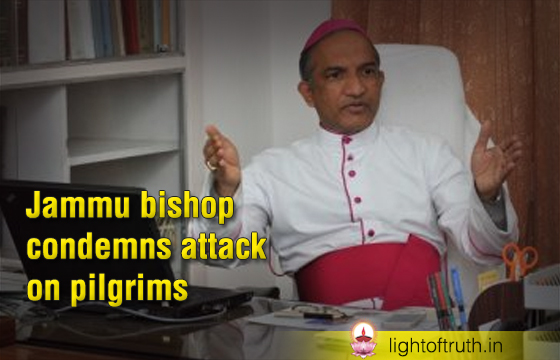
Jammu bishop condemns attack on pilgrims
Bishop Ivan Pereira of Jammu-Srinagar on April 23 expressed deep anguish and unequivocal condemnation of what he called horrific terrorist attack on innocent tourists in Kashmir state. Suspected rebels on April 22 killed 27 people in the picturesque tourist resort of Pahalgam. The attack in Kashmir’s southern district of Anantnag came amid the peak tourist season as thousands of tourists were holidaying in the region. Bishop Pereira said the “act of senseless violence” has “cast a dark shadow over our collective conscience.”