
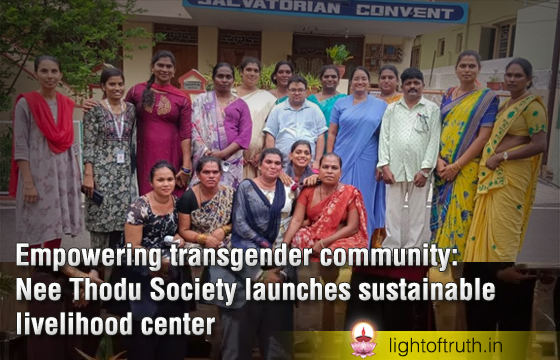
A non-governmental organization based in Visakhapatnam, Andhra Pradesh, has opened a sustainable livelihood center for transgender individuals. The Nee Thodu Society for Transgender Persons operates under the leadership of Sister Amitha Polimetla, its founder director. The member of the Salvatorian Sisters Congregation is committed to provi-ding skill training and employment opportunities. The center aims to enable transgender individuals to lead dignified lives and integrate into mainstream society. “Our goal with the Sustainable Livelihood Center is to dismantle the barriers that have historically excluded the transgender community,” stated Sister Polimetla, an advocate for skills-based empo-werment. “We believe that with the right skills and opportunities, every individual can lead a life of dignity and contribute meaningfully to so-ciety.” She emphasized the trans-formative vision of the center: “This center is more than just a skill train-ing facility; it’s a beacon of hope. It represents our commitment to creat-ing a future where transgender indi-viduals are not just tolerated, but truly integrated and empowered.” Currently, the center offers short-term courses in tailoring, jute bag making, and paper plate production.
Category Archives: From The States
Catholic church blessed at Protestant’s martyrdom site
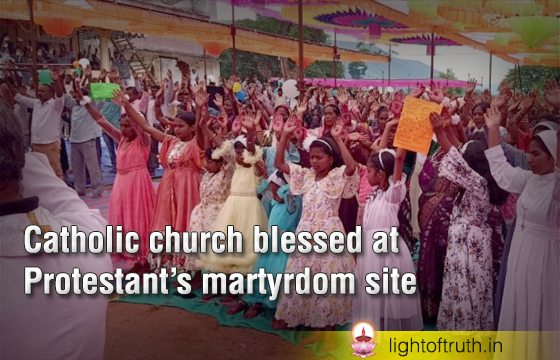
Archbishop John Barwa of Cuttack-Bhubaneswar has blessed a church built at the site where a Protestant Christian was burnt alive during the 2008 anti-Christian violence. “The perpetrators of violence had planned to eliminate Christians from this region, but they have failed in front of our God’s mighty hand,” said the Divine Word prelate during homily at the opening of the Archangel Michael Catholic Church of Gudrikia, a substation under the Padangi parish. The prelate thanked God for giving them a new church, which he said was a house of His blessings, unity, love and fraternity. “Let us witness our deep faith in God through our daily life. May Archangel Michael intercede for us to encounter difficulties and threats to remain firm in our Christian faith,” Archbishop Barwa added. Fourteen priests and seven nuns were among more than 500 Catholics who attended the May 26 blessing ceremony
Horror and heartbreak in India’s Kashmir
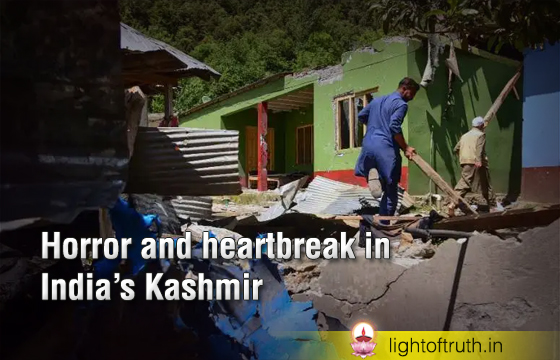
An unsettling calm has returned along the Line of Control (LoC) in Jammu and Kashmir following the announcement of a truce on May 10 between India and Pakistan. The agreement, which called for an “immediate and full cessation of hostilities,” came after a week of heavy cross-border shelling that left at least 16 civilians dead and thousands homeless. Kashmir is claimed in full by both India and Pakistan. After they have fought two full-fledged wars over it, both control parts of it. Several skirmishes have also erupted, including the conflict that has just ended. India usually blames Pakistan for backing separatist campaigns to liberate the area from India. Pakistan has always refuted this accusation. Deaths attributed to the unrest in the last three decades total at least 100,000. Though the guns have again fallen silent, people living in the border towns of Uri, Kupwara, Rajouri, and Poonch said the damage — both mental and physical — will take much longer to fix. Many communities still have funeral pyres smoldering, homes are in rubble, and children are traumatized.
Vatican recognizes Eucharistic miracle in Kerala church
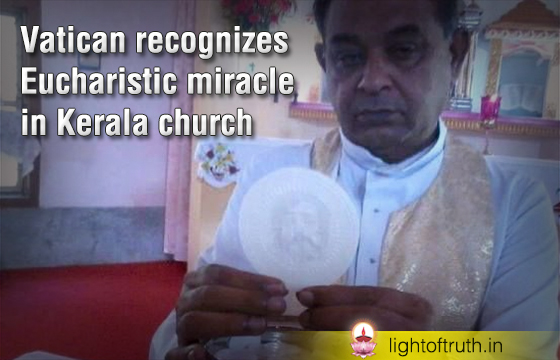
The Vatican has approved the appearance of Christ’s face on a Sacred Host during Mass in a Kerala church 12 years ago as a Eucharistic miracle. Abp Joseph Pamplany of Tellicherry on May 9 said the apo-stolic nuncio to India had relayed the Vatican recognition to the arch-diocese. The archbishop made the official confirmation at a ceremony in Christ the King Church in Vilakka-nnur, a village in Kerala’s Kannur district and a parish under the arch-diocese, where the miracle occurred on Novem. 15, 2013. Father Mathew Paravarakath, the current parish priest, told that he and the parish community are thrilled that their prayers for the Vatican recognition have been finally answered.
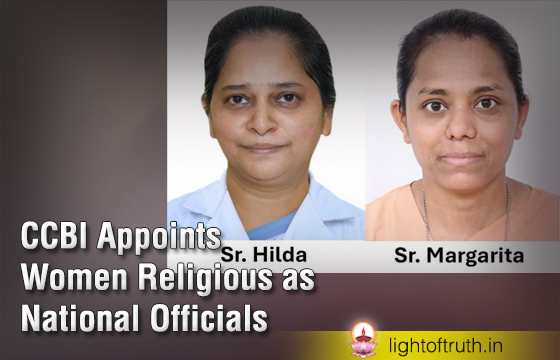
CCBI Appoints Women Religi-ous as National Officials
In a significant step to promote the role of women in Church leader-ship, the Conference of Catholic Bi-shops of India (CCBI) has appointed two women religious to key national positions. Sr Hilda Diago Rodrigues, MMSB, aged 49, has been named the new Coordinator of the Health Apostolate and Sr Margarita Dias, SCB, aged 40, from the Congregation of St Charles Borromeo, Western Pro-vince, has been appointed Associate Director of Communio.
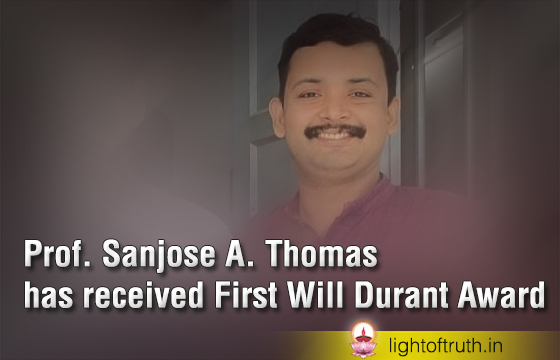
Prof. Sanjose A. Thomas has received First Will Durant Award
Prof. Sanjose A. Thomas has receiv-ed the First Will Durant Award Inter-national from the Indo-American Phi-losophical Society. He is the head of the Sociology De-partment at SH College, Thevara. The award is based on the excellence of social science studies conducted since 2020. It recognizes his research on how modern education and the general public adapted to social cha-nges during the COVID-19 period, as well as international publications. The award carries a prize of one thousand US dollars. The Sociology Department at SH College conducted studies on various social groups, fo-cusing on changes in social relation-ships, increased use of social media, and the challenges faced in child socialization. These research findings formed the basis for the award.
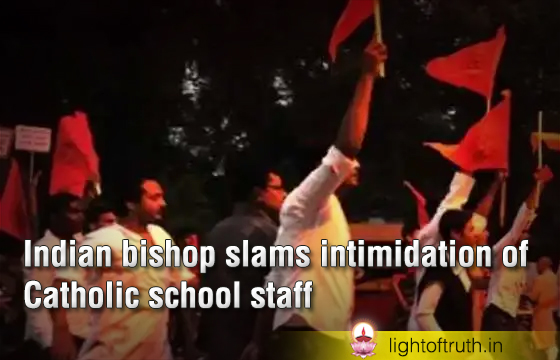
Indian bishop slams intimidation of Catholic school staff
A Catholic bishop has condemned the harassment of staff from a Church-run school, including a priest and two nuns, while they were on a picnic, by alleged Hindu activists in the central Indian state of Madhya Pradesh. “The men stopped us on spotting the nuns and some of our staff wearing rosaries around their necks, and started interrogating us,” said Father Sonu Vansuniya, the principal of New Catholic Mission Sch-ool under the Catholic diocese of Jhabua. The men claimed to be members of the Hindu organization, Bajrang Dal, or the army of the Hindu god Hanuman, and he recalled that they “suspected we were carry-ing out conversion activities.” “They stopped us from getting into our bus after leaving the park we were visiting, and instead told us to accompany them to the nearest police station,” Vansuniya told on May 2. When refused, they began questioning members of the staff, mostly from indige-nous tribal or Dalit (formerly untouchable) backgrounds, if “they were being lured or forced to accept Christianity,” he said. Meanwhile, some police officers arrived at the scene and repeated the same questions that the Hindu acti-vists were posing. “Failing to find anything wrong or obje-ctionable, the police allowed us to leave after around two hours of harassment in full public view,” Vansuniya said. Bishop Thomas Mathew Kutti-mackal of the Indore diocese condemned the incident that occurred in his jurisdiction.
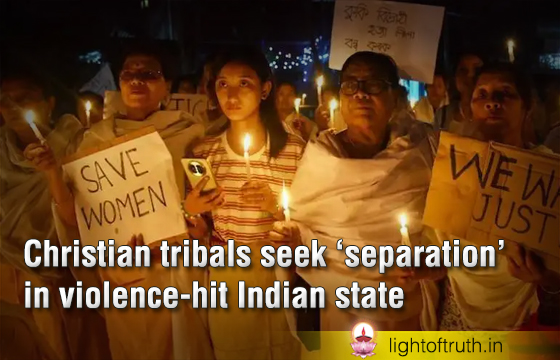
Christian tribals seek ‘separation’ in violence-hit Indian state
A Christian-majority tribal group in India’s Manipur state has reiterated its demand for a separate administrative area as it marked the second anniver-sary of the outbreak of ethnic violence between them and the Hindu-majority Meitei people. Kuki-Zo communities observed May 3 as “Separation Day,” marking the start of the unpre-cedented ethnic violence in 2023 that has claimed at least 260 lives and displaced some 60,000 people, mostly Christi-ans. Thousands gathered for a memorial service at the Wall of Remembrance in Kuki-Zo dominated Churachandpur district, where they read the Bible and sang hymns for those lost in the violence. Ginza Vualzong, spokesperson for the Indigenous Tribal Leaders’ Forum (ITLF), said that the community demands a federally ruled separate territory because “that’s the only option for ensu-ring welfare and justice for the indigenous communities.” He said Kuki-Zo and Meitei people “can no longer coexist” in one state and under the same administration, as people have lost trust in administrative sys-tems involving Meitei people. Violence erupted when Meitei people attacked a Kuki-Zo march protesting a government initiative to classify the Meitei as tribal. This classification would grant the Meitei, an economically and politically influential group, access to benefits from the state’s affir-mative action program designed for weaker sections of society.
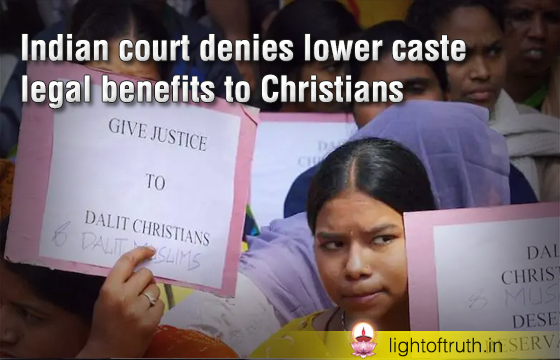
Indian court denies lower caste legal benefits to Christians
An Indian court has de-nied Christians of Dalit origin legal protections meant for lower caste people, saying a person who converted to Chri-stianity cannot claim to be a member of a lower caste group. The Andhra Pradesh High Court, the highest court in the southern Indian state, issued the ruling in an appeal challenging criminal proceedings against a group of non-Christians, based on a complaint by a Protestant pastor. The pastor, who comes from the Dalit community, officially referred to as Scheduled Caste people, filed the complaint in January 2021 against a group of people who allegedly abused him, violating clauses of the Scheduled Castes and the Scheduled Tribes (Prevention of Atrocities) Act.
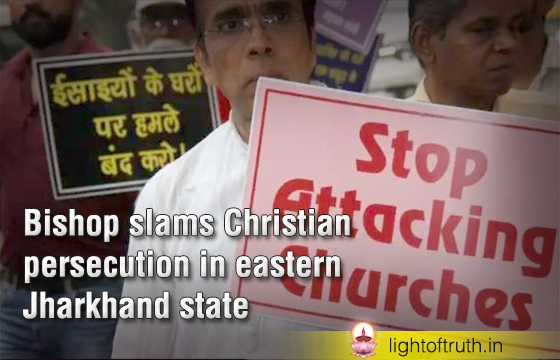
Bishop slams Christian persecution in eastern Jharkhand state
Church leaders in the eastern Indian state of Jharkhand have deplored the continuing persecution of tribal Christians in the state by “anti-social groups” with the backing of some political parties. “These anti-social groups are certainly backed by bigger forces, including political parties; else how can they take the law into their hands?” said Bishop Theodore Mascarenhas of Daltonganj. The prelate said a sustained campaign is underway against the work done by the Christian missionaries for the welfare of the tribal people in Jharkhand. “Religious conversion is alleged very often nowadays with no basis or proof by some anti-social elements who do not want peace to prevail in the state,” Mascarenhas told on May 2. He referred to the latest incident of six Christian families in his diocese who were forced to abandon their homes and flee, fearing for their lives. These Christian families from Hata village in Latehar district were threatened by a pro-Hindu group for refusing to donate money for Sarhul, a spring festival celebrated in early April by various tribal groups in Jharkhand. The six families left the village on April 28, reported the local ETV Bharat news channel. The report quoted Nageswar Oraon, one of the Christians who is now living with his family in a neighbouring village, saying that “since we had no money, we expressed inability to pay for the festival.” “We were threatened and attacked by some villagers because we are Christians,” he added.