
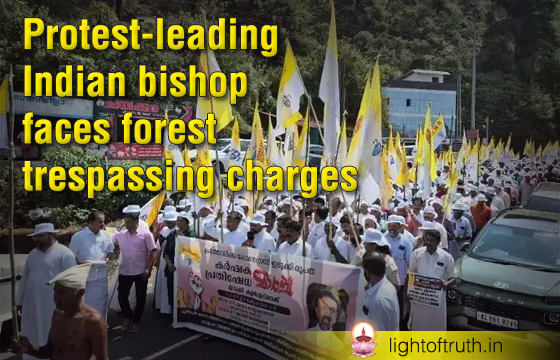
An 88-year-old Catholic bishop and 23 others are facing legal action in southern Indian Kerala state for entering a restricted forest after they led a march demanding the reopening of a blocked public road. Kerala State Forest Department filed charges against retired Bishop George Punnakottil of Kothamangalam and others, including elected representatives, for violating forest laws and trespassing into the forest land. “It is highly condemnable that a case of trespass has been registered against an elderly bishop” for advocating a public cause, said Father James Kokkavayalil, the secretary of the Public Affairs Commission of the Eastern Rite Syro-Malabar Church on March 24. The bishop and political leaders led a march of some 3,000 people on March 23 along a public road that the forest department closed for traffic and denied public entry in 2012. The department also opposed the proposals to reopen the road, saying it passes through ten kilometres of protected forest and that traffic noise and vehicle pollution will harm the environment and endanger wildlife. Protesters say that the road constructed during the British colonial era continues to be the shortest route connecting Aluva town near the western coast to Munnar town in the eastern hills. It cuts the distance by some 30 kilometres and does not have sharp hikes and slopes, “Munnar is an internationally acclaimed tourist destination. Reopening of the road will help local people and tourist traffic,” Father Kokkavayalil told UCA News on Mar. 24. In a March 23 statement, the eastern rite bishops’ body said the forest department’s move against the bishop and others “is unlawful as it blocked the public movement illegally.” The land of the road belongs to the “revenue department and not to the forest,” it said. The bishops also accused the forest department of usurping the public road and “infringing upon citizens’ right to free movement.” Kerala Catholic Bishops Council (KCBC) also issued a statement on March 24 deploring the legal action and urging the state government to “immediately correct the forest department’s anti-people policies.”
The statement said the forest department “grossly misused” the law against people pressing for their basic facilities.
It asked the department to withdraw all such legal moves against people. Several cases were registered against people allegedly for violating India’s Wildlife Protection Act 1972, a federal law meant to protect forests and wild animals, after they protested the government’s failure to protect them from wild animal attacks. According to government data, 486 people were killed in wild animal attacks between 2019-2024. At least 22 people were killed by elephants, and a person was mauled to death by a tiger in the state in 2023-24. Other wild animal attacks killed 71 people.
Category Archives: From The States
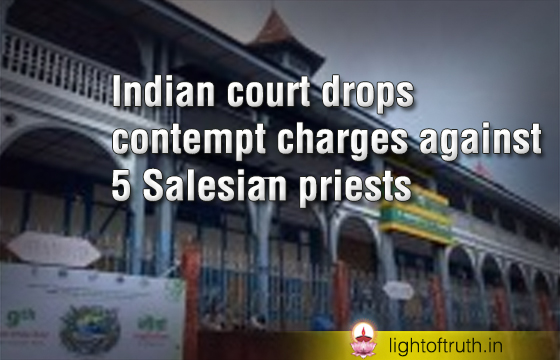
Indian court drops contempt charges against 5 Salesian priests
A court in northeastern India has dropped contempt of court charges leveled at five Salesian priests after they submitted a written apology. The priests in Meghalaya state were facing charges after they allegedly demolished a school building owned by their Salesian congregation without the court’s say so. However, after having apologized, the state High Court dropped the charges on March 19, saying the priests “have the greatest respect for this court.” “They had and have no intention of disobeying the orders passed by it and every intention of obeying them. They tendered an unqualified apology and prayed for forgiveness,” the highest court in the state said. The court had charged the priests – Sagi Stephen, Arcadius Puwein, Edmund Gomes, Dianetius Fernandez and Cyril Tirkey – on Jan. 28, calling on them to explain “why they should not be punished for criminal contempt.” The charges came after they began demolishing a 72-year-old dilapidated school building in the state capital, Shillong. They allegedly ignored a public interest litigation against the move pending in the High Court. The court also told them to explain why they needed to demolish it. “We are happy that the court accepted our apologies and let off without any punishment,” said Father Stephan, one among the accused.
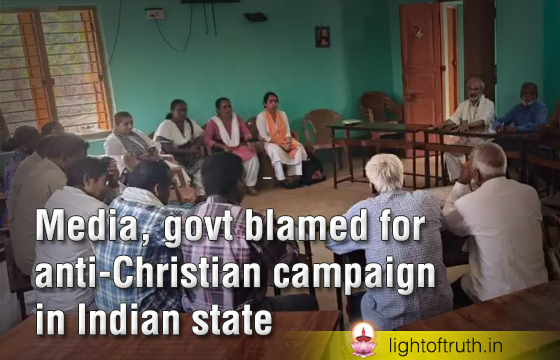
Media, govt blamed for anti-Christian campaign in Indian state
A six-member team that studied reasons for increased hostility toward Christians in an eastern Indian district have blamed the media and a new government for causing the problem. “A few local daily newspapers played a villainous role in escalating the hate campaign against Christians,” the team said in a March 15 report after touring Balasore district in Odisha state. “The changing of the guard in Odisha state has further escalated the vulnerable situation of Chri-stians,” it added, referring to the Bharatiya Janata Party (BJP) taking power in the state in June 2024. The team of six lawyers, who included priests and nuns, visited villages in the Raibania area and listened to Christian villagers discussing how Hindus opposed burying their dead and conducting religious ceremo-nies. “We interacted with more than 25 affected Christians about ongoing challenges they faced,” said Catholic priest, lawyer and activist Ajay Kumar Singh. He told on March 23 that the fact-finding team toured the Balasore diocesan area, which reported several cases of anti-Christian activities like burial denial and disruption of religious ceremonies. Their re-port said some tribal Christians also faced social boycott threats for practicing their faith. “The triggering point of the unrest” was on Dec. 18, when a tribal-dominated village in the area opposed burying Budhia Murmu, a local santal tribal Christian.

Thieves target Catholic Church in eastern India
Thieves have ransacked and desecrated a Catholic Church in the eastern Indian state of Odisha, stealing the tabernacle containing the Holy Eucharist and money from the donation box, sources confirmed. The incident targeting the Holy Family Church in Sambalpur diocese, about 390 kilometres south of the state capital Bhubaneswar, took place on the night of March 21. Church officials said the thieves broke into the Church, founded in 1981, in Titilagarh, in Balangir district, and fled with the tabernacle and money, but did not damage the statue of Mother Mary close to the donation box. Church authorities lodged a complaint with Titlagarh police on March 22. “My parishioners and I are shocked by this incident,” Divine Word priest Joseph Antony, the parish priest, told on March 23. The thieves took advantage of stormy weather and a power outage to commit the crime, he said. Prior to targeting the Holy Family Church the thieves stole a music keyboard and a dona-tion box containing money from a nearby Protestant church, he said. “CCTV footage showed three people were involved,” the priest added. Bishop Nira-njan Sual Singh of Sambalpur said Christian communities in tribal-dominated areas of Odi-sha have been targeted recently. “Our churches and our Chris-tian community have increasi-ngly come under attack in these tribal areas,” Singh told on March 23. Odisha is ruled by the Bharatiya Janata Party (BJP). On March 22, Singh sent a letter to Catholics in the dio-cese, lamenting the desecration of Holy Eucharist.
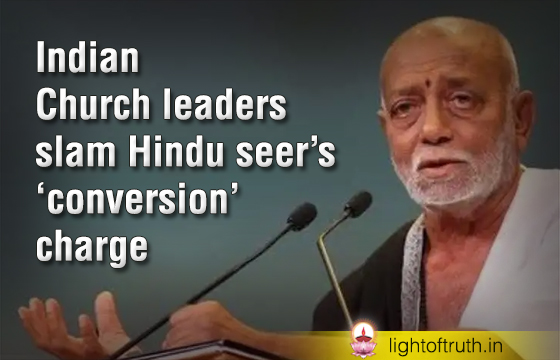
Indian Church leaders slam Hindu seer’s ‘conversion’ charge
Church leaders and a Christian law-maker have slammed a popular Hindu spiritual leader for accusing Christian school teachers in western India’s Gujarat state of converting students to Christianity. Morari Bapu claimed that 75% of govern-ment school teachers in Gujarati’s tribal-dominated Tapi district are Christians and “are actively involved in converting students to Christianity.” The spiritual leader’s discourses use poetry and music to tell the life of the Hindu god Ram. He made the allegation at such a discourse in Songadh town on March 14.
“The unwarranted comments without even a shred of evidence need to be condemned unequivocally,” said Father Cedric Prakash on March 20. The Jesuit priest and rights activist based in Gujarat said that the Hindu spiritual leader has a large following in Gujarat. “His followers lap up everything he says, even blatant lies such as this,” Prakash added. He said Christian missionaries have empowered indigenous tribal people in the area through a well-run network of quality educational institutions. “This has surely rankled those who for years have been exploiting them and keeping them on the margins of society,” Prakash said. Mohan Kokani, the lone tribal Christian legislator from Vyara constituency in Tapi district, called the conversion claim “baseless.” Konkani, a member of the Bharatiya Janata Party (BJP) said: “We have not received a single complaint of a Christian teacher converting students in the district. Bapu should give proof of his statement.”
The elected legislator said that till 1970, the tribal area lacked health and education facilities. “Christian missionaries arrived and provided health care and education, so people accepted them. They did not lure anyone to Christianity,” Kokani said. John Dayal, a senior journalist and spokesperson of the All India Catholic Union, said India’s constitution guarantees freedom of religion and belief. “In a Hindu majority country where the law-and-order machinery is firmly in Hindu hands, there’s no question of any forcible or fraudulent conversion as alleged,” he said. “This is a falsehood created, perpetuated and enlarged to suit a political objective,” Dayal added.

Hindus call off rally through Christian villages in eastern India
Government interventions have forced right-wing Hindu activists to call off a march, alleviating fears of an attack on Christian villagers in the eastern Indian state of Chhattis-garh. Christians across the state had been on edge after social media posts last month began mobilizing Hindu activists to march through three Christian villages, to demand the pro-tection of cows and attack Christians thought to be beef eaters. Aadesh Soni, a right-wing Hindu man who was accused of making such violent calls on social media, denied the allegations. But he admitted calling for the march. He told a week ago that the march will occur on March 1. However, Shivam Takur, an asso-ciate of Soni, told on March 3 that they “called off the proposed rally as the government has accepted our demands.”

Dayal among three awarded for promoting religious freedom, civil liberties
John Dayal, a veteran journalist-turned human rights activist, was among three people chosen on March 5 for fighting for the cause of civil liberties and religious freedom. The annual Quaide Milleth Award, established in 2015, is given by the Che-nnai-based Quaide Milleth Educa-tional and Social Trust involved in the advancement of underprivileged sections of society. Church of South India Bishop V Devasahayam of Thoothukudi-Nazareth was in the four-member jury that chose also Navid Hamid and Vipin Kumar Tripathi for this year’s award. Dayal, based in New Delhi, has served as the treasurer of the Editors’ Guild of India and a member of the National Integration Council. The 76-year-old Catholic was the secretary general of the All India Christian Council and president of the All India Catholic Association, the largest association of the Catholic laity in the country. Hamid also was a member of the National Integration Council, formed in 1961 as a group of senior politi-cians and public figures in India to help the federal government address communalism, casteism and regiona-lism and problems. He is a former president of the All India Majilise Mushawarat, an umbrella body of Indian Muslim organizations, and general secretary of Movement for Empowerment of Muslim Indians.

Church ‘cautious’ about Indian state lifting liquor ban
Church leaders in the Christian-majority Mizoram have reacted cautiously to the government lifting a liquor ban in this state in India’s northeastern region. The state legislature, on March 10, amended the existing prohibition law amid opposition members walking out of the house protesting the change, local media reports said. However, Bishop Stephen Rotluanga of Aizawl said the Church was “not opposing the new bill completely so long as it helps to improve the economic conditions of local people.” The amendment to the Mizoram Liquor (Prohibition) Amendment Bill, 2025, seeks to allow the manufacture and supply of wine and local beer made solely from locally produced agriculture and horticulture products. The amendment, introduced by the ruling Zoram People’s Movement (ZPM) government, also proposes to grant special permits to foreign dignitaries and domestic tourists for possession and consumption of India-made liquor. The law, before the amendment, imposed a blanket ban on the sale, manufacture, and consumption of liquor. The previous Mizo National Front (MNF) government enacted it in 2019. Both the ZPM and MNF are indigenous parties rooted in the state, which also has a presence of India’s national parties, the Bharatiya Janata Party and the Congress. “I believe the government has promised to use local farm products like grapes, dragon fruit, guava, banana, etc.,” Bp Rotluanga told on March 12. But the Church will be opposed to importing any other liquor products from outside the state, the prelate added. Father Felix Antony, a former public relations officer of the North East India Regional Bishops’ Council, said consum-ption of liquor is a taboo, especially among Christians, in the entire region. “So, lifting the ban will have [the] wrong impact, especially on the well-being of families,” he said. The priest said that “as Christians, we oppose the move of the Mizoram government.” The bill faced stiff opposition from the 10 MNF, two BJP, and the lone Congress legislators, who walked out of the house in protest.

Catholics go on penitential pilgrimage in India’s Goa
Thousands of Catholics walked from their parishes in the Archdiocese of Goa and Daman in western India to the Our Lady of Good Health Church in Sancoale as part of an annual penitential pilgrimage. Father Barry Cardozo, director of the Diocesan Centre for Social Communications Media, said this year being the Jubilee Year of Hope, the annual pilgrimage was themed “Pilgrims of Hope, Let Us Proclaim the Good News.” “A special feature this year was the depiction of the images of the Passion of Christ and scenes showing Christ accompanying people in difficult situations,” he told on March 9. The depictions were created by youth members of different parishes across Goa who participated in large numbers, offering penance and prayers. ”Over 28,000 men and women walked from Neura, Cansaulim, Bambolim, Verna, and Vasco to the Church, considered one of the pious places in Goa,” said Father George Ratos, convenor of the diocesan Lenten Walking Pilgrimage. The pilgrims covered around 15 kilometers on foot from the five designated spots marked for the pilgrimage, the priest told on March 9. “It was a sea of humanity. One had to see it to believe it,” Ratos added. The pilgrimage walk started early morning, around 2 a.m. on March 9, and they reached their destination at 5 a.m. for adoration, followed by the Eucharist, Ratos said.
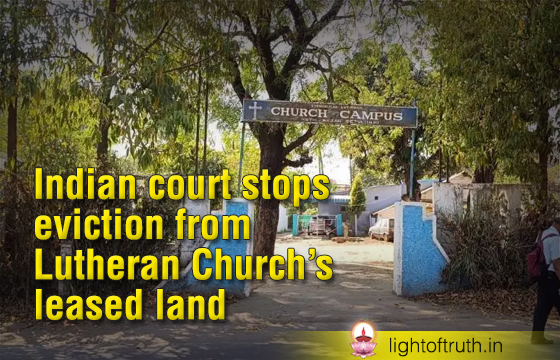
Indian court stops eviction from Lutheran Church’s leased land
The High Court in India’s Madhya Pradesh state has stopped officials from evicting some 150 Christian families from their homes, built on land the government leased out to their Church 50 years ago. Authorities in Betul district in January initiated the process to evict 151 Christian families and members of the Evangelical Lutheran Church after they cancelled the lease, alleging that the Church authorities violated lease conditions by misusing the land. However, the court stopped the eviction move. Until “further order no coercive step shall be taken on the residential properties,” said the court order issued on Mar 7. The copy was made public on Mar 10. Ashok Chowsky, treasurer of the church, said the district authorities cance-lled the lease, accusing the church of violating the lease conditions and erecting commercial structures on the property. He said they built some 21 shops on a piece of land. “But that was after that particular piece of land was made freehold with proper government permissions. So the allegations are baseless,” he said. “The government has no right to cancel the lease deed. It is illegal,” Chowsky told on March 11. The state govern-ment gave some 20 hectares of land to the church for charitable purposes in 1975. The Lutheran Church authorities built a chur-ch, a school, and houses for the church members. On Jan. 3, the district administration cancelled the lease deed of the entire land and served an eviction notice to all Christian families on it.