Category: Asian

  • Gunmen take Catholic hostages; Philippines’ Duterte imposes martial law

    Gunmen take Catholic hostages; Philippines’ Duterte imposes martial law

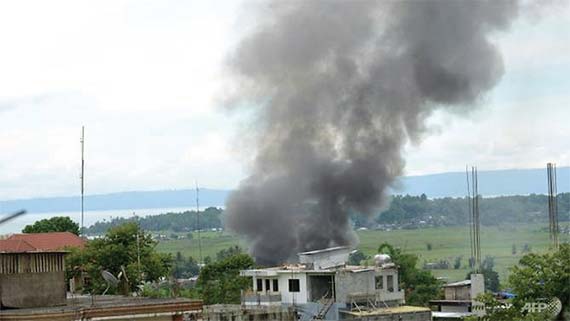
    Gunmen claiming to have links with the Islamic State group threatened to kill hostages, including a Catholic priest, who were taken from the southern Philippine city of Marawi May 23. President Rodrigo Duterte imposed martial law across the entire Muslim-majority region of Mindanao late May 23, but ucanews.com reported that many, including church leaders, characterized the imposition of martial law as an overreaction.

    Initial reports received by ucanews.com said Father Teresito Suganob, vicar general of the Prelature of Marawi, and several staff of St Mary’s Cathedral, which was set on fire, were taken hostage. The gunmen also forced their way into the residence of Bishop Edwin de la Pena of Marawi.

    Duterte placed all of Mindanao’s 27 provinces and 33 cities, roughly a third of the country, under martial law for a period of 60 days. Mindanao is home to an estimated 20 million people. “I’ll be harsh,” said Duterte. “I have to do it to preserve the Republic of the Philippines,” he said, even as he assured Filipinos “not to be too scared.” Redemptorist Father Amado Picardal, who works with basic ecclesial communities and the bishops’ conference, said, declaring martial law across Mindanao while only Marawi was attacked “is either idiotic or an excuse to expand dictatorial control.”

    A Catholic archbishop has given his blessing to President Rodrigo Duterte’s declaration of martial law in a region of the Philippines as long as human rights are protected.

    Archbishop Martin Jumoad of Ozamiz said that the government needs to step up its efforts to restore peace and order to the besieged city of Marawi where Islamic State-linked militant groups have torched buildings, hoisted Islamic State flags, seized 14 Catholic hostages and beheaded a member of the police.

    The archbishop warned Marawi’s residents to be careful and to “cooperate” with the military, the news service of the Philippine Catholic Bishops Conference (CBCP), reports.
    Five soldiers, two policemen and 13 militants have died in the three days of fighting, according to authorities.

    Abu Sayyaf and Maute have been blamed for bombings, attacks against government forces and kidnappings in the Philippines. They have also  beheaded hostages.
    Photos posted on social media by Marawi residents showed armed men roaming the city with the black flags of ISIL.
  • Pakistani official: ‘We have failed minorities’

    Pakistani official: ‘We have failed minorities’

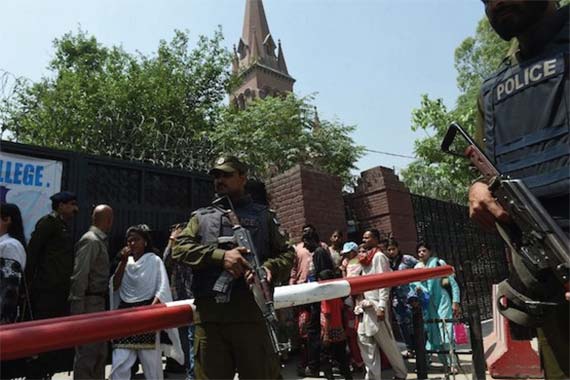
    An official from Pakistan’s most populous Punjab province has admitted that authorities have failed to protect religious minori-ties from hard-line Islamists.

    “The intolerance, anger on religious matters and culture of lynching disturbs us,” said Malik Muhammad Ahmad Khan chief spokesman of the Punjab government speaking at the May 12 event titled “Securing Punjab’s Diversity” in Lahore, the capital of Punjab province where majority of Christians in the country reside. Punjab also has 60 percent of the country’s population.

    As an example, Khan said four people from the Ahmadiyya sect were killed by hardliners during April. “The religious cleansing must stop,” said Khan who is also special assistant to the Punjab chief minister.

    Ahmadis, who believe Prophet Mohammed was not the last prophet, have suffered harsh persecution since they were declared non-Muslims by Pakistan in 1974. “We have failed in protecting minorities from forced conversion,” Khan said at the event attended by more than 30 activists, journalists and edu-cationists. “Everybody knows it, why should we hide it?” he asked.

    Out of 1,000 Christian and Hindu women forcibly converted to Islam and forcibly married each year in Pakistan, 700 of them are Punjabi Christians, according to the National Commission of Justice and Peace and the Pakistan Hindu Council. Rights group say many of these are under the age of 18 and are married off to Muslims, or forced into bonded labour.

  • Four religions in Korea unite for migrants

    Four religions in Korea unite for migrants

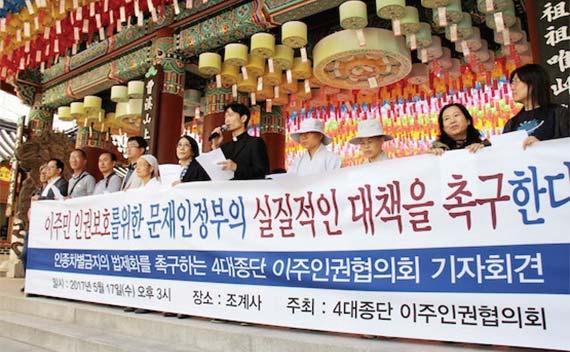
    An inter-religious group in Korea has asked the new government to ensure the protection of migrants and ban racial discrimination.

    Solidarity of Four Religions for the Human Rights of Migrants held a press conference on May 17 in front of Jogye-sa Buddhist temple in Seoul. Composed of Buddhists, Catholics, Protestants and Won Buddhists, they have been campaigning against racial discrimination.

    “Even during the presidential election campaign, the candidates did give any attention to the two million migrants in Korea. Given that even the basic human rights of migrants are not guaranteed, we should take care of them by establishing concrete policies,” they said in a statement.

    The group called on people to raise awareness of the problem, report cases of rights infringe-ment and to pray for an improve-ment in the situation. “Any action based on racial discrimination should be banned and punished,” they added.

  • Catholic students press for radical cleric’s prosecution

    Catholic students press for radical cleric’s prosecution

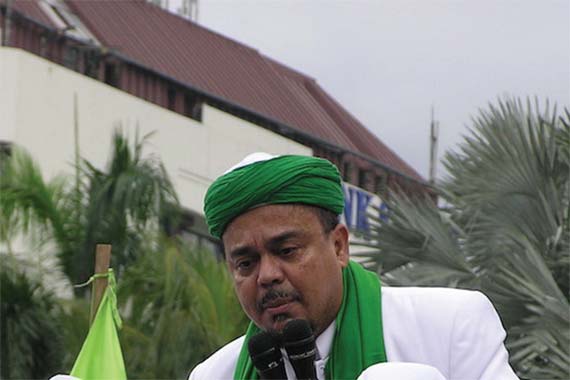
    The Indonesian Catholic Students Association has called on police to process their blasphemy complaint against prominent Islamic cleric Muhammad Rizieq Syihab after Christian governor Basuki “Ahok” Tjahaja Purnama was jailed for the same crime. Angelo Wake Kako, the student’s chairman, said the government must ensure that the law is equally implemented. “Ahok has been imprisoned so Rizieq Syihab’s case should also be processed,” Kako said.

  • Catholics in Laos welcome first cardinal appointment

    Catholics in Laos welcome first cardinal appointment

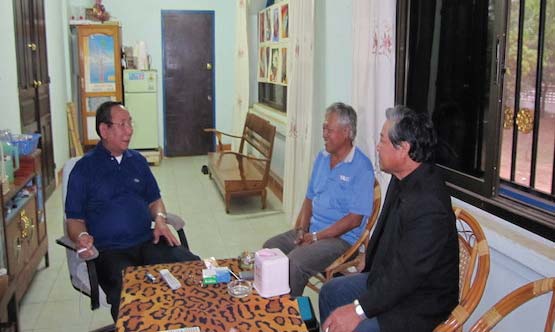
    Catholics in Laos have welcomed their first cardinal appointment in anticipation of improved religious activities within the communist-run country. “We are extremely happy to hear that our Bishop Louis-Marie Ling Mangkhanekhoun has been named as the first ever cardinal in Laos,” Martha Le Thi Thuy Hanh from Sacred Heart Parish, in the southern province of Champasak, told ucanews.com.

    The consistory is scheduled for June 28, the vigil of the Feast of Saints Peter and Paul. The church is treated very poorly in Laos — probably the worst in ASEAN save for Brunei,” a well-placed diplomatic source noted. “One reason is that most of the Catholics are of Vietnamese heritage or hill-tribes — not Lao Llum — the lowland Lao who rule the country. Catholics number some 45,000, about 1 percent of an estimated 7 million population, mostly Buddhist.  There are only 4 bishops, 2 of them retired.  The faithful are served by 21 Lao priests and deacons and a few dozen nuns.

  • Jakarta’s Christian governor found guilty of blasphemy against Islam

    Jakarta’s Christian governor found guilty of blasphemy against Islam

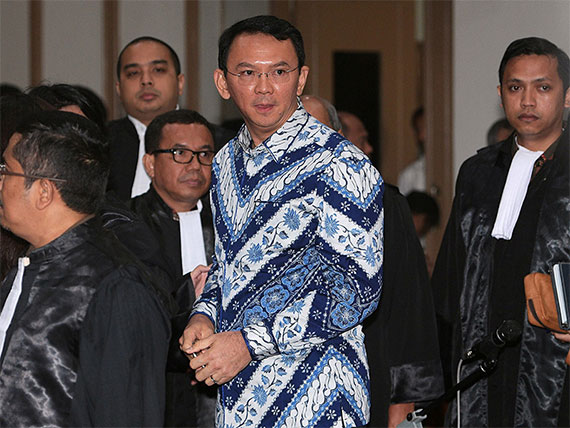
    Jakarta’s Christian governor was sentenced to two years in jail for blasphemy against Islam on May 9, a harsher than expected ruling that is being seen as a blow to religious tolerance in Indonesia, the world’s largest Muslim-majority nation.

    The guilty verdict comes amid concern about the growing influence of Islamist groups, who organized mass demonstrations during a tumultuous election campaign that ended with Basuki Tjahaja Purnama losing his bid for another term as governor.

    President Joko Widodo was an ally of Purnama, an ethnic-Chinese Christian who is popularly known as “Ahok,” and the verdict will be a setback for a government that has sought to quell radical groups and soothe investors’ concerns that the country’s secular values were at risk.

    As thousands of supporters and opponents waited outside, the head judge of the Jakarta court, Dwiarso Budi Santiarto, said Purnama was “found to have legitimately and convincingly conducted a criminal act of blasphemy, and because of that we have imposed two years of imprisonment.”

    Andreas Harsono of Human Rights Watch described the verdict as “a huge setback” for Indonesia’s record of tolerance and for minorities. “If someone like Ahok, the governor of the capital, backed by the country’s largest political party, ally of the president, can be jailed on groundless accusations, what will others do?” Harsono said.

    Purnama told the court he would appeal the ruling.The governor was taken to an East Jakarta prison after the verdict, and his lawyer Tommy Sihotang said Purnama would remain there despite his appeal process unless a higher court suspended it.

    Shocked and angry supporters, some weeping openly, gathered outside the prison, vowing not to leave the area until he was released, while others vented their shock on social media.

  • Time to re-erect crosses in Zhejiang,  say Chinese Christians 

    Time to re-erect crosses in Zhejiang, say Chinese Christians 

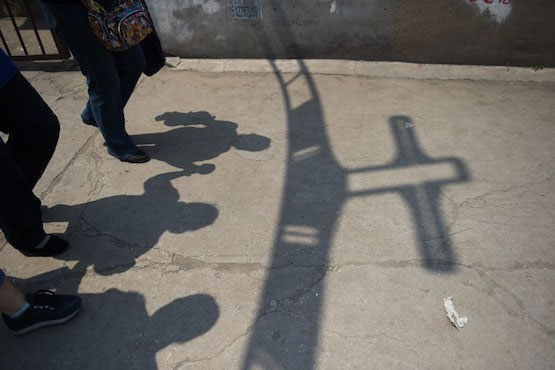
    Chinese Christians in the eastern province of Zhejiang are proposing that crosses taken down from churches during a government cross removal campaign be re-erected as way of celebrating the departure of an official responsible for their removal. The proposal — made by some Protestants in the area — was sent out via social media not long after it was known that Xia Baolong, Communist Party secretary of Zhejiang, was being reassigned to Beijing. The proposition to re-erect the church crosses was a way to “bid farewell” to Xia who local Christians hold responsible for the removal of 1,700 plus church crosses in Zhejiang since late 2013.

  • Gender-based abortions threaten Nepalese society

    Gender-based abortions threaten Nepalese society

    Since Nepal legalized abortion in 2002 there has been an epidemic of gender-based abortions. At least 50,000 abortions a year are performed after parents find out their unborn child is a girl. Gender identifi-cation of fetuses is illegal but many clinics do not follow the 11th amendment to the country’s civil code that details how abortions can be performed.

    In Section 28C, the code prohibits the termination of a pregnancy for the sole purpose of sex-selection with a maximum punishment of two years in prison.

    However, the law is flouted so much that there was a marked decrease in the female birth rate. A study in 2013 by British researcher Melanie Dawn Frost and her team found there were 742 girls per 1,000 boys in 2007-2010, down from 1,021 girls per 1,000 boys in 1998-2000.

    Many married couples prefer male children is because tradi-tionally, girls leave the family when they are married to serve their in-laws. They are also an economic burden due to the dowry system. Few people question the misogyny that underlies these cultural beliefs.

    The desire for boys is higher in urban areas. The Nepal demographic health survey in 2011 found that the number of gender-based abortions in towns was twice as high as in rural areas.

    The practice may be higher in educated and wealthy families given that the proportion of pregnancies ending in abortion rises proportionally with household wealth. It ranges from three percent in the poorest households to 18 percent in the wealthiest.

    The Nepal medical council once suspended a reputable gynecologist for three months on the charge of sex-selective abortion in Patan city in 2015. Half of induced abortions are estimated to be unsafe. It’s a worldwide problem. According to the World Health Organization, about 22 million unsafe abortions are performed every year resulting in the deaths of 47,000 women and maiming an additional 5 million internationally.

  • Indonesian bishop criticizes mega Jesus statue project

    Indonesian bishop criticizes mega Jesus statue project

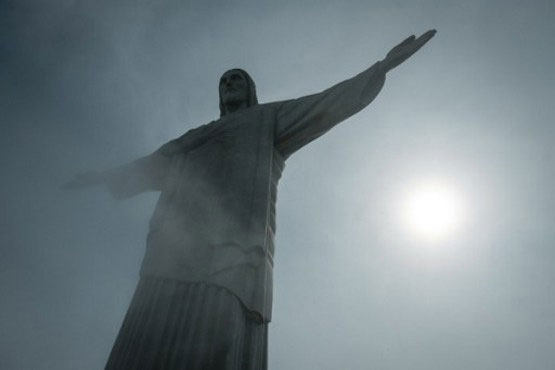
    A Catholic bishop in Indonesia’s Papua province has criticized a plan by local authorities in Jayapura to build “the world’s tallest statue of Jesus,” calling the move a waste of much-needed money. Djuli Mambaya, head of Papua’s public work agency, told reporters last week that construction would cost 300 billion rupia (US$23 million) and begin sometime next year. Planners say the statue at 73 meters high would dwarf the Christ the Redeemer statue in Rio de Janeiro, Brazil, which is 38 meters high.

  • Three ‘stubborn’ Chinese priests held, as bishop goes free

    Three ‘stubborn’ Chinese priests held, as bishop goes free

    Three underground priests from Mindong Diocese in eastern China were briefly detained the same day Bishop Vincent Guo Xijin was freed on May 6 after one month’s detention. Fathers Zhu Ruci, Xu Wenmin and Peng Zhenshen, vicar general, chancellor and procurator of the diocese respectively, were summoned to a so-called learning class to study religious regulations the same day Bishop Guo returned to Luojiang village, the head-quarters of the diocese. The three priests were supposed to undergo a class lasting just over a week.

    “The brainwashing class was meant to run for 10 days but the three priests returned after three days because officials found them too stubborn,” a church source told ucanews.com.

    Officials had earlier informed the diocese that the underground bishop – who is not recognized by the Chinese government and who was released the same day the three priests were detained – had to attend a similar class for 20 days. They took him away before the start of Holy Week, the source said.