
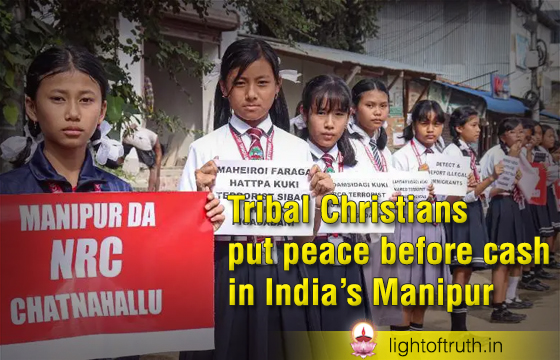
Indigenous Christian leaders have called on the government to restore peace instead of distributing cash to build new houses for victims of the sectarian strife in northeastern Manipur where Christians fight Hindus.
The real problem is “restoring pace,” noted a Church leader from Manipur where a 15-month-long conflict over conferring tribal status on the majority Meitei Hindu community has claimed more than 226 lives and uprooted over 60,000 people, most of them Christians.
The unprecedented violence that began on May 3, 2023, has hit more than 18,370 families, of which more than 14,800 of them have taken shelter in relief camps, Chief Minister N Biren Singh of Manipur told the state assembly. On Aug 5, Singh informed the assembly about the decision to distribute Rs 100,000 (US$1,191) to victims to build new houses. The Catholic Church has a diocese in Manipur, based in the state capital Imphal, and headed by Archbishop Linus Neli. Indigenous people mostly Christians make up 41 percent of the state’s 3.2 million people and Meitei Hindus form 53 percent. There are Christians among the Meiteis, too. Unless “peace is restored no such announcement will be of any use,” the Church leader who did not want to be named due to security reasons told UCA News on Aug. 6. “Obviously, everyone wants to have a home. People in Manipur are asking for a dignified life back in their villages from where they fled,” he added. The government needs to create an environment that will enable them to return to their homes, the Church leader said.
They have been living in relief camps for over a year with “no individual identity,” he noted. The chief minister announced the cash to build houses. But what will they do with it “unless there is peace in the state?” asked a tribal Christian leader. Singh, a member of the Bharatiya Janata Party of Prime Minister Narendra Modi, is accused of orchestrating the violence and protecting those behind it. According to government data, 11,133 houses have been set on fire, and 4,569 of them were completely gutted. Singh told the assembly that there are 12,977 boys and 13,763 girls living in government-run relief camps. The violence broke out between the wealthy Meiteis and the minority Kukiz-Zo community last year after the top court in the state asked the government to consider granting tribal status on Hindus. According to indigenous people, if the court’s request is implemented it would rob them of their share in the government’s affirmative action plan. Above all, their inclusion will allow them to purchase indigenous lands, which are mostly located in the hilly districts in the state, they complain. Indigenous people who live in the hilly districts of the picturesque state have stated categorically that they have lost trust in Singh as he is backing the Meitei community, of which he is a member. They are insisting on his removal as chief minister to restore peace in Manipur.
All posts by Light of Truth

Wayanad: Church joins others to plan survivors’ rehabilitation
Various dioceses, religious congregations, and laity groups have formed a task force with Hindus and Muslims to implement short term and long-term rehabilitation plans for the landslide survivors in Kerala’s Wayanad district. The hilly district on July 30 witnessed one of the “worst ever landslides” in the southern Indian state that killed more than 400 people and wounded many others. More than 2,000 people are in the camps. The interreligious “Wayanad Relief Group” has decided to make temporary family shelters as an immediate step and then build permanent houses eventually. The group headed by Claretian Father George Kannanthanam has visited the affected areas, relief camps and victims’ families to make a rapid assessment of the situation and identify immediate priorities. The group under parish priest Father Mathew Periappuram’s coordination then met at St. Vincent De Paul Forane Church, Kalpeta, a major town in the district, to review the situation. Among the more than 40 participants were the representatives of religious congregations, Mananthavady Syro-Malabar diocese and Latin Archdiocese of Bangalore and diocese of Calicut. The team has also met District Collector D R Meghashree and briefed her about its proposed plan and pledged full support to the government proposal for building an exclusive township with all amenities for the victims.
The group observed that people, who are now living in temporary shelters such as schools, have to be settled back to their communities. “This process of permanent settlement with houses and other amenities will take minimum three years, and therefore, there is a need for temporary arrangements,” Father Kannanthanam told Matters India August 6. While some participants suggested building community shelters for several families others said the survivors should be given exclusive facilities to stay as families. “Therefore, it is required to create transitional houses meanwhile, so that they can stay as families and can carry on with regular life,” the meeting recommended who studied various models for a cost-effective pre fab houses of about 200 square feet with a kitchenette and toilet costing about 300,000 rupees. The group also decided to propose the plan to the government and offer to undertake its implementation while the government and other NGOs build permanent houses. Some members also have suggested to develop an education fund to support the children who lost their school and arrange counseling facilities for them. Around 53 students were killed in the landslides and several now stay in relief camps. Some have lost their parents, siblings or relatives. The group also observed that offers have come from corporate groups and the governments to build more than 500 permanent houses. “There is no scarcity of funds. So, we should make sure each house will be decent enough with at least 700-800 sq ft size with all amenities,” the group said. A new house will cost around 1.5 million rupees and those sponsoring houses should also involve in their planning and implementation too. The group proposed to involve the beneficiaries also in the planning. The group suggested creation of a coordination committee, involving members and experts, nominated from all concerned agencies, to ensure that the best ideas and practices are incorporated in the process

Indian bishops condemn Last Supper parody at Olympics
Indian bishops and laity groups have joined Catholics around the globe to deplore the parody of Leonardo da Vinci’s iconic painting of the Last Supper at the Paris Olympics opening ceremony. “The Last Supper is not merely a piece of art but a profound symbol of the Holy Eucharist, established by Jesus Christ himself,” said a press statement from the Catholic Bishops’ Conference of India (CBCI). The July 29 statement signed by CBCI’s public relations officer Father Robinson Rodrigues said the Olympic games which symbolize unity and respect among diverse cultures and faiths, should uphold the highest standards of sensitivity towards all religious beliefs. “Christ’s Last Supper event unites Christians worldwide, and its disrespect can never be perceived as a celebration of community tolerance as mentioned by the Olympics organizers,” it added. The apex body of the Catholic Church in India urged all concerned to reflect on the importance of mutual respect and understanding in fostering true global harmony. The CBCI also called upon the International Olympic Committee “to ensure that such instances of disrespect towards religious sentiments are not repeated.” A drag performance during the July 26 opening ceremony in Paris depicted a scene based on a parody of Leonardo da Vinci’s iconic wall painting in Milan’s Dominican convent, causing outrage among Christians across the world. Cardinal Oswald Gracias of Bombay said, “The Last Supper is a sacred event, which commemorates Jesus Christ’s final meal with his disciples, and is of immense significance to Christianity.” “The parody of this profound moment watched by millions is not only deeply offensive but also a blatant display of insensitivity towards the religious sentiments of believers worldwide,” he said in a statement. The cardinal stressed the need for respect towards religious beliefs in artistic expressions, particularly at globally significant events like the Olympics. “The organizers of the Olympics need to address this grave incident with the seriousness it warrants, the current apology issued by the Olympic committee is extremely condescending and a poor attempt to appease everyone,” he said.
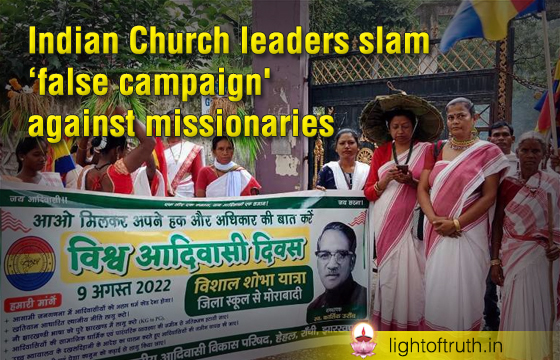
Indian Church leaders slam ‘false campaign’ against missionaries
Church leaders have criticized fringe elements in India’s ruling pro-Hindu party for giving a “communal colour” to the International Day of the World’s Indigenous Peoples celebrations in the country, which has the second-largest tribal population in the world. The day was celebrated in different parts of the country on Aug. 9. However, the Akhil Bharatiya Vanvasi Kalyan Ashram (all India tribal welfare body), alleged that “external forces and Christian missionaries in India are hatching up a large-scale conspiracy to divide society in the name of the celebration.” The organization is affiliated with the ultranationalist Rashtriya Swayamsevak Sangh (RSS), which is considered the mother organization of the Bharatiya Janata Party (BJP).
Its president Satyendra Singh said on Aug. 8 that the celebration was meant for other countries like America, Australia, New Zealand and Canada” and had no relevance for India. “All people of our country are indigenous to this land, and we are now free from the clutches of colonial forces,” Singh said. Observing the international day whose theme this year is ‘Protecting the Rights of Indigenous Peoples in Voluntary Isolation and Initial Contact’ has nothing to do with any religion, said Father Vincent Ekka. “Blaming Christian missionaries of a conspiracy is misleading,” the Jesuit priest told . Ekka, who heads the tribal studies department in the Church-run Indian Social Institute in the national capital New Delhi, said Hindu groups are afraid that the tribal people may become aware of their rights “and may revolt.” The RSS has been campaigning against Christian missionary activities among tribal people and their conversion to Christianity. Its affiliate organizations run a nationwide campaign called Ghar Wapsi (homecoming) to convert tribal people and Dalits or former untouchables and bring them into the Hindu religion. “Blaming Christian missionaries is purely a political agenda [for them], said Ekka who belongs to the Oraon tribal community in the central state of Chhattisgarh. The Jesuit appealed to fellow tribal people not to fall prey to the “false campaign.” India’s tribal people make up 8.6 percent of its 1.4 billion people, according to the last Census conducted in 2011. The RSS and its fringe elements always come up with “new ideas to attack Christian missionaries,” said Ratan Tirkey, a former member of the tribal advisory committee in eastern Jharkhand state, which has a large tribal population. “Will they recognize the contributions made by Christian missionaries” for the welfare of the tribal people, the Catholic lay leader asked.
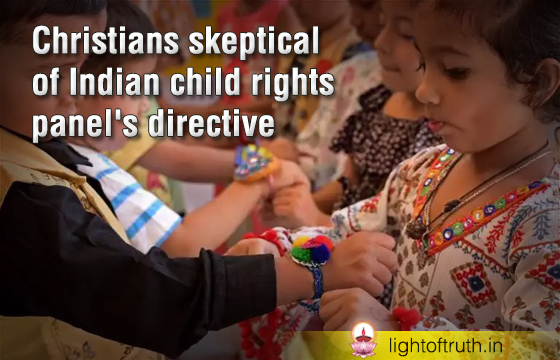
Christians skeptical of Indian child rights panel’s directive
Ahead of a Hindu festival, India’s child protection panel has issued a directive asking schools not to discriminate against children, which some Church leaders said could become a tool to harass Christian schools. The National Commission for Protection of Child Rights, in its Aug. 8 directive, asked education departments in all Indian states not to “engage in practices that expose children to any form of corporal punishment or discrimination.” The directive comes ahead of Aug. 9 Raksha Bandhan, the Hindu festival celebrating the bond of siblings. Hindu girls and women tie a sacred decorated thread (rakhi) on the wrists of their brothers, who, in turn, promise life-long protection. Christian leaders fear the directive could help the panel file non-compliance with the directive based on some children not wearing the rakhi on their wrists. “The directive is superfluous as all education departments already have ample guidelines in this regard,” said Father Babu Joseph, former spokesperson of the Indian bishops’ Conference. Priyank Kanoongo, the chairperson of the child protection panel, noted some instances of students in some schools not being allowed to wear rakhis and other Hindu symbols by teachers and school management during Hindu festivals. The directive also has asked relevant state authorities to ensure its compliance and sought a report by Aug. 17. Christian groups accuse right-wing Hindu groups of harassing Christian schools for not celebrating Hindu festivals, particularly after the pro-Hindu party of Prime Minister Narendra Modi came to power in 2014. “Our schools will abide by the decision of education departments in respective states,” Father Maria Charles, secretary of the education office national bishops’ conference told. The child rights panel has a history of targeting Christian institutions aiming to tarnish their image, said the Church leader based in the central Indian state of Madhya Pradesh, a Christian leader who did not want to be named. The panel has “unleashed targeted attacks” on our institutions and registered false cases under the draconian anti-conversion law against “our bishops, priests, nuns and other school staff,” he said. He recalled that the panel had registered several cases against Church-run institutions in his state. Christians comprise 2.3 percent of India’s 1.4 billion population. However, they run thousands of educational institutions nationwide. The Catholic Church runs some 50,000 institutions, including 400 colleges, six universities, and six medical colleges in different parts of the country. India’s constitution allows Christians who are grouped along with Muslims, Sikhs, Jains, Buddhists, and Parsees as minorities to set up schools and colleges to propagate their faith.
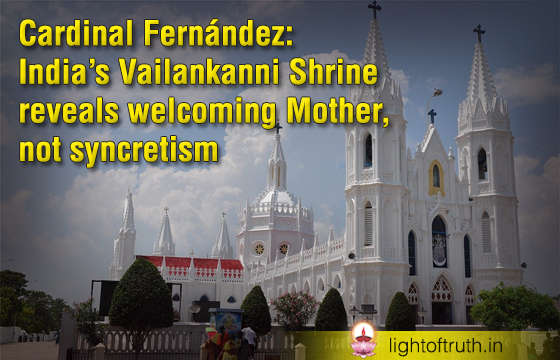
Cardinal Fernández: India’s Vailankanni Shrine reveals welcoming Mother, not syncretism
The Prefect of the Dicastery for the Doctrine of the Faith sends a letter ahead of the feast of Our Lady of Health in Vailankanni, India, expressing the Pope’s appreciation for the shrine and noting the spiritual fruits enjoyed by pilgrims, including non-Christians. Millions of pilgrims faithfully visit the Sanctuary of Our Lady of Good Health in Vailankanni, in the Indian state of Tamil Nadu. According to Cardinal Victor Manuel Fernández, Prefect of the Dicastery for the Doctrine of the Faith, “the many spiritual fruits that are produced at this Shrine make us recognize the constant action of the Holy Spirit in this place.”
The Cardinal Prefect wrote those words in a letter dated August 1, approved by Pope Francis, and addressed to Bishop-elect Sagayaraj Thamburaj, of Tanjore (Thanjavur) Diocese. The Shrine will celebrate the feast of Our Lady of Health on September 8, and devotion in Vailankanni dates back to the 16th century.
“Many non-Christian pilgrims who come seeking solace echo similar experiences,” emphasized Cardinal Fernández. “Some of them are healed of their illnesses and many find peace and hope. Without doubt, the Holy Spirit is also at work in them, responding by Mary’s intercession.” “This,” he noted, “should not be considered as a form of syncretism or mixing of religions. The Sanctuary is a place where the closeness of Mary, who welcomes everyone and demonstrates the love of the Lord to those who reflect on it, is manifested. Those who cannot receive the sacraments of the Catholic Church are not denied the consolation of the Mother of Jesus.”
Cardinal Fernández stated that he and Pope Francis recalled the spiritual beauty of this place of faith during the papal audience he was granted on August 1. “The Holy Father cares a lot about the popular piety of the faithful pilgrims, because they reflect the beauty of the Church on the move which seeks Jesus in the arms of Mary and entrusts its pain and hope to the heart of His Mother,” he said. For this reason, added the Cardinal, Pope Francis has expressed “great appreciation” for this place of faith. In preparation for the September celebrations at the Vailankanni Shrine, he added, the Pope extends his paternal blessing to all pilgrims.
According to an ancient account, the Virgin Mary first appeared in Vailankanni in the 16th century to a young man carrying milk for a customer, asking him to offer it for the Child she was holding in her arms. The young man promptly agreed, only to realize upon reaching the customer that the milk was still in his container. “This,” said Cardinal Fernández, “was an expression of the generosity of those who are willing to give something to others, in their own poverty. You do not need to have much in order to be generous. May this call to share, to assist, to be close to those who need us always resonate in this place. Mary loves the generosity of her children.”
The Prefect of the Dicastery for the Doctrine of the Faith praised the “beautiful traditions ascribed to the encounters that the Virgin had with poor and sick boys at this place of worship. Thus, the tenderness and closeness of Mary, whom Jesus desired to bequeath us as Mother of all, is manifested. Through her intercession, Jesus Christ often pours out his strength and restores health to the sick.” He recalled that, “in 2002, Saint John Paul II chose that place for the celebration of the World Day of the Sick. Thus, the same Virgin Mary who manifested herself at Lourdes also manifested herself in India as the Mother of Health.”
“It is not merely a matter of bodily health,” concluded Cardinal Fernández, “but also one that touches the soul. Contemplating the image of Mary we can all recognize the love of Jesus Christ that can heal our sadness, our anguish and our fears. If we pause before Mary, even in a brief moment of faith and love, her maternal gaze restores peace to us.”

Seoul paves the way for World Youth Day 2027 with launch event
In celebration of the next World Youth Day (WYD), the Catholic Church in South Korea hosted a grand launch event at the Myeongdong Cathedral in Seoul on July 28.
The occasion, which drew more than 1,000 young attendees, consisted of various events intended to reflect the theme “Hope Ignites in Seoul. Success for WYD Seoul 2027.”
During the inauguration ceremony, a flag parade was held in which both young Koreans and international attendees carried colourful flags from 193 different countries into the cathedral.
Following the parade, a puzzle ceremony commenced in which the young participants pieced together the various flags to form the words “WYD SEOUL 2027.”
According to LiCAS News, the highlight of the ceremony was the kickoff declaration in which Archbishop Peter Chung Soon-taick shared that preparing for World Youth Day would be a good opportunity for young people to become “miracle-makers.”
Chung, who serves as the chair of the local organizing committee for WYD Seoul 2027, marked the official start of preparations with this declaration alongside two young Korean delegates.
Gleison De Paula Souza, secretary of the Vatican’s Dicastery for the Laity, the Family, and Life, also discussed Seoul’s rich cultural history and selection as the host city for WYD.
Additionally, a research team conducted by the KDI School of Public Policy and Management’s Professor Taejun Lee presented an analysis forecasting the economic impact of WYD Seoul 2027. Among the projections of trillions of dollars expected to be generated from the event, it is forecast that 24,725 jobs will also be created related to World Youth Day 2027, according to LiCAS News.
The ceremony’s concluding Mass, which included a universal prayer said in multiple languages, was celebrated by Chung alongside Cardinal Andrew Soo-jung Yeom, Bishop Paul Kyung-sang Lee, Bishop Titus Sang-Bum Seo, and Bishop Job Yo-bi Koo.
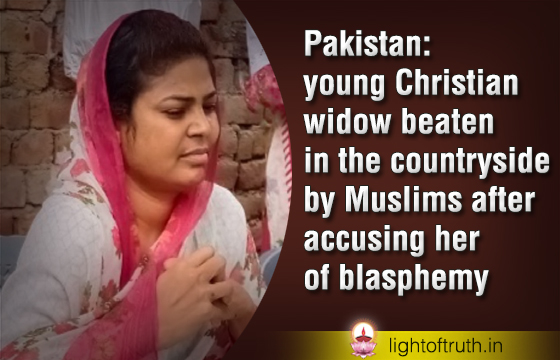
Pakistan: young Christian widow beaten in the countryside by Muslims after accusing her of blasphemy
A young Christian mother of two in Pakistan ran for her life after being accused of blasphemy before being cornered in a field and beaten by a mob. Saima Farhad Gill, a widow, living in a village, near Gojra, in the Punjab, was saved by police and placed in custody after being charged under Pakistan’s notorious blasphemy laws. Saima’s neighbours in Chak 304 Kator, claimed they had found in the bin documents bearing the name of her daughter, Emma, aged nine, which included ripped pages containing the Qur’an. The enraged mob blocked the roads. The police were able to reach Saima and she was taken into custody in Toba Tek Singh. Saima, who is about 33, on 7th August was charged under 295B of the Pakistan Penal Code in which the sentence for desecration of the Qur’an is life imprisonment.
Saima’s maternal uncle is now looking after Emma, and her brother, Saviour, aged seven. Speaking to Catholic charity Aid to the Church in Need (ACN), which supports persecuted and other suffering Christians, prominent Pakistan Catholic priest Father Bonnie Mendes said: “Saima has had a hard life after losing her husband in a road accident in September 2019. “She continued with courage, giving her children education in a private school, a few kilometres from her home.
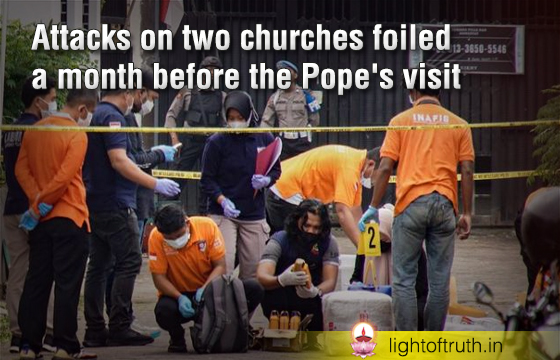
Attacks on two churches foiled a month before the Pope’s visit
A little more than a month before Pope Francis’s visit to Indonesia, two Catholic churches were in the crosshair of Islamic extremists. Densus-88 Polri, the counter-terrorism unit of Indonesia’s national police, foiled suicide attacks against the two places of worship in Malang, East Java.
This sends a warning signal ahead of the pontiff’s apostolic journey to Southeast Asia and Oceania from 2 to 13 September, raising questions about security and sectarian violence in Indonesia. Asked by local media about the affair, Brigadier General Trunoyudo Wisnu Andiko said that “two churches were targeted,” but he did not add further details about the operation and its timing. Indonesian police dismissed rumours that the terrorist operation was linked to the papal visit to the country, which has, for long time, sought to show the world a moderate version of Islam.
Speaking about the foiled attack at the heart of Catholicism in East Java, General Andiko explained that the three suspects arrested are politically linked to the extremist group called Daulah Islamiyah. At night, the Densus-88 Polri unit raided a rented house in Jeding, a village in Junrejo district, Batu regency, about 25 km from Malang. The city of more than 820,000 people is home to many Christian religious groups and congregations, as well as the famous Widya Sasana School of Philosophy and Theology, where hundreds of seminarians study.
One of the three suspected terrorists arrested is known as “Hok”, a high school student believed to be one of the would-be suicide attacker.Yesterday afternoon, he reportedly admitted under questioning that he wanted to blow himself up in one of the churches in Malang, after he was indoctrinated “for six or seven months” by Daulah Islamiyah.“The social media of the terror group seriously affected his mindset,” said Densus 88 police spokesman Senior Superintendent Aswin Siregar speaking to AsiaNews. The young man used some of the money he received from his family to buy bomb material.
The police detained Hok’s parents on board a train bound for the capital, Jakarta. However, since they found no dangerous material in their possession, the two were released. The counter-terror squad did confiscate materials – triacetone triperoxide (TATP) – to make a bomb better known as the “Mother of Satan” for the big blasts it generates. Police also found other items, including iron balls, which terrorists usually add to amplify the damage of the blast and cause more victims.
Indonesia, the world’s most populous Muslim nation, has in the past been the scene of several attacks on churches or acts of intolerance against minorities, including Christians, Ahmadi Muslims, and others.

Pope Francis offers message of hope for the Chinese people
In an interview with the Chinese Province of the Society of Jesus, Pope Francis says China is a “great people” that “must not waste its heritage”, and repeats his desire to make an apostolic journey to the country. The heart of the interview given by Pope Francis to Father Pedro Chia, director of the press office of the Chinese Province of the Society of Jesus, is “a message of hope” and a blessing for the entire Chinese people. It is an interview with a strong spiritual focus, punctuated by the Pope’s personal memories and his reflections on the future of the Church.
The Pope does not hide his desire to visit China, particularly the Shrine of Sheshan in the Songjiang District, dedicated to the Blessed Virgin Mary, Help of Christians. In the Asian country, he says, he would like to meet with local bishops and “the people of God who are so faithful”. “It is a faithful people”, he continues. “They have gone through many things and remained faithful”. To young Chinese Catholics, in particular, the Pope emphasizes the concept of hope, even though—he notes— “it seems tautological to me to give a message of hope to a people who are masters of hope” and “of patience in waiting”. And this, he highlights, “is a very beautiful thing”. The people of China are “a great people” who “must not waste their heritage”, Francis adds; on the contrary, “they must patiently carry forward their legacy”.