
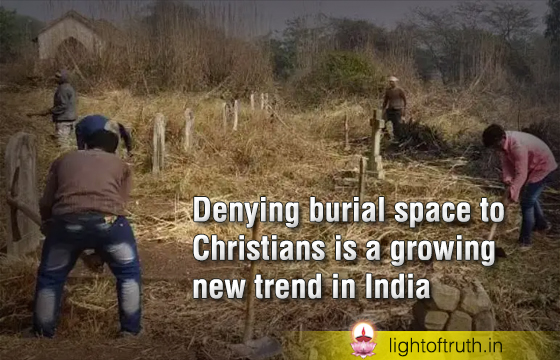
Refusing burial space to Christians has become a new trend in villages in central and eastern India to pressure Chris-tians into abandoning their faith and to discourage others from associating with missionaries, say Christian leaders. “Christians, irrespective of any denomination, are aware of repeated cases of denial of burial space to tribal Christians in their own villages. It has become a trend now and a serious concern,” Archbishop Victor Thakur of Raipur told UCA News on May 22. The latest reported case was that of Ankalu Ram Potai, who died on May 13 in the village of Havechur, in Chhattisgarh state’s Kanker district. Reports said villagers opposed his burial in the local graveyard because he was a Christian. Potai, who was 55 years old, had converted to Christianity a few decades ago, which upset the Hindu villagers. They kept watch outside the dead man’s home throughout the night on May 13 to prevent his relatives from burying him in the darkness, local media reported. In the last two years, Chhattisgarh and Odisha states alone have reported at least 25 cases of Hindu villagers refusing to bury Christians because of their faith, Christian leaders say. According to Christian activist Arun Pannalal, Chhattisgarh has reported at least 15 such cases since 2023. “It is aimed at forcing people to abandon their Christian faith,” he told. Odisha reported at least 10 cases in the past year, according to rights activist Father Ajay Singh of Cuttack-Bhubaneshwar archdiocese.
All posts by Light of Truth
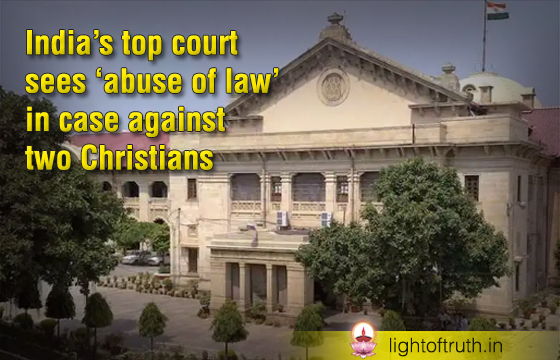
India’s top court sees ‘abuse of law’ in case against two Christians
India’s Supreme Court has quashed two criminal cases against a top Christian educator and his friend in northern Uttar Pradesh state, declaring the cases an “abuse of the process of law.” The May 24 order of the top court in the country said the lower courts need to exercise their powers to examine if “the criminal proceedings are being misused as instruments of oppression or harassment.” The order quashed two police complaints and the resultant criminal trial proceedings against Vinod Bihari Lal, the director of Sam Higginbottom University of Agriculture Technology and Science, based in Prayagraj, formerly Allahabad. The cases were registered against Lal and his friend, David Dutta, another Christian residing in Allahabad, in 2018, accusing them of violating a state law banning gangster activities. The charges included economic offences, as well as engaging in activities that threatened “law and order” in society. The complaint states that Lal and Dutta comprise “an organized gang… proficient in the commission of economic crimes through fraud and deceit” and other criminal activities, according to court documents. The complaint said that through criminal activities, they both “accumulate wealth” and, due to the “fear and terror” surrounding them, “no one comes forward” to report their crimes or “muster courage to testify in court.” The Allahabad High Court, the state’s top court, on May 19, 2023, rejected Lal’s plea for relief and allowed the district court to proceed with the criminal trial. It forced Lal to appeal to the Supreme Court to clear his name of the allegations.
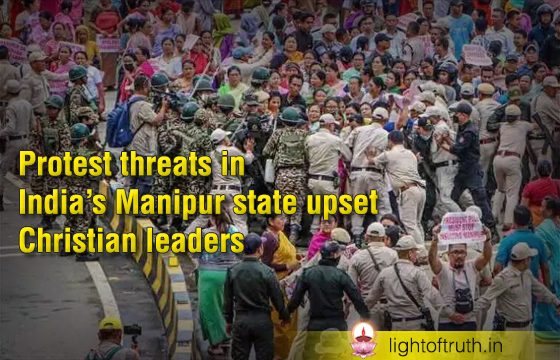
Protest threats in India’s Manipur state upset Christian leaders
An influential Hindu orga-nization in India’s conflict-ridden Manipur state has called for an escalation in protests against the state administration, which Chri-stian leaders warn could jeo-pardize ongoing peace initia-tives in the region. The Coordinating Committee on Manipur Integrity (COCOMI), the top body of the majority Hindu Meiteis, ended a 48-hour protest on May 24. The protest demanded an apology from the state governor, Ajay Kumar Bhalla, for what they called an “insult to the identity of the state” to appease their rival, the Kuki-Zo tribal people. “The Meiteis are targeting the governor, practically challenging federal rule. They want to restore a popular government under their leadership,” a local Church leader told on condition of anonymity because he feared for his safety, on May 27. In the latest protest, Meiteis held Bhalla responsible for insulting the state by concealing the state name – Manipur – written on the Manipur State Transport bus that carried media persons to cover a local flower festival – the Shirui Lily festival – in Ukhrul district, a tribal dominated area. They also decided to escalate their protest and called for a “civil disobedience campaign” against federal rule under Bhalla.

Thousands attend elevation of Calicut as archdiocese
More than 10,000 people braved heavy rains to attend a ceremony to elevate Calicut diocese as a metropolitan arch-diocese and its bishop as its first metro-politan archbishop. Apostolic Nuncio to India and Nepal Archbishop Leopoldo Girelli led the May 25 ceremonies at St. Joseph’s Church, in Kozhikode (formerly Calicut). In his homily during the inaugural Mass, Cardinal Baselios Cleemis, head of the Syro-Malankara Catholic Church and president of the Kerala Catholic Bishops’ Council, stressed the deep spiritual signi-ficance of occasion. He commended the faith and leadership of the faithful of the newly erected archdiocese. The cardinal paid tribute to St. Francis Xavier, whose missionary zeal in the Malabar region laid the foundation for the Syro-Malabar and Syro-Malankara Churches. He noted that Calicut’s new archdiocesan status stands as a testament to this enduring spiritual legacy, rooted in centuries of evangeliza-tion and community witness.

Christian marriage takes away lower caste social benefits: Indian court
The top court in southern Indian Tamil Nadu state has ruled that persons marrying under the Christian personal law should be considered to have converted to Christianity and abandoned their eligibility for caste-based social benefits. The ruling came in a case seeking the court’s order to disqualify the “illegal” election victory of a lower caste woman to a local body seat that is reserved for lower caste people, officially referred to as Scheduled Castes. In October 2022, Prime Mini-ster Narendra Modi appointed a three-member panel to exa-mine the implications of exten-ding benefits to Christians of lower caste origin, following the court’s request for the go-vernment’s view on the issue. The hearing is halted again due to the panel’s failure to submit its report to the government. Out of India’s 1.4 billion people, 201 million belong to the Dalit community, and nearly 60 percent of India’s 25 million Christians trace their origin to Dalit and tribal communities.

Christians in India’s Odisha denied ‘right to belief, dignified burial’
A legal rights group on a fact-finding mission in a tribal district of India’s eastern Odi-sha state has found that aggre-ssive Hindu mobs are denying poor Christians from tribal and Dalit communities the “right to belief and a dignified burial.”
The Odisha Lawyers Forum, in a May 14 report titled: Free-dom to Be Buried, A New Stru-ggle for Christians in Odisha, has cited recent cases of “denial of the rights of the deceased” in Nabarangpur district, which they say are a clear violation of the Indian Constitution and laws. The report has docu-mented many such cases between 2022 and 2025, based on testimonies provided by survivors in the villages.
“The Odisha Lawyers Forum found gross violations of fundamental, constitutional and human rights of the most vulnerable communities of Adivasi, Dalit and religious minorities in terms of equality before law, right to freedom of expression, thought, belief and association, more importantly, the right to life and a dignified burial in Nabarangpur district in Odisha,” the report said.
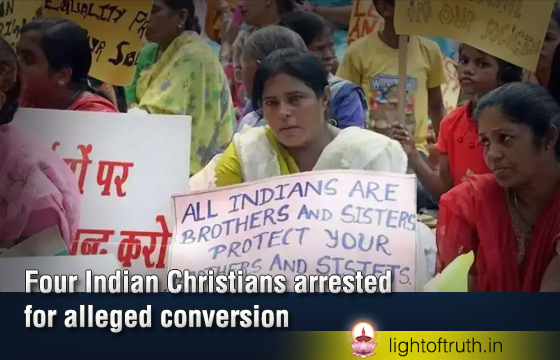
Four Indian Christians arrested for alleged conversion
Police in Uttar Pradesh in northern India have arrested four Christians after they were accused of violating the state’s stringent anti-conversion law. “Our four faithful were arrested on May 12 after they were accused of attempting to convert gullible indigenous people with job offers and financial aid,” said a Church official providing legal help to the victims. They were arrested and taken to Chandan Chawki police station in Lakhimpur Kheri district in the state, which witnesses high levels of persecution against Christians, according to rights activists. The four were remanded in custody the following day. Efforts to secure their bail were still ongoing, according to the Church official, who did not wish to be named. This was the latest in a series of arrests of Christians for alleged violations of the anti-conversion law, which carries up to 20 years in jail. Christian leaders and rights activists say these laws are tools to persecute minorities by right-wing Hindu groups and have called on the Supreme Court to declare them unconstitutional.
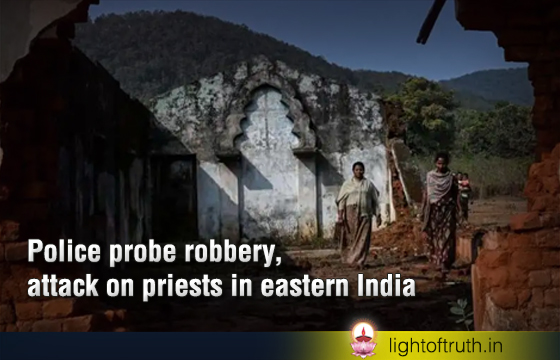
Police probe robbery, attack on priests in eastern India
Police in eastern Indian Odisha state have started probing an armed robbery at a Catholic seminary that left two Catholic priests assaulted and injured and valuables looted. A gang of nine suspected robbers barged into Carmel Niketan minor seminary in Charbati of Kuchinda in the state in the early hours of May 23, said Father Thomas Bose Velassery, the regional vicar of the Order of Discalced Carmelites. The seminary is managed by the religious order. He said during the attack, two priests – Silvin K. S., 40, and Linus George, 90 – who look after the seminary, were tied, assaulted, and their phones snatched. During the attack, the seminary was mostly deserted as students were away on summer holidays, he added. Odisha is also known for the persecution of Christians by Hindu hardliners. In 2008, Odisha’s Kandhamal district witnessed one of the worst anti-Christian violence that left at least 39 Christians killed and as many as 70,000 became homeless, according to official government reports. Other reports said the death toll was 100, and some 40 Christian women were sexually assaulted by a Hindu mob. At least 100 churches and between 5,000 and 6,000 houses were destroyed in the violence.
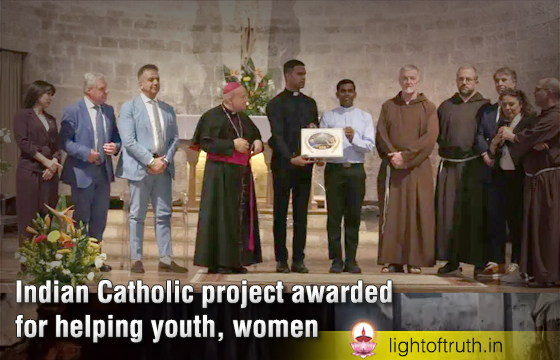
Indian Catholic project awarded for helping youth, women
A project run by the Catholic Church in western India’s Goa state, which supports vulnerable youth and marginalized women in becoming self-reliant, has won the 2025 “Francis of Assisi and Carlo Acutis, for an Economy of Fraternity” international award. Project HOPE was conferred the award at the Church of St. Mary Major in Assisi, Italy, on May 25. The award includes a cash prize of 50,000 euros and a scarf featuring an image of St. Francis of Assisi removing his clothes as a symbol of renouncing the material world.
Father Sanford Rodrigues from the Archdiocese of Goa and Daman received the award on behalf of the project team. HOPE, which stands for Healing, Opportunities, Protection, and Empowerment, was born out of “Childline” — an initiative by Catholic charity Caritas Goa that sought to rescue and rehabilitate vulnerable children from the poor and neglected villages. The government took over the project in 2023, and subsequently, some volunteers launched a new project on a pilot basis, which evolved into HOPE.
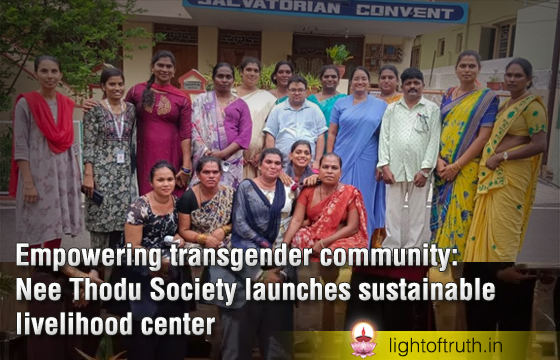
Empowering transgender community: Nee Thodu Society launches sustain-able livelihood center
A non-governmental organization based in Visakhapatnam, Andhra Pradesh, has opened a sustainable livelihood center for transgender individuals. The Nee Thodu Society for Transgender Persons operates under the leadership of Sister Amitha Polimetla, its founder director. The member of the Salvatorian Sisters Congregation is committed to provi-ding skill training and employment opportunities. The center aims to enable transgender individuals to lead dignified lives and integrate into mainstream society. “Our goal with the Sustainable Livelihood Center is to dismantle the barriers that have historically excluded the transgender community,” stated Sister Polimetla, an advocate for skills-based empo-werment. “We believe that with the right skills and opportunities, every individual can lead a life of dignity and contribute meaningfully to so-ciety.” She emphasized the trans-formative vision of the center: “This center is more than just a skill train-ing facility; it’s a beacon of hope. It represents our commitment to creat-ing a future where transgender indi-viduals are not just tolerated, but truly integrated and empowered.” Currently, the center offers short-term courses in tailoring, jute bag making, and paper plate production.