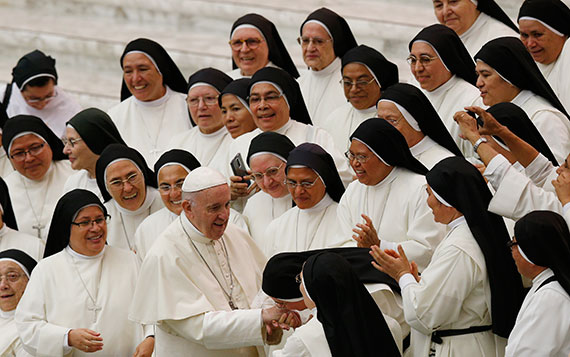
51% of Dutch people over 15 years of age do not belong to any Church or to any religion whatsoever. Just released by the National Statistics Bureau (Centraal Bureau voor de Statistiek) as part of a survey of “social cohesion and welfare,” this figure shows a further decrease in the religious belonging of the Dutch: in 2016, 49% of them stated they did not belong to any religion, in 2012 they were 46%. The believing minority is composed of 24% Catholics, 6% belonging to the reformed Church and as many to the Protestant Church, 6% to other confessions, 5% to Islam. 78% of Dutch people have never or hardly ever attended a religious service, 10% of them attend once a week (6% for Catholics), 3% go 2 to 3 times a month, and the same proportion attends one religious celebration/meeting a month; 7% go less than once a month. The figures change depending on the age range and sex: 71% of Dutch people over 75 years of age stated they are religious, 34% that they regularly attend a celebration in a place of worship. The less religious ones are young people aged 18 to 25:32% of them are somehow connected to a religious group, and 13% of them regularly see their group. As to men, 46% of them belong to a religious group, while 52% of women do.
ENDING INDIA’S GAP BETWEEN RICH AND POOR CATHOLICS
Benny D’Souza remembers good past times at Christmas when he enjoyed a week of sumptuous meals and quality time in India’s western Pune city with a local Christian Mascarenhas family that traces its roots to Portuguese missionaries.
“We were poor and the parish organized that I have lunch and spend the evening with the Mascarenhas family, and come home for the night,” said D’Souza, 55, father of a son and daughter.
“The daily visits for a week made me feel on top of the world.”
The help came as part of the Small Christian Community (SCC) activities of the Immaculate Conception Church in Poona Diocese. Poona is the former name of Pune.
The growth of such communities across India helps narrow a rich-poor divide, and caste-based discrimination, in hundreds of village parishes, a group of Indian bishops recently explained.
For example, Archbishop Anil Joseph Couto of Delhi noted that in Poona Diocese rich and influential people mingle with others who are poor and not so well educated.
Archbishop Couto was among 41 bishops and four archbishops, who met on Sept. 17-20 for a bishops’ colloquium on Small Christian Communities. The theme was: ‘Bishops are builders of communities to re-vitalize the Church.’
The bishops met and interacted with families and various groups in several parishes of the diocese.
A CHRISTIAN DOCTOR ARRESTED FOR ‘FORCED CONVERSION’ OF A CHILD
A Christian veterinary surgeon was arrested by the Jharkhand police on charges of forcibly converting a 13-year-old girl by offering her money. The arrest took place in Pakur on October 16, following the complaint filed by the child’s father the day before.
Speaking to AsiaNews Sajan K George, president of the Global Council of Indian Christians (GCIC), condemns “the arrest of the Christian, according to the Jharkhand Freedom of Religion Act [the anti-conversion law in force in the State, ed.]. We are suspicious of the arrest, given that recently Jharkhand is a hotbed of persecution against Christians.
The arrested person is called Dalu Soren and lives in the village of Sawanlapur. He is a cattle inspector in Chatarpur, in the Pakur district, and he also runs a school in his village. Some report that in the past he has already been accused of forced conversions against minors, and that is why he moved to the place where he resides.
PRO-HINDU TRIBAL PEOPLE TAKE OVER INDIAN CHURCH
Pro-Hindu tribal people have removed a cross from a Protestant Church and converted the building into their community hall in India’s Jharkhand State in a move that Christian leaders believe is linked to upcoming elections.
Some 50 tribal people took down the cross from the Vishwa Vani (voice of the world) church in Khadnga village, 25 kilometres from state capital Ranchi, on Oct. 20. They also repainted the name as Sarna Bhavan — the house of those following the traditional tribal Sarna religion. They also held a purification ceremony and prayers at the church.
“We lodged a complaint with the police on Oct. 24 after our efforts to amicably settle the issue failed,” said Pastor Emmanuel Kujur, coordinator of the Protestant group in the state.
He said tribal people in the village captured the church on grounds that it was built on tribal land. They claimed to have a government order to reclaim the land and the building but failed to produce the document, he said.
Pastor Kujur admitted there was a dispute over the land. The church was built on land donated by a tribal Christian. He and his brothers had a dispute over their property and a local magistrate ruled the land belonged to the government.
“But that does not give anyone the right to capture the church. The dispute continues between the brothers. Until it is settled, how can someone take it over?” he asked.
US MISSIONARY WHO HELPED YOUTHS BREAK FROM DRUGS PASSES AWAY
Bangladeshis are mourning a prominent American Catholic missionary who dedicated much of his life to the treatment and rehabilitation of drug addicts in the South Asian nation.
Holy Cross Brother Ronald Drahozal passed away at a retirement and treatment facility run by his order in the U.S. State of Indiana on Oct. 16. He was 81.
Brother Drahozal had been suffering from a range of ailments for years and had been in the U.S. since March for medical treatment.
It was Brother Drahozal’s work helping thousands of Bangladeshi youth fight drug addiction that brought him national and international recognition.
Bishop Gervas Rozario of Rajshahi Diocese, the vice-president of Catholic Bishops’ Conference of Bangladesh, said Brother Drahozal’s death is a great loss.
PAKISTANI HEAD TEACHER SUSPENDED FOR ATTACKING CHRISTIAN STUDENT
Pakistani authorities have suspended the head teacher of a government school for assaulting a Christian student and abusing his mother.
Nusrat Shaheen was suspended on Oct. 22 after a complaint of discrimination against 12-year- old Sharjeel Masih by his parents.
Sharjeel, a fourth grader, was beaten and suspended for a week from the Government Boys Primary School of District Attock, Punjab province. The district education officer has launched an inquiry into the incident.
“I was just trying to turn off a running tap when the teacher grabbed me, called me churha (low caste) and asked why I had touched the tap and made it filthy. ‘This tap is not from the country of your mother,’ she said before abusing me. I had to sit outside the school for five hours,” said Sharjeel, whose father works in a military hospital as a sanitary worker.
His mother Farzana Ejaz recounted the humiliation of the incident to ucanews.com.
“I accompanied him to school the next day to apologize for any mistake committed by my son. She [Nusrat Shaheen] asked me to grab her feet for the mistake of my son and threatened that her brother, a police officer, would sell my younger daughter to a brothel,” said the mother of three.
VIETNAM UPHOLDS CATHOLIC ACTIVIST’S HARSH SENTENCE
An appeals court in central Vietnam has confirmed a harsh sentence imposed on a Catholic activist accused of trying to overthrow the nation’s communist government. Attorney Dang Dinh Manh said on Oct. 18 that the Superior People’s Court upheld John Baptist Le Dinh Luong’s sentence of 20-years’ imprisonment to be followed by five years of home detention.
Attorney Manh, one of two lawyers who acted for Luong in court, said the defendant, aged 53, was also deprived of the right to government employment. During the quick trial, the court building in Vinh City was tightly guarded and surrounding streets were blocked off.
IN VIETNAM’S CENTRAL HIGHLANDS FAITH IS SPREADING
Every Sunday, Paul Rmah Bral and a partner, along with other friendly men in pairs, travel around on motorbikes in Vietnam’s Central Highlands region introducing villagers to Catholic values.
Bral is a 60-year-old ethnic Jarai, part of a wider group known as Montagnards, who speak a Malayo-Polynesian language related to other tongues in the Asia-Pacific region spoken from Indonesia to far-away Fiji.
A French Catholic missionary made contact in the mid-1800s with the traditionally animist Jarai.
During the Vietnam War, many Jarai joined with clandes- tine American forces and later resettled in the United States.
Bral and other lay missionaries, known as giao phu, have for the past two decades been bringing more villagers into their fold in Kontum Diocese.
“It is the happiest thing in life to know that God creates and loves us, and to bring His love to our brothers and sisters,” said
Bral, a former Vietnamese language teacher who embraced Catholicism in 1995 and was baptized in 2000.
He and dozens of other villagers, including his wife and son, attended weekend catechism classes held at the Redemptoristrun Evangelization Centre.
Local communist authorities in the Central Highlands, which borders with Cambodia, pressured locals into withdrawing from their study sessions.
CHINA ECONOMICS SPURS MYANMAR RELIGIOUS REPRESSION
In recent months there has been a crackdown on religious practices by an ethnic militia force in a remote region on Myanmar’s mountainous border with China.
Churches in northern Shan State have been closed, crosses torn down and pastors and other Christian leaders detained by the United Wa State Army (UWSA).
On October 9 about 100 Christians were released, but as many as 92 remained in custody, Christian leaders said.
The UWSA, the military wing of the United Wa State Party (UWSP), dominates the population of about 500,000 in the self- proclaimed Wa Self-Administered Division of Myanmar.
According to various researchers, the UWSA is the largest standing militia in the country with a force of up to 30,000 troops. The enclave has long been widely seen to be backed by China as it is the implementation of the now intensified crackdown on religious practice.
The militia and its political arm are remnants of the Burmese Communist Party and retain very close links with authorities in China. China is conducting a fresh campaign of internal repression of religion, but its motives in northern Myanmar are essentially economic.
AUTHORITIES SHUT DOWN SIX MORE CHURCHES IN GUIYANG
At least six unregistered Protestant churches in Guiyang city, Guizhou Province in Southwest China were shut down by authorities on 8 October. All six churches are from the same district and it is believed that similar forced closures are occurring in other districts in the city.
The churches, which have a total of around 300 members, were accused of being “illegal religious venues,” an accusation often levelled at unregistered churches, sometimes referred to as ‘house’ or ‘family’ churches. Unregistered churches in the area have been under pressure from authorities to join the state- sanctioned Three Self Patriotic Movement (TSPM). Authorities have harassed church members, and some congregations have lost up to 40% of their members due to this kind of pressure.
These closures follow the introduction of revised Regulations on Religious Affairs which continue and place fresh emphasis on the requirement that group religious activities take place in specifically designated registered sites, outlined in Chapter IV. Lawyers familiar with the issues say that in practice, the only way for a church to register as a religious site is through the state-sanctioned TSPM. However, TSPM churches have also been closed down and even demolished in some areas, leaving a shortage of registered religious venues.