
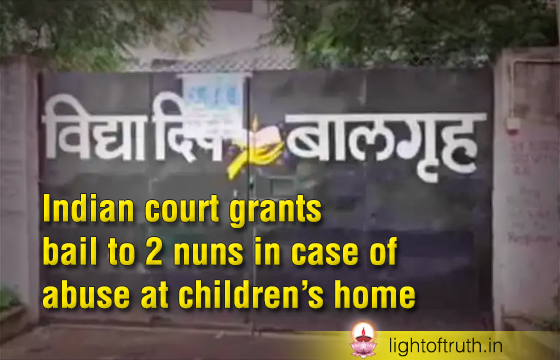
A court in India’s Maharashtra state has granted bail to two Catholic nuns and a caretaker of a children’s home, a week after they were arrested for allegedly ill-treating minor girls under their care. “We are relieved that they are out on bail and hope the truth will come out,” Sister Rosaline Rodri-gues, president of the western region of the Conference of Religious India (CRI), told. Sisters Suchita Gaikwad and Alka Salunke of the Sisters of the Cross of Chavanod, along with caretaker Anwelari Bhag-wandas, were arrested in the western state’s Chhatrapati Sambhajinagar (formerly Aurangabad) district. The police arrest was based on the complaint of nine girls, who escaped from the nuns-managed Vidyadeep (light of knowledge) Children’s Home.
They complained to the district welfare authorities about a lack of facilities and ill-treatment by the nuns and caretaker. District Court Judge M S Deshpande granted bail on the condition that each of them furnishes a personal bond of 50,000 rupees (approximately US$580) and separate local sureties of the same amount.
The July 14 bail order also stated that the accused must cooperate with the investigation, refrain from tampering with evidence or influencing witne-sses, and seek prior permission of the court before leaving its jurisdiction. It further asked them to report to the local police every Sunday until the police file the chargesheet in the case.
A member of the Sisters of the Cross of Chavanod said this was a straightforward plot hatched to make use of the children to defame our sisters.

Vatican envoy lauds Syro-Malankara church founder during India visit
A top Vatican official, currently visiting India, has exhorted the Eastern rite Syro-Malankara Catholics to emu-late the example of Venerable Archbishop Mar Ivanios, who is known as “tireless apostle for unity.”
Archbishop Paul Richard Gallagher, the Vatican’s Secretary for Relations with States and International Organizations, said Venerable Mar Ivanios, who established the Eastern rite Church in 1930, “made immense sacrifices” for Christian unity.
At the July 15th Mass commemorating the 72nd death anniversary of Venerable Ivanios in the Church’s base in Kerala state, Gallagher asked Catholics to emulate the vene-rable one who sought “holiness in everyday life, and to serve others selflessly.”

Indian state proposes law to deter religious scripture desecration
Church leaders have cautiously welcomed a pro-posed law prescribing harsh punishment for acts of sacri-lege against holy scriptures in the predominantly-Sikh state of Punjab in northern India. The Punjab Prevention of Offences Against Holy Scriptures Bill, 2025, a first of its kind in the country, was tabled in the state legislative assembly on July 14 after being cleared in a meeting of the council of ministers chaired by Punjab chief minister Bhagwant Mann. The bill prescribes “a minimum of 10 years’ imprison-ment, extendable to life im-prisonment” for acts of sacrilege against any holy scripture, which are on the rise in the state, particularly against the Sikh holy book, the Guru Granth Sahib, local media reports said. “The proposed bill has come at the right time, as several cases involving sacrilege of religious scriptures were reported lately,” said Father Daniel Gill, vicar-general of Jalandhar diocese. He hoped the bill would soon pass in the state assembly and help the govt to keep a check on incidents of sacrilege.

Catholic nuns’ arrest over ‘false’ charges rocks Indian parliament
The arrest and jailing of two Catholic nuns on false charges of human trafficking and conversion has rocked the Indian parliament, with opposition members seeking their immediate release. Congress leader Rahul Gandhi, who is the leader of the opposition in the Lok Sabha (upper house), on July 28 called the arrests an example of “BJP-RSS mob rule.” He was referring to the pro-Hindu Bharatiya Janata Party of Prime Minister Narendra Modi and its parent body, the Rashtriya Swayamsevak Sangh (national volunteer corps), by their acronyms. Sisters Vandana Francis and Preeti Mary, who are members of Assisi Sisters of Mary Immaculate (ASMI), a Franciscan congregation of the Syro- Malabar Church, were arrested on July 25 by the Railway Police at Durg railway station in central Chhattisgarh state. Chhattisgarh is a BJP-ruled state, and its chief minister, Vishnu Deo Sai, defended the action, terming it a serious matter of “human trafficking under the guise of religious conversion.” He asserted that the law would take its own course. However, Rahul Gandhi alleged “systematic persecution of minorities” and a “dangerous pattern” of targeting individuals for their faith. “Religious freedom is a constitutional right,” he asserted. Sisters Francis and Mary had gone to Durg railway station to pick up three young women, aged between 19 and 22, to be employed as domestic help in three convents in the state. As the nuns and the girls were showing their tickets to a railway official, a mob arrived and surrounded them, said Father Josh Abraham from Raipur archdiocese, based in the state’s capital.
“The members of the mob claimed to belong to Bajrang Dal, a militant Hindu group, and accused the nuns of forcibly taking away the girls for religious conversion,” the priest, who is a lawyer and gathered details of the incident, told on July 28. The railway police arrived and took away the nuns, the girls, and a boy who accompanied them for the journey from their homes to Durg.
“The police later took the three girls to a shelter home. The nuns and the boy were charged with human trafficking and religious conversion, and remanded in custody for 14 days by a local court,” Abraham said. The priest-lawyer said the police had said they would release the nuns and the boy in the evening, but instead jailed them. The girls are members of the Church of South India (CSI), a union of Protestant denominations. One of them allegedly told the police that she was taken to Durg without her consent. “This could have been done by pressuring the girl, which led to totally false charges being laid against the nuns,” Abraham alleged.
He said the nuns’ bail applications were filed on July 28 and hoped they would be released soon, as the “charges against them are totally false and baseless.” Both the nuns are natives of Kerala, and their arrest and jailing caused a stir in the southern state. Parliamentarians belonging to the Congress-led United Democratic Front (UDF) and the ruling Left Democratic Front (LDF) from Kerala staged a protest in the parliament complex, waving placards that read “Stop attacks on minorities.” Federal Minister of State for Minority Affairs George Kurian, who is also from Kerala, refused to take a clear stand, saying “the matter was subjudiced.”
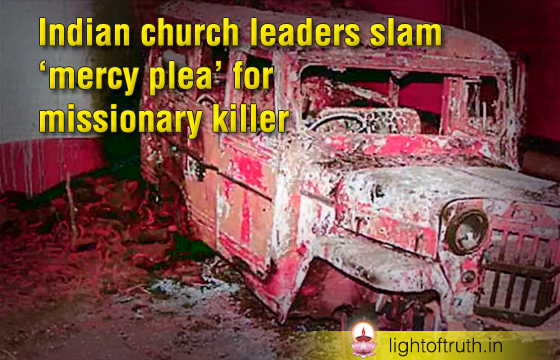
Indian church leaders slam ‘mercy plea’ for missionary killer
Christian leaders and activists have criticized a petition seeking a presidential pardon for Rabindra Kumar Pal, known as Dara Singh, the main convict in the 1999 murder of Australian missi-onary Graham Staines and his two children. “A plea for mercy must never come at the expense of truth or the suffering of victims,” Father Ajay Singh, a rights activist who has been following the case, told on July 24.
Mahendra Hembram, the only other convict imprisoned in the same case, submitted the mercy petition to President Droupadi Murmu on July 15. Hembram himself was released last April for his “good behaviour” after spending 25 years in prison. The mercy petition “cannot be morally justified” unless the murderer shows “sincere repentance” and acknowledges “the gravity of the crime,” said the priest from the Archdiocese of Cuttack–Bhubaneswar in Eastern Odisha state.
However, neither Hembram nor the prime convict has expressed any sense of “remorse” for burning to death the missionary and his two sons, aged 6 and 10. A district court initially convicted 13 people, including Dara Singh and Hembram. However, the Orissa High Court acquitted 11 of them. Dara Singh was initially sentenced to death, but it was later commuted to life in prison, the same punishment given to his accomplice Hembram.
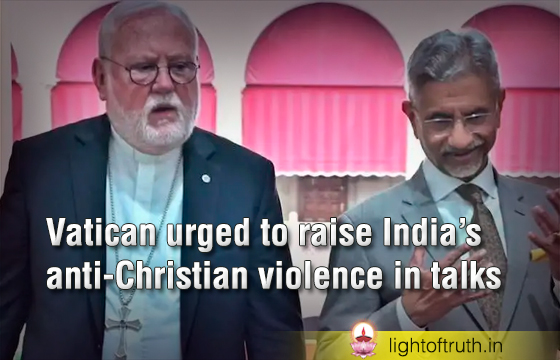
Vatican urged to raise India’s anti-Christian violence in talks
Vatican’s Secretary for Re-lations with States, Archbishop Paul Richard Gallagher, met with India’s External Affairs Minister S. Jaishankar amid calls to make increasing attacks against Chri-stians a bilateral discussion point. Gallagher, on a week-long visit to India, met Jaishankar in New Delhi on July 17, the third day after arriving, following some church functions and meetings with church officials. Jaishankar, in a social media post, said he was “pleased” to meet the Vatican official. It was “a good conver-sation about the importance of faith, and the need for dialogue and diplomacy to address conflicts,” the post said. Neither the Vatican nor India issued any public statements on the issues the officials discussed. Church officials in India also refused to comment on the “conflicts” Jaishankar mentioned in his post.
However, the archbishop was asked to take up the increasing Hindu attacks against Christians in bilateral dialogues with Indian officials in a memorandum that an ecumenical Christian group submitted. The violence against Christians “should be taken up in bilateral human rights dialogues with India, specifically highligh-ting the targeted use of anti-con-version laws on religious minori-ties,” said the memorandum United Christian Forum (UCF) submitted to Gallagher. The Vatican’s engagement should not be limited to the federal govern-ment but also include state govern-ments that “aggressively enforce” anti-conversion laws, it said.
Archbishop Anil Joseph Couto of Delhi submitted the memora-ndum on behalf of the group during a meeting with Gallagher at the Vatican Nunciature in New Delhi on July 17. The memoran-dum wanted the Vatican to issue official statements “condemning the rising incidents of violence and systemic discrimination against Christians in India.”
It also wanted the Vatican to take steps to “ensure judicial transparency” in trials under anti-conversion laws and to have “monitoring and fact-finding missions” to assess ground realities, particularly in states witnessing recurring violence. “Anti-Christian violence has been consistently increasing,” A. C. Michael, convenor of the ecumenical forum, told UCA News, pointing to the numbers in the memorandum. The forum, which documents violence targeted at Christians in the country, recorded 834 incidents in 2024, from 734 incidents in 2023.
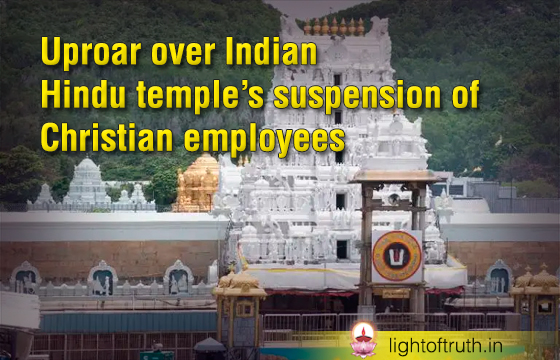
Uproar over Indian Hindu temple’s suspension of Christian employees
Church leaders have criticized the authorities of one of India’s most famous Hindu temples for suspending four employees because of their Christian faith. The managers of the Sri Venkates-wara temple, popularly known as the Tirupati temple, in southern Andhra Pradesh state, announced on July 19 the suspension of employees for “following other religions.” The Tirumala Tirupati Devasthanams (TTD), a trust managed under the state govern-ment, manages the temple, billed as India’s most popular and richest.
“The employees were reportedly following the Christian faith, which violates the code of conduct,” of the temples, TTD said in a statement posted on social media. The decision was taken following a vigilance report and review of supporting evidence, the trust said. The temple report-edly owns assets and properties worth about US$30 billion, making it one of the richest in the world. The TTD’s administrative board manages 12 temples and sub-shrines, employing some 14,000 people. Father Robinson Rodri-gues, public relations officer of the Catholic Bishops’ Conference of India (CBCI), termed the deci-sion a violation of constitutional rights.
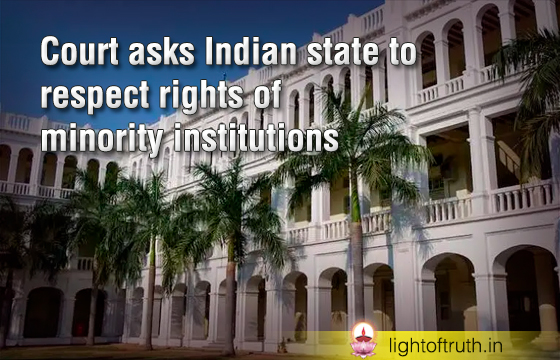
Court asks Indian state to respect rights of minority institutions
A verdict by the Madras High Court in the state of Tamil Nadu could serve as a guide to resolve several cases across India where state officials have delayed staff appointments at Church – run educational institutions, Church officials say. Father Maria Charles, secretary of the Indian Catholic bishops’ Office for Education, called the court order “a blessing,” as many Christian-run, government-aided educational institutions face staffing problems nationwide. Charles told on July 23 that the verdict from the highest court in the southern state regarding staff appointments at Jesuit-run Loyola College could be des-cribed as a “guiding verdict safeguarding the rights of religious minorities.” The court ordered the state government on July 14 to grant approval for 19 appointments –18 assistant professors and one librarian – made by Loyola College, an autono-mous institution for higher education based in the state capital, Chennai.

Thai Catholic Church voices concern over Cambodia border conflict
“The Thai Catholic Church views the current military tension along the border with profound concern”, Archbishop Francis Xavier Vira Arpondarattana of Bangkok and President of the Thai Catholic Bishops’ Conference told the Italian Catholic news agency AgenSir in an interview published July 26.
Tensions across the Thai and Cambodian border erupted on Thursday, July 24, in ongoing clashes that have resulted in at least 33 people dead and more than 168,000 displaced. The 800-kilometer frontier between the two countries has been disputed for decades, but past confrontations have been limited and brief
“The Church is fully aware that border disputes, although presented as mere territorial issues, are often exploited for political purposes”, Archbishop Arpondarattana explained in the interview. He said “these tensions may be manipulated to stoke nationalist sentiments”, distract the population “from domestic issues” and “serve the interests of specific political actors”. According to the Archbishop this places “short-term political opportunism” above the well-being of the population and hinders a peaceful, sustainable long-term resolution.
He also said that the Church has often warned against “the dangers of extreme nationalism” and that border conflicts like this one stem from historical complexities and disagreements which need to be considered and understood in order to promote “genuine reconciliation and fair solutions” that lead to a more peaceful future.
The President of the Bishops’ Conference underlined that the Church “strongly supports dialogue, negotiation, and international mediation as pathways to lasting peace”.
He also said the Church is close to the ordinary people who live in the border areas. “They suffer displacement, loss of livelihoods, and constant threats of violence”, he said, emphasizing that “our faith calls us to recognise the inherent dignity of every human being, regardless of nationality or ethnicity”.
“We must resist divisive ideologies and instead foster a culture of solidarity and genuine fraternity”, he continued.
“The Church unequivocally condemns all acts of violence against civilians”, Archbishop Arpondarattana said. “We reiterate that international humanitarian law must be respected, and that non-combatants – including women, children, and the elderly – must always be protected”.
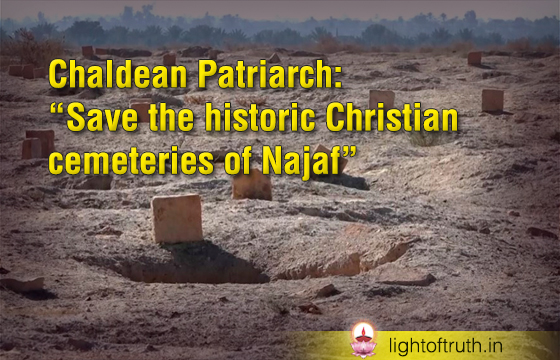
Chaldean Patriarch: “Save the historic Christian cemeteries of Najaf”
In an attempt to safeguard Iraq’s fragile Christian heritage, the Chaldean Patriarch of Bagh-dad has launched an urgent appeal to Prime Minister Mohammed Shia al-Sudani to stop what he calls ‘attempts to destroy historic Christian cemeteries’ in the province of Najaf.
In their place, Cardinal Louis Raphael Sako denounces in a reflection published on the pa-triarchate’s website, local autho-rities want to support commercial development plans that would end up erasing a historical testimony of great value.
According to the Chaldean Church leader, ‘reliable sources in Najaf’ – a city 160 km south of the capital – are sounding the alarm about ‘attempts to transfer control of historic Christian cemeteries’ to investors and entrepreneurs with the aim of ‘carrying out projects’ in the construction sector. Hence the initiative of the cardinal, who has appealed directly to the head of government to block the expro-priation and keep alive the me-mory of a Christian presence in the area.
According to the statement, Cardinal Sako asked al-Sudani to ‘intervene and stop the violation of Christian holy sites,’ speci-fically identifying the ‘Manathira cemetery’ and the ‘Umm Kheshm cemetery for Christian Mana-thira’ as being at risk of ‘imminent threat.’ ‘These historic sites,’ the cardinal continued, ‘must be guarded and fenced off. Further-more, they must not be tied to private investment projects, which would end up completely erasing them.’
Framing his appeal in terms of national interest, the cardinal argued that these areas have immense cultural and economic value that goes beyond the Christian community and concerns the entire Iraqi population, including Muslims. Cardinal Sako went on to emphasise that Iraq’s diverse history predates the Islamic era by a long way, encompassing ‘the Akkadians, Sumerians, Chaldeans, Babylonians, Assyrians, Arabs, Persians, Christians and finally Muslims.’