
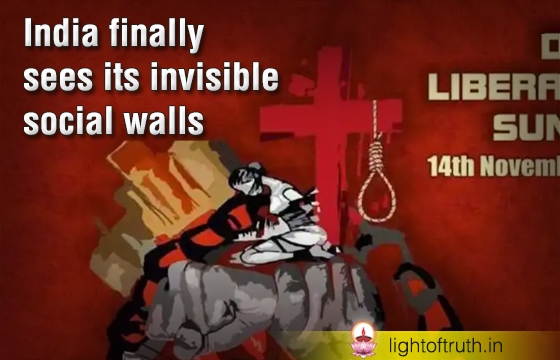
On April 30, the Indian government announced a decision that will reverberate through the nation’s social fabric for genera-tions: the upcoming national census will include comprehensive caste data for the first time since 1931. This watershed policy shift, declared by Federal Information Minister Ashwini Vaishnaw, promises to reshape how India understands and addresses its most persistent social divisions. Since indepen-dence, India’s leaders have deliberately avoided counting caste in national censuses, except for Scheduled Castes and Tribes. The idealistic hope was that by not measuring caste, India might eventually transcend it. Reality proved more stubborn. Caste has remained a powerful force in Indian life – influencing marriages, job opportunities, political alliances, and educational access. The absence of data did not diminish caste’s impact; it only made addressing caste-based inequalities more difficult. For religious minorities, including Christians, the census represents both promise and uncertainty – a chance for greater visibility and inclusion, but also potential vulnerability in a political climate often charged with religious tensions. For all Indians, it offers a more honest reck-oning with social realities that have persisted despite decades of constitutional commitments to equality. In choosing to count caste after decades of avoidance, India acknowledges a fundamental truth: meaningful progress requires honest confrontation with social realities, however uncomfortable. If imple-mented with integrity and sensitivity to the complex interplay of religious and caste identities, the census could mark a significant step toward the more equitable and inclusive society that India’s founders envisioned.
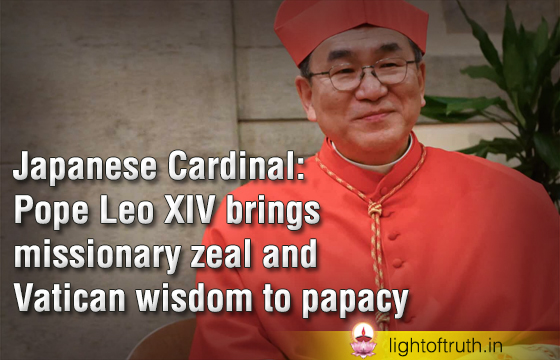
Japanese Cardinal: Pope Leo XIV brings missionary zeal and Vatican wisdom to papacy
Japanese Cardinal Isao Kikuchi of Tokyo says Pope Leo XIV’s previous work as a mi-ssionary and as a Vatican official were important reasons he will make a good pontiff. Speaking to the Catholic Herald, the cardinal gave his reflections on the election of American Cardinal Robert Francis Pre-vost, a member of the Augusti-nian order, to the Chair of Peter on May 8.
“Pope Leo XIV has a rich background in missionary work, especially in Peru, where he served both as a missionary and later as a bishop. He also led the Augustinian Order as its Superior General and most recently served as Prefect of the Vatican’s Dicastery for Bishops, giving him deep experience in both pastoral and administration in the Church and also as an effective and reliable leader,” Kikuchi said.
“During the general con-gregation, many cardinals reflected on the importance of the leadership of Pope Francis, especially his courage and wisdom to lead the People of God,” the Japanese cardinal said. “However, we all understood that we were not looking for a second Pope Francis, photocopy of Pope Francis, but a true successor to Saint Peter, who would faithfully guide the Church according to God’s will and responding to the trust given by Jesus,” he said.
“Many expressed that we need a pope who has deep experience and knowledge in both pastoral and administration of the Church with deep spirituality. Many expressed the need to have pastoral minded Pope to continue the footpath of Pope Francis and deepen the path of synodality,” Kikuchi continued.
“Many expressed that we need Pope to run the Curia well with the mind of restructuring began by Pope Francis. Also many expressed that we need a pope with deep spirituality and sound understanding of the faith to unite all in the Church. There were not so many cardinals among us who could be fit into this category and Cardinal Prevost was just the man to fulfill all these requirements,” he explained. Kikuchi said that after some votes, it was clear for all cardinals in the conclave that Prevost “is the one who had already chosen by Jesus himself: We finally found him.
Indonesia’s Papuans pin their hope on new pope
People in Indonesia’s Chri-stian-majority, strife-torn Papua expressed hope that newly elected Pope Leo XIV, who visited the region twenty years ago, will pay attention to their ongoing plight and challenges. The optimism sparked after Cardinal Robert Francis Prevost was elected the successor of late Pope Francis in the Vatican on May 8, becoming the first pope from the United States.
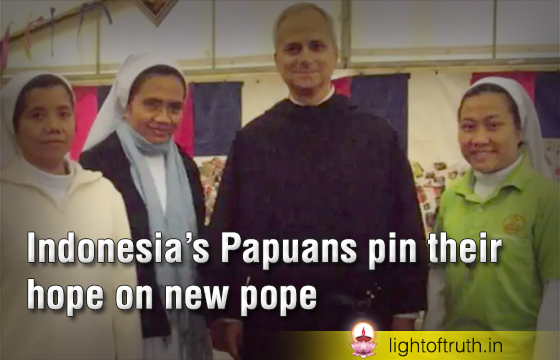
Following the election, several photos from his visit to Papua in 2003 have been widely shared on social media sites, triggering enthusiastic reactions from Papuan netizens. One photo shows Father Prevost posing for a photo with several nuns, another shows he is eating a Papuan dish called papeda and talking to native Papuans.
Prevost visited Papua as the head of the Order of St. Augustine (OSA) to join the 50th anniversary of the order’s arrival in the region. Over the past decades, the order has been involved in various social services including running seminaries and schools.
Both online and offline, Papuans expressed optimism that the new pope’s experience and under-standing of Papua will allow him to pay attention to their problems. Activists, church circles, and academics have often called for dialogue between Jakarta and Papua as an effort to end the conflict. During Pope Francis’ visit to Jakarta in September last year, Papuans expressed their concern by carrying out the ‘Way of the Cross’ rally.
Bishop-elect Bernardus Bofitwos Baru of Timika says the new pope is aware of challenges Papuans face every day because he knows the ground situation from Augustinian members. “Pope Leo XIV has the opportunity to help reduce the conflict in Papua with his position as the highest leader of the Catholic Church,” Baru told.
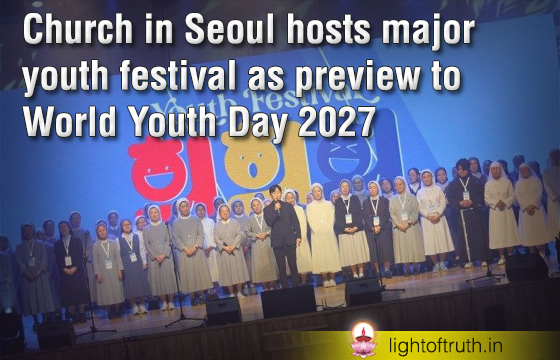
Church in Seoul hosts major youth festival as preview to World Youth Day 2027
More than 30,000 people took part in the “Hee Hee Hee” Youth Festival in Seoul, South Korea, from May 9 to 11, a large-scale, youth-led celebration organized by the Archdiocese of Seoul and the Local Organizing Committee for World Youth Day (WYD) 2027. Organizers said the festival aimed to offer “a vibrant, youth-led celebration of faith, vocation, and community” through programs inspired by the Korean characters for “Light,” “Hope,” and “Joy.”
Young people played a central role in planning and executing the festival, which featured thematic zones, concerts, liturgical cele-brations, and interactive exhibits. According to organizers, the event welcomed “people of all ages, nationalities, and religious back-grounds, creating a space of shared joy and intercultural dialogue.”
Structured to mirror elements of WYD, the Seoul gathering included catechesis, witness talks, creative performances, a prayer vigil, and a concluding Mass held on May 11 at the Catholic Uni-versity Sungsin Campus, also known as the “Truth Zone.”
Presiding over the Mass, Archbishop Peter Soon-taick Chung of Seoul urged young people to listen to God’s call. “In a special way this year, as we journey toward the 2027 World Youth Day within the grace of the Jubilee Year, I earnestly hope that the ‘Hee, Hee, Hee’ Youth Festival will inspire more young people to open their hearts to the Lord’s call and respond with courage and faith,” he said in his homily.
“The Church thrives and bears fruit when it gives rise to new vocations,” he added. “In many ways, the world is, perhaps unknowingly, yearning for ‘witnesses of hope’—those who testify through their very lives that following Christ is the wellspring of true joy.”
An estimated 3,500 people attended the Mass, which featured music, testimonies, and a strong focus on vocational discernment.
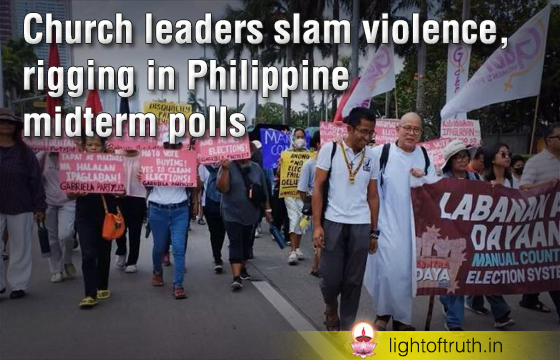
Church leaders slam violence, rigging in Philippine midterm polls
Church leaders joined poll watchdogs and activist groups in denouncing the violence, vote-buying and rigging reported during the May 12 midterm ele-ctions in the Catholic-majority Philippines. “The people have spoken, but it was not a perfect discourse. Money tainted it. Blood stained it. It was blotted by lies,” Archbishop Socrates Villegas of Lingayen-Dagupan wrote on social media on May 13.
Villegas, a former president of the Catholic Bishops’ Conference of the Philippines, said the midterm election ”was coloured with vulgarity.” “Really and truly, no elections are perfect. We keep on hoping. We have leveled up a bit, but the mountain peak is still far from sight. Be critical so that govern-ment services can level up even more. There is so much to impro-ve on,” the archbishop added. He further said that losing or winn-ing in the elections has “lessons to teach” and urged Filipinos “not to get carried away by the glee or the grief. Commission on Elections (Comelec) chairman George Erwin Garcia said the May 12 mid-term polls have been the most peaceful so far in terms of election-related violence. The poll body chief claimed at a press conference in Manila on May 12 that the 44 incidents of violence were much lower compared with the 128 incidents in 2019 and around 120 in 2020.
A day after the midterm elections, some 200 members of various groups led by poll watchdog Kontra Daya and progressive group Makabayan, protested in the capital, Manila, against alleged irregularities and voter disenfranchisement.
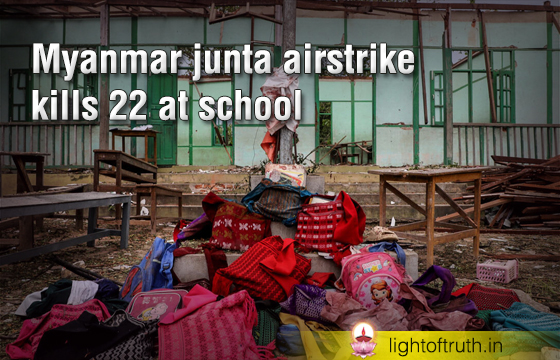
Myanmar junta airstrike kills 22 at school
A Myanmar junta airstrike hit a school on May 12, killing 22 people, including 20 children, witnesses said, despite a purported humanitarian ceasefire called to help the Southeast Asian nation recover from a devastating earthquake.
The strike hit a school in the village of Oe Htein Kwin – around 100 kilometres (65 miles) northwest of the epicentre of the March 28 quake – at about 10:00 am (0330 GMT), locals said.
UN chief Antonio Guterres is “deeply alarmed” by reports of the strike, his spokes-man told reporters in New York, adding that “schools must remain areas in which children have a safe place to learn and not be bombed.”
The green school building was a shattered husk on May 12 afternoon, its metal roof crumpled with gaping holes blasted through its brickwork walls.
Over a dozen abandoned book bags were piled before a pole flying the Myanmar flag outside, as parents chiselled small graves out of the hard earth to bury the shrouded bodies of their children.
“For now 22 people in total – 20 children and two teachers – have been killed,” said a 34-year-old teacher at the school, asking to remain anonymous.
“We tried to spread out the children, but the fighter was too fast and dropped its bombs,” she added. “I haven’t been able to collect all the casualty data as parents are in a rush.”
An education official from the area of the village in Sagaing region gave the same toll. The junta information team said reports of the strike were “fabricated news.” “There was no airstrike on non-military targets,” it said in a statement.
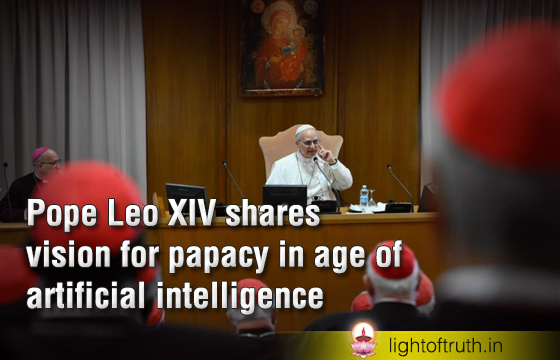
Pope Leo XIV shares vision for papacy in age of artificial intelligence
Pope Leo XIV met with the College of Cardinals on May 10 for his first official address since his election, outlining key priorities for his pontificate in the age of artificial intelligence while emphasizing continuity with his predecessors and commitment to the Church’s social teaching.
The U.S.-born pontiff, speaking in Italian, explained his choice of papal name, noting that Pope Leo XIII “addressed the social question in the context of the first great industrial revolution” with his encyclical Rerum Novarum. “In our own day, the Church offers to everyone the treasury of her social teaching in response to another industrial revolution and to developments in the field of artificial intelligence that pose new challenges for the defence of human dignity, justice, and labour,” Pope Leo said.
The 69-year-old pope began the meeting with a prayer, expressing his gratitude to the cardinals while acknowledging his own limitations in assuming the papacy. “You, dear cardinals, are the closest collaborators of the pope. This has proved a great comfort to me in accepting a yoke clearly far beyond my own limited powers, as it would be for any of us,” he said. The pope specifically thanked Cardinal Giovanni Battista Re, dean of the College of Cardinals, and Cardinal Kevin Joseph Farrell, camerlengo of the Holy Roman Church, for their service during the sede vacante period.
In his address, Pope Leo emphasized his commitment to continuing the Church’s path following the Second Vatican Council, specifically highlighting Pope Francis’ apostolic exhortation Evangelii Gaudium as providing “masterful and concrete” direction.
The pope identified several fundamental principles to guide his pontificate, “the return to the primacy of Christ in proclamation; the missionary conversion of the entire Christian community; growth in collegiality and synodality; attention to the sensus fidei, especially in its most authentic and inclusive forms, such as popular piety; loving care for the least and the rejected; courageous and trusting dialogue with the contemporary world.”
After his prepared remarks, the Holy Father engaged in a dialogue session with the cardinals, discussing “advice, suggestions, proposals, concrete things” raised during the pre-conclave meetings. Pope Leo concluded by quoting St. Paul VI’s hope expressed at the beginning of his pontificate in 1963, praying that the Church would “pass over the whole world like a great flame of faith and love kindled in all men and women of goodwill.”
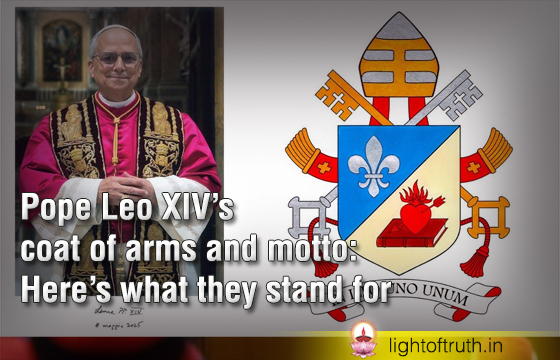
Pope Leo XIV’s coat of arms and motto: Here’s what they stand for
The official coat of arms and motto of Pope Leo XIV were made public on May 10. Rooted in Augustinian spirituality, the symbols the pontiff chose represent a sign of continuity with his episcopal past, confirming elements already adopted during his consecration.
The papal coat of arms is presented with a shield divided diagonally: in the upper section, on a blue background, stands a white lily, a symbol of purity and spiritual dedication. In the lower section, on a light background, is depicted a heart pierced by an arrow, resting on a closed book. The latter element recalls the Order of St. Augustine and, in particular, evokes the intense conversion experience lived by the saint from Hippo.
The symbol is inspired by the Latin expression “Vulnerasti cor meum verbo tuo” – “You pierced my heart with your Word” – uttered by St. Augustine to describe the transforming effect of the scriptures on his life.
Leo’s motto, visible under the shield, is “In Illo uno unum.” The phrase, taken from a sermon by St. Augustine on the Exposition of Psalm 127, means “Although we Christians are many, in the one Christ we are one.” This choice highlights the pontiff’s fidelity to the Augustinian heri-tage, but calls for spiritual unity of the church under one shepherd.
In his first speech as pope, Leo expressed his desire to lead God’s people by following the example of St. Augustine, whose thought and spirituality profoundly influenced his religious journey.

Pope Leo XIV to media: Thank you ‘for your service to the truth’
In his first address to international media on May 12, Pope Leo XIV thanked journalists for their service to the truth and for communicating peace in difficult times.
“We are living in times that are both difficult to navigate and to recount. They present a challenge for all of us, but it is one that we should not run away from,” Leo said in the Pope Paul VI Audience Hall on May 12. “On the contrary, they demand that each one of us, in our different roles and services, never give in to mediocrity.” The pontiff, elected May 8, also emphasized the important role of communications for promoting peace. ”In the Sermon on the Mount, Jesus proclaimed: ‘Blessed are the peacemakers’ (Mt 5:9). This is a beatitude that challenges all of us, but it is particularly relevant to you, calling each one of you to strive for a different kind of communication, one that does not seek consensus at all costs, does not use aggressive words, does not follow the culture of competition, and never separates the search for truth from the love with which we must humbly seek it,” Leo said.
“Peace,” he continued, “begins with each one of us: in the way we look at others, listen to others, and speak about others. In this sense, the way we communicate is of fundamental importance: We must say ‘no’ to the war of words and images, we must reject the paradigm of war.”
According to the pope, one of the most important challenges for media today is promoting communication that moves away from the confusion of the “Tower of Babel” and the “loveless languages that are often ideological or partisan.”
“Your service, with the words you use and the style you adopt, is crucial,” he underlined. “As you know, communication is not only the transmission of information, but it is also the creation of a culture, of human and digital environments that become spaces for dialogue and discussion. In looking at how technology is developing, this mission becomes ever more necessary.”
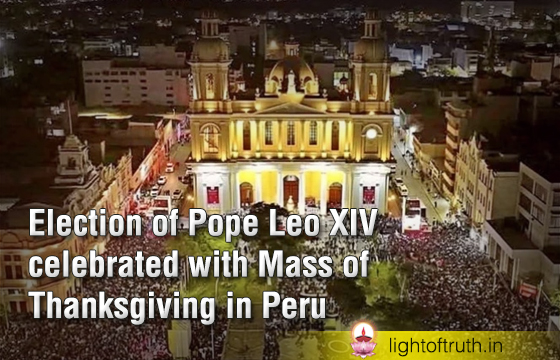
Election of Pope Leo XIV celebrated with Mass of Thanksgiving in Peru
In a jubilant atmosphere, more than 10,000 faithful gathered in front of the Basilica and Cathedral of Santa María de Chiclayo in Peru to celebrate a thanksgiving Mass for the election of Pope Leo XIV, who was bishop of the diocese for more than eight years.
The celebration vibrated with joy following the election of Cardinal Robert Francis Prevost Martínez — both a U.S. and Peruvian citizen — as successor to Peter on May 8. Dozens of local priests joined Chiclayo Bishop Edinson Farfán at the celebration. The plaza in front of the cathedral was outfitted with an outdoor platform and altar for the occasion, surrounded by musical bands and giant banners with the image of the pontiff and phrases from his first papal greeting from St. Peter’s Square.
In his homily, Farfán spoke of the profound love the new pontiff has for Peru — a country he first visited in 1985 — and, in a special way, for the Diocese of Chiclayo, which he pastored from 2014 to 2023. The bishop of Chiclayo noted the deep spiritual connection then-Bishop Prevost had with the expressions of faith of the Peruvian people: from his devotion to the Señor Cautivo of Ayabaca and the Señor de los Milagros to his love for the Peruvian saints: Rose of Lima, Martin de Porres, Francis Solano, John Macias, and Toribio de Mogrovejo.
“His beloved Diocese of Chiclayo, as he called it in his first address, was for him a school of faith, of closeness, of humanity,” he affirmed, adding that this city in northern Peru “is a simple town that he loved deeply and that he continues to carry in his heart.” Farfán also announced that the diocese will extend an “invitation for him to visit us” and said that “without a doubt, Chiclayo will be in his heart.” The prelate further emphasized the pastoral profile of Pope Leo XIV, describing him as “a shepherd with the smell of sheep,” deeply human, sensitive to the suffering of the most vulnerable, and close to the needs of the people.