A Historic Milestone: First Woman to Lead India’s Largest Catholic Health Network

Sister Helen Mary Anthony , 63 year old nun of the sisters of St.Anne , Bangalore, will become the first women director of the Catholic Health Association of India (CHAI) on May 1 . She succeeds redemptorist Fr. Mathew Abraham, who mentored her during her tenure as deputy director. She is a medical doctor specialising in gynecology and extensive experience in rural health care and hospital management.

Her appointment breaks the 83 year streak of male leadership at CHAI , India’s largest network of catholic medical professionals, comprises 3,572 member institutions, where 90% of members are women religious.

Sister Anthony said,  she aims to follow the footsteps of Australian missionary Sister Mary Glowrey, a medical doctor who laid the foundation for the medical ministry in India and founded the association in 1943.

Sister Anthony said the Sister Doctors Forum initially focused mainly on maternal and child health, addressing critical needs in underserved communities. When she began her career, infant mortality rates in rural regions reached 50 percent. It is brought down to less than 3 percent by the help of combined mission of the catholic nuns and government of India.

Sister Anthony said she will continue to implement the association’s goal to reach the unreached, engage in direct community health programs in the poorest areas, and in palliative care.

Sister Anthony represents as a symbol of infant survival and maternal hope.

Ten Sisters and Candidates Detained at Indore Railway Station, Later Released

Ten members of the Sisters of the Visitation congregation were detained and questioned by Railway Police at a railway station in Indore on April 7 after authorities suspected a case of human trafficking.

The group included eight candidates from Odisha and two young sisters. They were preparing to travel home for the holidays when police stopped them soon after they arrived at the station.

According to Bishop Thomas Mathew of Indore, the police had received information claiming that the group could be involved in human trafficking. The sisters and candidates were taken for questioning, but they managed to contact Church authorities and their families.

Priests from the diocese, including the procurator, quickly informed senior railway police officials about the matter. After the intervention, the group was released. However, they missed their scheduled train.

Bishop Mathew described the incident as disturbing and said it reflects the growing suspicion often faced by Church members. He said the exact source of the complaint is not known, but added that there are people who are often critical of the Church.

The bishop also said that even when people are later found innocent, they still suffer loss of time, money, and peace of mind.

In a message to clergy and religious in the diocese, Bishop Mathew advised them to be more careful while travelling. He reminded them that their movements are often watched and that they should take extra precautions to avoid unnecessary problems.

He expressed relief that the matter ended peacefully and thanked God that the situation did not become more serious.

CBCI Urges Government to Reconsider FCRA Amendment Bill

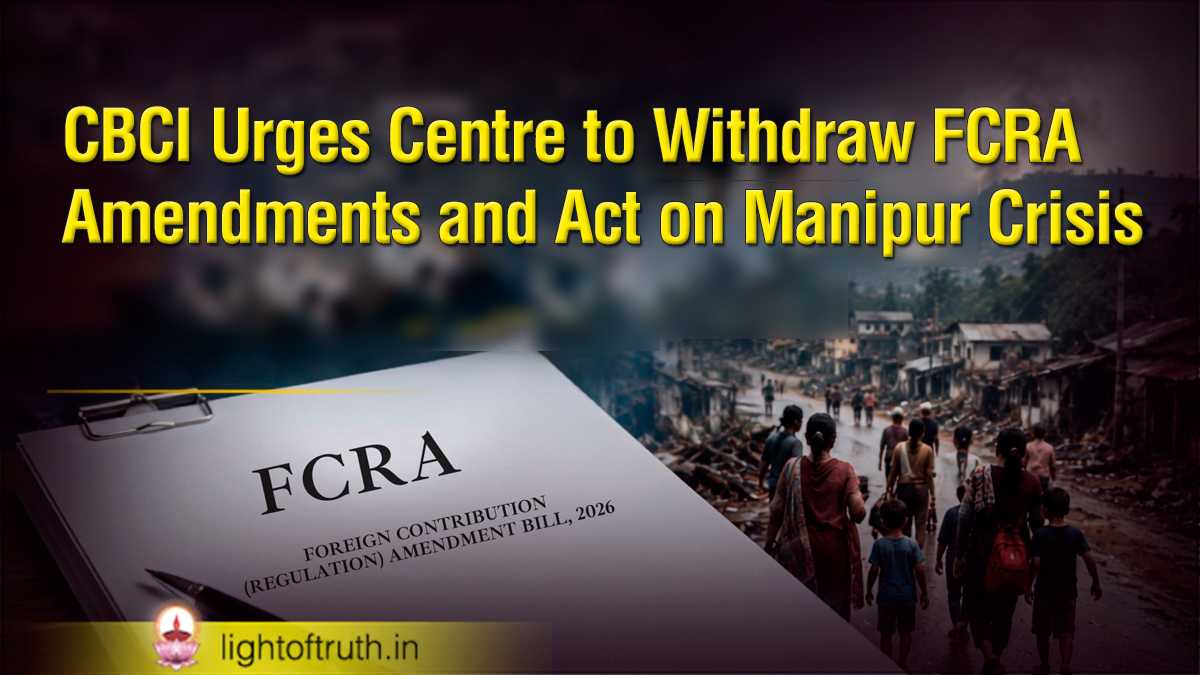
The Catholic Bishops’ Conference of India (CBCI) has asked Parliament and Home Minister Amit Shah to reconsider the proposed Foreign Contribution Regulation Amendment Bill.

In a memorandum sent on March 31, the bishops warned that the bill could harm charities, educational institutions, and faith-based organizations across India. The memorandum was signed by Archbishop Anil J. T. Couto, Secretary General of the CBCI.

The bishops said the bill raises serious concerns about civil society freedom, constitutional rights, and the future of charitable service in India. They warned that under the proposed law, foreign funds and assets of organizations could be taken over by the government if their registration is cancelled, surrendered, or stopped.

The CBCI said this could unfairly punish organizations for simple administrative mistakes. It urged lawmakers to ensure that minor errors do not lead to harsh penalties such as asset seizure.

The bishops also raised concerns about property rights under the Indian Constitution. They warned that the bill could make trustees and office bearers responsible even before they are proven guilty.

The memorandum stressed that faith-based organizations have played an important role in nation-building through schools, hospitals, and social services. The bishops warned that millions of poor and needy people could suffer if these institutions are weakened.

Following protests from opposition parties and Church groups, the government has currently put the bill on hold.

The proposed legislation was introduced in the Lok Sabha on March 26 by Nityanand Rai, Minister of State for Home Affairs.

Adivasi Forum Meeting Focuses on Tribal Rights and Unity

A leadership meeting of the Adivasi Forum under the Bongiyo Christian Pariseba (BCP) focused on protecting the constitutional rights of tribal communities and planning collective action. The meeting was held on April 9 in Kharagpur and brought together representatives from five districts, including West Midnapore, Jhargram, Bankura, Purulia, and Burdwan.

BCP founder and state secretary Herod Mullick explained the background of the “de-listing” issue, which questions the status of tribal communities. He said the issue, first raised decades ago, is again gaining attention through various groups and campaigns. He warned that such debates could divide tribal unity and urged people to stay alert and united.

Legal expert Aditya Tewari said tribal identity is based on ethnicity, culture, and geography, not religion. He explained that changing religion does not change a person’s tribal identity, and the Constitution supports this view.

State coordinator Victor Behera also stressed that tribal identity is natural and cannot be removed. He compared it to a river that keeps its identity even when it changes form.

The forum announced several plans until 2026, including digital awareness campaigns, cultural programs, and promotion of tribal languages and traditions. It also called for unity among all Adivasi groups to protect their rights related to land, forest, and livelihood.

More meetings are planned in different parts of West Bengal to continue this effort.

Violence in Manipur Leaves Children Dead, Tensions Rise Again

Fresh violence has shaken Manipur after two children from the Meitei community were killed in a suspected militant attack. The incident is seen as a serious setback to the fragile peace in the conflict-hit state.

A five-year-old boy and his five-month-old sister died in a bomb attack on their home in Moirang, located in Bishnupur district, on April 7. Their mother was seriously injured and is receiving treatment.

Following the attack, Meitei organizations blamed suspected militants from Kuki-Zo tribal groups and organized a protest rally demanding justice. The protest later turned violent, with clashes reported between protesters and security forces.

Officials said the situation became uncontrollable when some protesters tried to storm a Central Reserve Police Force (CRPF) camp. Vehicles were set on fire, barricades were broken, and attempts were made to seize weapons. Security forces opened fire to control the crowd, leaving at least three people dead and 25 injured.

Authorities responded by imposing a curfew in Bishnupur district and shutting down internet services for three days in several areas to prevent further unrest.

Tribal groups have denied involvement in the attack and called for a fair investigation. They also warned against blaming communities without clear evidence.

Manipur has been facing ethnic tensions since 2023 between the Meitei community and tribal groups, mainly Kuki-Zo Christians. The conflict has already claimed around 260 lives and displaced thousands. The latest violence highlights the urgent need for peace, dialogue, and justice in the region.

Rajasthan Revokes Catholic School Recognition Over Conversion Allegation

The government of Rajasthan has revoked the recognition of St Paul Secondary School Dungarpur, raising allegations that the institution promoted religious conversion among students. The decision has created concern among Church leaders, parents, and the local community.

In an official letter dated April 2, the district education officer stated that the school could no longer operate classes, admit students, or conduct examinations. Around 500 students have been asked to move to nearby schools. The order also mentioned issues such as alleged mistreatment of students, the presence of a statue of Mother Mary on campus, and the use of terms like “father,” “mother,” and “sister” for staff.

School authorities have strongly denied all allegations. The manager of the school said the decision was unfair and taken without any prior notice. He confirmed that the matter has been challenged in the High Court, seeking justice and a review of the order.

Parents of nearly 100 students also came forward in support of the school. In a letter to officials, they stated that the school provides a disciplined and positive learning environment. They clearly denied any form of forced religious conversion and said students from different religions study together peacefully.

Church leaders believe the action is part of increasing pressure on Christian institutions in the state. They have called for a fair inquiry and protection of minority education rights.

The incident highlights the need for careful handling of sensitive issues related to religion and education, ensuring that students’ futures are not affected.

“Doctor Priest” Fr. Francis Alapatt Laid to Rest

The Catholic Church in Kerala bid a heartfelt farewell to Fr. Dr. Francis Alapatt, who passed away on April 9 at the age of 72. Widely known as the “Doctor Priest,” he was remembered as a priest, doctor, writer, and humanitarian who dedicated his life to serving people.

A former vicar general of the Archdiocese of Thrissur, he combined medical knowledge with pastoral care, becoming a rare example of service both at the altar and in hospitals.

His funeral on April 11 drew a large gathering of bishops, priests, healthcare workers, and many people whose lives he had touched. The final rites were held at Our Lady of Dolours Basilica. Archbishop Andrews Thazhath led the requiem Mass, while Mar Raphael Thattil shared a condolence message.

As his final wish, his body was donated to Jubilee Mission Medical College Hospital, where he served for many years. His eyes were also donated, continuing his mission even after death.

Fr. Alapatt played a key role in developing healthcare in central Kerala. He promoted blood donation and founded the Kerala Blood Donors Forum, inspiring many young people to help save lives.

Born in Thrissur, he studied medicine before becoming a priest in 1995. He also contributed as a writer and filmmaker, using media to spread awareness.

He will be remembered as a compassionate leader who served all people beyond barriers of religion and society.

Khammam Bishop Calls for SC Reservation Benefits for Dalit Christians

Bishop Sagili Prakash of the Diocese of Khammam has asked the Supreme Court of India to review the exclusion of Dalit Christians from Scheduled Caste reservation benefits.

Speaking during a Good Friday gathering in Khammam on April 3, the bishop said that Dalit Christians continue to face social and economic discrimination and should not lose reservation benefits after converting to Christianity.

He said the Indian Constitution guarantees equality and freedom of religion under Articles 13, 14, and 25. According to the bishop, people who choose to become Christians do so freely, but their conversion should not take away benefits linked to their historical social disadvantage.

Bishop Prakash criticised the Presidential Order of 1950, which limits Scheduled Caste status mainly to Dalits who follow Hinduism. The benefits were later extended to Sikhs and Buddhists, but not to Christians or Muslims.

He said this exclusion prevents Dalit Christians from receiving reservation benefits in education and government jobs.

“For generations, Dalits have faced discrimination and untouchability. Denying reservation benefits makes their suffering worse,” the bishop said.

The bishop spoke after leading a “Way of the Cross” procession in Khammam that was attended by more than 5,000 people.

During his address at Ambedkar Centre, he also spoke about peace, unity, and the idea of the world as one family.

Bishop Prakash said he has raised this issue many times with national leaders, including prime ministers, presidents, and members of parliament.

Church in Chennai Opens Help Desk for Transgender Persons

The Archdiocese of Madras-Mylapore has opened a special help desk for transgender persons at Kadarkarai Sagaya Madha Church in Ennore, Chennai.

The new initiative was blessed and opened by Archbishop George Antony Samy. The help desk aims to offer spiritual support, mental health counselling, and help with employment for transgender persons, especially in and around Chennai.

The desk is located inside the parish premises and is seen as one of the first efforts of its kind in the Catholic Church in India. It hopes to support a community that has often faced rejection and discrimination in society and even within the Church.

The initiative is led by Fr. Leo Joseph along with Inba Ignatius, founder of the Snegidhan Snegidhi Trust. The trust is known for helping transgender persons with shelter and job opportunities.

Fr. Joseph said he began this work after seeing the struggles faced by many transgender people during his earlier ministry in Chennai. He said many were afraid to take part in Church activities because of past experiences of exclusion.

Inba Ignatius also shared that she had once been an active Catholic but later felt rejected after her gender transition.

An eight-member committee of priests, religious sisters, laypeople, and transgender representatives has been formed to guide the project.

Church leaders hope the new desk will help transgender persons feel accepted, respected, and welcomed in parish life.

Kerala Mourns Death of Devotional Music Composer Fr. Justin Panackal

Fr. Justin Panackal, the famous Carmelite priest and composer of the beloved devotional song Paithalam Yeshuve, passed away on Maundy Thursday at the age of 91.

A member of the Discalced Carmelites congregation, Fr. Panackal was one of the most important figures in Christian devotional music in Kerala. He composed 28 songs, many of which became popular through the voice of K. J. Yesudas.

Some of his best-known songs include Paithalam Yeshuve, Manju Pozhiyunna Maamaram, Navyamaya Oru Kalpana, and “En Jeevithamaam Ee Marakkombil.” These songs continue to be sung in churches and prayer gatherings across Kerala.

Fr. Panackal was born on August 10, 1935, in Kumbalangi near Kochi. After losing his father at a young age, he was raised in Alappuzha, where his talent in music was noticed early.

He joined the seminary in 1954 and was ordained a priest in 1962 at Mangalapuzha Seminary. Later, he studied in Rome and earned a doctorate in Carmelite spirituality.

For many years, he taught theology and music at St. Joseph’s Pontifical Seminary in Aluva. He also wrote 17 books and more than 125 articles.

His death on Maundy Thursday was seen as especially meaningful because one of his well-known songs, Navyamaya Oru Kalpana, is traditionally sung in churches on that day.

Official Website

Exit mobile version