Pope Francis has authorized 12 decrees on miracles, martyrdom and heroic virtues of 22 men and 5 women. Pope Francis took 27 men and women a step closer to sainthood. The Pope received Card. Angelo Amato, the Prefect of the Congregation for the Causes of Saints and authorized him to promulgate 12 decrees regarding 22 men and 5 women from as many as 8 nations. They concern 3 miracles, a martyrdom and 8 heroic virtues. Nineteen candidates, including 3 miracles and the martyrdom of 16, have been cleared for Beatification, the penultimate stage before Canonization or sainthood. Among the 12 is the decree on the heroic virtues of the noted “Rosary Priest,” Servant of God Fr Patrick Peyton of the Congregation of Holy Cross (CSC). Another person whose heroic virtues have been recognized is Servant of God, Cardinal Stefan WyszyDski, the former primate of Poland. The cardinal who was Bishop of Lublin and later Archbishop of Warsaw and Gniezno died on 28 May, 1981, in Warsaw. He is known for his struggle against the Communist state over freedom and the basic rights of the church, and he even suffered imprisonment.
Pope rips ‘traitors’ in Christmas message to Roman Curia
Pope Francis lashed out at Vatican officials who resist his reform programs on December 21, in his Christmas message to the Roman Curia.
The annual papal address to the Curia, officially listed as an exchange of Christmas greetings, has traditionally been an opportunity for the Pontiff to review the past year’s work and outline top priorities for the future. In 2014, Pope Francis broke from that pattern by delivering a scalding critique of the Roman Curia, listing the “spiritual diseases” that beset the Vatican. Last year, at the same December event, he blasted “malicious” opposition to his plans for reform.
Pope Francis returned to that topic in this year’s address, berating the “traitors” within the Roman Curia and the “unbalanced and debased mindset of plots and small cliques.” He went on to complain that some Vatican officials, “when they are quietly sidelined, wrongly declare themselves martyrs of the system” rather than acknowledging their own failures.
23 Missionaries killed in 2017
In the year 2017, 23 Catholic pastoral care workers were killed worldwide: 13 priests, 1 religious brother, 1 religious sister, 8 lay persons. For the eighth consecutive year, the place most affected, with an extremely elevated number of pastoral care workers killed is America, where 11 pastoral care workers were killed (8 priests, 1 religious brother, 2 lay people); in Africa 10 pastoral care workers were killed (4 priests, 1 religious sister, 5 lay people); in Asia 2 pastoral care workers were killed (1 priest, 1 lay person). According to information gathered by Agenzia Fides, from 2000 to 2016, 424 pastoral care workers were killed worldwide, including 5 Bishops.

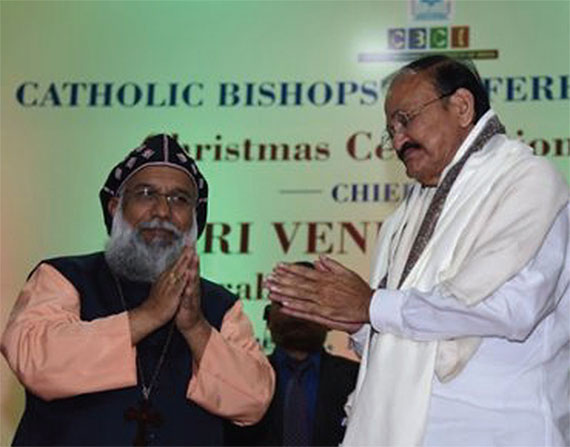
Vice President applauds Christian share in building new India
Indian Vice President Venkiah Naidu on December 12 commended Christians for their service to those on the periphery and share in building a new India.
“The Catholic community is peace-loving and it contributes immensely to nation building,” the vice president told a gathering that the Catholic Bishops’ Conference of India (CBCI) organized to launch Christmas celebrations in the national capital.
“I have been attending Christmas functions at different parts of India as part of my political and social activities. This is the first occasion as the vice president of India that I am participating in a Christmas celebration,” said Naidu, who assumed the second highest officer in the country on August 11, this year.
The vice president asserted that Jesus’s message for love and peace is for all seasons, cultures and nationalities. “People all over the world irrespective of caste, creed or nationality celebrate Christmas with great joy and gaiety,” the vice president, the chief guest of the program, told the gathering comprising religious, political and social leaders as well as diplomats and media persons.
Christian community, especially Catholics, work for people’s welfare. “They maintain best educational institutions in the country that create awareness about the need for education and education for the needy.”
Christians have opened thousands of dispensaries and hospitals in remote areas and collaborate with the central and state governments. “The Christian community as a whole is assiduously engaged in contributing their share in building a new India which is united and strong,” the vice president said and added that he has personally witnessed how Christian helped in social transformation through formal and non-formal education.

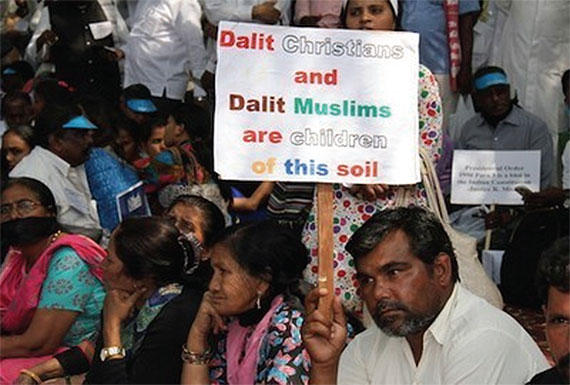
Dalit Christians take out march for quota in Kerala
Dalit Christians, under the aegis of the Council of Dalit Chri-stians, held a march to the Secretariat on Dec. 12 demanding prote-ction of re-servation for Dalit Christians.
The rally, organised by the Council of Dalit Christians (CDC), raised the demand of 5% reservation for Dalit Christians in Union government recruitments and 4% reservation in the State. It also demanded 10% reservation for students of the community in higher education. Inaugurating the rally, Church of South India (CSI) moderator Thomas K. Oommen said the discrimination of people based on their religious beliefs was violation of the Constitution.
The rally began from the Museum junction. People from various districts, including women and children, joined the rally. “This is not merely a community issue but a church issue as 95% of Indian Christians are Dalit,” CSI Kollam-Kottarakara Bishop Oommen George said.
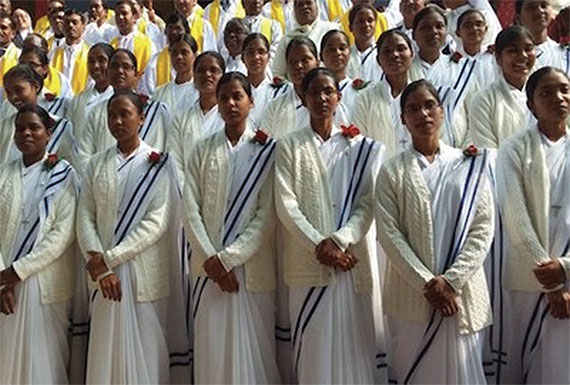
Vocations increase from ethnic minority groups in India
Forty-one young women from ethnic minority groups took vows to become Catholic nuns in a rare event of this scale in the eastern Indian State of Jharkhand.
Church leaders welcomed what they described as a trend for more tribal people to choose a religious path in life.
More than 1,000 Catholics, including families and parishi-oners of the women, gathered December 8 for the ceremony at the Nirmala Catholic Church in the State capital, Ranchi.
The women took vows to become nuns of the indigenous congregation of Daughters of St Anne. “This is a great sign that young people are attracted to religious life,” Cardinal Telesphore Toppo of Ranchi, who officiated at the ceremony, told.
It also showed that the Indian Church was thriving despite opposition from Hindu nationalist groups, the cardinal added.

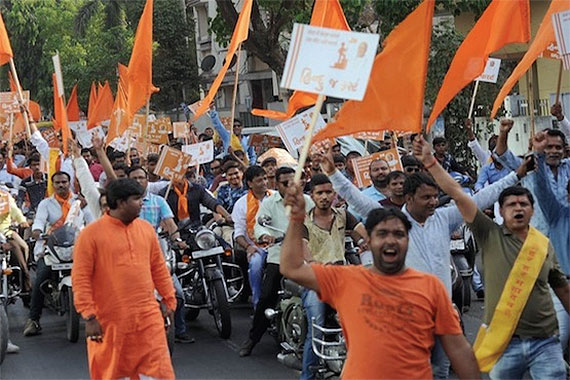
Bishop criticizes death-penalty call for cow slaughter
An Indian Catholic leader has slammed an inflammatory call by a radical Hindu group for the execution of people who slaughter cattle or transport beef.
Bishop Vincent Barwa, who chairs the bishops’ office for ethnic minorities and lower caste people, said the demand by the Vishwa Hindu Parishad (World Hindu Council-VHP) sought to create violence and religious divisions.
The senior prelate was responding to ucanews.com following media reports that the VHP had resolved to press for a national law against cow slaughter stipulating death sentences for violators.
Laws restricting the slaughter of cows, bulls and bullocks exist in 20 of India’s 29 states. Since the pro-Hindu Bharatiya Janata Party came to power nationally in 2014, India has witnessed more than 20 mob lynchings connected with what is generally referred to as “cow slau-ghter.” The media have widely reported orchestrated attacks on Muslims and Dalits, formerly known as untouchables, by so-called cow vigilantes. A report, compiled by India Spend, India’s first data journalism outfit, found that Muslims were targeted in 51% of violence connected with bovine issues between 2010 to 2017.
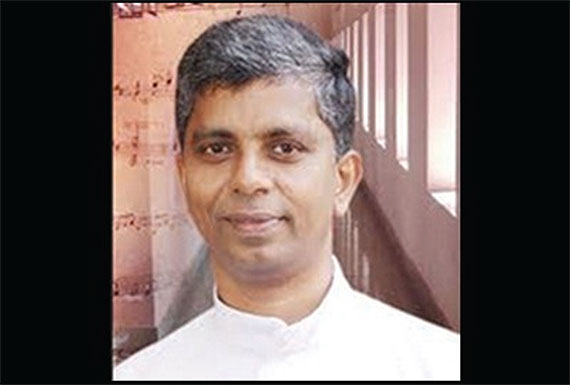
New Coadjutor Bishop of Alleppey appointed
Pope Francis has appointed Fr James Raphael Anaparambil as the coadjutor bishop of the Diocese of Alleppey in Kerala on Dec 7.
Bishop-elect Anaparambil was born in Chellanam in Alleppey diocese on March 7, 1962. He was ordained priest for the same diocese on December 17, 1986.

Minorities insecure, suffocated: Scholars
Despite all Constitutional guarantees of India being a sovereign socialist, secular, democratic republic, the minority sections in India — Dalits, creative artists, writers, rationalists and sensitive, enlightened citizens — are all feeling suffocated, insecure and less-than-equal citizens of India since the communal ideology has come into power at the Centre and some big Indian states.
This was stated by scholars from Delhi, Panjab and Punjab varsities and representatives of minority organisations from across India during a two-day seminar which concluded at the Institute of Sikh Studies (IOSS), Chandigarh, here today. Prof Kulwant Singh, president, IOSS, highlighted several acts of intolerance and violence by those in majority.
Prof Apoorva Nand from Delhi University said: “When saffron fanaticism is being promoted under the garb of nationalism, majority of Hindus are answerable for the undesirable activities of some fringe radical, vocal elements. In fact, it is not only a struggle between majority and minority communities, but also a struggle between the enlightened and half-baked Hindutva zealots.”
Prof Khalid Mohd from Panjab University said Muslim bashing was rampant under the garb of terrorism, love jihad, ghar vapsi, triple talaq, four marriages and beef-eating, etc. “History is sought to be reinterpreted where Muslims are being exhibited only as traitors and all their monuments are projected to be built after destroying Hindu temples.”
Former Punjab Vidhan Sabha Deputy Speaker Bir Devinder Singh said the doctrine of religion-based majoritarianism should diminish in India.


Indian seminary to honour Archbishop Romero through play
Mumbai: St Pius X College, the seminary of the archdiocese of Bombay, is all set to stage a play in Hindi on Blessed Oscar Romero of El Salvador, who was shot dead while celebrating Mass in 1980. “Oscar Romero and Jesus of Nazareth had many similarities,” says Father Nigel Barrett, spokesman for the archdiocese of Bombay explaining the reason for the major seminary to stage ‘Nirnayon ka Jeevan (A Life of Decisions)’ during the birth centenary year of the El Salvadorian prelate. According to the Mumbai priest, both Jesus and Romero were born in abject poverty, in a small and insignificant country. “Both learned the trade of carpentry. They lived a life of profound intimacy with God, often praying all night.”