Poland: ‘The Rosary to the Borders,’ criticized as anti-Islamic

The Polish Episcopal Conference has issued the following statement:

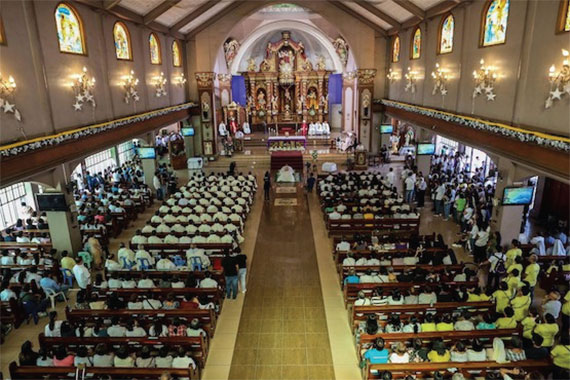
Several million Poles prayed the rosary at the same time throughout the country on October 7. This was the largest prayer event in Europe after the 2016 World Youth Day.

“The Rosary to the Borders” is the name of the prayer initiative, which took place on 7 October, the feast of Our Lady of the Rosary. On the 100th anniversary of the apparitions in Fatima, pilgrims went to the borders of Poland, where Holy Mass was celebrated simultaneously in 300 churches at 11am, with the Rosary prayed at 2pm.

Archbishop Marek Jedras-zewski of Krakow said during his sermon on the feast that people should pray for “Europe to remain Europe.

Rafal Pankowski, an expert on xenophobia and extremism, said the prayers were an expression of Islamophobia at a time of rising anti-Muslim sentiment in Poland, even though the country’s Muslim population is small.

“The whole concept of doing it on the borders reinforces the ethno religious, xenophobic model of national identity,” Pankowski, who heads the Never Again association in Warsaw, told the Associated Press.

German-speaking bishops move to take full control over liturgical translations

Catholic bishops in the German-speaking countries of Europe have been at odds with the Vatican for years over a controversial and never-implemented translation of the Missal, the Latin prototype for the celebration of the Roman Catholic liturgy.

Germany’s bishops never even mentioned the disputed translation last month in the final report of the national episcopal conference’s autumn plenary. Instead, they thanked Pope Francis at length for his recent “motu proprio.” Magnum principium, which gives such conferences greater authority over liturgical translations.

They also expressed gratitude that the Pope had once again underlined, as he did in his 2013 exhortation Evangelii gaudium, that the “genuine doctrinal authority” of episcopal conferences needs to be more fully elaborated (EG 32). And they said the liturgy commissions of all the various German-speaking conferences would now begin discussing Magnum principium and its consequences in detail.

The German bishops’ president, Cardinal Rei-nhard Marx of Munich, said the first reaction he and his confreres had to the new “moto proprio” was a sense of “huge relief.”

During a press conference at the end of the September 25-28 plenary assembly, he said he believed the Congregation for Divine Worship (CDW) had taken too narrow a view on liturgical translations in the norms it issued in 2001 with the docu-ment, Liturgiam authenticam. The cardinal pointed to the long ordeal of producing the English translation of the Missal, saying he thought it was “altogether excessive” the way the Vatican had insisted on a strictly literal rendering of the Latin.

Cardinal Marx revealed that some of the English-speaking bishops had turned to him for help and that even he found it hard to pray some of the prayers in their Missal.
“The language is simply unacceptable,” he said.

Hilarion: Russia and European Christians for the Salvation of the Continent

On 22 September, Metropolitan Hilarion (Alfeev), the “Foreign Minister” of the Moscow Patriarchate, delivered an important speech at a conference organized by the Russian Embassy in London in front of diplomats, politicians, entrepreneurs and exponents of the major religious confessions.

The Metropolitan’s address developed the main theses that have marked the positions of the Russian Orthodox Church in recent years, especially Patriarch Kirill’s (Gundjaev), calls to Europe and the West. These are the positions which largely inspired President Putin’s policy, at least in terms of the ethical aspects of relations between Russia and the superpowers of the globalized world.

The speech focused on the future of Europe, and in particular on the conditions of Christianity in the old continent. According to Hilarion, who cited several recent statistics, Christianity today is the most persecuted religion in the world, and also faces new challenges that question the “moral foundations of people’s lives, their faith, and their values.”

AUSTRALIAN CHURCH FACING BIGGEST CRISIS IN ITS HISTORY, SAYS BRISBANE ARCHBISHOP

A leading Australian bishop says the Church in his country is facing the biggest crisis in its history after taking part in talks with the Vatican over how to address the problem.

The Archbishop of Brisbane, Mark Coleridge, who is Vice President of the Australian Bishops’ Conference, told The Tablet that he and fellow bishops were in Rome to discuss the fallout of the clerical sexual abuse crisis, and how the Church will adopt a new approach. This, he says, will look at how to include women in positions of “governance.”

High on the agenda at the Vatican summit was Australia’s Royal Commission inquiry into how institutions handled child sexual abuse. This has seen the Catholic Church facing unrelenting criticism for its response to the scandal. The problem has been magnified after the Australian police’s decision to charge Cardinal George Pell, the Vatican treasurer and former Archbishop of Sydney, with historic sexual offences.

The Royal Commission has already had a huge impact on the Church in Australia, and the Final Report will make the impact still greater. The Church has been shaken to the core, or as one well-informed voice has said, “It has broken the heart of the Church in this land.” Yet there’s a searing grace in this, summoning the whole Church to a greater authenticity. In this, the call of the Royal Commission and the call of Pope Francis converge in what looks to be one of the strange disruptions of the Holy Spirit. Abp. Mark Coleridge said. The big question is how we become a more inclusive Church without abandoning truths of the faith we have received rather than concocted.

Will a visit from Pope Francis compel Aung San Suu Kyi to act?

For the past three weeks, the world has watched aghast as Myanmar’s military has carried out the latest, most deadly phase of a five-year operation against the Muslim Rohingya people who number about 1.1-1.3 million.

It has been an outrageously outsized reaction by Myanmar’s notorious military, known as the Tatmadaw, to a small attack by what is, thus far, a threadbare insurgency that has taken clearer shape as the Arakan Rohingya Salvation Army. It’s o15f little surprise that the Rohingya, who have suffered waves of persecution and terrorisation by Myanmar’s military, and Burma’s before it, for countless decades, have finally decided to fight back. That is now being used as an excuse for what the UN High Commissioner for Refugees has called a textbook case of ethnic cleansing. In forcing roughly half the Rohingya population from their homes, it’s hard to call it anything else.

At the same time, the world has been bewildered, then dismayed, as arguably the most internationally (and domestically) beloved Nobel Peace Prize Laureate since Nelson Mandela, Myanmar’s state counsellor, foreign minister and de facto leader Aung San Suu Kyi has remained all but silent. When she has opened her mouth, it has only been to put her foot in it by introducing red herrings such as the alleged complicity of NGOs in the insurgency. She remains unable, for largely political reasons, to utter the word Rohingya or even to make comments of any concern about the fate of the latest victims of one of the world’s most murderous militaries.

Francis responds to critics: Morality of ‘Amoris Laetitia’ is Thomist

Pope Francis appears to have responded indirectly to the four cardinals who publicly challenged him last year over his most recent teachings on family life, as contained in the 2016 apostolic exhortation Amoris Laetitia.

In a question and answer session with members of the Jesuit order in Colombia earlier this month, the text of which was made public for the first time Sept. 28, the Pope referenced those who “maintain that there is no Catholic morality underlying Amoris Laetitia, or at least, no sure morality.”

“I want to repeat clearly that the morality of Amoris Laetitia is Thomist, the morality of the great Thomas,” said Francis, referring to 13th century Dominican theologian St Thomas Aquinas.

“I want to say this so that you can help those who believe that morality is purely casuistic,” the Pope told the Jesuits, according to a text of the encounter published Sept. 28 by La Civiltà  Cattolica.” Help them understand that the great Thomas possesses the greatest richness, which is still able to inspire us today.”

Four cardinals wrote to Francis in September 2016 with five yes or no questions about how he understood Church teaching following publication of the apostolic exhortation. After not receiving a response to their letter, the cardi-nals made their letter public in November 2016.

Francis visited Colombia from Sept. 6-11 and met privately with about 65 Jesuits Sept. 10 during his visit to the city of Cartagena. The Pope spoke about Amoris Laetitia in response to a question from a Jesuit about what kind of theological and philosophical questioning he wants the wider Church to undertake.

He said first that he does not want philosophy to be undertaken “in a laboratory, but in life, in dialogue with reality.” He referred to how Pope Benedict XVI had spoken of truth “as an encounter, that is to say no longer as a type of classification, but a path.”

Tortured Communist-era priest beatified in Slovakia

A Slovak priest who died from torture and radiation poisoning after forced labour in Czechoslovakia’s uranium mines is the Catholic Church’s latest communist-era martyr to be beatified.

Fr Titus Zeman, a Salesian of Don Bosco who died in 1969, was hailed during a beatification Mass Sept. 30 in Petrzalka Park in the Slovakian capital of Bratislava, the Catholic News Service reported. He was beatified by Cardinal Angelo Amato, prefect of the Vatican’s Congregation for Saints’ Causes, also a member of the Salesian religious order.

The Vatican official said Blessed Zeman had been under “genuine persecution” in the years following World War II as the newly installed communist government arrested clergy and suppressed Catholic schools and associations. However, during his priesthood, he had shown “love is stronger than hatred.”

Born in 1915, Zeman joined the Salesians in 1932 and was ordained in 1940.

‘Middle East Christians are second-class citizens’

George’s mother is buried at Iqrit in Galilee, near the border with Lebanon. In 1948, the village of Iqrit was declared a military zone by the Israeli state and the inhabitants, all Catholics, were relocated. In 1951, a decision by the Israeli Supreme Court authorized their return. However, the army ignored the decision and completely destroyed the village, with the exception of the church and cemetery. Since 2014, photographer Constance Decorde has regularly visited Iqrit.  She bears witness to the struggle of a whole community to regain the right to live in the village of their ancestors.

In some places, they are deprived of the right to build or renovate their churches. Elsewhere they are not eligible for social benefits, or to go to university. In most countries of the Middle East, Christians are not citizens like the others.

They are often refused access to top administration posts, in the army or politics. The idea is to prevent them from exercising any power whatsoever over Muslims.

In Egypt, that was why the post of Vice President promised to a Copt by former president Mohammed Morsi, who was close to the Muslim Brotherhood, was changed surreptitiously to “assistant for the political transition” in 2012. In Iraq, the situation is becoming worse. Based on medieval Islamic law, judges are now refusing to admit Christians as witnesses in trials. The urgent need to guarantee their survival in countries where their existence is most threatened should not hide the other struggle of Christians living in the Near East: the fight for citizenship.

Government seals off Catholic mission in central India

Government officials in a remote area of central Indian Madhya Pradesh state have impounded the property of a Catholic mission and forced its priest out of the premises, allegedly under pressure from right-wing Hindu activists.

The 20-year-old mission in Mohanpur village of Guna district was “sealed” over a land title dispute and Father Siljo Kidangan forced out on Sept. 12, local Bishop Anthony Chirayath told ucanews.com. Father Kidangan said government officials acted under pressure from members of hard-line Hindu groups who are opposed to the mission’s work and accuse it of trying to secure religious conversions.

The mission aims to help poor villagers by coordinating several welfare projects.

Mohanpur and some 40 nearby villages are provided with basic amenities and a hostel for about 15 boys studying at a nearby government school.

A Hindu right-wing activist group on Sept. 11 went to the mission demanding that the priest and schoolboys vacate or face dire consequences, Bishop Chirayath said. The priest refused to move.

However, the next morning govern-ment officials, a village headman and two police constables threatened the priest and confiscated the hostel by locking and sealing it. Local Sub-Divisional Magistrate Dinesh Shukla confirmed with ucanews.com that the government has taken over the land and the hostel building as the Church “lost a case” with the Land Revenue Board on Sept. 8.

Two local Hindus filed a case in 2005 claiming that the Church did not have mandatory title deeds for the mission land, which was donated to a tribal Catholic priest by a local tribal villager.(see Focus)

Salesian priest recounts harrowing tale of his capture, liberation

Salesian Father Tom Uzhunnalil was sitting in a room in an unknown location — one of several he had been relocated to during his 18-month imprisonment — when he received some unexpected news. “Those who kept me came to where I slept (and said), ‘I bring you good news. We are sending you home. If you need to go to the bathroom, go. Take a shower, but quickly!’” Father Uzhunnalil told reporters September 16 at the Salesian headquarters in Rome.

The Salesian priest from India was kidnapped March 4, 2016, from a home for the aged and disabled run by the Missionaries of Charity in Aden, Yemen. On that day, four Missionaries of Charity and 12 others were murdered in the attack by uniformed gunmen. Seeing a group of Missionaries of Charity sisters seated at the news conference in Rome, Father Uzhunnalil expressed his condolences. However, the memory of the four sisters’ martyrdom still proved too difficult to bear. Silence filled the room as the Salesian priest covered his eyes, tears streaming down his face while doing his utmost to hold back emotions that he thought he could contain. “I thank God Almighty for this day, for keeping me safe, healthy, clear minded; my emotions were in control until now,” he said after regaining his composure. “I don’t want to speak too much about the sisters because I get too emotional,” he said. Although reports following his kidnapping suggested the attack was carried out by the so-called Islamic State, Father Uzhunnalil said his captors never identified themselves.

Official Website

Exit mobile version