Pope asks German bishops to try to find unanimity on Communion question A German Bishop says Pope Francis Has Hinted Support for Intercommunion Proposal

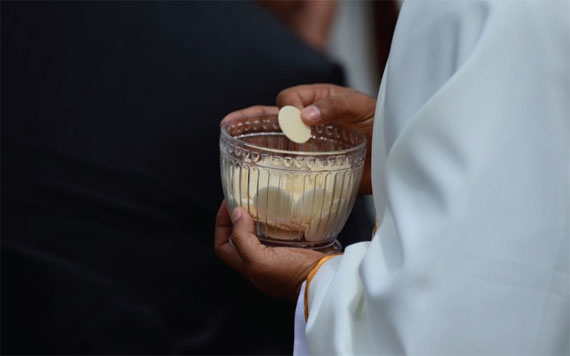
Pope Francis asked the bishops of Germany to continue working together to find broader consensus on guidelines for allowing a Protestant married to a Catholic to receive the Eucharist. “Pope Francis appreciates the ecumenical commitment of the German bishops and asks them to find, in a spirit of ecclesial communion, a result as unanimously as possible,” the German bishops were told, according to a Vatican statement.

The Pope had invited six German bishops and the general secretary of the bishops’ conference to Rome for a May 3 meeting with top officials from the Congregation for the Doctrine of the Faith, the Pontifical Council for Promoting Christian Unity and the Pontifical Council for Legislative Texts.

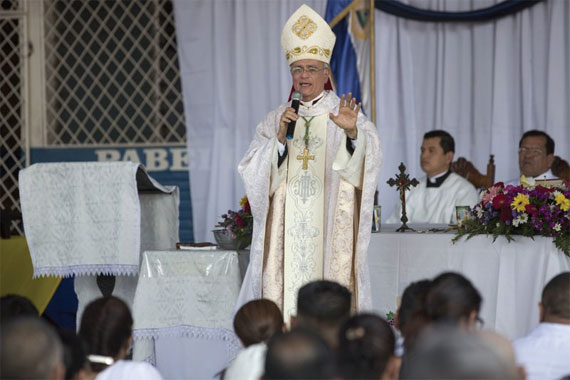
A German bishop has said he believes Pope Francis has given a clear nod of approval to the German episcopal conference’s controversial proposal which would allow some Protestant spouses to receive Holy Communion.

But Cardinal Willem Eijk, the Archbishop of Utrecht, Holland, said the statement was “completely incomprehensible” as the Church’s doctrine and practice is “perfectly clear.” By failing to create clarity, “great confusion is created among the faithful and the unity of the Church is endangered,” he said, adding that he was reminded of Article 675 of the Catechism of the Catholic Church, which warns of a “religious deception” that offers man “an apparent solution” at the “price of apostasy from the truth.”

In February, the Vatican statement said, “more than three-quarters of the members” of the German bishops’ conference approved a “pastoral handbook titled, ‘Walking with Christ — In the Footsteps of Unity: Mixed Marriages and Common Participation in the Eucharist.’”

Pope Francis invited leaders of the bishops’ conference and some of the bishops opposed to the guidelines to come to the Vatican for a discussion with officials from the three offices. “Various points of view were discussed; for example, how the question relates to the faith and to pastoral care, its relevance for the universal church and its juridical dimension,” the Vatican statement said, without providing further details.

Cardinal Rainer Maria Woelki of Cologne, one of the seven German bishops who objected to the conference guidelines, participated in the meeting at the Vatican May 3. In his letter to the Vatican, which prompted the meeting, he had asked whether the guidelines were not simply pastoral, but went to the heart of Catholic faith and practice, and whether the German guidelines could have a wider impact on the question of eucharistic hospitality in countries around the world.

Pittsburgh diocese will see number of parishes drop from 188 to 57

After three years of discussions, Pittsburgh Bishop David A. Zubik said the 188 parishes of the diocese will be placed into 57 groupings that will eventually become new parishes. Bishop Zubik announced the plan on April 28 during a media conference, saying the effort was designed to promote vibrant faith and revitalize parishes. The announcement detailed the maximum number of weekend Masses per grouping and timelines for each grouping to work toward mergers and clergy assignments.

Henan suppression is ‘systematic and planned’

Concern in Beijing about the growing influence of Christianity triggered a recent escalation of repression against Christians in China’s Henan province, according to a leading Hong Kong academic.

The recent crackdown on various Catholic and Protestant communities was the result of more than two years of organization and preparation at provincial, city and country level through the Chinese Communist Party’s increasingly powerful United Front Work Department, Professor Ying Fuk-tsang, director of the Divinity School at the Chinese University of Hong Kong told ucanews.com.

Mangalore’s age-old harmony caught in crosshairs of communal hate

The beauty of coastal Karnataka is in sharp contrast to its politics. Sparkling back-waters and swaying palms were once witness to a land of religious co-existence. But over the last two decades, this picturesque region has been caught up in the politics of religious polarisation.

It was from here the Sangh Parivar first began its campaigns, starting with Hindu mobilisation against migrant Muslim workers from Kerala. In the 1983 Assembly elections, the BJP won 18 seats for the first time, mostly from the coastal districts of Dakshina Kannada and Uttar Kannada.

In 2013 the Congress breached the saffron fortress and swept the region as the Sangh Parivar faced a revolt within. Out of 12 seats of Dakshin Kannada, Congress won 10, BJP 2. In Mangalore out of 8 seats, Congress won 7. A year later though in Lok Sabha polls it was business as usual as the BJP won all 3 MP seats of coastal Karnataka.

Mangalore comprises 18% Muslims, 13% Christians and 69% Hindus. “The mix of religions here makes Mangalore a communal tinder box,” says Suresh Bhat Bakrabail of the PUCL, “ but those fomenting communal troubles are only playing politics. It is not religious but purely political communalism.”

Lenin should be buried, Stalin returned to Georgia – Kadyrov

Moscow, April 13, Interfax – A prompt decision needs to be made on the burial of the remains of Soviet leader Vladimir Lenin and on the transfer of the remains of Joseph Stalin to Georgia, Ramzan Kadyrov, the head of Chechnya, said. “If I was asked, I would make this decision today, without waiting until tomorrow. Why torture Lenin’s dead body, clean it constantly, keep this mummy? Who needs it? He is not a holy person.”

Hindu influence tips India’s scales of justice

For the first time since the British left and India became a free country, its judicial system is being questioned, with opposition and civil society groups accusing the pro-Hindu ruling Bharatiya Janata Party (BJP) of using the judiciary for its own political purposes. On April 21, seven opposition parties led by Congress met Vice-President Muppavarapu Venkaiah Naidu and handed him a notice to impeach Chief Justice Dipak Misra, accusing him of misbehaviour and abuse of authority.

“We have mentioned in our notice how the chief justice is choosing to send sensitive matters to particular benches by misusing his authority as master of the roster with the likely intent to influence the outcome,” Congress leader Ghulam Nabi Azad told reporters in New Delhi.

BAVARIA TO DISPLAY CROSSES IN ALL GOVERNMENT BUILDINGS

Bavaria’s regional government has ordered crosses to be placed at the entrances of all state administrative buildings. The state’s conservative administration said that the crosses should reflect Bavaria’s “cultural identity and Christian-Western influence.” The decree was passed on April 24th and won’t apply to federal government buildings in Bavaria.

The predominantly Catholic state’s public schools and courtrooms are already obliged to display crosses at entrances. Bavaria is governed by the Christian Social Union, the Bavarian partners of Chancellor Angela Merkel’s Christian Democrats who tend to be more conservative on social issues. The decision comes after last September’s federal election, which saw a rise in support for the anti-immigration and populist Alternative für Deutschland.

Horst Seehofer, former CSU premier of Bavaria and now Germany’s interior minister, has pressed Merkel’s government for tighter immigration controls. Following the re- election of Viktor Orban in Hungary earlier this month, Seehofer warned that the European Union had displayed “arrogance and paternalism” to states like Hungary.

POPE, COUNCIL OF CARDINALS DISCUSS NEW DOCUMENT ON ROMAN CURIA

Pope Francis and his interna- tional Council of Cardinals have reviewed a complete draft of the apostolic constitution that would govern the Roman Curia, the Vatican spokesman said.

The cardinals still need some time to finalise the draft, approve it and present it formally to the Pope for “further consultation and final approval,” said Greg Burke, director of the Vatican press office. Even the title of the document has not been finalised, he said on April 25th, although the entire project revolves around the idea of a “church that goes out.” Much of the Council of Cardinals’ work 23-25 April was dedicated to “re-reading the draft of the new apostolic constitution on

the Roman Curia,” Burke said. The draft document emphasises four points, he said: the Roman Curia is at the service of the Pope and the local churches throughout the world; the work of the Curia must have a pastoral character; particulars on the role and functioning of the new section in the Vatican Secretariat of State to oversee the training, assigning and ministry of Vatican nuncios and diplomats around the world; and the proclamation of the Gospel and a missionary spirit must characterize the activity of the Curia.

60,000 CATHOLIC MIGRANTS, REFUGEES LIVE IN ISRAEL

On April 4, 2018, Archbishop Pierbattista Pizzaballa, Apostolic Administrator of the Latin Patriarchate of Jerusalem, announced in a statement the forthcoming creation of a personal parish for migrants and refugees in Israel. Father Rafic Nahra, the current coordinator for the pastoral among migrants, explains in an interview with the Media Office the reasons for this creation. He said “it is about 60,000 faithful, half of whom are from the Philippines. The other communities are Indians, Sri Lankans and Eritreans. Other communities are also present but in smaller numbers: French-speaking Africans, Romanians and Poles. Migrants are people who, for the most part, have fled difficult economic situations in their home country and have come for work in Israel. Asylum seekers have fled war or dictatorship and currently have no confidence in their future in Israel.” A personnel parish is being established on May 20.

EVANGELIZING BY TRAIN IN GERMANY

In an effort to reach out to local people, a German Catholic priest from the Diocese of Limburg has adopted the habit of taking a weekly train journey during which he makes himself available to chat to other passengers. Father Olaf Linden-berg has experienced enormous success with his simple idea of setting out to meet people while he travels on local trains.

Nearly every Tuesday he boards the 6.55 a.m. train between Limburg and Frankfurt-am-Main.

Official Website

Exit mobile version