Church calls for clean Nagaland by poll

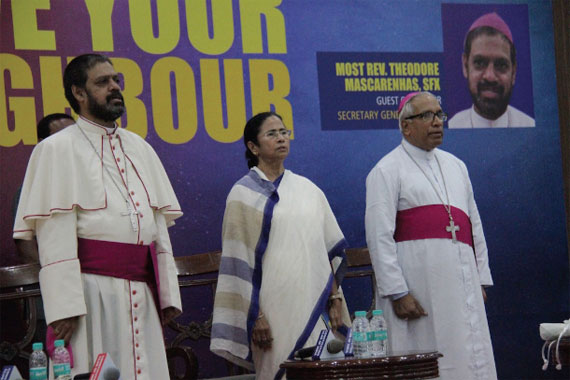
The Nagaland Baptist Church Council (NBCC) has reminded people to go for a “clean election,” vote with a clear conscience and without influence. May 26 appeal came two days ahead of the Nagaland Lok Sabha by-election. Naga People’s Front (NPF) president Shürhozelie Liezietsu also urged the party people to take a firm stand to defend the Christian faith.

The by poll was necessitated after Chief Minister Neiphiu Rio resigned from the Lok Sabha in February to contest the Assembly election. The polling held on May 28 and the counting of votes will take place on May 31. Campaigning closed on May 26.

India’s Christians to back supportive parties in polls

Six months ahead of elections in three northern Indian states, Christian leaders have pledged to vote for poli-tical parties assuring protection of their communities from discrimination and abuse.

Ecumenical Christian group Sarva Isai Mahasangh (All Christian Forum) has resolved not to support parties in upcoming federal and state elections that work against religious minorities.

Madhya Pradesh, Rajasthan and Chhattisgarh States, ruled by the pro-Hindu Bharatiya Janata Party (BJP), face elect-ions in November and December while the term of BJP Prime Minister Narendra Modi expires next May. “We are passing through a very critical period in the history of our country where people are divided on caste and religious lines,” said Arch-bishop Leo Cornelio of Bhopal, the capital of Madhya Pradesh. “A very dangerous trend exists in the country that undermines the secular tenets of our constitution.” He added: “Come what may, we will continue with our mission of serving the poor and the needy.”

Pope: if it is not ‘feminine’, the Church becomes a ‘church for old bachelors’

“The Church is a woman” and if she lacks this identity she becomes “a charity association or a football team;” when “it is a male Church,” it becomes “a Church of old bachelors,” “incapable of love, incapable of fecundity,” said Pope Francis at Mass this morning at Casa Santa Marta, on the day dedicated to the memory of the Blessed Virgin Mary, Mother of the Church.

The feast is being celebrated this year for the first time, after the publication in March of the decree Ecclesia Mater (“Mother Church”) by the Congregation for Divine Worship and the Discipline of the Sacraments. Pope Francis himself decided the feast should be celebrated immediately following Pentecost, in order “to encourage the growth of the maternal sense of the Church in the pastors, religious and faithful, as well as a growth of genuine Marian piety.”

In his homily, Pope Francis said that in the Gospel, Mary is always described as “the Mother of Jesus,” instead of “the Lady” or “the widow of Joseph”: her motherliness is emphasized throughout the Gospels, beginning with the Annunciation. This is a quality that was noted immediately by the Fathers of the Church, a quality that applies also to the Church.

The Church is feminine, because it is “Church” and “bride” [both grammatically feminine]: it is feminine. And she is mother; she gives life. Bride and Mother. And the Fathers go further and say that even your soul is the bride of Christ and mother.” And it is with this attitude that comes from Mary, who is Mother of the Church, with this attitude we can understand this feminine dimension of the Church, which, when it is not there, the Church loses its identity and becomes a charitable organization or a football team, or whatever, but not the Church.

Only a feminine Church will be able to have “fruitful attitudes,” in accordance with the intention of God, who chose “to be born of a woman in order to teach us the path of woman.”

German President: Catholic Church should ‘share’ Communion with Protestants

The President of Ger-many has called for the Catholic Church to allow Protestants to receive Communion. Speaking at Katholikentag, a major conference for German-speaking Catholics in Münster, Frank-Walter Steinmeier said: “Let us seek ways of expressing the common Christian faith by sharing in the Last Supper and Communion. I am sure: Thousands of Christians in interdenomi-national marriages are hoping for this.”

Steinmeier said he was speaking “not as Federal President, but as an a vowed Evangelical Christian who lives in an interdenominational marriage.”

He also criticised the Bavarian government’s decision to hang crosses in public buildings, saying the state should not “patronise” religion.

His words came after the Vatican failed to rule on whether a proposal by German bishops to allow Protestants married to Catholics to receive Communion under certain circumstances violated Church teaching. Seven German bishops, including Cardinal Rainer Woelki of Cologne, had challenged the proposal and asked the Vatican to intervene, but Pope Francis urged the bishops to come to an agreement amongst themselves.

“I don’t see the point of a public debate about wafers,” he said, referring to the Blessed Sacrament. He added that climate change is a “far more serious” issue. The crowd, which was mainly Catholic, applauded him as he said that, since he paid his Church tax, the Church had “better happily hand out a wafer for it, or give me back my money!”

Pope Paul VI prepared ‘resignation letter’

Pope Paul VI wraps his cape around a small boy who has just presented him a bouquet of flowers on behalf of the parish children Photograph: S&G Barratts/EMPICS/PA Archive 13 years before his death, Blessed Paul VI wrote that he should be allowed to resign if he became too ill to carry on Commenting on the letter, Pope Francis said, “We must thank God, who alone guides and saves the church, for having allowed Paul VI to continue until the last day of his life to be father, pastor, master, brother and friend.”

Blessed Paul said he was writing “aware of our responsi-bility before God and with a heart full of reverence and of charity, which unite us to the holy Catho-lic Church, and not unmindful of our evangelical mission to the world.”

“In case of infirmity, which is believed to be incurable or is of long duration and which impedes us from sufficiently exercising the functions of our apostolic ministry; or in the case of another serious and prolonged impediment,” Blessed Paul wrote, he renounced his office “both as bishop of Rome as well as head of the same holy Catholic Church.”

Chile’s bishops offer to resign en masse

Every Chilean bishop has offered his resignation to Pope Francis after a series of closed-door meetings with all 34 bishops at the Vatican, to discuss the abuse crisis in the country. The dramatic announcement followed the leaking of a 10-page letter to television channel T13, reportedly handed to the bishops at the start of discussions, in which Francis said removing bishops may be needed but would not be sufficient to solve the abuse crisis in Chile. In the letter Francis cites clericalist, elitist and authoritarian attitudes dominating in the Church and an urgent need to put Christ back at the “ecclesial centre.” “It would be irresponsible on our part not to delve into looking for the roots and the structures that allowed these [abuses] to happen and to be perpetuated,” the Latin American Pope explained. Francis ordered the bishops to Rome after receiving a 2,300- page report into the sex abuse problems written by the Archbishop of Malta, Charles Scicluna. He commissioned the report after his visit to Chile in January in which he defended Bishop Juan Barros of Osorno against accusations from abuse survivors.

Bishops warn of ‘growing genocide’ in Cameroon

“They are hunting us,” murmurs a secondary school teacher, turning his back to the camera and asking not to be named. “The Cameroon government security forces were entering villages and killing unarmed people. Bodies have been found in forests, they used every method and means to kill. It’s a huge number of fatalities.” Nearly 26,000 people, four-fifths of them women and children, have fled into Nigeria from Southern Cameroon. The number has doubled since January, according to Caritas Internationalis and the UN High Commissioner for Refugees (UNHCR). More are arriving daily, while an estimated 40,000 people are displaced inside Cameroon. Political upheaval is provoking an under-reported humanitarian crisis in both countries, with refugees flooding into Nigeria’s border states carrying nothing but their children and the clothes on their backs.

Irish abortion referendum : Landslide win for pro-choice

Voters in Ireland have opted to remove the right to life of the unborn from the country’s constitution, paving the way for abortion on demand up to 12 weeks.

With votes counted from 30 of Ireland’s 40 constituencies, results from the nationwide referendum showed that 67.3% of citizens opted to remove the Eighth Amendment from the constitution, while 32.7% voted to retain it. Turnout was 64.5%.

Voters inserted the original amendment in the constitution in 1983 by a margin of 2-1, and it “acknowledges the right to life of the unborn and, with due regard to the equal right to life of the mother, guarantees in its laws to respect, and, as far as practicable, by its laws to defend and vindicate that right.”

That text will now be deleted and replaced with an article stating that “provision may be made by law for the regulation of termination of pregnancy.” Minister for Health Simon Harris has said he would introduce legislation that would allow abortion on demand up to 12 weeks, up to 24 weeks on unspecified grounds for the health of the mother, and up to birth where the child is diagnosed with a life-limiting condition that means he or she may not live long after birth.

Pope creates 14 new cardinals in June

Pope Francis announced he would make 14 new cardinals June 29, giving the red cardinal’s hat to the papal almoner, the Iraq-based patriarch of the Chaldean Catholic Church and the arch-bishop of Karachi, Pakistan, among others.

Announcing his choices May 20, the Pope said that coming from 11 nations, the new cardi-nals “express the universality of the church, which continues to proclaim the merciful love of God to all people of the earth.”

Pope Francis’ list included three men over the age of 80 “who have distinguished them-selves for their service to the church.”

When the Pope made the announcement, the College of Cardinals had 213 members, 115 of whom were under the age of 80 and therefore eligible to vote in a conclave to elect a new Pope. Cardinal Angelo Amato, prefect of the Congregation for Saints’ Causes, was to celebrate his 80th birthday on June 8. The new cardi-nals hail from: Iraq, Spain, Italy, Poland, Pakistan, Portugal, Peru, Madagascar, Japan, Mexico and Bolivia.

Nigerian minor seminary attacked, priests injured byMuslim herdsmen, plan to ‘Islamicize the Christian areas’

According to reports in the Nigerian media, confirmed on May 28 by a Nigerian priest, a Catholic minor seminary has been attacked by largely Muslim Fulani herdsmen in Jalingo, part of Nigeria’s north-central “Middle Belt” region, leaving no fatalities but several injuries, including two priests.

The attack occurred in the early morning hours, and is the latest in a long-running series of violent incidents invol-ving mostly Muslim herdsmen and mostly Christian farmers in the Middle Belt area.

“They shot and injured one of the priests, Father Cornelius Pobah, in the leg, [and] beat up Father Stephen Bakari,” he said.

For now, the Nigerian priest said, calm has been restored “thanks to the prompt response from the Nigerian Police, Army, Civil Defence and local vigila-ntes.”

The attacks were carried out by nomadic cattle herders of the Fulani tribe which tends to be Muslim. “We are not speaking of Boko Haram this time, although some of the cattle herders have had relations with that terrorist group in the past and both groups are united in the same intention to Islamicize the entire region,” the bishop charges. In the face of so much violence one of the most worrying aspects for the bishop is the complete lack of action on the part of the government, especially the federal government.

“THERE IS A CLEAR agenda: a plan to Islamicize all the areas that are currently predominantly Christian in the so-called Middle Belt of Nigeria.”

Those are the words of Bishop Wilfred Chikpa Anagbe of the Diocese of Makurdi in Nigeria. His diocese is home to the parish of Saint Ignatius in Ukpor-Mbalom, Benue State—the scene of the most recent attack by Fulani herdsmen, which took place on April 24, 2018.

Official Website

Exit mobile version