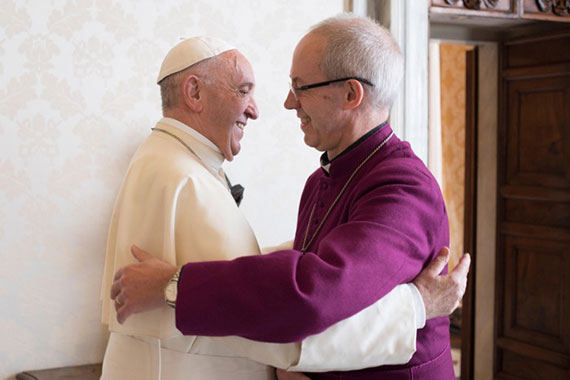
Nobel laureate Kailash Satyarthi met Pope Francis at Vatican seeking support for a new legally binding International law against ‘online child sexual abuse,’ a statement said. For over a year, Satyarthi has been demanding a legally binding United Nation convention against online child sexual abuse, like pornography and trafficking, which is backed by a new global task force and could provide victims with holistic support.
Berlin prepared to offer asylum to Aasia Bibi
The German government is prepared to offer asylum to the Pakistani Christian Aasia Bibi. Ms Bibi was freed from prison in Pakistan’s Punjab province on 7 November after spending eight years on death row for alleged blasphemy. Muslim co-workers had accused her of insulting Muhammad during an argument when they accused her of contaminating a cup of water because she was a Christian drinking from it. Since her release was announced, Islamist mobs have brought Pakistani cities to a standstill, calling for her and the judges who ruled for her release to be beheaded. Prime Minister Imran Khan caved in to the mobs’ demands by forbidding her to leave the country and allowing an appeal against the Supreme Court ruling.
Priest’s “Five Loaves” restaurants set new trends
The ‘Anjappam’ collective initiated by a Capuchin priest to feed the hungry with love and respect has opened its fourth branch in Changanacherry in Kottayam district in Kerala on Nov 1st.
The latest addition located in Panachikkal Buildings in the heart of Changanassery town was inaugurated by Capuchin Father Bobby Jose Kattikad, who is popularly known as ‘Bobbyachan.”
Fr Kattikad is known for his preaching, writing and evangelization through television, radio and social media.
Anjappam (five loaves), a concept visualized by Fr Kattikad and supported and facilitated by a community of friends who supports financially or otherwise, irrespective of caste or religion.
Anjappam restaurants have no cash desk or bills. Instead it has a box kept inside where people make contributions if they wish to. During the day, the restaurants act as places where good, healthy meals are available at affordable prices and in the evenings, they are transformed into libraries with reading spaces. It also acts as a hub for discussions and book reviews.
The restaurant chain funds itself through voluntary donations by customers. They uphold the thought that donations need not be in terms of money .Anyone who intends to help the poor and needy always have an option available here. This can be as spending one’s time at the restaurants, serving food and helping with cleaning activities.
The restaurants serve only vegetarian food. The members of the Trust take care to ensure that a majority of the vegetables are acquired locally so that they can provide healthy as well as environment friendly food, which is good for both the body and mind.
Anjappam also plans to distribute basic food packs free of cost to the homeless and other needy sections of society.
Anjappam currently has three other branches in Kerala – Ranni, Neyyattinkara and Kozhencherry.
Bishop asks priests to walk the talk
“Walk the talk is to live the gospel values in day today life. The type of leadership in Pope Francis is participatory leadership. Then only any changes shall happen in clericalism,” said Bishop Sarat Chandra Nayak of Berhampur on November 7 in his keynote address at the golden jubilee of Morning Star Regional Seminary, Kolkata.
Bishop Nayak asserted that the root of priestly formation lies in virtues of love, joy and humility.
“Merciful approach of God to all is to define the personality of true pastors. Avoiding luxury and embracing simplicity is the ideal of Francis in life,” said Bishop Nayak, an alumnus of the seminary.
The golden jubilee celebrations had a theme “to love all including those who do not love us.”
Sufficient openness for the laity in the Church in areas such as the diocesan councils for marriage, finance and pastoral is urgent, said the prelate.
He said that the next millennium will be of the laity.
Quoting Pope Francis, Bishop Nayak spoke on marching with joy and hope in current challenging situations of the Church.
In another talk, Father Soosai Mannickam, former staff, spoke about Pope Francis’ pastoral ministry expectations from the priests.
The principle character of a pastor is to know his people, (smell the sheep), the forgiving love of God (who am I to judge), the priest said.
Father Mannickam also noted that Pope Francis’ leadership is to inspire all.
“The new way of evangelizing God’s word is living a life in the values of the Kingdom a life of mercy and kindness in holiness.”
Mother Teresa nuns back in India’s adoption system
The Missionaries of Charity (MC) congregation has agreed to resume its service of giving children for adoption. The congregation founded by St Teresa of Kolkata, commonly known as Mother Teresa, dis-continued giving babies from their orphanages for adoption in Oct. 2015 after disagreeing with a new federal law that allowed single and divorced woman to adopt children.
The congregation has revised its stance and will join the centralized adoption service system set up by the government, said Maneka Gandhi, who heads the Ministry of Women and Child Development.
A delegation of three MC nuns including Sister Mary Prema Pierick met the minister on Oct. 29 and decided that children in its 79 homes can go into family care. The nuns in a Nov. 2 press release said they had agreed to register all their childcare homes with respective state governments as man-dated by the Juvenile Justice Act of 2015. Most MC homes for children are already registered and the remaining homes are in the process of completing registration formalities, the release said.
Goan priest-turned-activist buried after three years
The body of a Catholic priest-turned-activist was buried in western India after a three-year wait by his family and friends who suspect he was murdered for his strong stand for environmental protection.
Some 60 priests and 2,000 admirers of Jose Bismarque Desidor Dias joined the Nov. 6 burial service in his village of Sao Estevam in Goa State, a former Portuguese enclave.
The burial of Dias, a former Blessed Sacrament priest, was delayed after his friends and family sought a detailed probe into the mysterious circumstances surrounding his death.
Dias, 51, went missing on Nov. 5, 2015, after he went for a swim in a river near his home with friends. His body was found floating two days later. Local police claimed it was a case of drowning.
However, his family and associates delayed burial and demanded an investigation, suspecting that he could have been murdered by those who were angry with his campaign against mining and unbridled property development.
Following pressure, the Bombay High Court that also covers Goa in April 2017 ordered the state’s specialized Crime Branch police to probe the case, considering it a murder.
In March 2018, however, investigators submitted a closure report to the court asserting it was a case of drowning.
“Only the body of Dias is laid to rest, not the concept of justice. The fight for our fallen comrade will go on,” said Sudip Dalvi, an associate of Dias who was among those pressing for court intervention.
Dalvi told ucanews.com a review petition has been filed in court. “But all connected with him thought it was time to give him a decent burial” and decided to do it on his third death anniversary, he added.
Dias’ parish priest Eusico Pereira highlighted Dias’ childhood wish for priesthood.
“He lived for others,” he said. Pope Francis’ on May 2015 encyclical Laudatosi’ made him overjoyed because he felt he had the mandate of the Pope.
Dias was a “fearless witness to Christ in truth,” Father Pereira added.
Dias mobilized people through music, rallies and meetings against large government and private projects including a golf course of a seven-star hotel and Goa’s second airport.
Indian Muslims upset over Taj Mahal prayer restrictions
The Archaeological Survey of India (ASI), which is tasked with the monument’s management, said in a Nov. 5 order that only Muslims living around the Taj Mahal can pray on Fridays in the mosque adjacent to the mauso-leum. Muslims from other areas are barred, Vasant Swarankar, super-intending archaeologist at the ASI’s Agra chapter, told media. Namaz (prayers) can only be offered on Fridays. Imams and staff can enter the mosque only from noon to 2 pm, according to the order.
The world-renowned mausoleum was built by Mughal emperor Shah Jahan in memory of his wife in 1658.
The UNESCO-designated world heritage site receives more than 200,000 overseas tourists and some 4 million local tourists every year. But Friday is a holiday when no tourists are allowed. The ASI said it was only implementing a July Supreme Court order that only residents of Agra should be allowed to enter the mosque for congregational prayers as unregulated entry could adversely affect the monument.
However, leaders of Muslims, who comprise 14 percent of India’s 1.2 billion people, say the order is unnecessary.
Warriors for women’s dignity
Six years ago, at the age of 26, Laila Talo Khuder Alali was sold as a sex slave eight times to men of different nationalities by militants of Islamic State in Iraq and Syria (ISIS).
Standing in a hotel auditorium in India’s commercial hub of Mumbai to receive an award in the name of St Mother Teresa, she told of how her husband and a child were still missing.
Several of her family members had been killed, but eight were rescued.
Those missing are among more than 3,000 people known as ‘Yazidis’ still in ISIS captivity, Alali said when receiving the Mother Teresa Memorial Award for Social Justice on Oct. 21.
The militants of ISIS are accused of perpetrating genocide against the Yazidi, a religious minority group in northern Iraq.
Yazidism combines elements of Islam, Christianity, Judaism and Zoroastrianism. ISIS, also known simply as Islamic State, seeks to wipe out their faith. “We faced torture, sexual slavery and unimaginable acts,” the 30-year-old woman recounted at the award ceremony in Mumbai.
Indian deaths in Persian Gulf: Nun endorses NGO analysis
A Catholic nun working among migrant workers agrees with a voluntary group’s finding that at least 10 Indians die every day in the Persian Gulf countries. “I am not surprised. The number could be more,” Sister Josephine Amala Valarmathi told Matters India on November 7.
The member of the Missionary Sisters of the Immaculate Heart of Mary was responding to the findings of the Commonwealth Human Rights Initiative. The 43-year-old nun, based in Chennai, has addressed the problems of Indians working in the Persian Gulf countries, Malaysia and Singapore, for the past 16 years.
She says she is quite familiar with the problems of Indians working overseas as she often gets such distress calls from them.
The Commonwealth Human Rights Initiative released early November its analysis of the deaths of Indian workers in Bahrain, Oman, Qatar, Kuwait, Saudi Arabia and the United Arab Emirates from January 1, 2012 to about mid-2018. Venkatesh Nayak of the voluntary group provides the figures for six years from 2012.
“Available data indicates, at least 24,570 Indian workers died in the six Gulf countries between 2012 and mid-2018. This number could increase if the complete figures for Kuwait and UAE are made available publicly. This amounts to more than 10 deaths per day during this period,” Nayak told reporters.
He said he had got those figures through the Right to Information data from External Affairs Ministry.
Nayak’s data was provided by Indian missions in Bahrain, Oman, Qatar and Saudi Arabia but the embassy in the UAE refused to give information. The Indian embassy referred to data on their website which was only 2014 onward.
In order to fill gaps, Nayak used data provided in Parliamentary questions in LokSabha and RajyaSabha.
Sister Valarmathi shared another list compiled by an unnamed person on the number of Indian workers who died in the Persian Gulf countries between 2005 and 2015.
Her list has a total of 31,810 deaths reported from Bahrain, Iran, Iraq, Kuwait, Oman, Qatar, Saudi Arabia and the United Arab Emirates during the 11-year-period. This accounted for 8 deaths daily.
The nun’s list gives the number of bodies repatriated to India between 2005 and 2015.
Oman expatriated bodies of all 5,402 Indian workers who died there, Qatar sent all 2,396 bodies, Bahrain 1,493, Iran 52, Iraq 123 and UAE 384.
However, no data is available for the number of repatriation in Saudi Arabia where 13,248 Indian deaths occurred. Kuwait had 5,249 deaths, but repatriated only 4,021.
Christians in Indian state seek religious freedom
Chhattisgarh Christian Forum presents charter of demands to political parties before election.
Christian leaders in India’s poll-bound Chhattisgarh State have presented a charter of demands to major political parties seeking to end discrimination and violence. The charter prepared by leaders of the ecumenical Chhattisgarh Christian Forum expressed concerns over the security of the miniscule Christian community in the central state, now ruled by the pro-Hindu Bharatiya Janata Party (BJP).
It also calls on the next government to ensure freedom to practice religion.
“We have already handed over the charter to all major political parties,” Arun Pannalal, president of the forum, told ucanews.com on Nov. 7.
The state of 25 million people, where Christians make up barely 2 percent of the population, is scheduled to elect its 90-seat legislative house in two phases on Nov. 12 and Nov. 20.
Prime Minister Narendra Modi’s BJP, which has ruled the state for 15 years, is aiming to prevent the Indian National Congress party, its archrival, from gaining power. The smaller Bahujan Samaj Party and Aam Aadmi Party are also in the fray.