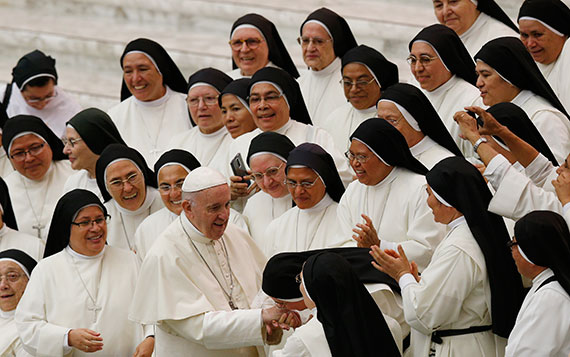
Vatican Creates New Office to Serve Catholic Charismatic Renewal Movement

Pope Francis has wanted the creation of a single service dedicated to the Catholic Charismatic Renewal organizations since 2015 — a vision that is now becoming a reality thanks to the creation of CHARIS (Catholic Charismatic Renewal International Service), which will be officially instituted on Dec. 8.

This new body within the Dicastery for Laity, Family and Life will replace the two existing services known as the International Catholic Charismatic Renewal Service and the Catholic Fraternity.

For the 50th anniversary of the Catholic Charismatic Movement in June 2017, Pope Francis already asked the two bodies to join together to organize the celebration at the Circus Maximus in Rome. On this occasion, the Pope quoted the late Belgian Cardinal Leo Suenens, the strong-est episcopal promoter of the movement in its early days, who called it “a current of grace, a renewing breath of the Spirit for all the members of the Church.”

The international service will be made of 18 members, as well as a moderator and an ecclesiastical assistant — Capuchin Father Raniero Cantalamessa, preacher to the Papal Household and a long-time supporter of the charismatic movement. The service’s officials will fully assume their functions from June 9, 2019, the Solemnity of Pentecost.

More than 2,000 people killed or missing in seaborne European migration attempts

The International Organisation for Migration (IOM), the UN-backed inter-governmental agency, has said that some 2,133 people seeking asylum have been killed or gone missing this year while trying to reach Europe by sea. The organisation said that in the period to 28 November, some 107,583 migrants and refugees had entered Europe by sea this year – the fifth successive year in which the arrival of irregular migrants and refugees had topped 100,000; but down on the figures by the same date in both 2017 and 2016 for the same period.

The Mediterranean Sea crossings from North Africa and the Middle East to Europe account for two thirds of the total number of migrants and asylum seekers killed or missing across the road this year – some 3,341 people. But the IOM warn that comparisons are hindered by incomplete data gathering in some regions. This year’s figure for the number killed or missing in the Mediterranean is considerably less than last year’s total of 3,113.

Egypt regularises 168 churches and Christian places of worship

The regularisation of more than a hundred new churches and Christian places of worship “is a positive step” and confirms that the government intends to “put into practice” what is in the “law on irregular places of worship approved a year and a half ago,” said Fr Rafic Greiche, spokesman for the Egyptian Catholic Church, who spoke to AsiaNews about 168 churches and other Christian places of worship recently approved by a ministerial committee.

Chaired by Prime Minister MostafaMadbouly (who is also Housing and Urban Utilities minister), the committee “legalised” 151 churches with another 17 set to follow.

“The approval process touches churches that lacked proper authorisation,” said the clergy-man. “This is an administrative issue meant to grant a legal status to buildings” that belong to Egypt’s Christian minority, which has been recently targeted by Islamic extremist groups.

In the past two months, the committee looked at churches that had requested regularisation, giving the go-ahead during a session attended by officials from the ministries of Justice, Antiquities and Parliamentary Affairs. The Prime Minister also authorised the regularisation of other places of worship if they meet legal requirements.

Births and Religious Marriages Collapse in Italy After Two Synods on the Family

On the very same day on which the Pontifical Urban University was opening anexhibit (see photo) dedicated to the heroic Ulma family of Poland – “this big family,” Pope Francis said, “shot by Nazi Germans during the second world war for having hidden and given aid to Jews” – in Italy the National Institute of Statistics released the figures on births and marriages in the year 2017.

Anything but “big” families, like that of those Polish martyrs or like many in Italy a century ago. The collapse of the birth rate here reached an all-time low in 2017. In a country of 60.5 million inhabitants, just 458,151 children were born last year, and even fewer, around 440,000, new births are predicted for 2018, a little more than 7 for every 1,000 inhabitants, 30 % below the average for the European Union, which is already the region with the lowest birth rate in the world.

If one considers that the “total fertility rate” that ensures zero growth, meaning a balanced turnover of the population, is 2.1 children per woman, the Italian figure has been dramatically below this for decades and in 2017 sank to the level of 1.32, with quite a few regions even more stingy with births, and with Sardinia even falling to the level of 1.06.

These are numbers that already attest to an inexorable march toward the extinction of a people.

But even more striking are the figures concerning marriage. There were 203,000 in 2016, and dropped to 191,000 in 2017, down 6% in a single year, a decrease second only to the structural one in 1975, the year following the approval of divorce in Italy.

Cardinal Pell Convicted on Charges He Sexually Abused Choir Boys

The Vatican’s third most powerful official has been convicted in Australia on all charges he sexually abused two choir boys there in the late ’90s, according to two sources with knowledge of the case.

A unanimous jury returned its verdict for Cardinal George Pell (Australian time) after more than three days of deliberations, the sources said, in a trial conducted under a gag order by the judge that prevented any details of the trial being made public.

Pell, the Vatican’s finance chief and the highest Vatican official to ever go on trial for sex abuse, left Rome in June 2017 to stand trial in Melbourne.

As that trial was about to get underway in June, a judge placed a suppression order on all press coverage in Australia, according to the order reviewed by The Daily Beast. Prosecutors applied for the order and it was granted to “prevent a real and substantial risk of prejudice to the proper administration of justice.” That order remains in place in Australia.

That trial, known as “the cathedral trial,” was declared a mistrial earlier this year after a hung jury, the sources say. A retrial began immediately and ended with the unanimous verdict.

In a book published last year, journalist Louise Milligan reportedly wrote that Pell was accused by two former choir boys of sexual abuse while he was archbishop of Melbourne in the ’90s. The boys sang in the choir at St Patrick’s cathedral and were allegedly abused by Pell in a room in the confines of the church. Pell’s office told The Guardian in 2017 he “repeats his vehement and consistent denials of any and all such accusations.”

Indonesian Christian governor Ahok set for early release from prison

Jakarta’s former governor, known as “Ahok,” who was sentenced last year to two years in jail for blasphemy against Islam, is to be released from prison next month, four months ahead of schedule.

The ethnic Chinese Christian, whose real name is Basuki Tjahaja Purnama, was due to be released in May but has been granted early release, scheduled for 24 January, for good behaviour, according to Sri Puguh Budi Utami, Director General for Prison Affairs, as reported by AsiaNews.

Ahok had refused parole in July as he hoped for early release after serving almost two-thirds of his sentence.

Ahok, the first Christian and ethnic Chinese to govern Indonesia’s capital since the 1960s, was charged with blasphemy in December 2016 after accusing his political opponents of using Quranic verses to dissuade Muslims from voting for him in his bid for re-election as Jakarta governor.

Shakespeare was a covert Catholic sympathizer, English countess says

Shakespeare has been considered a political for centuries – apart from the concessions he made to appease his patrons – but a new school of thought claims the Elizabethan play wright was a covert Catholic sympathizer who sprinkled clues about his religious beliefs throughout his early sonnets.

Clare Asquith, the Countess of Oxford and Asquith, has interpreted the bard’s epic poem The Rape of Lucrece as a political manifesto assailing the persecution of Catholics in England, Britain’s The Telegraph reports.

Written in 1594, the poem ostensibly concerns the rape of a noble-woman but Lady Asquith sees hidden messages buried between the lines.

She interprets its coded messages as referring to the destruction of Catholic monasteries and the handing over of Church property to rich land-owners at the bequest of the Protestants.

In her eyes, the poem is an extended account of the Act of Supremacy of 1534, which was passed after Henry VIII founded the Church of England, the media reports.

The Catholic who could succeed Angela Merkel

The German Chancellor Angela Merkel, having just formed her fourth government, has established herself as one of Europe’s longest-serving leaders. But she enters her new term of office in a weakened position, and speculation has been turning to her possible successors.

In last year’s general election Merkel’s Christian Democratic Union (CDU) polled the lowest share of the vote in its history, and has remained in power only because its rivals are even weaker and unable to form a majority. Merkel has also come under fire from party colleagues for giving away too much ground on core policies during the months-long coalition talks with the minority Social Democrats (SPD).

Monument to Alexander Solzhenitsyn unveiled in Moscow

At a ceremony on Alexander Solzhenitsyn Street in Moscow, Russian President Vladimir Putin unveiled a new monument of Solzhenitsyn on the 100th anniversary of the writer’s birth on 11 December 2018. The bronze monument sitting on a granite pedestal was designed by National Artist of Russia Andrei Kovalchuk. His project won the architecture and sculpture tender held in 2017 by the Union of Moscow Architects at the initiative of the Alexander Solzhenitsyn House of Russian Expatriate Community, with the support of the Ministry of Culture. President of Russia Vladimir Putin said.

He clearly delineated the true, genuine, people’s Russia and the totalitarian system, which brought suffering and severe trials to millions of people. But even being in exile, Solzhenitsyn would not tolerate anyone to speak evil or scornfully of his homeland, and opposed any manifestations of Russophobia.

A man of integrity, an exceptionally principled person, Solzhenitsyn never wanted to be comfortable. In his writings, in his literary, journalistic and social activity, he openly and consistently defended his views and convictions, and argued the unconditional value of the morals that provide for a healthy society.

Without understanding the country’s past there can be no meaningful movement into the future, Solzhenitsyn believed. Therefore, he directed his efforts toward finding and designating ways to improve Russia, so that the hardest and most dramatic trials that befell our country would never happen again, so that our multi-ethnic people would live in dignity and justice. This is how he saw his mission, his goals and the meaning of his service.”

New survey documents how people deal with grief at Christmas

For most people, Christmas is a joyous time with family and friends; but this joy can turn to grief when those family and friends have died.

How people deal with this sadness was the focus of a survey published Dec. 10 from St Mary’s University, Twickenham, that asked 2000 people across the United Kingdom what they do at Christmas in memory of deceased loved ones.

The survey is part of the University’s project, The Art of Dying Well, which offers practical and spiritual support to those faced with the prospect of death and dying.

“The Art of Dying Well commissioned this survey to try and help the bereaved navigate a way through what can be a very tough season,” said Maggie Doherty, the director of the project. Those taking the survey were given 16 possible ways to remember the deceased, although they were given the opportunity to write in other options.

The most popular option – at 32% – was to simply share memories of the loved one with friends and family.

Other popular activities to remember the dead included lighting a candle (20%), laying a wreath on a grave (20%), saying a prayer (16%), and making a special toast (15%).

“Holidays are a time to get the family together, particularly at Christmas. When a loved one is missing from those get-togethers, the sense of loss can be overwhelming,” Doherty told Crux.

Official Website

Exit mobile version