Vatican commission votes against ordaining female deacons

A Vatican commission studying the possibility of female deacons reported that the current state of historical and theological research “excludes the possibility of proceeding” toward admitting women to the diaconate, a conclusion that slows momentum on one of the church’s most debated questions while stopping short of a definitive no.

In a letter sharing the results of its work with Pope Leo XIV and released by the Vatican Dec. 4, the commission reported a 7-1 vote in favour of a statement concluding that the church cannot currently move toward admitting women to the third degree of holy orders, the diaconate. 

“In light of Sacred Scripture, Tradition, and ecclesiastical teaching, this assessment is strong, although it does not allow for a definitive judgment to be formulated at this time, as in the case of priestly ordination,” said the approved statement voted on in 2022.

Why only eight votes were recorded from the 10-member commission was not explained in the letter.

The “third degree” of the holy order refers to the diaconate as the foundational degree of ordained ministry. The episcopate (for bishops) and the presbyterate (for priests) represent the two other degrees which the church teaches are above the diaconate in the hierarchy of ordained ministry. 

Yet a “purely historical perspective does not allow us to reach any definitive certainty,” wrote Cardinal Giuseppe Petrocchi, president of the commission, introducing the commission’s results. “Ultimately, the question must be decided on a doctrinal level. Therefore, issues relating to the ordination of women as deacons remain open to further theological and pastoral study.”

Pope urges educators in Africa to support youth seeking a better future

Pope Leo XIV has urged Catholic educators in Africa to help young people rediscover confidence in their future, especially those driven to leave the continent out of despair. His message, signed by Cardinal Secretary of State Pietro Parolin, was sent to Archbishop Gabriel Sayaogo for the African Congress on Catholic Education held in Nairobi from 4 to 7 December. The congress, titled “Catholic Education and the Promotion of Signs of Hope in the African Context,” focused on revitalising formation grounded in Christ. The Pope expressed appreciation for ongoing efforts to advance the Global Compact on Education, a commitment strongly supported by Pope Francis.

Pope Leo recalls that Catholic education aims not only to develop “cultivated minds” but also “full hearts” capable of compassion and concern for others. Young people, he notes, are “the wealth of Africa,” and educators must find effective ways to guide students toward the future with confidence.

He warns that many youths, discouraged by limited opportunities, leave the continent at great personal risk. Educators, he says, can help restore in them the belief that “nothing is lost” when they are accompanied by mentors who help them recognise their talents and set ambitious goals rooted in Africa’s cultural and moral strengths.

Drawing on his homily for the Jubilee of Families, the Pope highlights the family as the place where “the future of peoples is built.” He calls for protecting the family as intended by the Creator and promoted by the Church, guarding it against harmful ideologies. Many African leaders were formed in Catholic schools, he notes, yet the continent still faces significant challenges. He encourages educators to nurture two qualities essential for responsible leadership: solidarity and a spirit of sacrifice—values deeply rooted in African tradition and central to the Church’s mission of forming people committed to the common good.

“Education is not only a job but an evangelising mission,” the Pope concludes. Recalling his predecessor’s description of young Africans as potential “ambassadors of peace,” he urges all involved in education to form men and women who can become the builders of the continent’s future.

Pope: Visit to Türkiye and Lebanon teaches that peace is possible

At the Sunday Angelus on December 7 prayer following his visit to Türkiye and Lebanon, Pope Leo XIV thanked the many people who made it possible and the faithful who accompanied him with their prayers.

In Türkiye, he prayed with his “beloved brother Bartholomew, Ecumenical Patriarch of Constantinople, and the Representatives of other Christian confessions” at the site of the Council of Nicaea in 325, at modern-day Iznik. “Precisely today we mark the 60th anniversary of the Common Declaration between Paul VI and Patriarch Athenagoras, which put an end to the mutual excommunications,” he said. “Let us give thanks to God and renew our commitment to the journey toward the full visible unity of all Christians.”

Pope Leo expressed his joy for the opportunity to meet with the Catholic community of Türkiye, which he said bears witness to the Gospel of love in its patient dialogue and service to those who suffer.

Turning to Lebanon, the Pope said the country continues to be “a mosaic of coexistence,” saying he was encouraged to hear many people bear witness to that model. “I met people who proclaim the Gospel by welcoming the displaced, visiting prisoners, and sharing bread with those in need,” he said. “I was heartened to see so many people in the streets greeting me, and I was deeply moved by the meeting with the relatives of the victims of the explosion at the port of Beirut.” Even as he brought a word of consolation, said the Pope, he in turn receive much greater consolation from the Lebanese people’s faith and enthusiasm.

“What has taken place in recent days in Türkiye and Lebanon teaches us that peace is possible,” concluded Pope Leo XIV, “and that Christians, in dialogue with men and women of other faiths and cultures, can help to build it.”

Philippines bishops’ conference elects Garcera as president, an advocate for synodality

Archbishop Gilbert Garcera of Lipa has officially begun his new role as president of the Catholic Bishops’ Conference of the Philippines (CBCP). The CBCP elected Garcera during its 130th plenary assembly on July 5 in a break from the conference’s tradition of electing the previous vice president, in this case Bishop Mylo Hubert Vergara of Pasig, to serve in the role. The last time the conference opted not to elect its vice president was in 2011.  Garcera, who has advocated for synodality within the Filipino Church, comes to the leadership position amid national instability due to government corruption and natural disasters. Garcera’s predecessor, Cardinal Pablo Virgilio David of Kalookan, served two four-year terms. Archbishop Julius Tonel of Zamboanga will act as Garcera’s vice president, and their terms will run until Nov. 30, 2027. “I hope you will pray for me, because the cross that was placed on me is very heavy,” Garcera said in a video message on Facebook after his election. 

Holy See satisfied with civil recognition of Chinese Bishop Zhang Weizhu

Satisfaction has been expressed with the news that on December 06 the episcopal dignity of Bishop Emeritus Joseph Zhang Weizhu of the Apostolic Prefecture of Xinxiang (Henan, mainland China) has received civil recognition.”

According to a statement issued by Matteo Bruni, Director of the Holy See Press Office, on December 06, “This measure is the result of dialogue between the Holy See and the Chinese authorities and represents a new and important step in the communal journey of ecclesiastical circumscription.”

On Friday, 5 December, the episcopal ordination of Bishop Francis Li Jianlin of Xinxiang took place. He had been appointed Bishop of the Apostolic Prefecture of Xinxiang (Henan Province, China) by Pope Leo XIV on 11 August.

The Pope approved his candidacy “within the framework of the Provisional Agreement between the Holy See and the People’s Republic of China” and accepted the resignation from pastoral governance submitted by Bishop Joseph Zhang Weizhu.

Thousands protest corruption in Philippines as Church leaders call for accountability

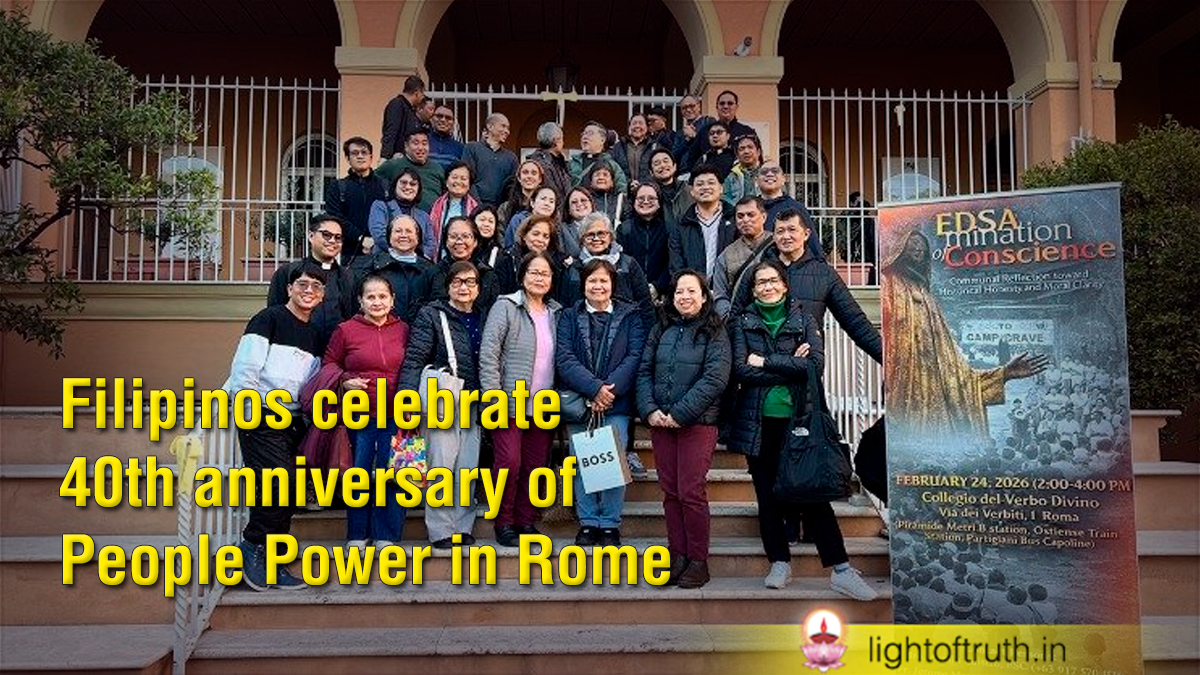
Over 90,000 people held a second nationwide protest over a corruption scandal involving infrastructure projects worth an estimated $2 billion on Nov. 30. According to the Philippine National Police (PNP), 119 rallies were organized by the Catholic Church, civil society movements, and others and were attended by bishops, priests, nuns, seminarians, catechists, and students as well as the laity and politicians. More than 16,000 people protested at the EDSA People Power Monument in Manila. About 17,000 police officers were deployed to maintain security, according to official sources.

Cardinal Pablo Virgilio David, outgoing president of the Catholic Bishops’ Conference of the Philippines, led Mass at the EDSA People Power Monument — a shrine commemorating the 1986 People Power Revolution that peacefully toppled the dictatorship of Ferdinand Marcos Sr. The site, located along Epifanio de los Santos Avenue in Metro Manila, also witnessed mass protests that ousted President Joseph Estrada in 2001.

“We returned to EDSA because this place holds the memory of peaceful courage. Here, our people once stood unarmed yet unafraid, choosing moral clarity over fear,” David said. “Today, as our country confronts wounds inflicted by greed and impunity, we come again — not to tear down, but to call our leaders and ourselves back to the path of truth. The democracy restored by the EDSA People Power Revolution may be flawed, unfinished, and fragile, yet it is the only soil where genuine change can take root. And so, we gather to protect it — not through force, but through fidelity,” he added.

Marcos Sr. was the father of current President Ferdinand Marcos Jr., who has acknowledged public distrust and anger about corruption. The country lost 118.5 billion pesos ($2 billion) from 2023 to 2025 due to corruption in flood control projects, according to the Department of Finance.

David, who also serves as bishop of Kalookan, a diocese in Metro Manila, was impressed by “the sight of countless communities mirroring this gathering across the archipelago. Parishes, civic groups, families, and young people stood under their own skies, offering their own prayers and witness.” According to him, the protest was “as though the whole nation exhaled in unison — a collective longing to heal what has been broken, a gentle but firm refusal to surrender our future to the darkness of corruption. There was no hatred in the air, only resolve. No violence, only vigilance. No despair, only the quiet bravery of those who still believe.” The cardinal said the country remains committed to truth, to justice, to the poor, and to each other. “EDSA is not a relic. It is a living vow. And today, once again, we renewed it,” he added.

Pope sends aid to Asian countries struck by floods

Through the Office of Papal Charities, Pope Leo XIV has offered support to several South and Southeast Asian countries facing severe hardship after devastating cyclones caused widespread loss of life and extensive material damage.

Nearly 1,800 people have died, and more than a thousand remain missing across the region after the late-November monsoon rains, intensified by a series of tropical cyclones, triggered floods, landslides, and mudslides, hampering rescue efforts. Entire villages remain isolated after bridges and roads were swept away by water and debris.

In response to the emergency, the Pope has sent assistance, through the Papal Almoner, to countries most affected, including Sri Lanka, Indonesia, Vietnam, and Thailand. During the Angelus on Sunday, 7 December, Pope Leo XIV had already expressed his closeness to the populations severely tested by these natural disasters. He assured his prayers and urged the international community to show solidarity with those facing grave hardship in these regions.

Hong Kong: Asian Church leaders gather to discern AI’s pastoral impact

Asian bishops, communication leaders, and media professionals have opened the Bishops’ Meet–2025 in Hong Kong with a call to embrace artificial intelligence (AI) responsibly, grounding technological advances in human dignity, ethical discernment, and the mission of the Church. The three-day gathering (10–12 December), organised by the Office of Social Communications of the Federation of Asian Bishops’ Conferences (FABC-OSC), is taking place at St. Francis University and brings together more than 30 participants from across the continent.

Celebrating the Opening Mass, Cardinal Stephen Chow, SJ, Bishop of Hong Kong, invited Asian communicators to regard AI as a “gift from God” whose use must remain oriented toward the good of humanity and the care of creation. “I think AI is not from the devil. AI comes from God, who helps us,” he said during his homily. “I pray that this meeting will help us, liberate us, and inspire us to work with AI to achieve the blessings God intends for us.”

The Cardinal encouraged participants to approach technological developments with hope, careful discernment, and ethical clarity. Catholic media, he said, must uphold moral credibility even amid rapid change.

“Otherwise, how can we call ourselves Catholic media?” he asked. “When we put our hope in the Lord, we must first honour Him, not funding agents or ideologies. We need to discern God’s will for our mission in this shifting context.” Cardinal Chow underscored that fidelity to conscience remains essential: “Whenever I spoke from my conscience, even when attacked, I still experienced peace.” Speaking from both personal and communal conscience shaped through synodal processes, he said, brings freedom and authenticity. Quoting Jesus’ words, “My yoke is easy,” the Cardinal concluded that communicators, too, will find lightness “when we speak with our hearts, guided by the Spirit.”

Addressing the assembly on 10 December, Dr Paolo Ruffini, Prefect of the Dicastery for Communication, offered a wide-ranging reflection on the promise and risks of AI for the Church and society. He cautioned against deepfakes, unverifiable sources, algorithmic filtering, and the opaque logic by which digital platforms shape information flows. These dynamics, he said, can enclose users in “filter bubbles” driven by commercial or ideological interests rather than truth. Ruffini noted that dominant AI models often prioritise speed and attention over depth and accuracy, endangering freedom of thought and distorting public discourse.

Echoing messages from Pope Francis and Pope Leo XIV, he stressed the importance of education and media literacy as safeguards for human freedom. Critical thinking, discernment, and an ability to evaluate information, he said, are essential to prevent “the human heart itself” from becoming artificial. “Artificial intelligence must never replace us,” he said, adding that the Church must help believers remain fully human in a digital era that can shape thought, memory, and behaviour. Quoting Romano Guardini, he called for a renewed attitude proportionate to the power of technology—one rooted in conscience, responsibility, and truth.

Pope prays for an end to clashes along Thai-Cambodian border

Pope Leo XIV appealed for an immediate end to the renewed hostilities on the Thai-Cambodian border, where recent clashes have caused casualties – including civilians – and forced thousands to flee their homes. Addressing the faithful gathered for the General Audience on December 10, the Pope expressed his “deep sorrow” at the reports emerging from the region.

“I am deeply saddened by the news of the renewed conflict along the border between Thailand and Cambodia. There have been casualties, including among civilians, and thousands of people have been forced to leave their homes. I express my closeness in prayer to these dear peoples.” 

The violence marks the latest flare-up in a decades-long border dispute, in which contested sections of territory – particularly areas surrounding culturally significant temple sites – have periodically triggered exchanges of fire between the two nations. While past efforts at arbitration and regional diplomacy have sought to stabilise the frontier, ceasefires have often proved fragile, leaving local communities repeatedly caught in the crossfire. Speaking at the end of the General Audience, the Holy Father lamented the recurrence of these tensions and asked the parties “to cease fire immediately and resume dialogue”.

Indian Carmelite friar appointed auxiliary bishop in Germany

Pope Leo XIV on November 26 appointed Carmelite Father Joshy Potteckal as the auxiliary bishop of Mainz, Germany. The announcement was made simultaneously in the Vatican and in Mainz. The 48-year-old bishop-elect is a member of the Order of Carmelites, a mendicant order. He is currently the regional superior of the Carmelites and representative for the clergy of the diocese of Mainz. He was introduced by Bishop Peter Kohlgraf at a press conference at the Mainz bishop’s residence.

The episcopal consecration is scheduled for March 15, 2026 in Mainz Cathedral. As auxiliary bishop, Father Joshy will serve as episcopal vicar for religious orders and continue his work in the personnel department until a successor is appointed.

He was born on April 30, 1977, at Meenkunnam, a village in Kerala’s Ernakulam district. He was ordained a Carmelite priest on December 28, 2003, in Thrissur. He served as a chaplain in 2005 and teacher of religion at the Martinus-Schule in Mainz. He was the head of youth pastoral care for the deanery of Mainz for three years until 2008.

During 2006-2008, he also served as the parish vicar of St. Alban, St. Jakobus and Hl. Kreuz in Mainz-Hechtsheim. He was parish priest of Hirschhorn and Neckarsteinach in 2009. He served as the vice dean of Bergstrasse-Ost in 2021. The following year, he was the staff representative at the Episcopal Curia. Within the Carmelite Order, he has served as regional superior for members of the Province of Saint Thomas resident in Germany (since 2016) and prefect for formation in the Episcopal Seminary since 2024, according to Vatican News.

Official Website

Exit mobile version