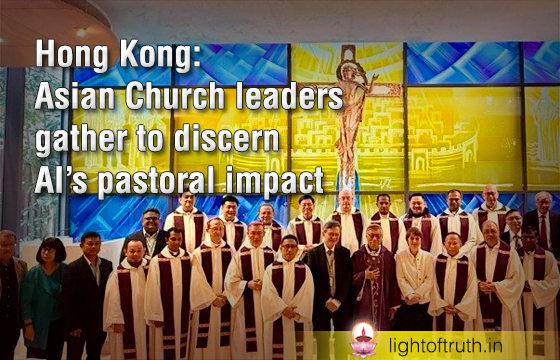
Asian bishops, communication leaders, and media professionals have opened the Bishops’ Meet–2025 in Hong Kong with a call to embrace artificial intelligence (AI) responsibly, grounding technological advances in human dignity, ethical discernment, and the mission of the Church. The three-day gathering (10–12 December), organised by the Office of Social Communications of the Federation of Asian Bishops’ Conferences (FABC-OSC), is taking place at St. Francis University and brings together more than 30 participants from across the continent.
Celebrating the Opening Mass, Cardinal Stephen Chow, SJ, Bishop of Hong Kong, invited Asian communicators to regard AI as a “gift from God” whose use must remain oriented toward the good of humanity and the care of creation. “I think AI is not from the devil. AI comes from God, who helps us,” he said during his homily. “I pray that this meeting will help us, liberate us, and inspire us to work with AI to achieve the blessings God intends for us.”
The Cardinal encouraged participants to approach technological developments with hope, careful discernment, and ethical clarity. Catholic media, he said, must uphold moral credibility even amid rapid change.
“Otherwise, how can we call ourselves Catholic media?” he asked. “When we put our hope in the Lord, we must first honour Him, not funding agents or ideologies. We need to discern God’s will for our mission in this shifting context.” Cardinal Chow underscored that fidelity to conscience remains essential: “Whenever I spoke from my conscience, even when attacked, I still experienced peace.” Speaking from both personal and communal conscience shaped through synodal processes, he said, brings freedom and authenticity. Quoting Jesus’ words, “My yoke is easy,” the Cardinal concluded that communicators, too, will find lightness “when we speak with our hearts, guided by the Spirit.”
Addressing the assembly on 10 December, Dr Paolo Ruffini, Prefect of the Dicastery for Communication, offered a wide-ranging reflection on the promise and risks of AI for the Church and society. He cautioned against deepfakes, unverifiable sources, algorithmic filtering, and the opaque logic by which digital platforms shape information flows. These dynamics, he said, can enclose users in “filter bubbles” driven by commercial or ideological interests rather than truth. Ruffini noted that dominant AI models often prioritise speed and attention over depth and accuracy, endangering freedom of thought and distorting public discourse.
Echoing messages from Pope Francis and Pope Leo XIV, he stressed the importance of education and media literacy as safeguards for human freedom. Critical thinking, discernment, and an ability to evaluate information, he said, are essential to prevent “the human heart itself” from becoming artificial. “Artificial intelligence must never replace us,” he said, adding that the Church must help believers remain fully human in a digital era that can shape thought, memory, and behaviour. Quoting Romano Guardini, he called for a renewed attitude proportionate to the power of technology—one rooted in conscience, responsibility, and truth.