
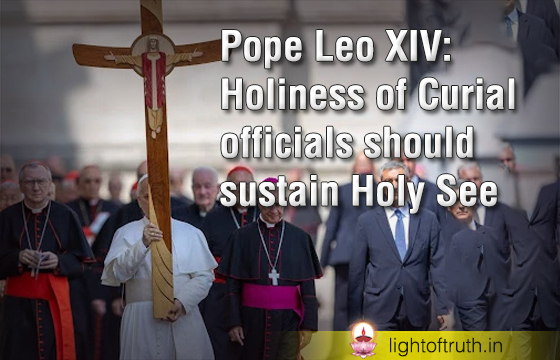
As the Church marks the Jubilee of the Holy See, Pope Leo XIV spent on May 09 Monday morning with employees and officials of the Roman Curia. The Jubilee began with a meditation offered by Sr. Maria Gloria Riva, a Sister of the Blessed Sacrament and Our Lady. The Pope then carried a Jubilee cross and led a procession of Holy See officials through the Holy Door of St. Peter’s Basilica.
After the procession, Pope Leo XIV celebrated Mass and reflected in his homily on the spiritual foundations of the Apostolic See. “The Holy See lives in a most particular way the co-presence of two poles: Marian and Petrine,” said the Pope. “It is the Marian one that ensures the fruitfulness and holiness of the Petrine one, through her motherhood, gift of Christ and the Spirit.”
The Holy Father noted that the Jubilee of the Holy See takes place on the liturgical memorial of Mary, Mother of the Church, a day after the Solemnity of Pentecost.
The Gospel reading from John, he said, recounts that Jesus entrusted His mother to the Beloved Disciple from the Cross. Pope Leo added that the Church’s fruitfulness is “the very fruitfulness of Mary,” which is realized in the lives of the Church’s individual members.
Each Christian, he said, is called to live the love of Jesus, as experienced on the Cross.
“This fruitfulness of Mary and of the Church is inseparably linked to her holiness, that is, her conformity to Christ,” said the Pope. “The Holy See is holy as the Church is holy, in her original core, in the fabric from which she is woven.”
Pope Leo XIV said the Apostolic See safeguards the holiness of her roots, just as she is safeguarded by that holiness. “It is no less true that she also lives in the holiness of each of her members,” he said. “Therefore, the best way to serve the Holy See is to strive to be holy, each of us according to his or her state of life and the task entrusted.”
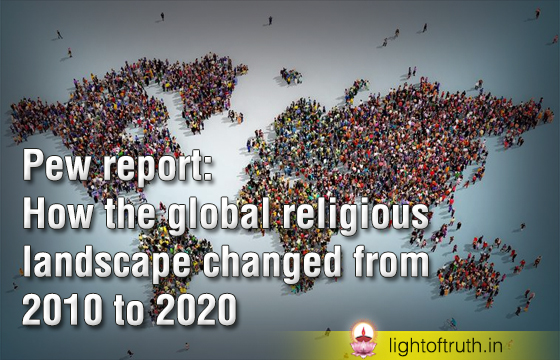
Pew report: How the global religious landscape changed from 2010 to 2020
While Christianity remained the largest global religion from 2010 to 2020, the latest Pew Re-search study found that followers of Islam outpaced every world religion in population over the course of the decade.
The recently released report, “How the Global Religious Landscape Changed from 2010 to 2020,” includes data from over 2,700 sources, including national census, demographic surveys, and population registers. Some of the estimates made in the report originate from data about 2020 that was not made available till 2024 due to the COVID-19 pande-mic, which delayed census data in at least 65 countries. The report covered 201 countries, focusing on seven religious categories: Christians, Muslims, Hindus, Buddhists, Jews, people who be-long to other lesser-known reli-gions, and religiously unaffiliated.
According to the report, the total number of Christians rose by 122 million from 2010 to 2020, while the total number of Muslims rose by 327 million – “more than all other religions combined.” The global Christian population rested at 2.3 billion in 2020, while the global Muslim population came to 2 billion.
Apart from Muslims, the only other group that grew as a per-centage of the global population were those who identify as having no religion, known as “nones.” The report described this pheno-menon as “striking” because reli-giously unaffiliated people are typically older and have lower fertility rates, putting them at a “disadvantage” for population growth. By the end of 2020, how-ever, “nones” made up 24.2% of the global population, making it the third-largest group in the study, following Christians and Muslims.
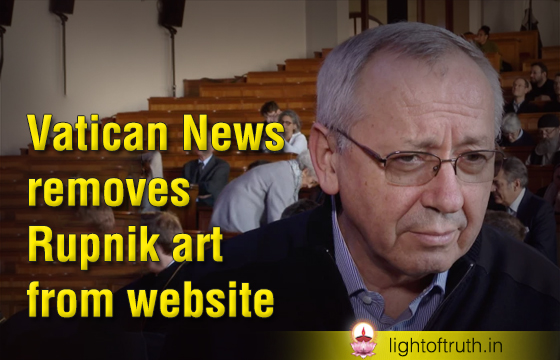
Vatican News removes Rupnik art from website
The Vatican on May 09 removed artwork by former Jesuit Father Marko Ivan Rupnik from its official web-sites. Digital images of the Slovenian priest’s sacred art, which were frequently used by Vatican News to illustrate articles of the Church’s liturgical feast days, are no longer found on the digital news service.
Catholic writer Amy Welborn took to X to show screenshots of Vatican News’ “Memorial of the Blessed Virgin Mary, Mother of the Church” article before and after Rupnik’s accompanying artwork was removed from the website on June 9.
Rupnik, who was expelled by the Society of Jesus in June 2023 for his “stubborn refusal to observe the vow of obedience,” is accused by about two dozen women, mostly former nuns, of spiritual, psychological, and sexual abuse they allege has occurred over the past three decades. The recent changes to the Vatican News and the Dicastery for Communication websites came soon after Pope Leo XIV met with members of the Pontifical Commission for the Protection of Minors on June 5.

Toronto Cardinal Leo tells Catholics to avoid using ‘symbols that do not represent us’
Archbishop of Toronto Cardi-nal Francis Leo called on the faithful to honour the most Sacred Heart of Jesus throughout the month of June rather than “using symbols that are contrary to God’s divine revelation.”
“This year the solemnity of the Sacred Heart is commemo-rated on June 27, though the entire month is dedicated to this long-standing and much appreciated devotion in the Church,” Leo said in a statement.
The month of June is a time to reflect on Jesus’ “loving, burn-ing, sacrificial, and life-giving heart,” which Leo called “one of the most profound and enduring symbols in Catholic devotional life.”
For Catholics, symbols “help us to deepen our faith and shape our prayer life, not to mention the lives we lead and the choices we make,” the cardinal said. “They are like bridges joining together the material and spiritual worlds and reveal to us the Gospel truths.”
Leo called on the faithful in Toronto to use symbols this month that “are consistent with our Catholic faith and not borrowed from ideological fora, promoted by lobby groups and endorsed by political movements.”
He said: “We ought to honour and respect our traditions and not compromise the integrity of the faith by using symbols that are contrary to God’s divine revelation.”
“We do good to use our own symbols to tell our own story without resorting to trendy, misguided, and inadequate symbols that do not represent us as Catholics but rather contribute to confusion, distortions, and ambiguities about what the Catholic faith truly teaches regarding the human person, human nature, and natural moral law.”
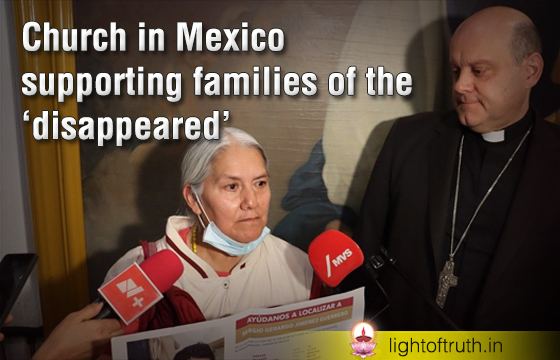
Church in Mexico supporting families of the ‘disappeared’
No longer relying on the State or police to find their missing loved ones, more than 200 groups of mothers and fathers, known as searchers, now dig with their own hands in vacant lots across Mexico. These families, living in anguish, act on anonymous tips about the locations of clandestine graves. Many such leads come through so-called “Peace Boxes,” installed in parishes throughout the country, where people can submit information anonymously. According to Mexico’s Ministry of the Interior, over 125,000 people have disappeared since 2006.
The Catholic Church, along with other organisations, accompanies these families in their pain and struggle, knowing that most of the disappeared have likely fallen victim to drug cartels or narco-political retaliation. Others may have been caught in the illegal human organ trade, which would explain the high number of young people, including children and infants, among the missing.
In March, national shock followed the discovery in Jalisco State of a site used by criminal groups as both a training ground and an extermination camp, complete with crematory ovens. Hundreds of charred human remains and over 1,800 personal items—including clothing, shoes, backpacks, and notebooks—were recovered at the so-called “Ranch of Horror.” Families were outraged to learn that police had previously dismissed the site’s significance. Mexico’s Episcopal Conference swiftly condemned the crimes as crimes against humanity, calling on authorities to break ties between drug trafficking and political sectors.
Bishop Acero, who in 2024 helped launch peace dialogues in Mexico, meets monthly with groups of searching mothers, creating spaces for empathy, mutual support, and the sharing of new
information.
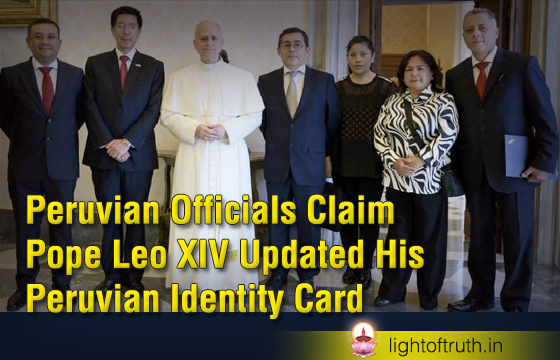
Peruvian Officials Claim Pope Leo XIV Updated His Peruvian Identity Card
Pope Leo XIV has reportedly updated his Peruvian national identity document (DNI) in the National Registry of Identification and Civil Status (RENIEC) of the South American country. Four Peruvian registrars from RENIEC visited the Pope on May 30th at the Vatican, and took his photograph for the Holy Father’s ID, which was taken that same Friday, the 30th. Robert Prevost Martinez’s previous ID number indicated the address in Chiclayo where he resided as Bishop. The new ID number will indicate the new Vatican address. Robert Prevost acquired Peruvian nationality in 2015 and obtained his first DNI in Lima. He obtained a DNI with a chip in 2016, which does not require renewal due to his age of 69. Peru’s Andina News Agency reported that Pope Leo XIV’s new update is the electronic DNI 3.0, issued by the Peruvian Government on April 15 and costing just over US$10. Pope Leo XIV has dual U.S. and Peruvian nationality. RENIEC officials also recorded the fingerprints and signature of «citizen Robert Prevost,» which would have been automatically entered into the administrative system for Peruvian citizens.
The Head of RENIEC, Carmen Velarde, told the Peruvian press: “What Pope Leo XIV has done confirms his attachment to the country and is also an act of responsibility. It is a message to all Peruvians to keep their national identity cards up to date. I thank the Holy Father for taking the time to update his document.” For her part, President Dina Boluarte emphasized that the granting of a Peruvian passport to Bishop Prevost in 2015 was obtained through the agreement between Peru and the Vatican, which establishes that Bishops in the country must have Peruvian nationality. However, the act was not “a merely formal gesture, but a profoundly spiritual and human one,” given that the new Pope dedicated a large part of his life to serving the country’s poorest. She also recalled that his pastoral work in Peru “sowed hope, walked with the most needy, and shared the joys of the Peruvian people.”
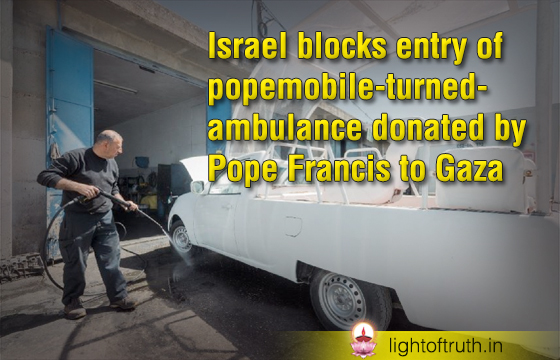
Israel blocks entry of popemobile-turned-ambulance donated by Pope Francis to Gaza
The vehicle, transformed with medical equipment and child-friendly interiors, was a final gesture of solidarity from the late Pope Francis before his death in April 2025. He entrusted it to Caritas Jerusalem with a simple but powerful mission: to reach Gaza’s youngest and most vulnerable–those wounded not only in body, but in spirit. It was once a symbol of joyful encounter. In May 2014, Pope Francis rode through the streets of Bethlehem in a white open-roofed vehicle, waving to crowds in the birthplace of Christ. That very papal car, now retrofitted into a mobile medical unit, was meant to become a lifeline for the children of Gaza. Today, it sits idle outside the border, blocked by war, diplomacy, and despair. The vehicle, transformed with medical equipment and child-friendly interiors, was a final gesture of solidarity from the late Pope Francis before his death in April 2025. He entrusted it to Caritas Jerusalem with a simple but powerful mission: to reach Gaza’s youngest and most vulnerable–those wounded not only in body, but in spirit. But the borders remain sealed. The Rafah crossing from Egypt is shut tight. Israel’s permissions are scarce and slow. The roads into Gaza are bottle-necks of desperation. For now, the papal ambulance has become a ghost of mercy that cannot yet cross into the inferno. “We are still trying to coordinate with au-thorities,” says Harout Bedrossian of Caritas Jerusalem. “But nothing moves. The frontiers are closed, and hope–however persistent–is thinning.”
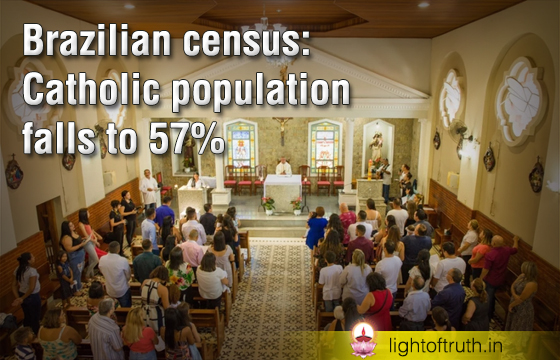
Brazilian census: Catholic population falls to 57%
The percentage of Brazilians who identi-fy as Catholic fell to 56.75% in 2022, a reduction of 8.4% compared with 2010, according to data from the 2022 demographic census released by the Brazilian Institute of Geography and Statistics. Despite the reduction, Catholicism remains by far the largest religion in the country, followed by evangelicalism and Brazilians who identify as having no religion, whose percentage has grown by 1.4% since 2010, accounting for 9.28% of the population. Evangelicals posted growth of 5.2% during the period, comprising 26.9% of the country’s population of just over 203 million people.
The trend of increasing numbers of people without a religious affiliation was discussed by the bishops during a January meeting in Rio de Janeiro. The archbishop of Porto Alegre and president of the National Conference of Bishops of Brazil, Cardinal Jaime Spengler, referred to this population as “dechurched.” Spengler said “there is an urgent need to invest in initiation into Christian life and the valorization of small communities of faith so that Catholicism can grow in Brazil.” Other religions account for 4.01% of the population. Spiritists represent 1.84%, while followers of Umbanda and Candomblé account for 1.05%.
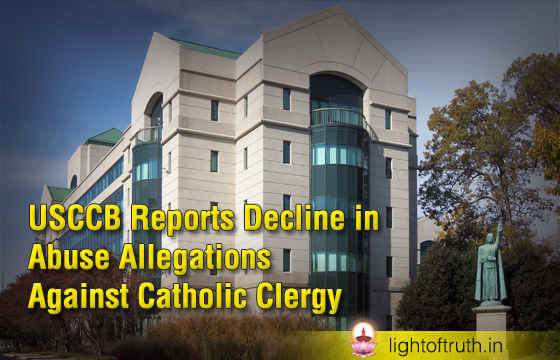
USCCB Reports Decline in Abuse Allegations Against Catholic Clergy
Since last year, there has been a 32% decline in U.S. child abuse allegations against Catholic cler-gy, according to the 2024 annual report of the U.S. Conference of Catholic Bishops’ (USCCB) Se-cretariat of Child and Youth Protection. Overall, “902 allega-tions were reported by 855 victims-survivors of child sexual abuse by clergy,” the report said, compared with 1,308 allegations by 1,254 survivors last year.
Covering July 1, 2023, to June 30, 2024, the annual report is based on a survey of 195 U.S. Catholic dioceses and eparchies, drawn from data collected by the Centre for Applied Research in the Apostolate at Georgetown University as well as an audit by StoneBridge Business Partners.
The annual reporting stems from the U.S. bishops’ 2002 creation of the Charter for the Protection of Children and Young People, which established a framework and protocols related to allegations of sexual abuse of minors by Catholic clergy.
StoneBridge also pointed out several cases of noncompliance by jurisdictions and entities that are in violation of the articles established in the 2018 revision of the youth protection charter.
“Measuring charter complia-nce allows each diocese/eparchy to assess strengths and weaknesses and identify programmatic areas requiring improvement, which are critical in our mission of prote-cting our children,” the report said. The report restated the Catholic Church’s commitment “to work to ensure the safety of children and vulnerable adults by performing background checks on clergy, employees, and volun-teers, and providing training on how to identify and report abuse signs.”
“For the U.S. Church and as articulated in the Charter for the Protection of Children and Young People, this commitment tran-slates into a zero-tolerance policy toward abuse,” the USCCB report reads. Abuse allegations have shown a steady decline since 2020, averaging a 30% decrease annua-lly, according to data accumu-lated over the past five years.
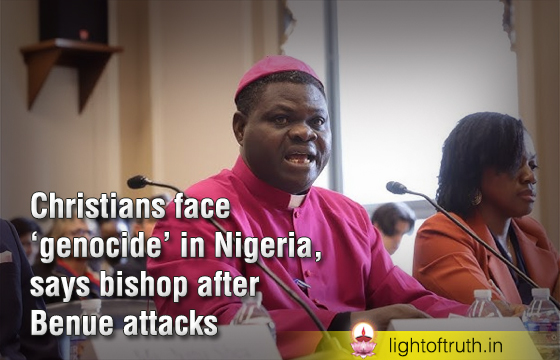
Christians face ‘genocide’ in Nigeria, says bishop after Benue attacks
The Bishop of Makurdi Wilfred Chikpa Anagbe des-cribed the persistent attacks on Christians in his diocese as “genocide.” Speaking after the latest wave of killings by jihadist Fulani herdsmen in Benue State in late May, in which hundreds of Christians died, Bishop Anagbe said: “No nation watches her citizens slaughtered like animals and says there is nothing to be done. It’s genocide.” In May, at least 100 Christians were killed in separate attacks in Gwer West, part of the diocese, and 5,000 people were displaced. Bishop Anagbe told the ACI Africa agency on 4 June that the killings had forced the closure of 17 parishes since 27 May.
“When we talk about 17 parishes being shut, it means an entire community has been displaced and taken over. They cannot go back,” he said.
A statement from the Catholic Bishops’ Conference of Nigeria (CBCN) expressed “deep anguish of soul” at “the utterly barbaric massacre of innocent civilians in Benue State.” “These cold-blooded attacks on defenceless communities – where countless have been slaughtered, homes destroyed, and families left in anguish – are an affront to God, a stain on our shared humanity, and a terrifying reminder of the utter breakdown of security in our land,” said the statement, signed by the CBCN president Abp Lucius Iwejuru Ugorji of Owerri.
“There is no justification whatsoever for the continuous bloodletting that has become the daily reality of many in Benue State and across Nigeria. The relentless attacks on innocent and defenceless communities under the watch of civil authorities constitute a grave moral and constitutional failure. This carnage must end.”