
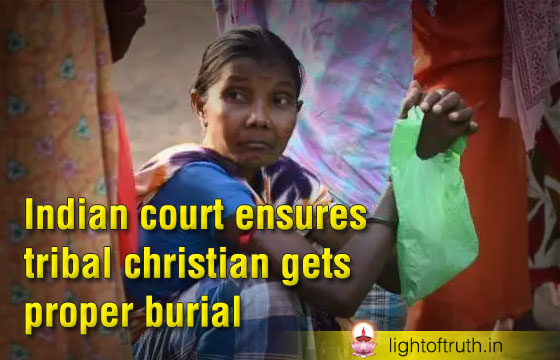
An Indian court had to inter-vene to ensure a proper burial for a tribal Christian after residents of his predominantly Hindu villa-ge objected to Christian burial in the village. Fifty-four-year-old Isvar Korram, an indigenous Christian, died on April 25 while undergoing treatment at a hospital in central Chhattisgarh state’s Jagdalpur city, which is the headquarters of Bastar district. But villagers from his native Chhindbahar, a remote village in the hilly, forested district, told his family not to bring back his body and bury it according to Christian rites. “This is not the first time that indigenous Christians were denied permission to bury their dead in the region,” said Bishop Vijay Kumar Thobi of the Protestant Church. Bastar is known as a stronghold of the Maoist rebels, who say they are fighting for the rights of the poor and have been engaged in an armed insurgency for many decades. Local church leaders said the villagers “opposed a Christian burial on the plea that it will prove a bad omen” for them. “This time, we decided to file a case in the Bilaspur High Court [the state’s top court] seeking a direction to bury Korram in his village,” Bishop Thobi told.
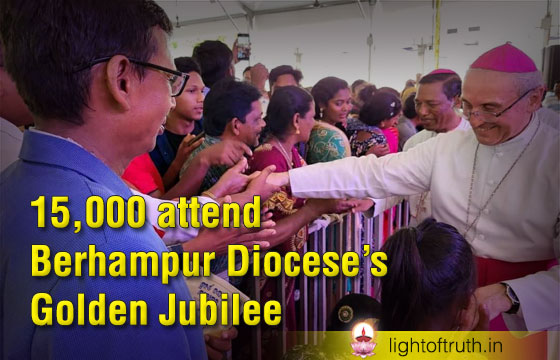
15,000 Attend Berhampur Diocese’s Golden Jubilee
Around 15,000, including Apostolic Nuncio Archbishop Leopoldo Girelli, on May 9th attended the golden jubilee celebrations of Berhampur diocese in the eastern Indian state of Odisha. “I am glad and happy to be with you and for you to celebrate this jubilee Mass,” the nuncio said in homily during the jubilee Mass at St.Peter Parish Mohana under Berhampur diocese. The Vatican ambassador expressed happiness that the diocese, founded by the Congregation of the Missions in 1974, now has 71,000 Catholics in 26 parishes, served by 29 women and 10 men religious congre-gations, and 379 catechists, besides the dio-cesan clergy. The seed your ancestors sowed 50 years ago has produced plenty of fruits, he added.
As many as 10 bishops and more than 100 priests and nuns too attended the celebrations. Catholicism was first introduced in the region back in the 17th century when it was under the care of Madras-Mylapur archdiocese. By 1845, Odisha came under the diocese of Visakhapatnam. The first missionaries were the Fransalians, who worked in the hilly region of Ganjam and Phulbani and the coastal belt of Berhampur and Cuttack. The Cuttack Mission was declared self-governing by Pope Pius XI on July 18, 1928, and Vincentian Father Valerian Gumes was appointed its administrator and ecclesiastical superior. In 1937, the mission was raised to the status of a diocese. On January 24,1974, the Cuttack Mission was divided into the Cuttack-Bhubaneswar archdiocese and the diocese of Berhampur. Berhampur’s first prelate was Vincentian Bishop Thomas Thiruthalil, who served the diocese until 1990. He was succeeded by Bishop Joseph Das who served the diocese during 1993-2007. The current bishop is Sarat Chandra Nayak.

Logos and mottos for pope’s visit to asia released
The Holy See Press Office has released the official logos and mottos for the Pope’s upcoming visit to Asia. The Pope’s journey to the continent – which will include stops in Indonesia, Papua New Guinea, Timor Leste, and Singapore – is scheduled to take place on September 2-13, 2024.
Pope Francis will land in Jakarta, Indone-sia, on September 3, remaining until the 6th.
The logo for this visit features the Pope with his hand raised in blessing, standing in front of a golden “Garuda”, a sacred eagle, which has been depicted in a manner reminiscent of traditional Indonesian “batik” fabric. Inlaid is a map of Indonesia, an archipelago characterized by a great variety of ethnic and social groups, languages, cultures and religious beliefs. The Apostolic Journey has been given the motto ‘Faith – Fraternity – Compassion’.
Next, the Pope will travel to Papua New Guinea, where he will remain until Sept. 9.
The centrepiece of the logo for this visit is a cross, depicted in colours meant to evoke Papua New Guinea’s sunrises and sunsets. On the cross, a Bird of Paradise, symbolising Papua New Guinea, can be seen. The motto for this Apostolic Journey is “Pray”, inspired by the disciples’ request to Jesus: “Lord, teach us to pray” (Lk 11:1).
From Papua New Guinea, Pope Francis will travel to Timor Leste, remaining until September 11. In the centre of the logo for this journey, we see Pope Francis with his hand raised in blessing. Behind him is the globe, from which a map of Timor Leste emerges. Above, written in an arc, is the motto of the papal visit, “May your faith be your culture”, an exhortation to the Timorese people to live out their faith according to their culture and traditions.
The Pope’s final stop will be the island nation of Singapore, which he will visit on September 11-13. The logo for this Apostolic Journey depicts a stylized cross, inspired by the star that guided the Magi, by the Eucharist and by the five stars of the flag of Singapore. On either side of the Cross is the motto of the Apostolic Journey: “Unity–Hope.”
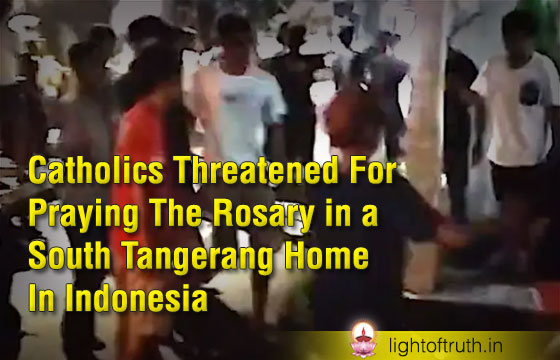
Catholics Threatened For Praying The Rosary In A South Tangerang Home In Indonesia
Catholic students from Pamulang University (UNPAM) were threatened by Muslim extre-mists as they prepared to pray the rosary. A group of armed Mus-lim men broke into the home of a Catholic family in South Tange-rang[I] that was hosting students. Shouting threats, the attackers ordered the university students to stop the prayer activity and dis-perse as soon as possible.
It seems that the hostilities were fomented by a man called Diding. “If you perform any praying, do it in your church as we local Muslims are used to do it in our mosque; not in a resi-dential house like this,” Mr Di-ding said, according to witnesses. “A dozen UNPAM students were reciting the rosary at the home of a local Catholic,” said a political activist known as Mr A. “We were at the police’s command post until at 3 am to demand perpe-trators be held accountable for last night’s hostile deed,” Mr A told. Speaking to local media, Chief Superintendent Alvino Cahyadi said police were looking into the case after a video about the incident was posted on social media. Some female students suffered minor injuries.
A similar incident took place in 2014, when Julianus Felicianus, a Catholic, opened his home to the community near Yogyakarta to pray the rosary, an activity that many Christians engage in, in the month of May. A group of Mus-lims targeted the Catholic gather-ing and Felicianus received threats, including death threats, from several people.

Card Chow In Guangdong: New Bridge With Catholics In Mainland China
Exactly one year after his historic visit to Beijing in April 2023 (almost 30 years after the last one), a delegation of the Diocese of Hong Kong led by Card Stephen Chow Sau-yan made a new, important visit to Catholic communities in mainland China.
From 22 to 26 April, the Chinese cardinal – together with Auxiliary Bishop Joseph Ha Chi-shing, Vicar General Fr Peter Choy Wai-man, and a small group of priests and lay people involved in pastoral care – travelled to Guangdong province where they held meetings in the dioceses of Guangzhou and Shantou as well as the Church of Shenzhen.
This is a very significant aspect of the task of building bridges, the cardinal laid out in his ministry for the Church of Hong Kong. Guangzhou and Shenzhen are large metropolises in southern China. With Hong Kong, they constitute the huge metropolitan area of the Pearl River Delta, which are increas-ingly becoming a single commu-nity through large-scale infra-structural development under-taken by Beijing.
For Card Chow, this was his first visit to these dioceses and on his return he relayed his impre-ssions to the diocesan weekly Sunday Examiner. He said, for example, that he was struck by the large number of parishes that a priest has to serve in China, citing as an example two parish priests who serve 31 parishes in Shantou.

Climate Change And Work: When It’s The Heat That Kills In The Factory
South Asia and Southeast Asia have been facing an exceptional heat wave, which in several countries has caused the mercury to rise above 40 degrees Celsius, with peaks of up to 45.
From Bangladesh to Thailand, passing through vast regions of India, Myanmar, Cambodia and the Philippines, there have been casualties due to the high temperatures. Governments have run for cover by decreeing the closure of schools. But there is also another aspect on which it becomes particularly significant to dwell on this day of 1 May: the effect that increasingly prohibitive weather conditions have on the world of work.
It was precisely to the incidence of this problem in the countries now affected by the exceptional heat wave that the Global Labour Institute, the research institute of the American University of Cornell that analyses working conditions in the supply chains of global markets, devoted an interesting study a few months ago. Entitled ’A Higher Level? The Climate Crisis, the World of Fashion and its Effects on Workers’, the survey deals with the impact of two phenomena such as rising temperatures and increasingly frequent flooding on the lives of workers in the textile and footwear industries in Bangladesh, Cambodia, Pakistan and Vietnam, four countries that alone account for 18% of world production in these sectors.
They come to an extremely alarming conclusion: without adequate mitigation measures, not only will the health of local workers become more and more at risk every day, but also the very productivity of the companies is destined to collapse, with the real risk of a ‘cut and run’ approach that would entail very high social costs.

Benoit Thun, The Missionary Who Brought The Cistercians To Vietnam To Be Raised To The Honours Of The Altars
The closing session of the diocesan phase of the process of beatification of Fr Benoît Thun (1880-1933) came to an end today in the Lateran Palace. This is a “moment of celebration for the whole Church” in Rome as well as in Vietnam, said Bishop Baldassare Reina, the vicegerent of the Diocese of Rome.
Born Henri François Denis, the French missionary arrived in Vietnam in 1903 where he founded in 1918 the monastery of Our Lady of Annam in PhýÛc Sõn, Archdiocese of Hu¿, the country’s first male monastic community.
As required by canon law, the documentation concerning the holiness of this servant of God still highly venerated in Vietnam were sealed and handed over to the Dicastery for the Causes of Saints, in a ceremony attended by Dom Mauro Giuseppe Lepori, Abbot General of the Cistercian Order, and Dom John XXIII, Abbot President of the Cistercian Congregation of the Holy Family, the branch founded in Vietnam by Fr Benoît Thun.
A native of Boulogne-sur-Mere (France), Fr Henri François Denis was ordained a priest for the Mission Étrangères de Paris on 7 March 1903. He left for Vietnam a few months later, assigned to the mission in Hu¿, where he took the name Thun, which in Vietnamese means obedience.
He adapted to the local culture, interacting with people to serve them, without any air of superiority. Eventually, as he pursued his missionary apostolate, he felt strongly called to bear witness to the Gospel with a monastic style.

Pope To Anglican Bishops: ‘Patient Dialogue’ Needed On Papal Primacy
Speaking to the Primates of the Anglican Communion, Pope Francis says that even the very earliest Christians had their disagreements. On 2 May, participants, including the Archbishop of Canterbury, Justin Welby, met with Pope Francis in the Vatican.
Pope Francis began his address by thanking Archbishop Welby for his presence, noting that he “began his service as Archbishop of Canterbury around the same time that I began mine as Bishop of Rome.” “Since then,” the Pope added, “we have had many occasions to meet, to pray together and to testify to our faith in the Lord. Dear brother Justin, thank you for this fraternal cooperation on behalf of the Gospel!” He stressed in particular the pair’s joint trip to Sudan in 2023, which, he said, was “really beautiful.”
Pope Francis went on to thank the gathered bishops for having chosen Rome, the “City of the Apostles Peter and Paul”, as the location for their meeting this year. “I realise”, the Pope said, “that the role of the Bishop of Rome is still a controversial and divisive issue among Christians.” He quoted Pope Gregory the Great’s definition of the Bishop of Rome as servus servorum Dei, or ‘servant of the servants of God’, suggesting that it accurately captures the reality that the Pope’s authority can never be detached from his service to the Christian community. “For this reason,” Pope Francis stressed, “it is necessary to engage in ‘a patient and fraternal dialogue on this subject, a dialogue which, leaving useless controversies behind’, strives to understand how the Petrine ministry can develop as a service of love for all.” Thankfully, the Pope noted, “positive results have been achieved in the various ecumenical dialogues on the question of primacy as a ‘gift to be shared’.”

Pope: Couples Need Church’s Help
“Your work is precious to the Church,” Pope Francis told the international leaders of the Teams of Our Lady International Catholic Movement for Christian Married Couples, as he thanked them for their commitment to help families, especially many “striving to live Christian marriage as a gift.”
The Christian family, the Pope warned, “is currently facing a true ‘cultural storm’ in this changing era, threatened and tempted on various fronts.” For this reason, the Holy Father emphasized the value of the efforts to accompany couples closely so that they do not feel alone in the difficulties of life and in their marital relationship. “In this way,” he said, “you are an expression of the Church ‘going out,’ which draws close to people’s situations and problems and spends itself without reserve for the good of families today and tomorrow.”
“It is a true mission today to accompany couples!” the Pope said. “To safeguard marriage, in fact, means to safeguard an entire family, it means to save all the relationships generated by marriage: the love between spouses, between parents and children, between grandparents and grandchildren.” It means, the Holy Father suggested, saving that witness of “a possible and forever love,” in which “young people struggle to believe.”

From Australia To The Vatican: ‘Aboriginal Mass’ Seeks Official Recognition
On May 7, Australia’s Catho-lic bishops officially approved a liturgy used in a remote Western Australian diocese that incor-porates elements of Abori-ginal language and culture. The liturgy has been celebrated for over 50 years in the Diocese of Broome, where some 13,000 Catholics live in nine parishes across an area about the size of Texas, with a total population of just over 50,000. The Mass of the Land of the Holy Spirit – in Latin, “Missa Terra Spiritus Sancti” – now awaits the Vatican’s official recognition after the Australian Catholic Bishops’ Conference passed the motion at its plenary meeting in Sydney on May 7.
Bishop Administrator Michael Morrissey of Broome said the decision was a milestone. “After a lengthy period of engagement, it’s a significant acknowledgment by the Australian bishops.” Two Indigenous elders, Maureen Yanawana and Madeleine Jadai, presented the Mass to the bishops and shared its impact on their community. “Singing at the top of our voices brings us peace,” Yanawana shared during the presentation at the bishops’ meeting in Sydney’s Mary Mac-Killop Place, highlighting the spiritual enrichment it brings.