ODISHA’S EASTER DAY INCIDENTS: PROBE TEAM ALLEGES CONSPIRACY

A civil society fact-finding team that investigated attacks on churches and a Hindu temple in Odisha on Easter Sunday sees evidence of conspiracy to divide Christian and Hindu tribal communities in the eastern Indian state. “The attacks were highly planned and purposefully executed. It was well planned to create fear and tension among Christians and others,” the five-member team told a press conference on April 23 in Bhubaneswar, the state capital. The team released its findings on the incidents after visiting Rajgangpur, Kutra and Kuarmunda block of Sundargarh district on April 11. The team investigated the vandalism of church and temple and discussed the incidents with local people.

SEXUAL CRIMES AGAINST MINORS IN INDIA UP 500%: CRY

Crimes against minors have soared 500% over the past 10 years in India, says a new analysis by Child Rights and You (CRY). CRY has done a cumulative analysis which revealed a rise of sexual crimes against children to 106,958 in 2016 as against 18,967 in 2006. “More than 50% of crimes against children have been recorded in just five states: Uttar Pradesh, Maharashtra, Madhya Pradesh, Delhi and West Bengal,” said a CRY statement. According to the NGO, while Uttar Pradesh topped the list with 15% of recorded crimes against children, Maharashtra and Madhya Pradesh came close at 14 and 13% respectively. “It is also a matter of grave concern that in 11 out of 36 states and union territories (UTs), more than 50% of the offences against children are sexual offences and in 25 out of 36 states and UTs more than one-third of the crimes against children are sex crimes,” it added. The National Crime Records Bureau data of 2016 suggests that crimes against children in India have increased by 14% from 2015.

DEATH PENALTY ‘WON’T STOP’ INDIA’S CHILD RAPE CRISIS

Church leaders doubt the effectiveness of India introducing the death penalty for child rape following a nationwide call for stringent laws to end the menace.

Indian President Ram Nath Kovind on April 22 promulgated an ordinance authorizing capital punishment for those convicted of raping girls under the age of 12, a day after the cabinet under Prime Minister Narendra Modi cleared the proposal.

The government rushed through the emergency law, which needs to be ratified in the next sitting of parliament, amid outrage over increasing cases of rape and murder of children.

“The ordinance appeared to be a knee-jerk reaction to console public anger,” said Catholic nun and social worker Sister Lizy Thomas in Madhya Pradesh State. She doubted if the death penalty or longer jail terms could help curb rapes.

India reported 10 more cases of child rape on the day the law was promulgated, according to media reports.

The most discussed case has been the gang rape and murder of an 8-year-old girl in the Hindu- dominated Jammu area that was allegedly committed to drive her Muslim community away from the area.

THREE-FOURTHS OF RUSSIANS DO NOT OBSERVE THE GREAT LENT, BUT PLAN TO CELEBRATE EASTER

Most of Russians (75% in general and 72% of those who call themselves Orthodox believers) did not have any special diet during the Great Lent, which this year ends on April 30, the Lavada-Centre told Interfax. During the poll held on April 22-25 among 1600 people in 137 cities and towns of Russia it cleared out that eight per cent of Russians in general and nine per cent of Orthodox believers were going to observe fast during the last week before Easter. Another 14% of respondents (16% of Orthodox believers) observe fast partially (for example tried not to drink alcohol and restrict themselves in food). Only one per cent of Russians (one per cent of Orthodox believers) strictly observe fast.

Majority of Russians are going to celebrate Easter. 66% of respondents will decorate Easter eggs (74% of Orthodox believers), buy or bake Easter cakes – 66% and 64% correspondently, some will go to see their friends or will welcome guests at their homes – 50% and 55% correspondently, some respondents are going to visit cemeteries.

OUTCRY AS RELIGIOUS LEADERS BECOME STATE MINISTERS IN INDIA

Muslim and Christian leaders in India have slammed Madhya Pradesh State government for according “minister of State” status to five Hindu religious leaders in what many called a deadly mix of religion and politics in an election year.

The central state’s government, run by the pro-Hindu Bharatiya Janata Party (BJP), gave minister status to the leaders even though they have not contested or won any election.

The move has snowballed into a controversy as it violates provisions of India’s constitution, which expressly upholds secular and democratic values. The constitution does not support unelected people, particularly religious leaders, being appointed to ministerial positions with a paid salary.

Chief Minister Shivraj Chouhan told journalists on April 4, two days after the order was issued, that his government has been making “attempts to bring different sections of society to work for the people.”

“We want every section of society to work toward the development and welfare of people, and that is why we have attempted to bring together each section of society,” he added.

The new status allows the five Hindu leaders to get salaries and other perks similar to those of a junior minister who is elected to the legislative house. They would also have a greater say in administrative matters in the government.

“This news shocked me. I do not know where our country is heading,” said Bishop Gerald Almeida of Jabalpur.

When religious leaders begin to assume government offices and assert themselves in the running of a democratic state, “it is a clear sign that the secular state is on the path of collapse,” the bishop told ucanews.com on April 5.

The policy of separation of state and religion continues to be respected across the globe because history is filled with disasters when they were mixed, he said. When “politics is mixed with religion, it is a deadly combination for any nation,” he asserted.

One of the five appointed religious leaders is Namdeo Das Tyagi, popularly known as “Computer Baba” because of his interest in electronic gadgets and technology. The others are Bhaiyyuji Maharaj, Narmadanandji, Hariharanandji and Yogendra Mahant.

(See Focus)

CBCI VISITS SUNDARGARH, ALLEGES CHURCH AND TEMPLE VANDALISATION A “PLANNED APPROACH”

A delegation of the Catholic Bishop’s Conference of India (CBCI) on April 7 visited the affected areas in Odisha’s Sundargarh where Marian statues were vandalised on Easter.

On April 1, during the late night of Easter Sunday, few “anti- social” elements vandalised a grotto outside the compound of St Thomas Church, Salangabahal, and mutilated the statues of Mother Mary and baby Jesus in the grotto. Marian statue in another grotto in Gyanpali village too was smashed and the goons attempted to burn the Church of the Victory of the Cross in Bihabandh, the Diocese of Rourkela.

To make the situation graver, theheadofastatueofabullofa Shiva Temple in the vicinity was also found chopped off.

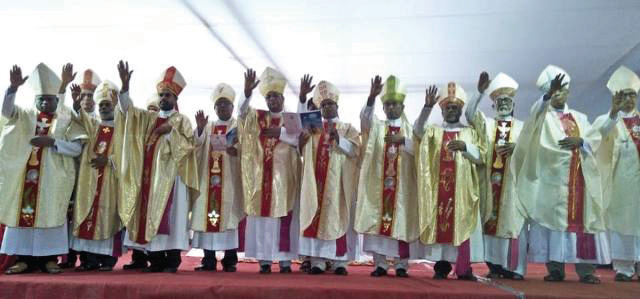
The bishops’ delegation included Bishop Theodore Mascarenhas, CBCI Secretary General, Archbishop John Barwa of Cuttack-Bhubaneswar, the Regional Chairman of the Odisha Catholic Bishops’ Council, Bishop Kishor Kumar Kujur of Rourkela, Bishop Telesphore Bilung, the Auxiliary Bishop of the Arch- diocese of Ranchi, and Emeritus Bishop Alphonse Bilung of Rourkela.

The church did not link the incident with any of the radical groups or Hindutva groups as such. However, it has accused the state of showing apathy in dealing with such cases.

“It appears that the anti-social elements targeted the holy places of two communities seeking to create a communal divide,” it reads further.

CHURCH’S VIEWS ON YOGA DRIVEN BY IGNORANCE, SAY YOGA GURUS

Yoga gurus, including a Catholic nun who runs two yoga centres, say the Syro Malabar Catholic Church’s position on Yoga is driven by its “ignorance” and that yoga is “a way of life as well as sciencem,” and it is not a “subdivision of any religion.”

The Syro-Malabar Church’s doctrinal commission report recently said that Yoga was not a medium to attain divine experience.

Meanwhile, Syro Malabar Church spokesman Fr Jimmy Poochakkatt has clarified that the Church is not in any way rejecting yoga as an exercise for mental and physical health.

Sr Infant Tresa, a Catholic nun and a yoga master, says the Syro Malabar Church’s observa- tion on yoga is due to its lack of knowledge on the subject. Sr Tresa runs Nirmala Medical Yoga Centre in Muvattupuzha.

A report by Pala Bishop Joseph Kallarangattu, chairman of the Doctrinal Commission of the Church, which was uploaded on the website of the Eparchy of Mananthavady, said the theology of yoga does not go along with the beliefs of Christianity.

“As far as I know, the Church has not accepted the report. There are even bishops who practise yoga. The report by the Doctrinal Commission of the Church is mainly due to its lack of know- ledge of yoga. I don’t think those who prepared the report have practised yoga even for a week,” she says.

AMERICAN INDIAN NUN LIVES TWIN VOCATIONS AS NUN AND DOCTOR

Sister Jocelyn Edathil of the Sisters of the Imitation of Christ (Bethany Sisters) is unique in at least two ways. First of all, she is a member of the India-based Syro-Malankara Catholic Church and on Aug. 6, 2016, when she took her vows at St Vincent De Paul Syro-Malankara Catholic Cathedral in Elmont, New York she became the first professed woman religious of her Church who was born in North America.

She also has the unusual distinction of being a hospitalist, a practicing doctor on staff at Philadelphia’s Temple University Hospital.

There, working in shifts seven days on, seven days off, she wears her veil and the traditional white habit of her congregation under a white lab coat while making her rounds, lovingly caring for the corporal needs of the sick.

And yes, if they wish, she will pray with them and give them spiritual comfort. For Sister Jocelyn, her twin vocations are a blessing. At age 37, it has been a long journey. Her mother, Rajamma Edathil, came to America from Kerala in 1975 and is now a retired ICU nurse. Her dad, Philip Edathil, arrived in 1977 and is a real estate broker. The second of four children, her younger brother, Michael, who was ordained in 2013, is the first American-born Syro-Malankara priest. But the seed of Sister Jocelyn’s own vocation goes back almost three decades. When she was 9 her uncle, Father George, an India-born priest, told her she should become a sister.

“I said I wasn’t good enough,” Sister Jocelyn recalls. “He passed away in 1996, and that was solidified my vocation, thinking about his as a life well-lived.” “I always loved science,” she said. “I think of it as the way the Lord communicates his message to us. My parents encouraged me to study medicine, but I didn’t do it at first.”

WHY CHRISTIAN FOOT-WASHING RITUAL IN INDIA IS A BIG DEAL


A husband washes his wife’s feet as part of a special ritual organised by the Kerala State unit of the Indian Christian Women’s Movement (ICWM) on March 28, 2018, one day before Maundy Thursday. The ICWM works to promote the equality of both genders and all castes, among other agendas.

Amid fears of possible adverse consequences, the Kerala State unit of the Indian Christian Women’s Movement (ICWM) organized foot-washing rituals on March 28, 2018, the day before Maundy Thursday. The idea was to promote the equality of both genders and all castes.

FOR PROTESTANT LEADER, THE GOVERNMENT THREATENS POOR AND MINORITIES

India’s central government is a threat to the poor and minorities, this according to Mgr Thomas K. Oommen, moderator of the (Protestant) Church of South India.

Msgr Thomas K. Oommen is the moderator of the Church of South India. With 4.5 million members, it is the second largest Christian denomination in the country. For him, “the current government [. . .] follows the Hindutva supremacist ideology,” and the federal administration is “pro-corporate and unkind to the poor.”

The Anglican bishop wrote an open letter addressed to all citizens dated 6 April, anniversary of the Salt March, the non-violent demonstration led by Mahatma Gandhi in 1930 against the British colonial government.

According to Msgr Oommen, living in India in the last four years, since the Hindu nationalist government of the Bharatiya Janata Party led by premier Narendra Modi took office, “has become a nightmare to the poor and the minorities in India.”

He wants to share his fears “As an Indian Citizen and the head of the second largest Church in India, with more than 4.5 million members, most of them being Dalits, Adivasis, poor farmers and fisherfolks.”

“It is true and sad fact that the current government that follows the Hindutva supremacist ideology seems to have consciously discounted what is stated in the Preamble of our Indian Constitution that declares liberty, equality, and fraternity as its ideals and assures social, economic and political justice to the citizens of India.” Hindutva promoters want to turn India into a Hindu state.

According to the bishop, the government has proven “to be pro-corporate and unkind to the poor by waiving [. . .] loans of rich people and corporate [interests] while not waiving [. . .] the loans of the poor farmers, not giving Minimum Support Price (MSP) to them, not addressing the issues of economic distress, joblessness, price rise by forcefully implementing policies like ’demonetisation’ and GST,” the Goods and Service Tax. “In fact, corruption and scams/scandals have become a hallmark of this government.”

Official Website

Exit mobile version