Philippines: Bringing to light safeguarding as a mission of all

A conference highlighting the Church’s mission to protect minors and vulnerable persons has taken place in the Philippines, marking an important step in strengthening safeguarding efforts in the country. It was the first national conference of its kind in the Southeast Asian island nation – a country that stands as a stronghold of the Catholic Church in the region. Experts from across the Philippines and neighbouring Southeast Asian nations took part. More than 300 delegates – including bishops, religious superiors, members of religious orders, and lay experts – gathered for four days in Angeles City, Pampanga Province, under the theme “Our Mission of Safeguarding: A Journey of Hope and Compassion.” The event was jointly organised by the Catholic Bishops’ Conference of the Philippines (CBCP), the Pontifical Commission for the Protection of Minors (PCPM), the Conference of Major Superiors of the Philippines (CMSP), and the Manila-based Catholic Safeguarding Institute (CSI).

Coleen Rae Ramirez-Panahon is the Director for Safeguarding Research and Reflection at the Catholic Safeguarding Institute (CSI) in the Philippines. She told Vatican Radio that the country’s first national safeguarding conference brought new visibility to the idea that safeguarding is a mission shared by all. “In the past, the issue might have remained in the shadows and been seen as the responsibility of only a few,” the Philippine expert explained. “Now, the most immediate step we can take is to share what we’ve gained from the conference – above all, the conversion and commitment of our wider communities to safeguarding. We must bring everyone on board and open up the conversation, so that fears and apprehensions begin to fade. It’s equally important to get to know the vulnerable people in our midst, to understand their situations, their barriers, and their hopes. Only then can we shape the protective measures that pastors must adopt in their own parishes.”

Don Bosco Gujarat launches 100-day drive to end child marriage

In a bold move to safeguard the rights of children, Don Bosco Gujarat, in collaboration with Just Rights for Children, launched a 100-day campaign to eradicate child marriage across Anand, Vadodara, and Chhotaudepur districts. The campaign was inaugurated on 13 October 2025 by Don Bosco Kawant and Don Bosco Kapadvanj, both of which have long championed the dignity and future of children. This regional initiative aligns with the national movement Bal Vivah Mukt Bharat (Child Marriage-Free India), launched by Union Minister Smt. Annapurna Devi in November 2024 at Vigyan Bhawan, New Delhi.

Under the national umbrella, DISHA Don Bosco, Kawant, and DRISTI Don Bosco, Kapadvanj — partners of the Just Rights for Children Alliance — have played a pivotal role in grassroots awareness and prevention. Nationwide, the campaign has prevented over 1.9 lakh child marriages, offering thousands of children the chance to pursue education and personal growth.

The 100-day intensive awareness drive, running from 1 November 2025 to 26 January 2026, aims to mobilize communities, strengthen local participation, and foster collaboration among stakeholders. Religious leaders — pujaris, maulanas, granthis — along with marriage enablers such as caterers, printers, musicians, and halwais, will be engaged to ensure vigilance and accountability. Village panchayats will play a key role in declaring child marriage-free zones. Between June and September 2025, Don Bosco teams profiled 150 villages, conducted community meetings, painted awareness messages on walls in 25 villages, and collected pledge letters from 150 families. A national workshop titled Voices of Survivors brought together 53 participants who shared stories of resilience and transformation. Don Bosco Gujarat continues its mission to educate, empower, and protect young lives. The campaign stands as a clarion call: every child deserves the right to grow, learn, and dream — free from the burden of early marriage.

Adivasi community’s push for rights and recognition sets the stage for Assam Assembly Elections 2026

After decades of marginalisation, the Adivasi and tea tribes of Assam have demonstrated renewed collective strength through massive rallies in Dibrugarh and Tinsukia in October 2025. These mobilisations, which evoked memories of the tragic Beltola mayhem in 2007, signal the community’s resolve to press for long-standing constitutional and welfare demands ahead of the 2026 Assam Assembly Elections. With an estimate of around 20% of the state’s population—the Adivasi community is poised to play a decisive role in the electoral outcome, making their demands a crucial political issue.

Scheduled Tribe (ST) Status: This is the community’s most significant and long-standing demand. Despite migrating to Assam over a century and a half ago to work as indentured labourers in tea gardens, they have been denied constitutional recognition as an ST, unlike in their states of origin. The All Adivasi Students’ Association of Assam (AASAA) argues that the government has demonstrated a lack of political will to grant this status, a demand promised by the BJP in its 2014 campaign. Granting ST status would provide safeguards and benefits essential for their socio-economic upliftment. Impact on electoral dynamics: With millions of votes at stake, the Adivasi community’s united front can determine electoral outcomes in numerous constituencies. By focusing on shared concerns and exercising their voting power strategically, they can hold parties accountable and make their demands a central issue in the election discourse.
The rallies also bring to the fore a crucial need for the community to maintain vigilance over their leadership. History shows instances where internal and external political forces have exploited the community’s aspirations for personal gain. By actively rejecting and boycotting leaders with questionable integrity, the Adivasis aim to protect their collective voice and rights.

Court questions empty posts in India’s minorities commission

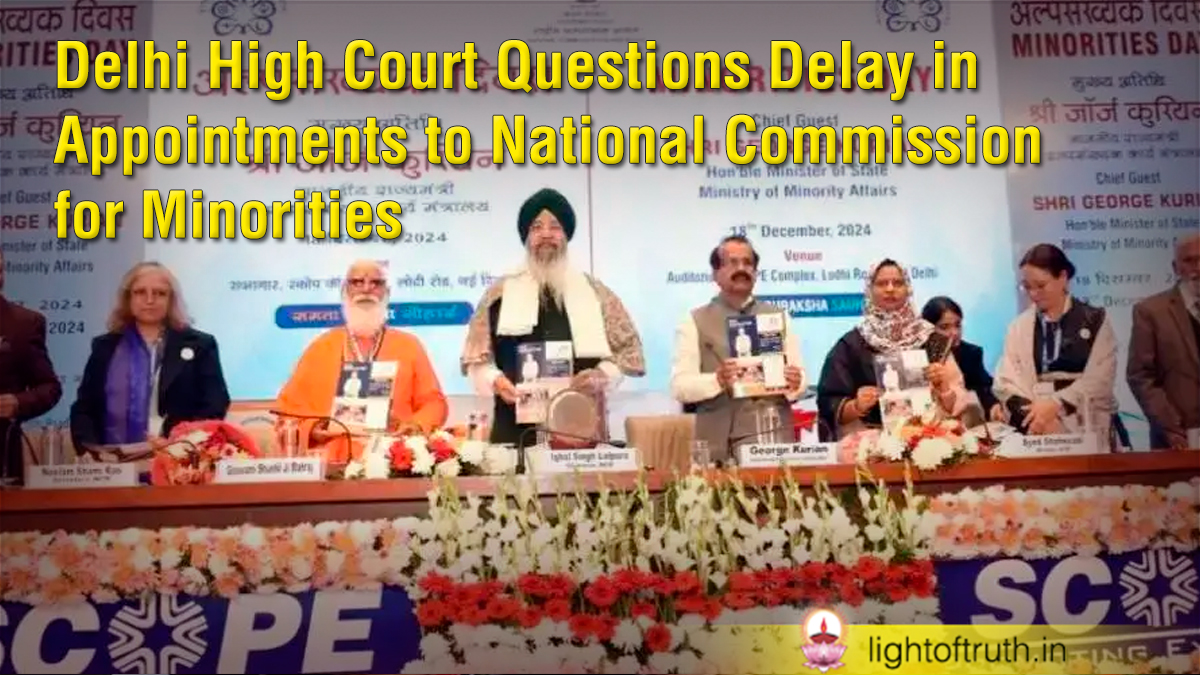
The Delhi High Court, the top court for the national capital region, issued a directive to the federal government to respond to the petition seeking explanations for prolonged vacancies in the federal National Commission for Minorities (NCM). The bench of Chief Justice D.K. Upadhyaya and Justice Tushar Rao Gedela observed on Oct. 15 that vacant posts of the commission chairperson, vice-chairperson and five members have rendered it ineffective and inoperative.

The court responded to a public interest litigation filed by Mujahid Nafees, convenor of the Minority Coordination Committee, an organisation focused on the welfare of minorities. In the petition, Nafees alleged that the government’s negligence in filling the top posts was a violation of constitutional safeguards for the minorities in the country. The National Commission for Minorities Act 1992 mandates the federal government to constitute the commission as a quasi-judicial body to safeguard the rights of minority communities. The commission remained largely defunct after several of its members moved out since November 2024, following completion of their five-year term.

Religious minorities form around 18 percent of India’s 1.4 billion people, more than 80 percent of whom are Hindus. Muslims are the largest minority community, forming 14.2 percent of the population, followed by Christians at 2.3 percent and Sikhs at 1.7 percent. The other religious minorities are Buddhists and Zoroastrians, the latter also known as Parsis. The Commission is mandated to have one member each from the six notified minority communities: Muslims, Christians, Sikhs, Buddhists, Parsis, and Jains.

Cardinal Filipe Neri: “Synodality Heals Divisions in a Polarised World”

In an interview, Cardinal Filipe Neri Ferrão, President of the Conference of Catholic Bishops of India (CCBI) and the Federation of Asian Bishops’ Conferences (FABC), reflected on the meaning of synodality in today’s fast-changing and polarised world. He shared his hopes for the future Church in Asia, the vital role of the laity and youth, and the blessings he has received throughout his long and distinguished ministry as a priest and bishop. According to him, synodality means walking together, listening deeply, and discerning God’s will as a community. In today’s polarised world, especially with social media and AI sometimes dividing us, synodality offers a way to rediscover unity. It calls us to pause amidst the noise, to create spaces where voices, especially those often unheard, are genuinely listened to. This kind of collective listening and openness can help heal divisions not only within the Universal Church, but also beyond.

Supreme Court slams misuse of anti-conversion laws

The Supreme Court of India on October 17 quashed multiple First Information Reports (FIRs) filed under the Uttar Pradesh Prohibition of Unlawful Conversion of Religion Act, 2021. The FIRs, lodged by third-party complainants affiliated with right-wing Hindu groups, accused Christian educators and clergy of orchestrating mass conversions—charges the Court found to be legally untenable and procedurally flawed.

The apex court’s ruling, authored by Justices J.B. Pardiwala and Manoj Misra, declared that “criminal law cannot be a tool to harass innocent citizens,” and emphasized that only the alleged victim or their immediate family may file a complaint of coercive conversion. The Court noted that none of the FIRs had been filed by actual victims, rendering them “incurably defective.”  Legal experts hailed the judgment as a watershed moment. “This ruling restores the sanctity of personal faith and curbs the weaponization of anti-conversion laws,” said constitutional scholar Anjali Menon. “It sends a clear message that religious choice is a matter of conscience, not criminal suspicion.”

The court’s decision also prompted a relook at pending cases across Uttar Pradesh, where dozens of FIRs had been filed under similar circumstances. “The judgment will encourage greater scrutiny of politically motivated complaints and protect minority communities from targeted harassment,” said advocate Ramesh Thomas, who represented several of the accused. In a poster circulated for public awareness following the judgment, the Court’s stance was summed up in bold clarity: “Faith is a matter of personal choice. No one else can police it.” As India navigates the tensions between religious plurality and political majoritarianism, this judgment stands as a constitutional compass—pointing firmly toward liberty, dignity, and the rule of law.

Derek O’Brien honoured with pride of community

Celebrated quizmaster, author, and parliamentarian Derek O’Brien was conferred the Pride of the Community Honour 2025 award at a special ceremony held at the Anglo-Indian Bishop’s School, Pune. More than 600 members of the Anglo-Indian community attended the October 17 function. The award honours exemplary individuals of Anglo-Indian heritage who have made significant contributions to Indian society. O’Brien, currently serving as a Member of Parliament (Rajya Sabha) and parliamentary leader of the All India Trinamool Congress, was recognized for his decades-long impact in public life, education, and media. The award places him in distinguished company, with past recipients including Olympic hockey legend Leslie Claudius and author Ruskin Bond, of Anglo-Indian excellence in sport and literature.

Bishop Lumen Monteiro Completes 45 Years of Service as Priest and Missionary in Northeast India

The Diocese of Agartala and the Church in India celebrate the 45th anniversary of the sacerdotal ordination of Bishop Lumen Monteiro, C.S.C., D.D., who was ordained a priest on October 28, 1980, and has since emerged as one of the most respected pastoral and missionary leaders in Northeast India, serving the Church not only in Tripura but also through major national ecclesial commissions.  A priest of the Congregation of Holy Cross, Bishop Monteiro became the first Bishop of Agartala when Pope St. John Paul II erected the diocese on January 11, 1996, and later consecrated him as its shepherd on May 26, 1996. With the episcopal motto “Duc in Altum — Lead Us Onward,” he undertook the formidable task of building the local Church in Tripura from the ground up during a time of social unrest and limited resources.

Kerala Hosts Kreupasanam Rosary Rally With Over 100,000 Faithful Praying for Peace

Tens of thousands of Catholics from across India gathered in Kerala for the Kreupasanam (Seat of Grace) Rosary Rally, one of the country’s largest Marian processions, held with a powerful call for world peace and unity within families. The rally began at the Kreupasanam Jubilee Mission Church in Kalavoor and concluded at St Andrew’s Basilica in Arthunkal, drawing an estimated 100,000 pilgrims. It was inaugurated at Mararikulam Beach by Bishop James Raphael Anaparambil of the Diocese of Alappuzha, who later presided over the Holy Mass. Pilgrims walked in prayerful procession with the Rosary, united in devotion to Our Lady and interceding for harmony, peace and healing in families and the world.

Bishop of Kottar Joins Muslim Funeral, Inspiring Religious Harmony

Posts celebrating interfaith harmony have flooded social media in Kanyakumari district since Sunday, 26 October, after images circulated of Bishop Nazarene Soosai of Kottar Diocese walking alongside members of the Muslim community in the funeral procession of A.S. Hameed, former president of the Inayam Jama’ath. The Bishop joined the procession and walked with his Muslim brothers for about half a kilometre.

A.S. Hameed passed away early on 26 October, and his burial took place that evening. As preparations were underway, Bishop Soosai, accompanied by his assistants, arrived at the residence, where he stood through the final rites conducted at the house. He then joined the funeral procession to the mosque, stood respectfully during the prayers, and remained at the burial site until the ceremony concluded.

Aseem, a resident of Colachel, who shared the event on his Facebook page, wrote: “I spoke to the Bishop while walking in the funeral procession. The Bishop mentioned that their friendship spanned over thirty years, starting when he was the parish priest of Inayam and A.S. Hameed was the president of the Inayam Jama’ath. He added that A.S. Hameed was a close friend who would invite him to his children’s weddings and host him with feasts on festive days.”

In another post, Aseem noted that the Bishop had postponed his evening church programmes to attend the funeral and spend several hours paying tribute to his late friend, describing his gesture as “praiseworthy.” This act of fraternity and mutual respect between the Bishop and his long-time Muslim friend has been widely lauded online, with many praising it as a moving example of religious harmony in the region.

Official Website

Exit mobile version