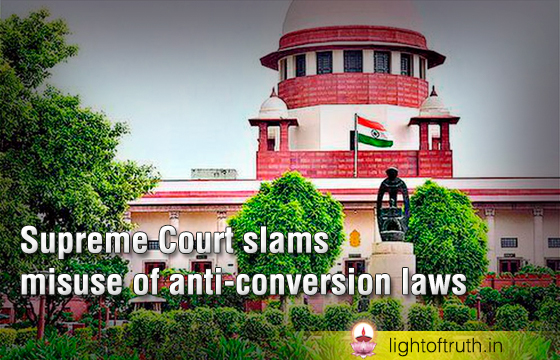
The Supreme Court of India on October 17 quashed multiple First Information Reports (FIRs) filed under the Uttar Pradesh Prohibition of Unlawful Conversion of Religion Act, 2021. The FIRs, lodged by third-party complainants affiliated with right-wing Hindu groups, accused Christian educators and clergy of orchestrating mass conversions—charges the Court found to be legally untenable and procedurally flawed.
The apex court’s ruling, authored by Justices J.B. Pardiwala and Manoj Misra, declared that “criminal law cannot be a tool to harass innocent citizens,” and emphasized that only the alleged victim or their immediate family may file a complaint of coercive conversion. The Court noted that none of the FIRs had been filed by actual victims, rendering them “incurably defective.” Legal experts hailed the judgment as a watershed moment. “This ruling restores the sanctity of personal faith and curbs the weaponization of anti-conversion laws,” said constitutional scholar Anjali Menon. “It sends a clear message that religious choice is a matter of conscience, not criminal suspicion.”
The court’s decision also prompted a relook at pending cases across Uttar Pradesh, where dozens of FIRs had been filed under similar circumstances. “The judgment will encourage greater scrutiny of politically motivated complaints and protect minority communities from targeted harassment,” said advocate Ramesh Thomas, who represented several of the accused. In a poster circulated for public awareness following the judgment, the Court’s stance was summed up in bold clarity: “Faith is a matter of personal choice. No one else can police it.” As India navigates the tensions between religious plurality and political majoritarianism, this judgment stands as a constitutional compass—pointing firmly toward liberty, dignity, and the rule of law.