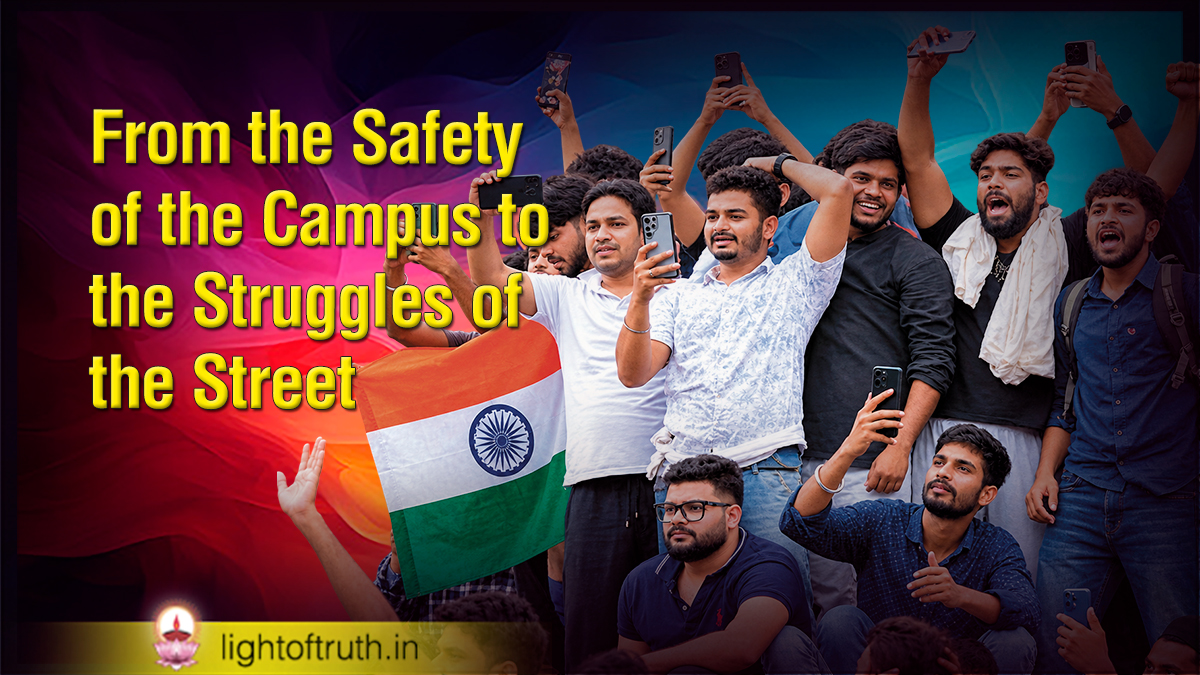
Question: Dissatisfied and agitated young Indians are taking to the streets. What are the core issues confronting them today?
Answer: Saji Mathew Kanayankal CST
The Jantar Mantar incident has once again brought the role of India’s youth into sharp public discussion. These mobilisations challenge the perception that young people in India are increasingly disengaged from politics or indifferent to public affairs and demonstrate that the youth in India can become a powerful force for social and political change.
According to the National Family Health Survey (NFHS), young people constitute more than half of India’s population, making them a decisive demographic force with immense talent, aspirations, and transformative potential. Their hopes and frustrations are not merely personal concerns; they have significant implications for the social, economic, and political future of the nation. The protests cannot be understood merely as a reaction to the NEET controversy, rather, they reflect growing anxiety over employment, education, opportunity of a generation and its place in the future of the country. It is about an entire generation standing at the threshold of the workforce, possessing aspirations and capabilities. The Jantar Mantar protests thus invite a broader reflection on the India’s youth, and on how the nation responds to the future they represent.
- Unemployment: A Crisis of Aspiration
Unemployment has consistently emerged as one of the most pressing concerns among the Indian youth. Various surveys indicate that more than 35% of young Indians aged 15–34 identify unemployment as the primary problem they face. The India Employment Report 2024, published by the Institute for Human Development (IHD) reveals the severity of the crisis. As per its report, 82.9% of India’s unemployed population are young people, with particularly high unemployment among those possessing secondary or higher educational qualifications. Even graduates of premier institutions such as the IITs are increasingly struggling to secure placements, highlighting not merely a shortage of jobs but a shortage of quality and secure employment. The situation remains particularly acute among those aged 15–29. In April 2025, youth unemployment stood at 13.8%, rising to 17.2% in urban areas, compared with 12.3% in rural areas. Young women are disproportionately affected, with unemployment reaching 14.4% nationally and 23.7% in urban areas. Graduate unemployment is also estimated at above 11%, more than three times the rate for the general population. These figures point to a widening gap between educational attainment and meaningful employment opportunities.
Every year, nearly ten million young Indians enter the workforce, yet the economy does not generate sufficient jobs to absorb them. Despite better qualifications, many are taking longer to secure stable incomes and establish an independent adult life. The saturation of the organised sector has intensified competition for employment in both the public and private sectors. Consequently, many young people increasingly perceive employment primarily as a means of financial security rather than as a source of vocation, fulfilment, or social contribution. For millions of educated Indians, a degree has become less a passport to employment than the beginning of a prolonged wait for one.
This youth unemployment is not simply an economic statistic. It represents a deeper crisis of aspiration, dignity, social mobility, and delayed adulthood, with significant implications for the country’s social and political future.
- Education: A Major Concern for Indian Youth
Another important area of concern among the youth in India is education. Poor infrastructure and inadequate quality within the educational system itself leads to considerable dissatisfaction, frustration, and unrest. Children in rural areas are particularly in need of good schools, yet the educational system functions poorly in many places. According to a NITI Aayog report released in May 2026, there is a deep gap in India’s school education system. More than 1.19 lakh schools operate without electricity, while nearly 98,600 schools do not have a functional toilet for girls. More than one lakh schools operate with only a single teacher who is responsible for teaching every subject and every grade. Moreover, a significant number of teenagers discontinue their education when they reach high school.
Higher education is often expensive and not easily accessible to ordinary students. Moreover, the disconnection between academic curricula and the practical requirements of the job market results in graduates who are not adequately prepared for employment. Many young people, especially those from rural, underprivileged, and marginalised communities, struggle to access affordable, quality, and skill-based education. High competition for limited seats in prestigious institutions and for employment opportunities adds to the stress and pressure experienced by young people. Many companies now increasingly prefer skill-based recruitment, placing greater emphasis on practical abilities rather than merely on formal degrees.

The protests of thousands of young people should be understood as a manifestation of the struggles, anxieties, and frustrations they experience in their daily lives. These concerns cannot be addressed through political rhetoric alone; they require a concerted and collective effort from all sectors of society. The government, in particular, has a major role and a responsibility to find appropriate means and measures to enable young people to realise their potential and fulfil their aspirations.

Despite the weaknesses in the educational system, the exploitation of young people in the name of experience and expertise is another cause of irritation and frustration. Many internship programmes and trainee appointments have become means of exploiting the joblessness and economic vulnerability of young people. Graduates often seek internships to gain practical experience, strengthen their CVs, earn some additional income, and improve their prospects. Since internships and trainee positions are not adequately regulated by law, employers can exploit young people by assigning them excessive workloads while providing inadequate compensation. Consequently, what begins as a journey towards gaining valuable experience can turn into a journey of considerable burden and exploitation.
Government policies and priorities are particularly important in this context. It is true that India’s Union Budget in 2026 has allocated rupees 1.39 lakh crore for education, representing an increase of 8.27% over the previous year. Though on the surface this signals a strong commitment to education, there should be a sincere auditing on what is being practically done. Interestingly, this allocation amounts to around 2.5% to 2.7% of total central government budget expenditure, while combined central and state spending on education hovers around 4.1% of India’s GDP. The key question is whether these allocations will translate into stronger learning outcomes, greater equity, and genuine future readiness, or whether they will largely reinforce existing systems.
- Mental Health Challenges
Along with these struggles, the mental health of Indian youth is also a matter of serious concern. It is reported that over 50% of Indian youth aged 18–24 experience poor mental health. Depression has become a particularly common mental health concern among young people. Studies indicate that psychiatric disorders affect 6.5% of the population in India, including 23.3% of school-aged children and adolescents. Approximately 10% of teenagers between the ages of 10 and 19 have a clinically diagnosable mental health condition. According to the World Health Organization’s 2015 report, 4.5% of India’s population was affected by depressive disorders, with the prevalence being highest among those between 18 and 29 years of age.
A 2021 UNICEF survey found that around 14% of Indians aged 15–24 reported frequently feeling depressed or having little interest in activities. It is also to be noted that India has one of the world’s highest suicide rates among young people aged 15–29.
Creating a better future for the youth should not be considered as responsibility of the government alone. What is needed is a collective commitment to provide every young person with genuine opportunities to succeed, regardless of their background or circumstances.
Although multiple factors contribute to mental health problems among young people, academic pressure, job insecurity, social isolation, and a lack of adequate support systems are considered key contributing factors. These statistics underscore the urgency of addressing psychological disorders, particularly depression, among the youth in order to enhance their overall quality of life. Many young people may not even realise that they are experiencing mental health difficulties because of a lack of awareness and knowledge about mental health.
Although the prevalence of mental health difficulties continues to increase, adequate steps have not yet been taken to create supportive environments in which employees can remain psychologically healthy, happy, and free from excessive stress. While it may not be possible to prevent depression entirely, proactive measures can potentially reduce its recurrence among individuals who have previously experienced it. Therefore, greater awareness, early intervention, accessible mental health services, and supportive educational and workplace environments are essential for addressing the growing mental health challenges faced by Indian youth.
- Socio-Economic and Political Burdens
Along with the above-mentioned concerns, the social, cultural, and political context of present India also places considerable burdens on the minds of young people. The expectations of family members and relatives, rigid cultural norms, caste and gender discrimination, religious biases, and the widening urban-rural divide significantly affect the aspirations and freedom of the youth. The patriarchal structure of Indian society, sustained by strong social norms, often becomes a hindrance to the expansion of the horizons and opportunities of young people.
Discrimination, social difficulties, traditional biases and practices, emerging social habits, unbearable poverty, hatred, misunderstanding, fear, and other forms of social pressure can trigger anxiety and worry among young people. The generation gap between youth and elders often leads to misunderstandings, frustration, and even rebellion. Economic pressures, including inflation and the lack of social mobility, prevent many young Indians from achieving financial independence. As a result, drug addiction and substance abuse are rising, particularly among illiterate and marginalised youth, many of whom lack adequate guidance and support.
Alongside these social stigmas, corruption, which is deeply rooted in society and reinforced by political interests remains a serious obstacle for the free growth of Indian youth. Corruption in public institutions and recruitment processes limits fair access to employment and educational opportunities, thereby demotivating many young people. Reservation policies and perceived inequalities within the system can also generate resentment and insecurity among sections of the youth. Together, these socio-economic and political realities can create a climate of frustration, uncertainty, and diminished hope among young people, restricting their ability to realise their aspirations and fully participate in the social and economic life of the nation.
- Conclusion
The protests of thousands of young people should be understood as a manifestation of the struggles, anxieties, and frustrations they experience in their daily lives. These concerns cannot be addressed through political rhetoric alone; they require a concerted and collective effort from all sectors of society. The government, in particular, has a major role and a responsibility to find appropriate means and measures to enable young people to realise their potential and fulfil their aspirations.
At the same time, creating a better future for the youth should not be considered as responsibility of the government alone. What is needed is a collective commitment to provide every young person with genuine opportunities to succeed, regardless of their background or circumstances. The older generation too has an important role to play by offering young people appropriate guidance, understanding, and accompaniment. Such support can bring consolation and comfort to dissatisfied young people and help them face their struggles with greater hope and confidence. Ultimately, responding to the concerns of the youth requires not merely solutions to individual problems, but a shared commitment to creating a society in which every young person can hope, aspire, and flourish.