- Dr. Johnpaul Parappalliyath
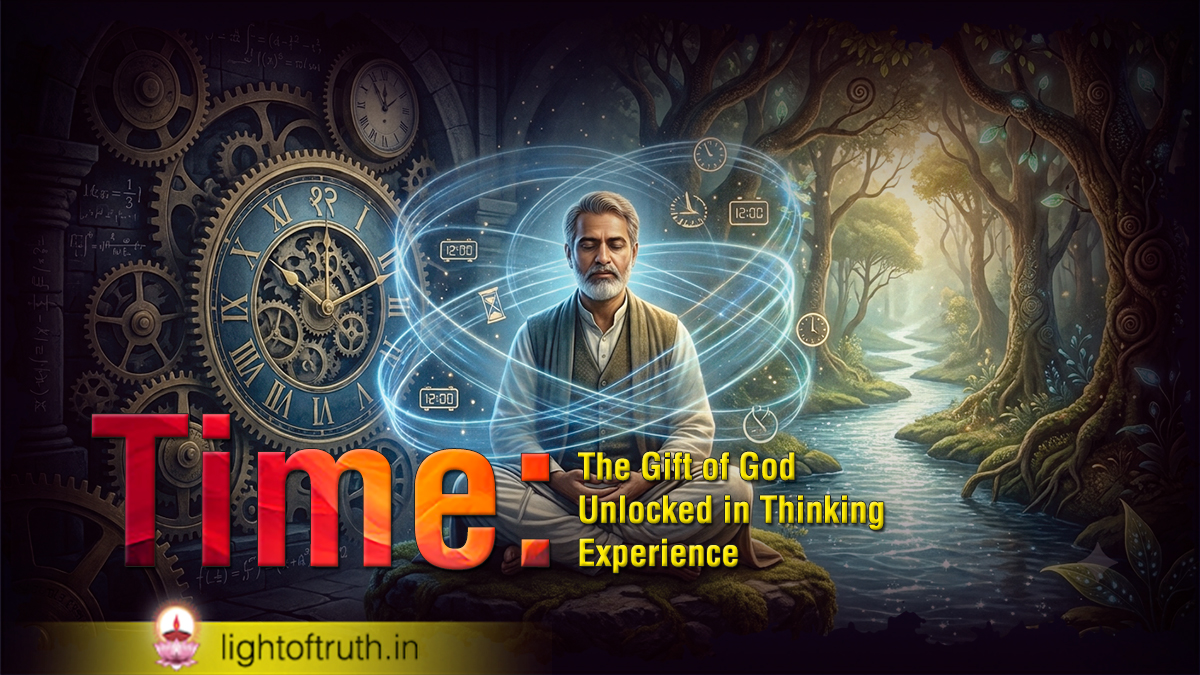
Almost everyone believes that the equal distribution of global wealth is a utopian idea. True equality of resources and opportunities seems to remain an unattainable dream. Yet, there is one resource that leaves no room for complaint. Whether rich or poor, black or white, everyone receives the exact same portion of it without discrimination: ‘TIME’. Everyone gets the same twenty-four hours a day. But this perfect fairness does not mean we are satisfied. Probably, there is not a single person who has not looked at the clock and wished for a few more hours in the day. Almost everyone in every culture, might agree that time is our most precious asset. We can only live in and with time. We experience its flow. We often ask what time it is. However, we rarely ask what ‘time’ actually is. Here we explore fundamental questions about time from a metaphysical perspective, such as whether time exists empirically or is merely a framework created by human minds? This writing builds upon existing frameworks (historical, metaphysical, physical, psychological, biological) on ‘time’ and argues only that time is a complex, multi-layered reality that requires sincere, sustained effort to explore and reconcile its multifaceted dimensions and to arrive at a unified, comprehensive explanation. This discussion focuses exclusively on Western frameworks.
Time: Exploring the History of Human Thought
A genuine seeking on the nature of time will find valuable insights in history. Since the Greek era, philosophers have sought to unknot this mystery. Aristotle elucidated time in terms of motion or change. But never identified time with change; rather, for him, time is the share of change. Time exists only because things change or transform. ‘Time’ is not a physical object. Time is like a cosmic tape measure of change. If there is no change or motion in the universe, time disappears. The past no longer exists, the future is not yet a reality, and the present is the ‘now’, an infinitely narrow line with no width. Time is real only because of us. The present helps us to mark ‘before’ and ‘after’ as the world changes. A mark is nothing if there is no one to notice it; that is to say, there is no time without a conscious mind to experience change (Physics 4:11).
For St. Augustine time is a psychological extension of the human mind. Time is not physical and objective. Past, present, and future are three mental states: memoria (the present of past things), contuitus (the present of present things), and expectacio (the present of future things). Augustine placed God outside of time. God is eternal, a changeless now. God created time with the universe (Confessions XI).
If there is no change or motion in the universe, time disappears. The past no longer exists, the future is not yet a reality, and the present is the ‘now’, an infinitely narrow line with no width. Time is real only because of us. The present helps us to mark ‘before’ and ‘after’ as the world changes. A mark is nothing if there is no one to notice it; that is to say, there is no time without a conscious mind to experience change.
For St. Thomas Aquinas time is an objective measure of change that requires a mind to count it. This counting generates the notions of ‘before’ and ‘after’. The flow of time remains inconceivable without motion or change. Time does have an objective dimension in the movement of things. However, to count and perceive successive moments, a rational soul is essential. Change may occur in the absence of a mind, but time, as a framework of past, present, and future, would not exist. What actively exists in the physical world is ‘now’ since the past is in memory, and the future exists only in expectation. Aquinas differentiated time and perpetuity. Time is intertwined with change and moving realities; eternity (perpetuity) belongs solely to God. God does not move. God has no beginning, no end and no succession. God is Actus Purus, who experiences all moments of time simultaneously in a single unchanging act. Aquinas believed that time had a beginning. Time was created alongside matter. According to him, there was no time before creation (ST I, Q. 10, 46, 85).
As western thinking entered the modern era, traditional interpretations gave way to new insights that redefined time. René Descartes in his Meditationes de Prima Philosophia (III), interpreted time as God’s sustenance or re-creation. A material body has the property of spatial extension but no essential capacity for continual action of sustenance for temporal endurance. But God, by his continual action, sustains or re-creates the body at each successive instance. Descartes equated time with God’s actions.
For Leibniz, time was a series of moments. He said that each moment is a set of coexisting events in a network of relations of earlier-than and simultaneous-with. He also proposed a relational theory of time, which holds that time exists insofar as physical objects are in motion. Isaac Newton argued that time exists entirely independently of physical events. Time is absolute and uniform. However, they both agreed that the duration of an event is universal and identical for everyone (The Principia: Mathematical Principles of Natural Philosophy).
Immanuel Kant said that human beings cannot experience the external world without a time-space reference. In fact, they perceive phenomena as they appear to them through the glasses of space and time. Thus, the perception is actually of a world of phenomena. One can perceive the world only through the lenses of time and space. Time is conceived as the form of the inner sense. Kant assigned time the role of the interpreter between the faculties of sensibility and understanding as well, and opined that it serves as the schematism of pure reason (Critique of Pure Reason).
In the early 20th century, Heidegger defined time as the form of becoming. The external world is a ‘becoming world’. Time is the form of this becoming. The world progresses in and through time. Time is not just a subjective experience; it is the form of growth (Being and Time). Another important shift in this century regarding time was the recognition of time as a theoretical entity. Time’s features were explained with reference to the role it played in confirmed fundamental theories. Most important among them was Einstein’s theory of relativity, which held that time is a resultant property rather than a fundamental reality. A four-dimensional container called space-time is fundamental, containing actual events in the past, present, and future. If the space-time dimension of an object is identified, it’s ‘where’ and ‘when’ can be determined. Einstein held that time is a distinguished, non-spatial dimension of space-time, and that time has no existence independent of space. Which part of space-time is space, and which part of space-time is time, is not distinguishable. Time is completely relative. If one is moving at a different speed than someone else, he/she will actually disagree on what time it is. We don’t notice this in everyday life because we move too slowly compared to the speed of light, and we all experience the same gravity. But Einstein showed that if someone travelled past Earth in a spaceship at 99.9% the speed of light, his/her clock would tick differently from ours. Surprisingly, both of them would be absolutely right-even though Newton and Leibniz believed only one absolute time could exist (Relativity: The Special and the General Theory).
The 1920s also witnessed a debate between Albert Einstein and Henri Bergson over what time actually is. Einstein believed in physical time – the kind you measure mathematically with a watch. Bergson, however, argued that real time is psychological and deeply related to human experience. He claimed that time isn’t a collection of separate seconds. Instead, it is a seamless, flowing stream of consciousness. Cutting time into measurable parts is like breaking a beautiful song into individual notes, which results in the whole melody vanishing.
Clashing Realities of Time
Presentism: Presentism holds that only the present moment exists and is real. In modern analytic philosophy, Arthur Prior (Past, Present and Future) reformulated the theory by introducing the A-theory of time. He argued that past and future tenses are simply linguistic operators acting on present facts, rather than markers of independent realities. Adhering to presentism seems to trigger the truthmaker dilemma; how can an assertion about the past be factual (Dinosaurs existed) if the objects that would make it true do not exist? Moreover, Einstein’s theory does not agree with the notion of a universal present moment, since observers moving relative to one another, will disagree on which events are happening simultaneously.
Eternalism: It is the view that the past, present, and future are all equally real. J.J.C. Smart (Philosophy and Scientific Realism) argued that all temporal events exist on the same ontological platform. In this perspective, time does not flow; instead, the passing of time is merely a psychological illusion. The universe is understood as a static, four-dimensional block of space-time where every past, present, and future event is permanently situated. Just as different places in space exist at once, all moments in time exist eternally. The term ‘now’ enjoys no special priority. It only acts exactly like the word ‘here’ does for space. Because the future already exists within the space-time block, all upcoming events are fixed and unchangeable.
The Growing Past: It acknowledges the reality of both the past and the present. It was C.D. Broad (Scientific Thought) who proposed this theory. For him, reality is a solid four-dimensional block of space-time that continuously expands. This expansion occurs because of the present moment, which serves as the objective, cutting edge of reality. As the outermost boundary of existence, the present constantly actualises what was once nothingness. Because the future is completely non-existent, statements about future events possess no objective truth value until they are brought into being.
Only by shifting our focus from abstract thinking to our living experiences we will be able to understand how time functions in our life. In practice, our relationship with time is not defined by a single framework but rather by three distinct yet interconnected dimensions. By separating our daily experience into these interconnected dimensions, we can better understand and explain time.
Time vs Body, Mind, and Universe
Physical Time: By Physical time, we mean the aspect of time that is objective, measurable, and independent of human consciousness. Clocks, atomic decay, and mathematical equations mirror this time. Physical time is viewed as an absolute, uniform flow by classical physicists. However, as we have seen, in modern physics, especially with Einstiene, physical time is viewed as a relative dimension interlaced into a four-dimensional space-time block influenced by velocity and gravity.
Psychological Time (Phenomenological Time) The internal, subjective experience of time. It captures how humans actually experience and live within this mysterious reality. From this perspective, time is far more than a mere sequence of separate, mathematical units; instead, it is felt and understood as a continuous, flowing stream of human awareness.
Biological Time: From the biological standpoint, time manifests as an internal physiological rhythm that governs the behaviour and cycles of living organisms. This system is regulated by biochemical mechanisms called ‘circadian rhythms’, an internal 24-hour cycle generated by environmental signals such as light. These rhythms direct life processes across plants, animals, and humans, including sleep-wake cycles, reproduction, and cellular regeneration. This framework forms the basis of chronobiology, a field shaped by Franz Halberg, who coined the term ‘circadian’ and stands as a foundational figure in the study of biological time.
Conclusion
Our analyses show that time, is a complex reality that has led to divisions among thinkers throughout history. Any attempt at a theoretical interpretation of this mysterious reality would require philosophers and physicists to seek new paradigms that can reconcile the undeniable reality of human consciousness with the mathematical constraints of the universe, since time is a multi-layered reality, one that remains fundamentally incomplete without reference to the depth of human experience. This study posits that time is a ‘reality’ in which aspects of physics, biological rhythms, and subjective consciousness coexist. In short, this study leads us to conclude that time cannot be reduced to a sequence of discrete mathematical seconds or to a purely mental construct; rather, it should be conceived as an active landscape where physics and the subjective intuition of human experience coincide. It is due to this synchrony that we are able to grasp our existence within its flow.






Leave a Comment