
Catholic Sisters Help Children Living with HIV Build a Better Future
Faith Brings New Hope to Assam Village Once Known for Alcoholism
Cardinal Tagle: Friendship reveals the face of Jesus and the Church
Israel prepares ‘extensive’ West Bank operation after deadly shooting near Tal
Pope: Visit to Türkiye and Lebanon teaches that peace is possible
Thousands protest corruption in Philippines as Church leaders call for accountability
Pope: Nicaea invites Christians to unity in face of violence, conflict
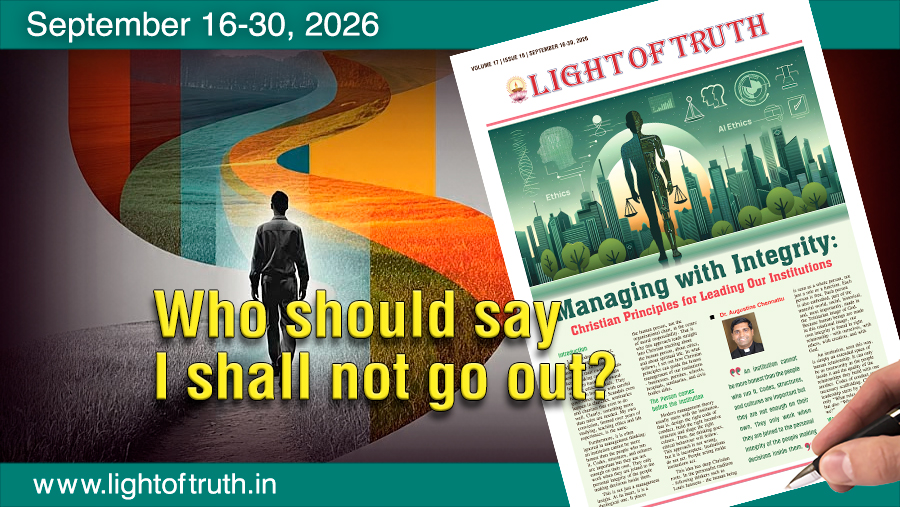
Often wide discussions and debates are seen in the visual and social media on who has the responsibility and authority to admonish a person. Who is responsible for my life? Usually these discussions emerge based on some sensitive statements made by a religious leader or sometimes initiated by a politician or a celebrity. When observing cosily these statements and the tinted or muffled arguments around it, the question arises who is responsible for my life? Who has the authority to control my life?
In general every individual is primarily responsible for her/his own life, choices, and well-being. Each person acts as the sole custodian of her/his physical and mental health. She/he has the freedom to act according to the precepts of the state. The society of course directly or indirectly supports to maintain this. In the matters of children, parents hold the duty to protect, raise, and empower them. Communities must build safe environments and support vulnerable members.
In the same way current generations bear the responsibility to preserve the planet for future life. Pope Francis during his period of service as pontiff repeatedly insisted on the global responsibility. His writings ‘Laudato si, Querida Amasonia, Fratelli Tutti’ and his relentless cry on the need of Justice and mercy towards migrants etc. are the evidences of this global responsibility. This of course means that he is not only the leader of the catholic community but as a responsible person as any other responsible persons in the world. Since he is known as the Christian leader his world renown has got much influence.
What is the role of religion and religious leaders on the right over a person? Religion and religious leaders guide a person’s moral choices and daily habits. Religious beliefs can teach basic rules for living, such as honesty, kindness, and respect for others. Teachings from the holy books help people decide between right and wrong. Religious traditions guide important life events, including birth ceremonies, weddings, and funerals offer advice, comfort during hard times. They bring people together, encouraging social unity and coordinates charity works.
There are areas where religion can enter in the life of a person. And religious social life is not exhaustive. Since religious activities are basically personal and voluntary it depends on the personal freedom. The commanding area of the religious leader is limited to the groups or community having the akin belief and practice.
In a country or state where religious politics prevails, where the religion manages the state the religious leader may have the voice to dictate terms over the persons.
In a secular or democratic country government is responsible for the life and safety of the individual and all the civilians of the country. Abided by the constitution and international human rights laws, the government machinery has the responsibility to safeguard the life and privileges of every citizen.
There are some rights which are spontaneous and inherent in human mature. Since these are inherent in all human beings, regardless of race, sex, nationality, ethnicity, language, religion, or any other status, it is called human rights. Human rights include the right to life and liberty, freedom from slavery and torture, freedom of opinion and expression, the right to work and education, and many more. Everyone is entitled to these rights, without discrimination. It is the obligations of governments to act in certain ways or to refrain from certain acts, in order to promote and protect human rights and fundamental freedoms of individuals or groups.
The Universal Declaration of Human Rights (UDHR) deals with rights such as freedom of movement; equality before the law; the right to a fair trial and presumption of innocence; freedom of thought, conscience and religion; freedom of opinion and expression; peaceful assembly; freedom of association; participation in public affairs and elections; and protection of minority rights. It prohibits arbitrary deprivation of life; torture, cruel or degrading treatment or punishment; slavery and forced labour; arbitrary arrest or detention; arbitrary interference with privacy; war propaganda; discrimination; and advocacy of racial or religious hatred. Prevention and Punishment of the Crime of Genocide, elimination of all forms of racial discrimination, discrimination against women, rights of the child, and rights of persons with disabilities are also included in this.
So no religion, no ethnic or religious society have absolute control over any individual. Man and woman are to be considered equals and have got equal rights and duties and every one irrespective of caste, religion, work and style of life. No one, even religion has authority to manage the personal right. The government – which represents the pulse of the people – has the responsibility officially to guide, instruct and protect without infringing my freedom.


Leave a Comment