
Catholic Sisters Help Children Living with HIV Build a Better Future
Faith Brings New Hope to Assam Village Once Known for Alcoholism
Cardinal Tagle: Friendship reveals the face of Jesus and the Church
Israel prepares ‘extensive’ West Bank operation after deadly shooting near Tal
Pope: Visit to Türkiye and Lebanon teaches that peace is possible
Thousands protest corruption in Philippines as Church leaders call for accountability
Pope: Nicaea invites Christians to unity in face of violence, conflict
Introduction
All kinds of living forms and non-living components constitute the environment. There is a constant interrelationship between the living and the non-living components for mutual benefit. Due to this interaction, there is a flow of energy and exchange of materials establishing a close unity, a web of life. There are verities of relationships, network of lives, by which different parts of God’s creation interact and flourish. The environment operates consistently according to it. The regulations of cycles of food, water, carbon, energy and maintaining adequate stability within and between ecosystems in the world follow this order. Today people are quite aware that a good and beautiful environment is very important for a happy and healthy life. To explain the environment people found God as the cause of order and harmony within creation.
Ever since human beings got involved in developmental, urbanisation processes and technological practices the environmental deterioration started. Destruction of rain forests, loss of biodiversity and genetic pool, extinction of species, depletion of the ozone layer, release of greenhouse gases, pollution of water, air and soil, global warming, horror of nuclear weapons and spread of radioactive wastes are result of this. Such environmental destruction threatens the world causing economic decline and social disintegration. It is a universal problem affecting all nations and cultures. It also affects the future generations. Therefore, we need to preserve and protect the environment. In order to protect it, we need a different view and perception by developing an environmental spirituality that will prompt to act in favour of protecting the environment…to live in balanced harmony.
Environmental Spirituality
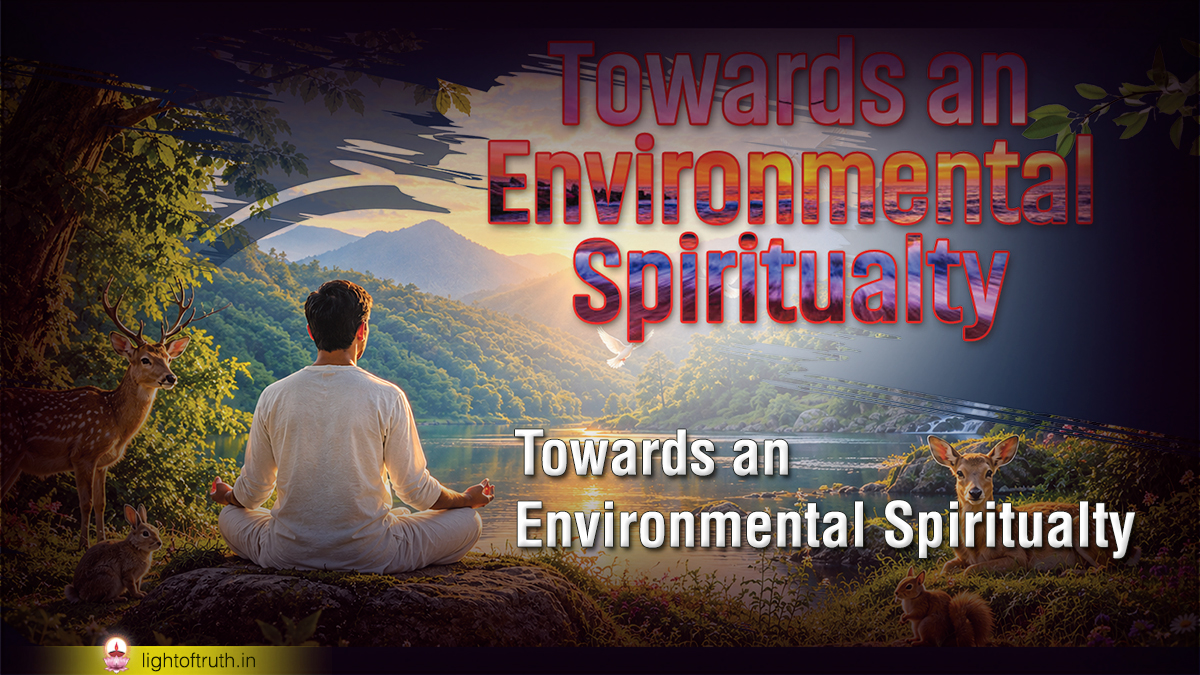
We need to re-discover our roots, our inter-connectedness and our interdependence in the environment. Environmental spirituality germinates through our link with the whole of God’s creation. Spirituality denotes the disposition of the mind and heart in consonance with the omnipotent Truth, religious beliefs, universal values, moral tenets, etc. Environmental spirituality is the spirituality that arises from experiencing the Divine in and through the environment. It emphasizes the connectedness to the environment and the realization of it as the heart of our intellectual, moral, aesthetic, psychological and spiritual existence. This realization enriches the intrinsic worth of the environment and acknowledges that the environment is the creative blessing of God.
This Spirituality enables us to respect, appreciate, protect and regenerate the environment evoking a love and care for nature. Humans are seen as integral part of nature, not as its rulers or conquerors but as the judicious users of the gifts of nature. Environmental spirituality prompts us to use natural resources sparingly, to protect nature, to form nature clubs and to motivate people to work for a clean and healthy world. Environmental spirituality emphasizes the importance of treating the environment as a sacred entity with intrinsic value, rather than merely seeing it as a resource to be used and exploited to the whims and fancies of human race. It challenges our faith, enkindles our spiritual experience, excites our conscience, elicits our thinking, encourages our response, enhances our involvement and promotes our commitment.
Environment and World Religions
Environment contributed to the well-being of humans not only by providing food, shelter, medicine etc., but also by elevating their spirits with ecstatic beauty and grandeur. Reverence for the sacredness of the environment is a basic impulse which is manifested in world religions. According to Hinduism all things come from the same sacred source, Brahman, and all forms are manifestations of the Divine Spirit. The earth is sacred mother and all the living beings as lineages. The mountains, rivers and forests are to experience the Divine. Buddhism teaches an ethic of non-violence, the awareness of the unity of the universe and a gentle and non-aggressive attitude towards nature. In Taoism, everything is part of the rhythm of nature, the Tao, the sacred. Each member depends on all others for survival, sustenance and fulfilment. In Shintoism, natural forces are sacred and animate all of nature. In Zoroastrianism, earth, fire, water and air are regarded as the most sacred elements in life, and therefore cannot be polluted.
In tribal societies, the Divine manifests itself in natural phenomena such as trees, rocks, mountains, and volcanoes; hence, these elements must be respected. Judaism, Christianity and Islam affirm that the world is God’s creation. People are expected to preserve, protect and promote all creatures and nature. So, it is very clear that in all religions God speaks through the environment. Rain and sky, sea and wind, beast and bird, every tree and flower are stories of manifestation of God’s love for us through the environment. Thus the environment makes the faith-encounter possible.
Environment and the Catholic Church
Catholic environmental concerns are rooted firmly in the dignity of each human being. Since 1971, popes and bishops from around the world have consistently expressed concern for the environment. Pope Paul VI in his Apostolic letter Octogesima Adveniens (1971, no. 21), communicated about ill-conceived exploitation which destroys and degrades the environment. Pope John Paul II, in Redemptor Hominis (1979, no. 15), spoke about the threat of pollution due to industrialization and demanded a rational and honest planning. Sollicitudo Rei Socialis (1988, no. 34) asserted the independent moral status of other creatures; respecting the environment, conserving non-renewable resources, restricting pollution and ecological systems. After its publication many bishops all over the world urged the people and the leaders to engage in environmental protection. ‘Centesimus Annus’ (1991, no. 38) spoke about nature as a gift from God and the need of humans co-operation with God in promoting the environment. Pope Benedict XVI in the encyclical ‘Caritas in Veritate’ (2008, no. 51) stressed the relationship between humans and the environment. He spoke on climate change and our responsible stewardship of creation. He even equated promotion of peace with protection of the environment.
The Encyclical ‘Laudato Si’ (2015) by Pope Francis was a groundbreaking encyclical on ecology, environmental justice and the moral imperative of caring for creation. It made a great impact on world leaders and people of good will. It combines theological reflections on the importance of care for the nature with a call for radical action at the political level. He asserts that climate crisis is intrinsically linked to present day social, political and economic problems and cannot be addressed alone. Pope Francis made it clear that peace, justice and the preservation of creation are three absolutely interconnected themes. Since everything is interconnected, climate crisis, if left unaddressed, will lead to greater resource scarcity, migration and inequality, and all factors that increase instability and conflict. ‘Laudato Si’ recommends a lifestyle focused less on consumerism and more on enduring values. It calls for environmental education, joy in one’s surroundings and ecological conversion. He invites us to place ourselves as creatures before our Creator and actively participate in the blossoming of the whole of creation. He promoted environmental spirituality by putting ourselves face to face with God through His creation.
Many saints and common people down the centuries experienced God’s presence in the environment. They realized that good relationship with God coincides with good relationships with everything in the nature. Saint Francis of Assisi did not see the natural world from a utilitarian perspective, as providing food, clothing and shelter for human beings. For him, the environment and its every aspect was a means of adoring God. The natural world is a sacred book, the ‘Book of Creation’. For him, every creature in the world is a mirror of God’s presence. In his famous ‘Canticle of Creatures’, he calls the Sun, the Moon and the Stars as his brothers and sisters.
Sensing God’s Presence in the Environment
God is present in everything through His creative energy. The environment is the embodiment of the Divine. The whole universe is the manifestation of the Divine. Hence everything has intrinsic value. Our encounter with the environment should lead us to the experience of this Divine presence. We know God through the grandeur of his creation and his providential care for all creatures. The beauty of the environment is an expression of God’s appearance. The beauty and goodness of creation should lead a person to God.
To see a flower as witness to the gentleness of God’s nature, to smell its fragrance as the sweetness of His touch, to feel the air as His enveloping presence and to experience the rocks, hills and mountains as witnesses of His never-failing loyalty and faithfulness are attempts to sense God’s presence. Each living being, every wonder in creation and every material on this planet reflect in some way the Divine who is immanent in all.
The experience of the Divine in the natural world is the first religious awakening; the primordial experience of natural religion. This elicits praise and reverence for the wonder, beauty and power of God; communicates something of the character and purpose of God. It provides example of God’s sustaining power. It elevates our minds and hearts to go beyond the ordinary and look at the splendour and grandeur with awe and wonder. We are intimately and intrinsically linked with every creature. We are part and parcel of this universe by connecting to the environment in an inseparable way.
Finding the Hand of God in the Environment
God expresses himself through the creative processes of the environment. Many people have been led to believe in God through the environment. As scientific discoveries have explained life in detail, natural wonders and awe reveal the power of the invisible God. Nature provides evidence of an intelligent, wise and benevolent Creator. When we appreciate God’s creation our love for God will grow. A lack of concern for the environment is equivalent to being insensitive to God’s presence. We have to sense the beauty of the environment in order to appreciate true love of God. Our understanding and love of the universe manifests our love of God and our moral behaviour.
Finding the hand of God in the environment invites us to work for the well-being of all creatures on earth. Every creature proclaims that God is love and God loves. So, every flower, every leaf, every grain of sand, every star and bird, every sunrise/sunset and seascape, and every colour in the rainbow are invitations to this love. Thus we may be inspired to take proper care of the environment and dedicate ourselves to work for its betterment.
Responsibilities for the Environment
We become the caretakers of the whole of creation through our positive response and respect. Humans are to heal and preserve the stability of the biosphere and environment. It is an effective medium to collaborate with the Creator. Greater the responsibility over nature, better are our feelings with God. God reveals Himself through the environment, and we are called to be good stewards of it. Environment is one of God’s ways of being with us and His life-giving involvement in our daily life. So, we have to treat the environment—the gift of God—in a more reverential and sustainable manner.
Everything is God’s personal handiwork and masterpiece. So the environment is the presence of God. This leads us to develop an environmental spirituality. It calls for attitudinal and structural changes in both moral and social spheres propelling to take care of the environment. If our approach to the environment is negative with lack of respect, arrogance, greed and neglect, it will reflect in our relationship with God and others. If we have a harmonious relationship with the environment with respect, love and gratitude, it also will reflect in our relations.
Environmental spirituality obliges us to re-examine our values, attitudes, behaviours and lifestyles and alter them wherever it is necessary. It calls for changes in the individuals and societies; clothing – simple and functional; our eating habits – avoiding processed foods, using fresh vegetables and fruits, reduce the use of fossil fuels, minimum use of lights, fans and other electrical items,., recycle and reuse of materials avoiding consumerist tendencies and Promotion of natural fertilizers. Pope John Paul II said ‘modern society will find no solution to environmental problems unless it takes a serious look at its lifestyle’. Undue desire for material enjoyment is environmentally, physically, psychologically and spiritually disastrous and unhealthy. Sustainable development occurs only by redesigning (restyle) lifestyles, changing attitudes, behaviours and becoming cautious and judicious in the utilization of natural resources. Spending time in contemplation on nature, reflecting on its value and becoming more sensitive to its needs will encourage us to work for the healing of the wounded environment. Environmental crisis can be solved solely by a transformation in the way humans view themselves and the environment. Environmental spirituality offers this perspective.




Leave a Comment